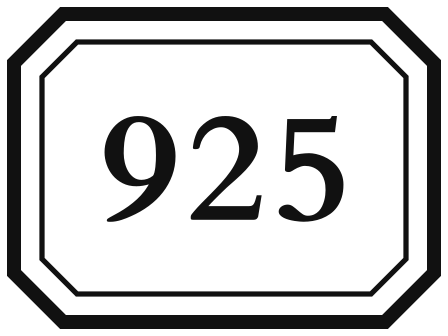
No single home test proves a piece is sterling silver, but several of them together will catch almost every fake. The method is to look for the things real sterling always does (carries a mark, tarnishes, conducts heat, weighs what it should) and the things fakes usually do (stick to a magnet, show a different metal at the edges, cost less than the silver would). Here are the checks, in the order to run them.
Key takeaways
- Start with the stamp (925, STER, STERLING) and look for a maker’s mark next to it. No stamp is a warning; a stamp alone is not proof.
- Real silver is not magnetic, conducts heat fast (ice melts quickly on it), and leaves black residue on a polishing cloth.
- Weight is the best single check: sterling has a density of about 10.4 g/cm³, so a sterling piece weighs what a sterling piece should.
- Price is a red flag you can check before buying: a heavy “925” chain priced below the value of its silver is not sterling.
- For anything expensive or disputed, a jeweler’s acid test or a lab’s XRF scan settles it for a modest fee.
1. Read the stamp, and what is next to it
Sterling jewelry sold in the United States carries a quality mark: 925, .925, STER, STERLING, or S925, on the clasp, the clasp tag, the inside of a ring, or the back of a pendant. Under the National Stamping Act, that mark should be accompanied by the registered trademark of the maker or seller, which is why genuine pieces usually show a small logo, initials, or a name beside the 925. Our guide to what 925 means explains the marks in full.
What the stamp cannot do is prove anything. The US has no independent hallmarking, so a stamp is a claim, and counterfeit 925 stamps on plated brass are common on marketplace listings. Treat the stamp as the first filter: no mark at all on a modern piece sold as sterling is a strong warning, a mark with a maker’s trademark from an accountable seller is strong evidence, and a bare “925” on a cheap piece from an anonymous seller deserves the rest of the tests.
2. The magnet test
Silver is not magnetic. Hold a strong magnet (a rare-earth magnet from a hardware store works best; a refrigerator magnet is too weak to be conclusive) against the piece. If it pulls, the piece has a steel or iron core and is not sterling. If it does not pull, you have not proved anything, because brass, copper, and most plating bases are also non-magnetic. The magnet test rules fakes out; it never rules silver in. Check the clasp separately: some genuine sterling chains use a steel spring inside the clasp, which can tug slightly at that one spot.
3. The ice test
Silver conducts heat better than any other metal. Lay the piece flat, put an ice cube on it, and put another cube on a piece of steel or a coin for comparison. On silver, the ice starts melting immediately and visibly faster than on the comparison metal. This works best on pieces with a flat surface and some mass (a cuff, a signet, a heavy chain laid in a coil) and is less useful on a thin chain. Plated pieces conduct heat like their base metal, so they fail.
4. The polishing-cloth test
Rub the piece firmly with a clean white cloth or a silver polishing cloth. Sterling leaves black or dark gray marks on the cloth, because you are wiping off a thin layer of silver sulfide (tarnish) that forms continuously on real silver. Plated and base-metal pieces usually leave nothing, or a greenish or yellowish smear. This is one of the better quick tests, with one caveat: a piece that is rhodium-plated over sterling will not mark the cloth either, because rhodium does not tarnish, so it can give a false negative on legitimate rhodium-plated pieces.
5. Smell, and what it does to your skin
Silver has no smell. Brass and copper have a sharp, metallic odor that transfers to your fingers after you handle them, especially when warm. Rub the piece between your hands for a minute and smell them. A clear metallic smell points to a copper-alloy base. On the skin, sterling leaves at most a faint dark mark from tarnish that washes off; a piece that turns your skin green is copper-based.
6. Weight and density
This is the test that catches hollow and plated pieces at the same time. Sterling silver has a density of about 10.4 g/cm³; brass is about 8.5, stainless steel about 8, aluminum about 2.7. A sterling piece is therefore heavy for its size, and for common chains and bands the expected weight is predictable. A solid 3 mm curb chain at 22″ weighs about 12 to 18 g; a solid 5 mm Cuban about 30 to 50 g; a solid 6 mm band in size 10 about 6 to 9 g. If a piece sold as solid sterling weighs far less than that, it is hollow, plated, or both. Compare the seller’s stated weight to those ranges before buying, and weigh the piece on a kitchen scale when it arrives.
If you want to go further, measure the density directly: weigh the piece, then weigh it again suspended in a glass of water (the difference in grams equals its volume in cubic centimeters), and divide the dry weight by that volume. A result near 10.4 is sterling; near 8.5 is brass. Chains are fiddly to do this with; rings and cuffs are easy.
7. Look at the edges and the wear points
Plating is thin, and it wears through first where the piece rubs: the inside of a ring, the links beside a clasp, the high points of a pendant, the ends of a cuff. Under a bright light and a magnifying glass (your phone camera zoomed in works), look for a different color showing through: yellow or pink for brass or copper, dull gray for steel. Sterling is the same color all the way through, including inside scratches. Tarnish on a real piece is black or gray, not green.
Red flags in listings, before you buy
| What you see | What it usually means |
|---|---|
| “Silver tone,” “silver color,” “silver finish,” “silvertone” | Not silver. These phrases describe the look, not the metal. |
| “925 plated,” “sterling silver plated,” “silver plated” | A base metal with a thin silver coating; the 925 refers to the coating, not the piece. |
| “Nickel silver,” “German silver,” “Tibetan silver,” “alpaca” | Copper-nickel alloys with no silver content. |
| The word “silver” only in the title, with “alloy” or “metal” in the specifications | Read the specifications; they are usually the honest part of a listing. |
| A heavy chain at a price below the value of the silver it would contain | Hollow, plated, or fake. Do the math: grams × 0.925 ÷ 31.1 × the silver price per ounce. |
| No weight listed, and the seller will not provide one | Assume the worst. Reputable silver sellers list grams. |
| Stock photos only, no photo of the stamp | Ask for a photo of the mark. Genuine sellers can provide one. |
When to pay for a professional test
For an expensive piece, an inheritance, an insurance valuation, or a dispute with a seller, get it tested. Two methods are standard.
- Acid test. A jeweler makes a tiny scratch in an inconspicuous spot and applies a testing solution; the color of the reaction indicates the silver content. Inexpensive and quick, but it leaves a small mark and it tests only the spot it touches, so a jeweler will usually file through the surface first to get past any plating. Leave this to a professional; the solutions are corrosive.
- XRF (X-ray fluorescence). A handheld analyzer reads the metal’s composition without damaging the piece. Many jewelers, pawn shops, and bullion dealers have one and will scan a piece for a small fee or free. It reads the surface layer, so a thick plating can fool it; a good operator knows to check an edge or a worn spot.
Tests to skip
Two home tests circulate online that are not worth doing. Bleach does darken silver quickly, but it also darkens other metals and it can pit the surface and damage stones and finishes; it proves little and costs you the piece’s finish. Biting a piece tells you nothing about silver and may chip a tooth. Stick with the checks above, and with weight above all.
FAQ
Does real silver stick to a magnet?
No. Sterling silver is not magnetic. If a piece pulls toward a strong magnet, it contains steel or iron and is not sterling. A piece that does not pull could still be brass or plated, so use the other tests too.
Does real silver tarnish?
Yes. Tarnish is normal on sterling and on fine silver; it is a thin layer of silver sulfide and it polishes off. A piece that never tarnishes at all is either rhodium-plated, Argentium, or not silver. A piece that turns green is copper-based.
Can fake silver have a 925 stamp?
Yes. The stamp is applied by the maker, and counterfeit stamps on plated jewelry are common in online marketplaces. Look for a maker’s mark beside the 925, buy from accountable sellers, and check the weight.
Is there a difference between real silver and sterling silver?
Sterling is real silver, alloyed to 92.5% purity so it can be worn. “Fine silver” is 99.9% pure and too soft for most jewelry. Both are genuine; sterling is the one you want for chains, rings, and bracelets.
How much does a professional silver test cost?
An XRF scan at a jeweler or bullion dealer is often free or a few dollars; an acid test is similar. A formal appraisal for insurance costs more because it includes a written valuation, not just a metal test.
Bottom line
Stamp with a maker’s mark, no pull on a magnet, fast ice melt, black marks on the cloth, no metallic smell, and a weight that matches what sterling of that size should weigh: a piece that passes all six is almost certainly sterling. A piece that fails any one of them deserves a closer look, and a piece you are spending real money on deserves an XRF scan before the return window closes.
Related guides
- What Does 925 Mean on Jewelry?
- Why Does Sterling Silver Tarnish?
- Sterling Silver Chains for Men: The Complete Buying Guide
Density figures are standard reference values for sterling silver (about 10.4 g/cm³), brass (about 8.5), and stainless steel (about 8). Read our editorial policy.

