
A good sterling silver chain comes down to five decisions: the metal, the link style, the length, the width, and the construction behind the weight. Get those right and the chain will look right, wear well, and hold its value. This guide takes them in the order you should make them, using the numbers US sellers actually list: inches for length, millimeters for width, grams for weight.
Key takeaways
- Buy 925 sterling silver with a quality stamp and a maker’s mark. Skip anything described as silver-tone, silver color, or silver-plated.
- Curb (Cuban), Figaro, rope, and box cover most men. Franco and wheat are the best chains for carrying a pendant.
- 20″ and 22″ are the most common men’s lengths. Go 22″ to 24″ if you are adding a pendant.
- 3 mm to 5 mm is the everyday range. Above 6 mm you are buying a statement piece, and weight and price climb fast.
- Compare grams for the same length and style. Weight tells you more than photos do, and it exposes hollow construction.
- A lobster clasp is the safe default. Heavy Cuban links belong on a box clasp with safety catches.
In this guide
- Confirm the metal is real sterling
- Pick a link style
- Choose the length
- Choose the width
- Weight, and solid vs. hollow links
- Clasps and end links
- Quality signals to look for
- What you are paying for
- Common mistakes
- FAQ
1. Confirm the metal is real sterling
Sterling silver is 92.5% silver alloyed with other metals, usually copper, which is what makes it hard enough to wear. In the United States, the Federal Trade Commission’s Jewelry Guides say a product should not be described as “silver,” “sterling,” or “925” unless it is at least 925 parts per thousand pure silver, and the National Stamping Act requires a quality stamp to be accompanied by the maker’s or seller’s registered trademark. That gives you two things to look for on the chain itself: a 925, STER, or STERLING stamp (usually on the clasp tag) and a maker’s mark next to it.
The listing matters as much as the stamp. “925 sterling silver” in the material field is what you want. “Silver tone,” “silver color,” “silver plated,” “925 plated,” and “silver finish” all mean the chain is not sterling. Our guides to what 925 means and how to tell if silver is real go deeper.
| Label you will see | What it actually is | Buy it for a daily chain? |
|---|---|---|
| 925 / Sterling / STER | At least 92.5% silver. The standard for quality silver jewelry. | Yes |
| Rhodium-plated sterling | Sterling base with a thin rhodium coat: bright white, slower to tarnish, plating wears in years. | Yes, if you want low maintenance and accept re-plating later |
| Argentium silver | 93.5% or 96% silver with germanium; noticeably tarnish-resistant. | Yes, a premium option |
| Oxidized / antiqued sterling | Sterling with an intentional dark finish in the recesses. | Yes, but clean it gently so the finish stays |
| Silver-plated / 925 plated / silver tone | Base metal (often brass) with a microscopic silver layer that wears through. | No |
| Nickel silver / German silver / alpaca | Copper-nickel-zinc alloy. Contains no silver at all. | No |
| Tibetan silver | Base-metal alloy with no silver standard behind the name. | No |
2. Pick a link style
Link style decides the look, how the chain moves, how it handles a pendant, and how likely it is to kink. The table below covers the styles you will see in nearly every men’s silver collection. For a deeper comparison of each pattern, with buying advice for every style, read our chain styles comparison.
| Style | Look | Durability and kink risk | With a pendant | Typical men’s widths |
|---|---|---|---|---|
| Curb (Cuban) | Flat, interlocking twisted links; lies flat on the chest | Very strong, low kink risk | Good at 3 mm or more | 3–8 mm (Miami Cuban 6–14 mm) |
| Figaro | Pattern of one long link then two or three short ones | Strong, low kink risk | Fine for light pendants | 3–6 mm |
| Rope | Twisted strands that catch light from every angle | Strong when solid; hollow rope dents | Good, slides freely | 2.5–6 mm |
| Box | Square links in a clean line | Strong; can kink if yanked | Excellent, the classic pendant chain | 1.5–4 mm |
| Franco | Dense V-pattern, square cross-section | Very strong, heavy for its width | Excellent for heavy pendants | 2.5–6 mm |
| Wheat (spiga) | Braided oval links, rounded profile | Strong, resists kinking | Excellent | 2–4 mm |
| Mariner (anchor) | Oval links with a center bar | Strong, flexible | Fine for light pendants | 4–8 mm |
| Byzantine | Intricate interwoven rounded links | Strong, heavy, no kink risk | Usually worn alone | 4–8 mm |
If you want one chain that does everything, a 4 mm to 5 mm curb is the safest choice: it lies flat, it carries a pendant, and it looks right on its own. If the chain’s main job is to carry a pendant, choose box, franco, or wheat, because the pendant will slide freely and the chain will not fight it.
3. Choose the length
Men’s chains are sold in two-inch steps from 16″ to 30″. Where a given length sits depends on your neck size and build, so the table gives the typical position for an average man; measure your neck and add 2 to 4 inches for the fit you want. The full method, with adjustments for height and pendants, is in our chain length guide.
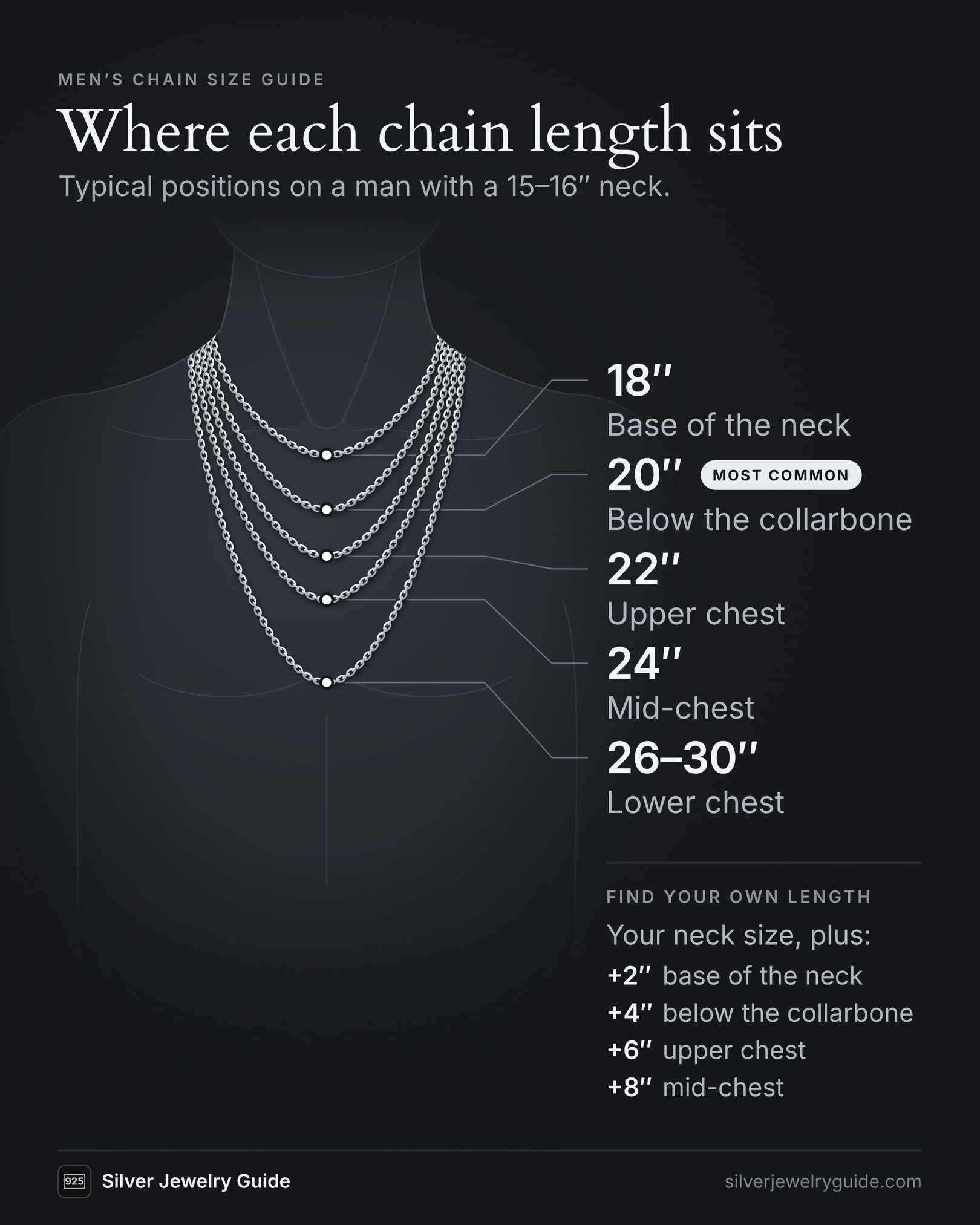
| Length | Where it sits (typical) | Best for |
|---|---|---|
| 18″ (46 cm) | Base of the neck, close to the collar | Slim builds, smaller necks, layering as the top chain |
| 20″ (51 cm) | Just below the collarbone | The most common men’s length; works alone or under a shirt |
| 22″ (56 cm) | A couple of inches below the collarbone, on the upper chest | Pendants, larger builds, visible over a T-shirt |
| 24″ (61 cm) | Mid-chest, about halfway down the breastbone | Heavy chains, big pendants, layering as the bottom chain |
| 26″–30″ (66–76 cm) | Lower chest, down to the bottom of the breastbone | Long statement chains and rosary styles |
4. Choose the width
Width is listed in millimeters and it changes everything: the look, the weight, and the price. Because wider chains also use thicker wire, weight rises much faster than width. A 6 mm curb is not twice the weight of a 3 mm curb; it is usually three to four times the weight.
| Width | How it reads | When to choose it |
|---|---|---|
| 1.5–2.5 mm | Fine; disappears under a pendant | You want the pendant to be the point, or a subtle chain under a shirt |
| 3–4 mm | Visible but understated | The everyday range; works for most faces and builds |
| 5–6 mm | Clearly a piece of jewelry | A single chain worn over a T-shirt or open collar |
| 7–10 mm | Bold statement | Miami Cuban links; worn as the focus of the outfit |
| 12 mm and up | Heavy statement | Only in solid construction, and only if you are ready for 200 g or more |
Two practical checks: a pendant’s bail (the loop it hangs from) has to clear the chain and the clasp, so match the bail opening to the chain width before you buy; and if you have never worn a chain, start at 3 mm to 4 mm rather than guessing bigger. Going up later is easy. Living with a chain that feels loud is not.
5. Weight, and solid vs. hollow links
Why the gram weight is the honest number
Photos can make a 3 mm chain look like a 5 mm chain. Weight cannot be faked in the same way. For any given link style, length, and width, a solid sterling chain lands in a fairly narrow weight range, so the gram figure tells you three things at once: whether the links are solid or hollow, how much silver you are paying for, and how the chain will feel on the neck.
| Chain (22″, solid sterling) | Typical weight range |
|---|---|
| 2 mm box | 7–10 g |
| 3 mm curb | 12–18 g |
| 3.5 mm Figaro | 12–17 g |
| 3 mm rope | 18–25 g |
| 3 mm franco | 20–30 g |
| 4 mm box | 24–32 g |
| 5 mm curb / Cuban | 30–50 g |
| 6 mm Miami Cuban | 55–80 g |
| 8 mm Miami Cuban | 100–150 g |
Solid or hollow?
Hollow (sometimes called “semi-solid” or “lightweight”) chains are made from tubular wire. They give you a big look for less money and less weight on the neck, and for a chain that is treated carefully they are fine. The trade-offs are real, though: hollow links dent, a dented link is hard to repair, and a hollow rope or Cuban can collapse if it is pulled or slept on. If the chain is going to be worn every day, with a pendant, or by someone who is not careful with jewelry, choose solid. If a listing does not say “solid,” and the weight is far below the ranges above, assume it is hollow and ask.
6. Clasps and end links
Chains fail at the ends, not in the middle. The clasp and the two small rings that attach it (the jump rings or end links) take all the stress, so this is where to be fussy.
- Lobster clasp: the default for anything from 2.5 mm up. Spring-loaded, secure, easy to operate with one hand once you are used to it. Bigger is better; a 12 mm to 14 mm lobster suits a 4 mm to 5 mm chain.
- Spring ring: the small round clasp. Fine on chains up to about 2.5 mm; too weak for anything heavier.
- Box clasp with safety catches: the standard on Miami Cuban links of 6 mm and up. The tongue slides into a box and one or two figure-eight catches back it up. Check that the catches snap firmly.
- Toggle: a bar through a ring. A style choice rather than a security choice; it can slip under the weight of a pendant.
- Hook or S-clasp: avoid for anything you care about.
Look for soldered end links. An open jump ring, one you can see the seam on, is the single most common point of failure on inexpensive chains. If you already own a chain with open rings, any jeweler can solder them closed in minutes.
7. Quality signals to look for
- Uniform links. Every link the same size and shape, with no gaps in the pattern.
- Smooth edges. Run the chain through your fingers; it should feel slick, with no rough or sharp spots. Rough edges snag collars and skin.
- It lies flat. A curb or Figaro chain should lie flat without twisting on itself.
- Stamps present and legible. 925 plus a maker’s mark on the tag or clasp.
- Weight matches the listing. Within a few percent of the stated grams for the length you ordered.
- Clear construction wording. “Solid” is stated, not implied.
- A real returns policy and a warranty. Reputable sellers back the chain against manufacturing defects.
“Made in Italy” or an “ITALY” stamp next to the 925 is common on good chains because Italian chain-making has a long track record, and it is a reasonable positive signal. It is not a guarantee, and plenty of excellent chains are made elsewhere. Judge the chain, not the stamp.
8. What you are paying for
The price of a sterling chain has two parts: the silver and the work. The silver part is easy to estimate. Multiply the chain’s weight in grams by 0.925 to get the pure silver content, divide by 31.1 to convert to troy ounces, and multiply by the day’s silver price. A 40 g chain contains 37 g of pure silver, or about 1.19 troy ounces. That is the metal’s floor value, and it is why heavy chains cost what they cost.
Everything above that floor is labor, finishing, the clasp, the brand, and the retailer’s margin. Intricate styles (rope, Byzantine, Miami Cuban) and hand-finished pieces carry more labor. The useful comparison, then, is price per gram for the same style. A chain priced far below the value of the silver it claims to contain is either hollow, plated, or not what it says it is.
9. Common mistakes
- Buying by photo instead of by specification. Ask for length, width, weight, and construction. If the seller cannot give all four, move on.
- Picking a pendant chain that is too thin. A heavy pendant on a 1.5 mm chain will stretch or snap it. Match the chain weight to the pendant.
- Guessing the length. Measure your neck and add 2 to 4 inches; 20″ or 22″ works for most men.
- Ignoring the clasp. A great chain on a spring ring is still a chain that will end up on the floor.
- Assuming tarnish means fake. Sterling tarnishes; that is normal and reversible. See why sterling silver tarnishes.
- Wearing it in the pool. Chlorine is the fastest way to turn a bright chain dark. Take it off before swimming, hot tubs, and heavy workouts.
FAQ
Is sterling silver a good choice for a men’s chain?
Yes. It is a precious metal with real value, it is strong enough for daily wear in solid construction, it can be repaired and re-polished for decades, and it is far more affordable than gold at the same size. Its one real drawback is tarnish, which is cosmetic and comes off with a polishing cloth.
Will a sterling silver chain turn my neck green?
Real sterling rarely does. Green marks come from copper reacting with sweat and acids, and sterling is 92.5% silver with only a small amount of copper. A chain that leaves green marks quickly is usually plated brass or a low-silver alloy. A faint dark mark from tarnish is different and harmless.
What width looks best on most men?
Between 3 mm and 5 mm. It is visible without dominating an outfit, it carries a pendant, and it weighs enough to feel substantial. Larger frames and necks can go to 6 mm before the chain reads as a statement piece.
How much should a men’s sterling silver chain weigh?
It depends on the style, length, and width. As a reference, a solid 22″ chain usually weighs about 12 to 18 g at 3 mm curb, 30 to 50 g at 5 mm Cuban, and 100 to 150 g at 8 mm Miami Cuban. If a chain is much lighter than that for its size, it is hollow.
Are Italian silver chains better?
Italian chain-making has an excellent reputation and consistent quality standards, so an “ITALY 925” stamp is a positive sign. But the stamp is not the point; the links, the clasp, and the weight are. Judge each chain on those.
Can I shower or sleep in a sterling silver chain?
Showering in plain water is harmless if you dry the chain afterward, though soap and shampoo residue will dull it over time. Sleeping in a solid chain is fine; sleeping in a hollow chain risks crushing it. Pools, hot tubs, and the ocean are the real hazards because of chlorine and salt.
Bottom line
For a first or only chain: a solid 925 sterling curb or Figaro, 4 mm to 5 mm wide, 20″ to 22″ long, with a lobster clasp on soldered end links. If a pendant is the point, make it a 2.5 mm to 3 mm box or franco at 22″ to 24″ instead. Confirm the stamp and maker’s mark, compare the gram weight for that exact length against the ranges above, and buy from a seller who states construction plainly and stands behind it.
Related guides
- Men’s Silver Chain Styles Compared: Cuban, Figaro, Rope, Box, Franco, and Wheat
- What Chain Length Should a Man Wear?
- What Does 925 Mean on Jewelry?
- How to Clean Sterling Silver Jewelry at Home
Sources: Federal Trade Commission, Guides for the Jewelry, Precious Metals, and Pewter Industries (16 CFR Part 23); FTC consumer guidance, Buying Platinum, Gold, and Silver Jewelry; manufacturer specifications for chain weights. Read our editorial policy.

