You can get your US ring size at home to within a half size with a strip of paper and a ruler, and closer than that with a ring that already fits. The chart below converts either measurement into a US size. The details that cause returns are not the measuring; they are the knuckle, the width of the band, and the time of day you measure, so those get their own section.
The short version
- Best method: measure the inside diameter of a ring that already fits that finger, then read the chart.
- No ring? Wrap a thin paper strip around the finger, mark the overlap, measure in millimeters, and read the circumference column.
- Measure at the end of the day, when your hands are warm and at their largest. Never when cold.
- Bands 6 mm or wider fit tighter: go up a half size.
- The ring must pass the knuckle. If the knuckle is bigger than the base of the finger, size between the two.
Method 1: Measure a ring that fits
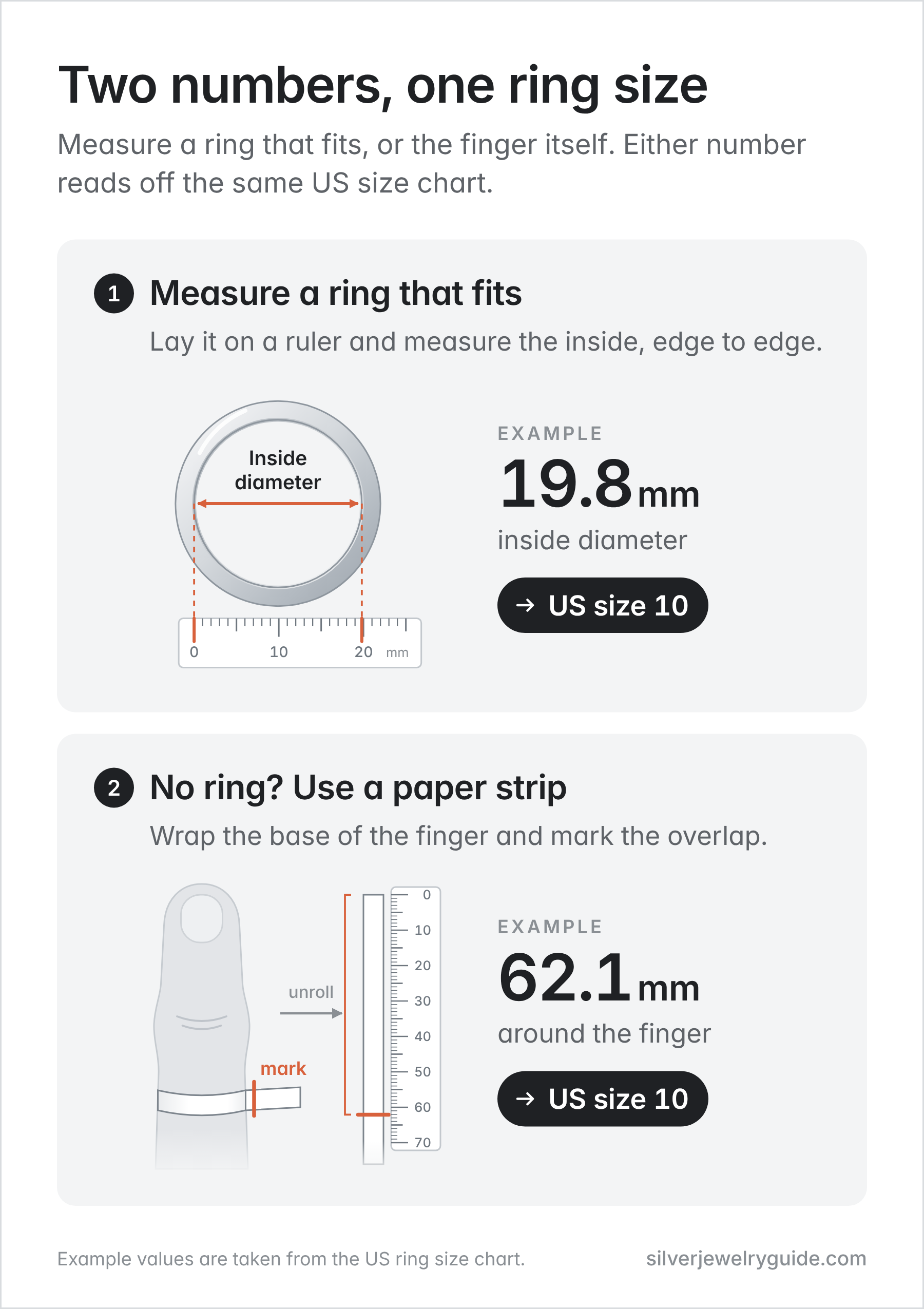
This is the most accurate home method because it measures a known good fit. Take a ring you wear comfortably on the finger in question (it has to be the same finger; sizes differ from finger to finger and hand to hand). Lay it on a ruler marked in millimeters, or use calipers if you have them, and measure the inside diameter: the widest distance from inner edge to inner edge. Read that number in the diameter column of the chart below. If the ring is slightly oval from wear, measure the longer and shorter diameters and average them.
Method 2: Paper strip or string
- Cut a strip of paper about 5 mm wide and 100 mm long. Paper works better than string because it does not stretch; thin, non-stretch string or dental floss is the next best thing.
- Wrap it around the base of the finger where the ring will sit, snug but not tight. It should slide over the knuckle only with some resistance.
- Mark exactly where the end overlaps.
- Lay the strip flat and measure from the end to the mark in millimeters. That is the circumference.
- Now wrap it around the knuckle the same way and measure again. If the knuckle number is larger, you will size between the two (see below).
- Repeat the finger measurement two or three times and use the average. Then read the circumference column of the chart.
Method 3: A plastic ring sizer
A set of plastic sizing rings, or an adjustable belt-style sizer, costs a few dollars online and is as accurate as a jeweler’s steel set for this purpose. If you are buying a ring that is expensive, hard to resize, or a gift you cannot try on, the sizer is worth the small wait. Many jewelers will also measure your finger for free. Printable paper sizers found online are less reliable: they only work if the page prints at exactly 100% scale, and most people do not check.
US ring size chart
Find your measured number in either column and read the US size. Men’s rings are most often sized 8 to 13; pinky rings and women’s sizes run smaller, so the chart starts at 5. If your measurement falls between two rows, choose the larger size for a wide band and the smaller size for a thin one.
| US size | Inside diametermm | Inside circumferencemm |
|---|---|---|
| 5 | 15.7 | 49.3 |
| 5½ | 16.1 | 50.6 |
| 6 | 16.5 | 51.9 |
| 6½ | 16.9 | 53.1 |
| 7 | 17.3 | 54.4 |
| 7½ | 17.7 | 55.7 |
| 8 | 18.1 | 57.0 |
| 8½ | 18.5 | 58.3 |
| 9 | 18.9 | 59.5 |
| 9½ | 19.4 | 60.8 |
| 10 | 19.8 | 62.1 |
| 10½ | 20.2 | 63.4 |
| 11 | 20.6 | 64.6 |
| 11½ | 21.0 | 65.9 |
| 12 | 21.4 | 67.2 |
| 12½ | 21.8 | 68.5 |
| 13 | 22.2 | 69.7 |
| 13½ | 22.6 | 71.0 |
| 14 | 23.0 | 72.3 |
The details that cause returns
The knuckle
A ring has to pass over the knuckle to reach the base of the finger. If your knuckle measures the same as or smaller than the base, size to the base. If the knuckle is larger (common on index fingers, pinkies, and men who have worked with their hands), size about halfway between the two: the ring will need a push to get on and will sit a little loose at the base, which is the normal compromise. Rings with a heavier head, like signets, tolerate this better because the weight keeps them oriented.
Band width
A wide band covers more finger and feels tighter than a thin band of the same size. The usual rule is to go up a half size for bands 6 mm and wider, and a full size for very wide bands over 10 mm. A comfort-fit band (rounded on the inside) partly cancels this, because less metal touches the finger; many jewelers suggest a quarter size down for comfort fit. If the seller offers free resizing, you can afford to be approximate; if not, measure twice.
Time of day and temperature
Fingers swell during the day, in heat, after exercise, and after salty food, and shrink in cold weather and first thing in the morning. A ring sized to a cold morning hand will be tight by evening. Measure at the end of a normal day with warm hands, and if your size is right on a boundary, measure again the next day before deciding.
Which hand and which finger
The dominant hand is usually about a half size larger. Each finger is different: ring finger and middle finger sizes are not interchangeable, and a pinky is typically three to four sizes smaller than the ring finger on the same hand. Always measure the exact finger the ring is for.
Average men’s ring sizes
Most American men wear a size 9 to 11 on the ring finger, with 10 the single most common. Index fingers run about one size larger, pinkies about three to four sizes smaller. Averages are useful for a sanity check (a measurement that gives size 14 on an average hand is probably a measuring error) and useless for buying; measure.
How a ring should fit
A correctly sized ring slides over the knuckle with slight resistance, sits at the base of the finger without spinning freely, and comes off with a gentle twist rather than a tug. It should leave no deep mark after a day. If you can spin it with one finger of the other hand, it is loose; if the skin bulges above it or you need soap to remove it, it is tight.
When an adjustable ring makes sense
If you are buying a ring as a gift, or your measurements keep landing between two sizes, an adjustable ring takes most of the guesswork out. The band has a small, deliberate opening at the back, so you can ease it open or press it closed by hand until it fits. Sterling silver suits the design: it is soft enough to move without tools and firm enough to hold its shape once set.
It also gets around the knuckle problem described above: open the band slightly to slide it over the knuckle, then close it gently at the base of the finger. Keep two things in mind. Adjust slowly and as few times as you can, because bending silver back and forth hardens the metal and can eventually crack it. And an adjustable ring covers a range of sizes, not every size, so if you wear well outside the usual men’s range of 8 to 13, check with the seller before buying.
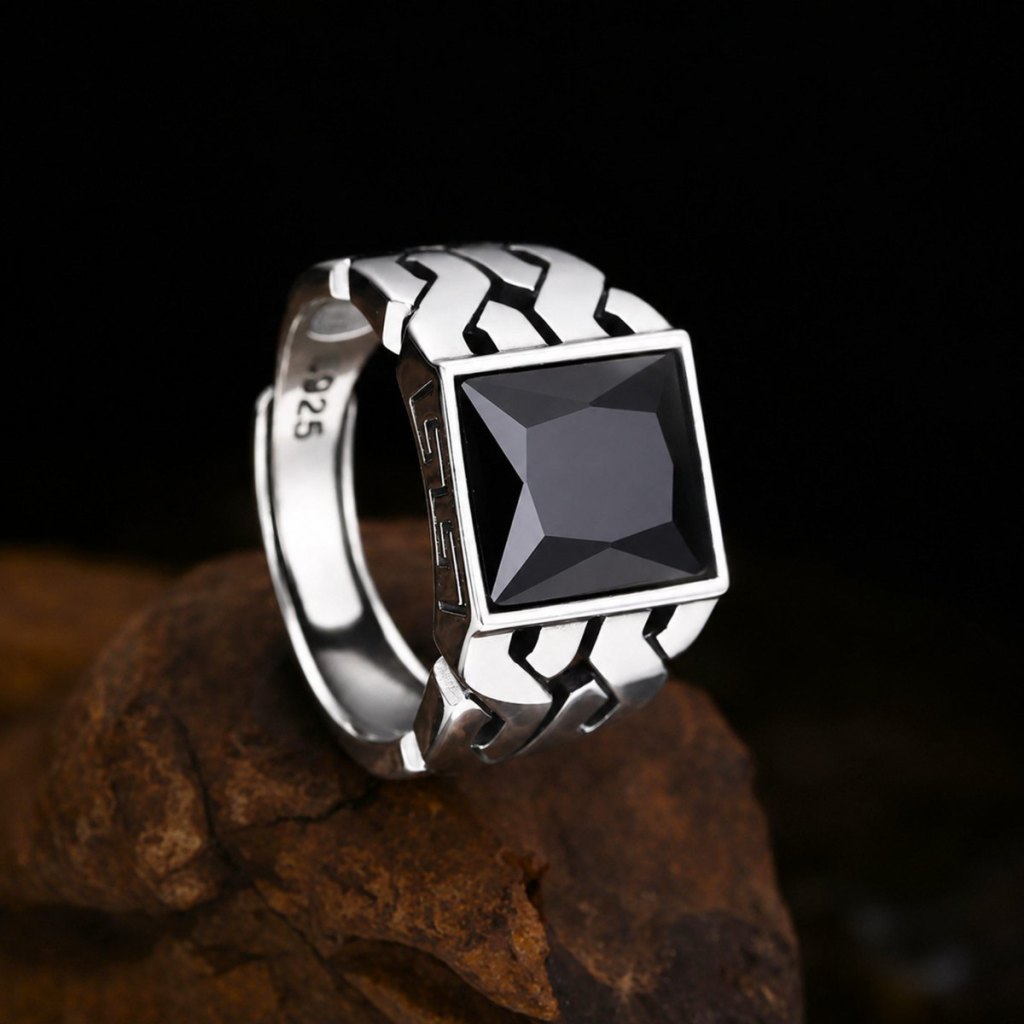
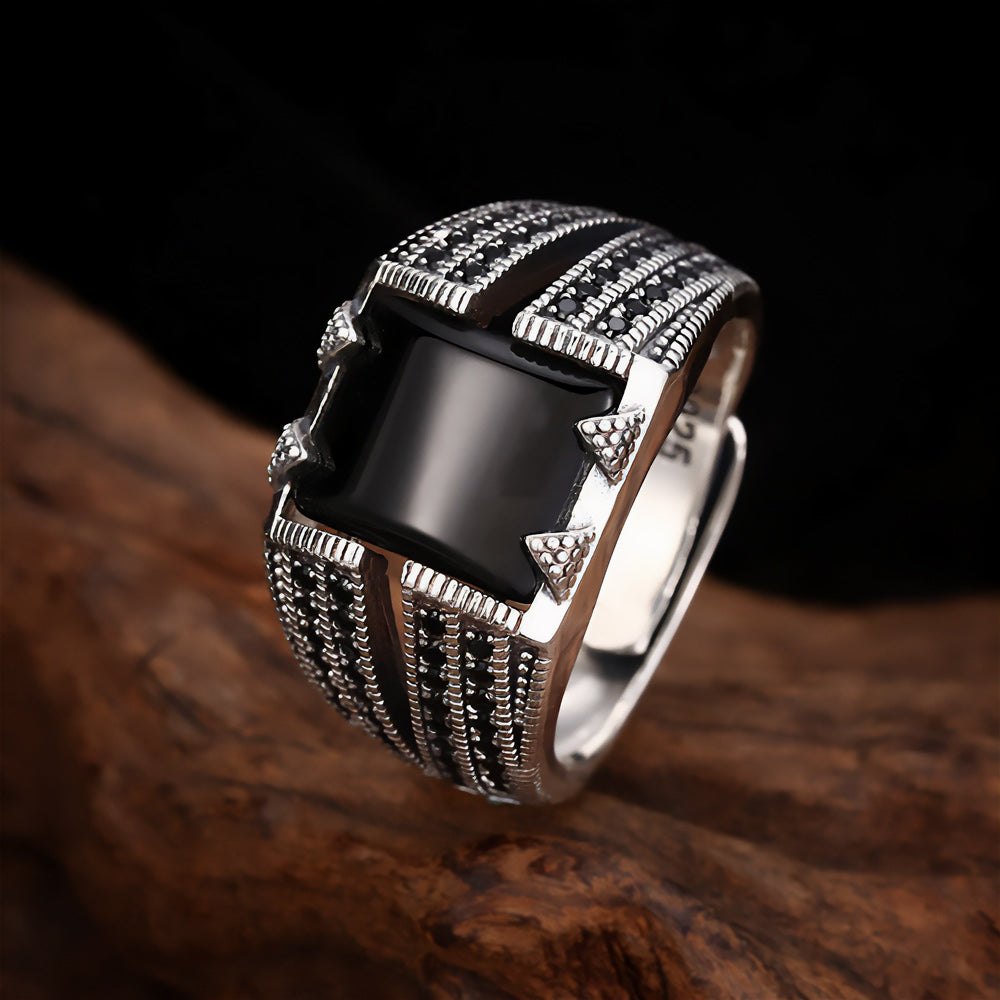
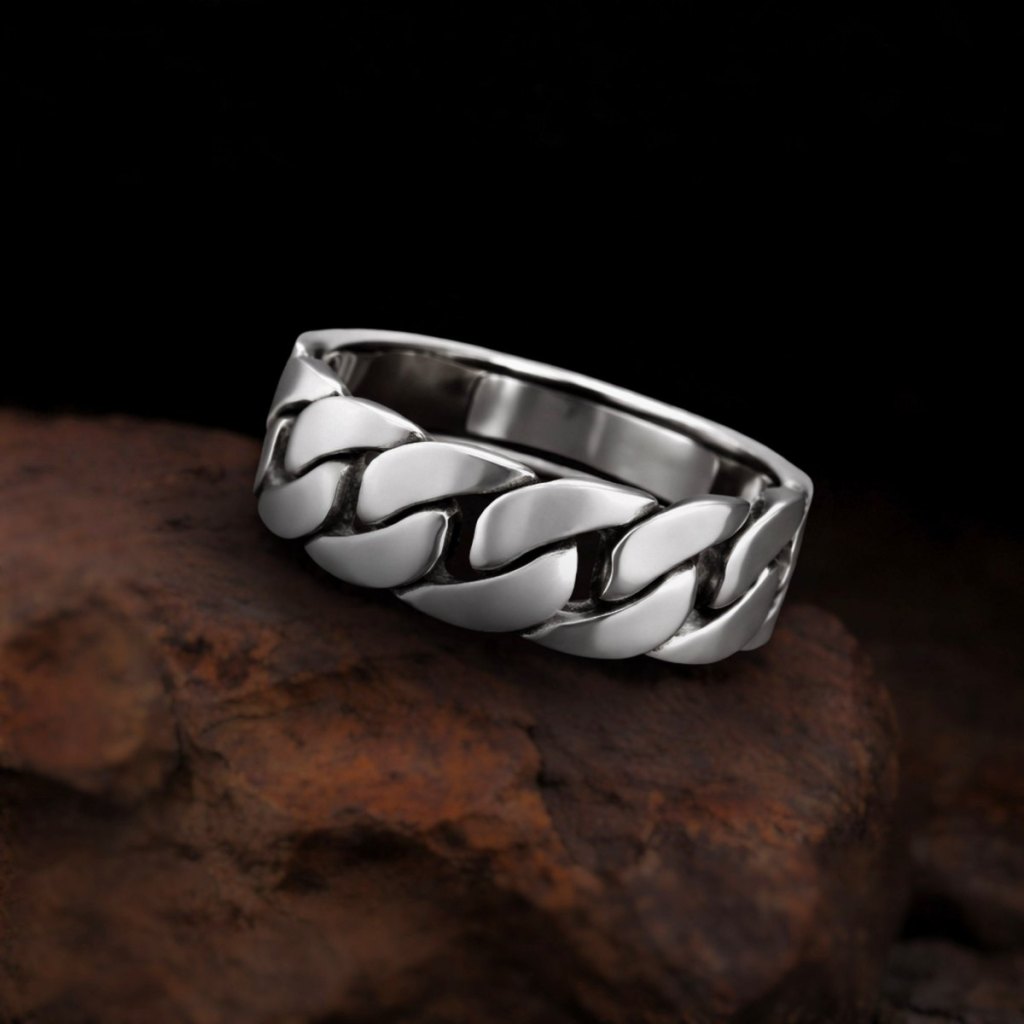
Ronatelli makes its men’s rings this way: every style is 925 sterling silver and comes in one adjustable size, so there is no ring size to choose at checkout. The Ragnar, a square black onyx ring, is its best seller; the Troy, also set with black onyx, and the Torin, an all-silver chain-link band, are two other popular designs.
FAQ
How accurate is the string method?
To within about a half size, if you use non-stretch paper or floss, measure snugly, and repeat it a few times. It is accurate enough for a ring from a seller who offers resizing; for an expensive or non-resizable ring, confirm with a plastic sizer or a jeweler.
What size ring is 60 mm around?
A 60 mm circumference falls between US 9 (59.5 mm) and 9½ (60.8 mm). Choose 9 for a thin band, 9½ for a band 6 mm or wider.
Can I measure with a tape measure?
A soft tailor’s tape is too wide and too stiff to wrap accurately around a finger and tends to read large. Use a narrow paper strip instead.
Can a silver ring be resized if I get it wrong?
Usually, yes. A sterling band can be sized up or down by one to two sizes by a jeweler for a modest fee, unless it has a pattern or stones running all the way around. Tungsten and titanium rings generally cannot be resized, which is one reason silver is forgiving for a first ring.
Is a US size 10 the same as a UK size?
No. The UK uses letters, and a US 10 is roughly a UK T to T½; a US 9 is roughly R½ to S. Because the scales do not line up exactly, convert through the millimeter figures in the chart rather than through a letter-to-number table.
Bottom line
Measure a ring that fits, or a paper strip around the finger and the knuckle, at the end of the day. Read the chart, go up a half size for a wide band, and size between the finger and the knuckle if the knuckle is bigger. Then buy from a seller who will resize it, or choose an adjustable ring, and the rest of the ring buying decision is about style.
Related guides
- Men’s Silver Rings: Styles, Band Widths, and What to Look For
- How to Wear a Signet Ring: A Modern Guide for Men
- Men’s Bracelet Size Guide
Chart values follow the standard US sizing scale (one full size ≈ 0.81 mm of inside diameter) and are rounded to 0.1 mm; individual jewelers’ charts may differ by a tenth of a millimeter. Read our editorial policy.

