Disclosure:The example pieces in this guide are from Ronatelli. The buying advice applies to any brand. Prices were checked on October 28, 2026.
A watch and a bracelet are the two things most men will ever wear on their wrists, and the only real question is whether they share one. The short answer: put the watch on one wrist and the bracelet on the other, and you can stop reading. If you want them together, it can work, but only with a slim bracelet, a snug fit, and a watch that won’t mind the contact. This guide covers both setups, which bracelet widths suit which watches, how to match the metals, what scratches what, and how to add a second bracelet without the wrist turning into a pile of hardware.
Key takeaways
- Opposite wrists is the default. It looks balanced, nothing rubs, and any bracelet width works.
- Same wrist only with a slim bracelet: 3.5 to 5 mm, fitted snug (wrist plus ½″ to ¾″), worn on the hand side of the watch.
- Silver loses every scratch contest. A steel or titanium case marks the bracelet, not the other way around; the marks polish out. Plated, PVD, and anodized cases are the ones a bracelet can damage.
- Match proportions before colors: 3.5 to 5 mm beside a dress watch, 5 to 7 mm with an everyday steel watch, 7 to 10 mm (other wrist) with a dive or sports watch.
- Silver suits steel, titanium, and black watches without any effort. With a gold watch, keep the bracelet slim and let the watch lead.
In this guide Opposite wrists Same wrist Metals Width Which wrist Two bracelets Examples Care FAQ
The default: watch on one wrist, bracelet on the other
Most men wear a watch on the non-dominant wrist, the left for a right-hander, because it stays out of the way when they write, eat, or use a mouse. Put the bracelet on the other wrist and three things happen at once: the two wrists balance each other, the bracelet never touches the watch, and you can wear any bracelet you like, from a 4 mm foxtail to a 10 mm cuff, without thinking about clearance.
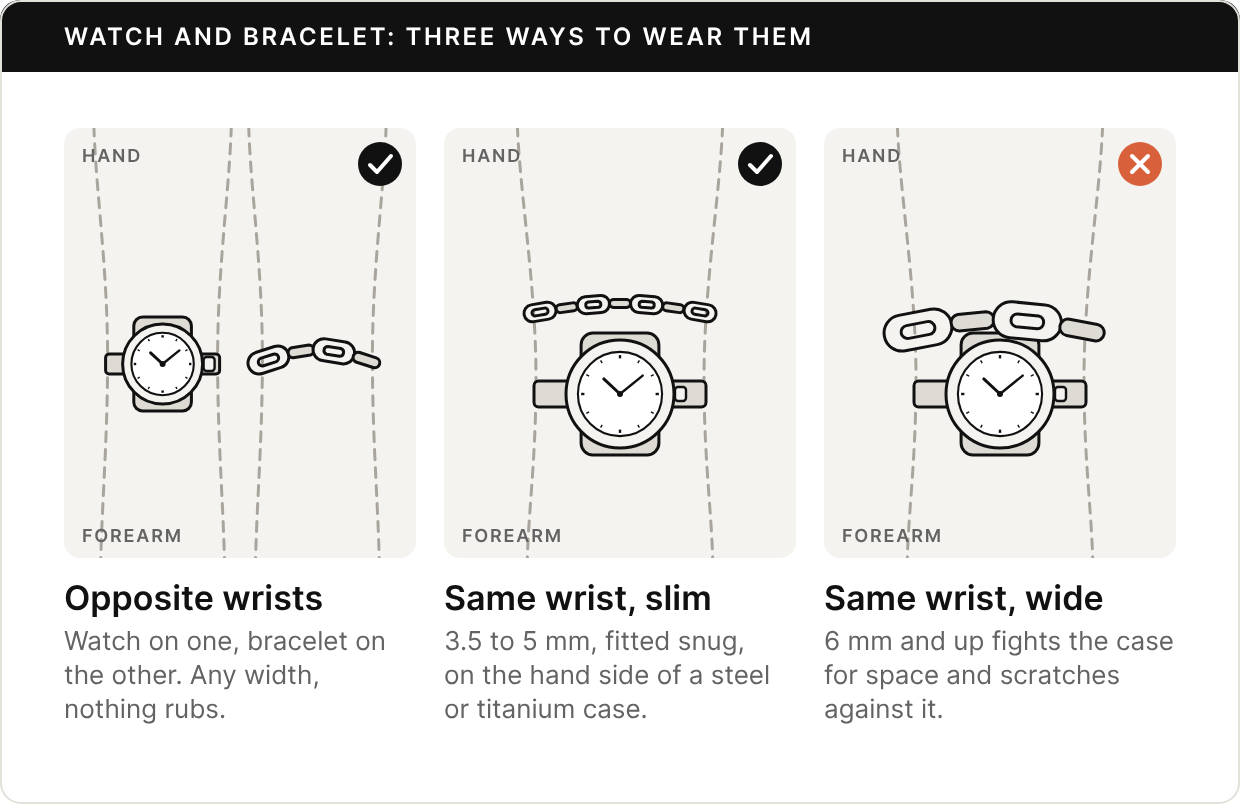
This is also the setup that photographs well. A watch is a dense, geometric object; a bracelet beside it on the same wrist competes with it, while a bracelet on the other wrist reads as a deliberate second piece. If you only ever follow one rule from this guide, follow this one.
The one argument against it is that the dominant wrist takes more knocks. A chain bracelet shrugs those off; the links move and the scratches spread thin. A polished cuff on the dominant wrist will show desk marks within weeks, which is fine if you like a worn-in look, and a reason to pick a hammered or brushed cuff if you don’t.
Same wrist: when it works, and the four conditions
A bracelet next to a watch can look good, especially a slim chain beside a steel watch on a bracelet or leather strap. It works when all four of these hold:
- Width: 3.5 to 5 mm. Anything wider fights the watch for space and pushes against the case. Our men’s silver bracelets guide calls 5 to 7 mm the everyday range; on the watch wrist, stay at the bottom of it or below.
- Fit: snug. Size the bracelet to your wrist plus ½″ to ¾″, not the usual ¾″ to 1″. A loose bracelet slides over the case every time you lift your arm; a snug one stays beside it. Our bracelet size guide covers how to measure.
- Position: on the hand side of the watch. A watch sits on or just above the wrist bone. A bracelet settles at the narrowest point of the wrist, which is below the bone, so the natural order is watch, then bracelet, then hand. Trying to keep the bracelet above the watch means it slides down anyway.
- A watch that can take contact. Solid stainless steel or titanium. Plated, coated, and anodized cases are the ones to keep on a separate wrist (next section).
Expect the two pieces to touch. Even a snug bracelet will rest against the case or the strap when your arm is down, and that contact is where the scratches come from. On a chain bracelet, most of that wear lands on the links nearest the clasp and polishes out with a cloth; on a cuff, it lands on one spot, which is why a cuff and a watch belong on different wrists.
Match the metal, loosely
The old rule, one metal per outfit, has relaxed, but a watch and a bracelet on the same arm still look best when they belong to the same family. Sterling silver is a white metal, which puts it in the same family as stainless steel, titanium, white gold, and platinum, so it needs no effort next to most men’s watches. The decision only gets interesting with gold and with coated cases.
| Watch case | Silver bracelet | What to choose |
|---|---|---|
| Stainless steel | Same wrist or opposite | Any width opposite; 3.5 to 5 mm beside it |
| Titanium | Same wrist or opposite | Brushed or oxidized silver, 4 to 6 mm |
| Gold or rose gold | Opposite wrist | Slim and plain; let the watch lead |
| Gold-plated or gold-tone (PVD) | Opposite wrist only | Keep the bracelet off the plating |
| Black PVD or ceramic | Opposite wrist | Any width; the contrast reads as intentional |
| Smartwatch, aluminum | Opposite wrist | 4 to 7 mm; a steel or titanium version takes up to 5 mm beside it |
| Leather, rubber, or fabric strap | Either wrist | The easiest pairing: the bracelet is the only metal |
The cases that get the opposite wrist only are the coated ones. Gold plating, PVD color, and the anodized finish on an aluminum smartwatch are thin surface layers, and a bracelet grinding against them wears through the color rather than leaving a scratch that polishes out. A solid steel or titanium case is harder than sterling, so there the bracelet takes the marks. A rubber or leather strap is the easiest neighbor of all: it grips the bracelet instead of scratching it, and the bracelet is the only metal on the wrist.
Two-tone watches, steel with gold accents, go either way: a silver bracelet picks up the steel. And if you wear a wedding band or a signet ring in gold, that is one more reason to keep the silver bracelet on the watch wrist’s opposite side, where it sits with a steel watch rather than beside a gold ring.
Match the width to the watch
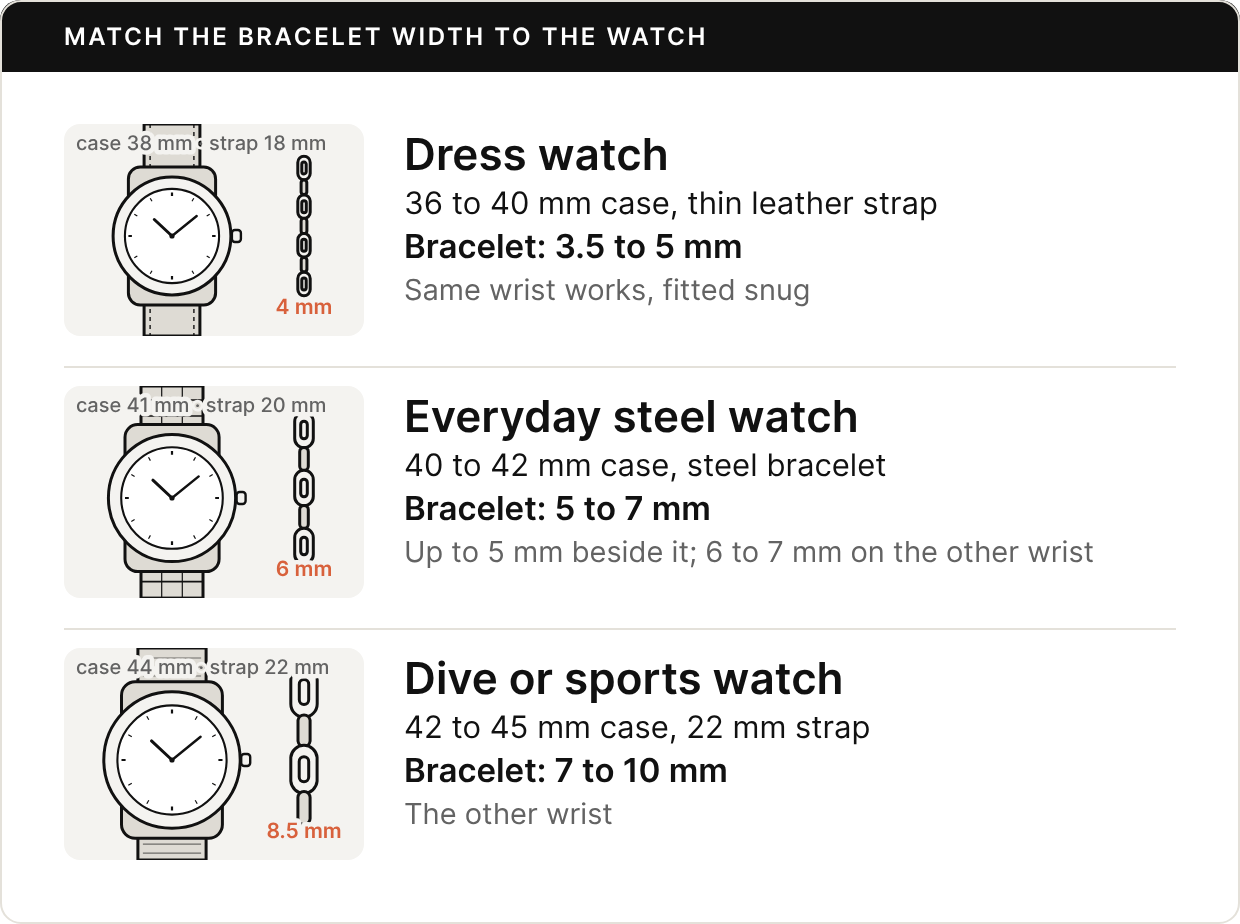
Proportion matters more than color. A watch is the biggest thing on the wrist, so the bracelet should read as the lighter piece. The practical measures are the case diameter (36 to 45 mm on most men’s watches) and the strap width at the lugs (18 to 22 mm). A bracelet a quarter of the strap width looks balanced; one approaching half the strap width starts to look like a second watch strap.
| Watch | Bracelet width | Same wrist? |
|---|---|---|
| Dress watch, 36 to 40 mm, thin leather strap | 3.5 to 5 mm | Yes, snug, on the hand side |
| Everyday steel watch, 40 to 42 mm, steel bracelet | 5 to 7 mm | Only up to 5 mm; 6 to 7 mm on the other wrist |
| Dive or sports watch, 42 to 45 mm | 7 to 10 mm | No; the other wrist |
| Chronograph or pilot watch, 42 to 46 mm | 6 to 9 mm | No; the other wrist |
| Smartwatch, 40 to 45 mm | 4 to 7 mm | Aluminum: no; steel or titanium: up to 5 mm |
Weight follows width. A solid 4 to 5 mm chain bracelet weighs about 10 to 16 g and a 6 to 7 mm one 18 to 28 g, while a steel sports watch on its bracelet is typically 100 to 180 g. The bracelet never has to compete on weight, so there is no reason to go heavy on the watch wrist.
Which wrist gets the bracelet?
Whichever one does not have the watch. For most men that means the right wrist, since the watch sits on the left. There is no rule beyond that: a bracelet carries no meaning by wrist in the United States, and the only practical consideration is that the dominant wrist sees more desk edges, door handles, and gym equipment. If you work at a keyboard all day, a bracelet on the writing hand will click against the desk; a snug fit, or a chain with flat links such as a curb, makes that quieter.
Left-handed men usually wear the watch on the right wrist and the bracelet on the left, the same logic mirrored. If you wear no watch, either wrist works; most men pick the non-dominant one for the same reasons they would pick it for a watch.
Adding a second bracelet
With a watch in the mix, the limit is one slim bracelet on the watch wrist and a stack of two, or three at most, on the other. Two bracelets on the free wrist work when they differ in texture and width: a 4 mm foxtail beside a 7 mm Cuban, or a chain beside a cuff. Two chain bracelets of the same width and link style tangle and rub against each other, and the effect is noise rather than style.
A cuff is the easiest second piece. It doesn’t slide, so it stays where you put it, and it sits beside a chain without catching its links. Keep the cuff on the wrist without the watch, for the scratch reasons above. Our guide to stacking bracelets covers which widths and textures pair, where each piece sits, and five silver pairings.
Pairings that work
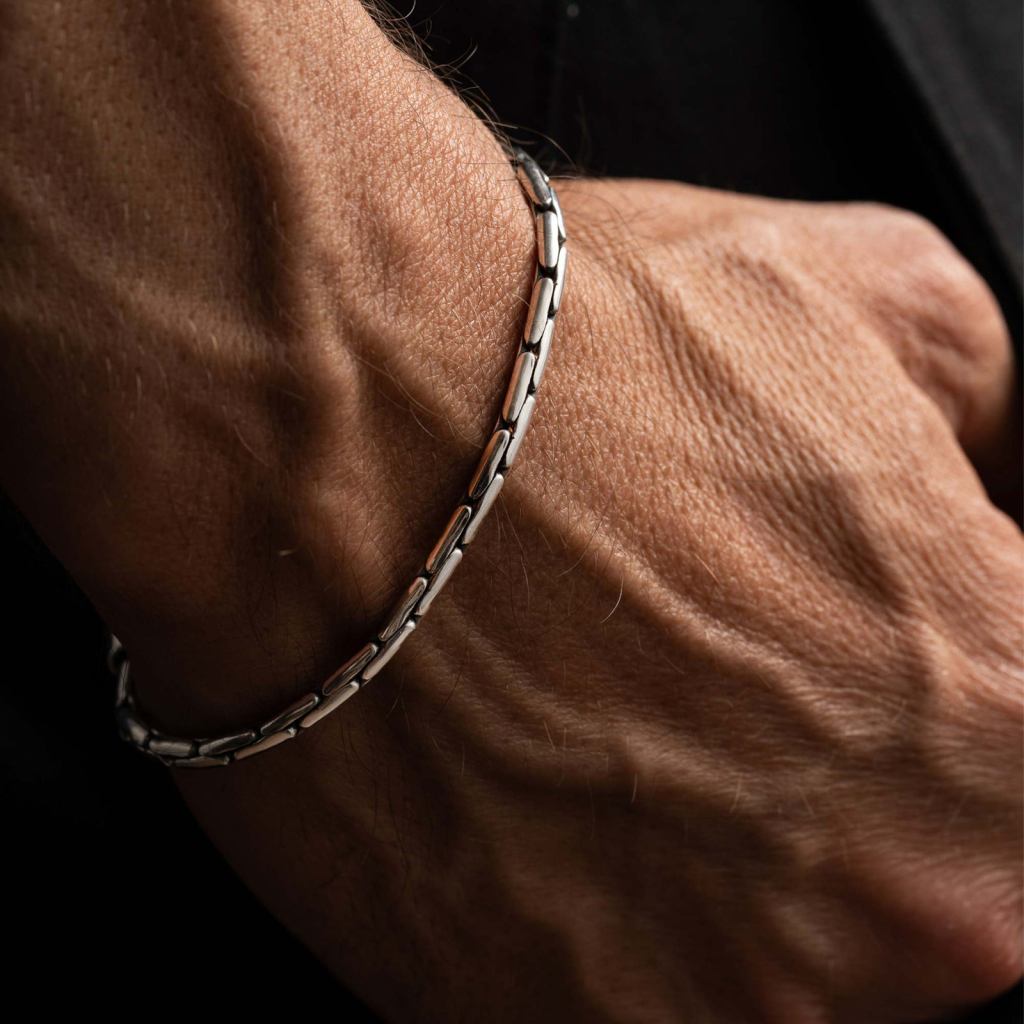
Some Ronatelli examples at their listed prices. The chain bracelets come in S (7.1″), M (7.9″), L (8.7″), and XL (9.5″); for the watch wrist, choose the size that lands at your wrist plus ½″ to ¾″, which is usually one size down from the comfortable fit. The cuffs are adjustable.
- On the watch wrist, beside a steel or titanium watch: the Alfo bamboo bracelet (3.5 mm), $149, or the Sergo foxtail bracelet (4 mm), $169. Both sit flat and have small lobster clasps that stay on the underside of the wrist.
- On the watch wrist, beside a 40 to 42 mm watch: the Bari Cuban link bracelet (5 mm), $169, is as wide as a same-wrist bracelet should go.
- On the other wrist, with an everyday steel watch: the Crein foxtail bracelet (6 mm), $249, the Cana Cuban link bracelet (7 mm), $199, or the Savona Cuban link bracelet (7 mm, fold-over clasp), $249.
- On the other wrist, with a dive or sports watch: the Lesi heavy braided bracelet (9 mm), $469, or a cuff such as the Lugo hammered cuff (6 mm), $249, whose hammered surface hides desk marks.
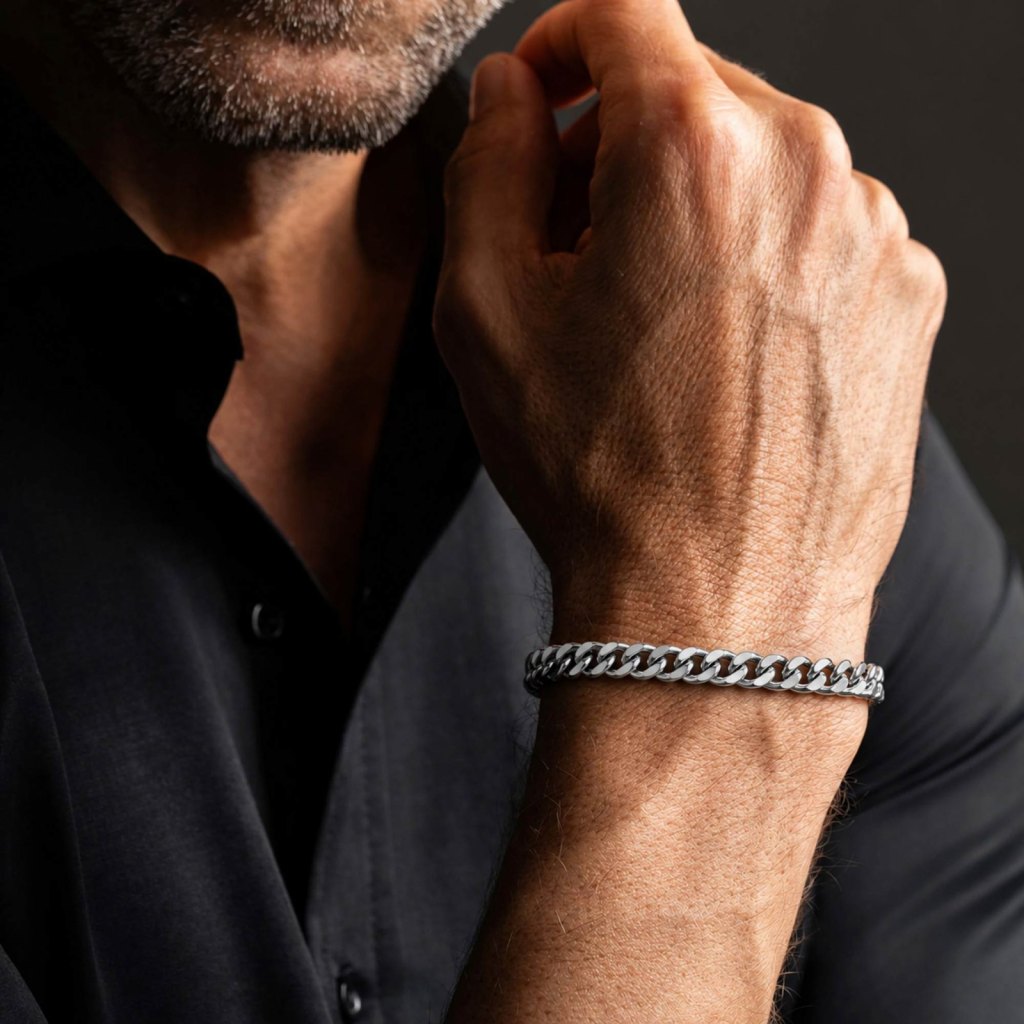
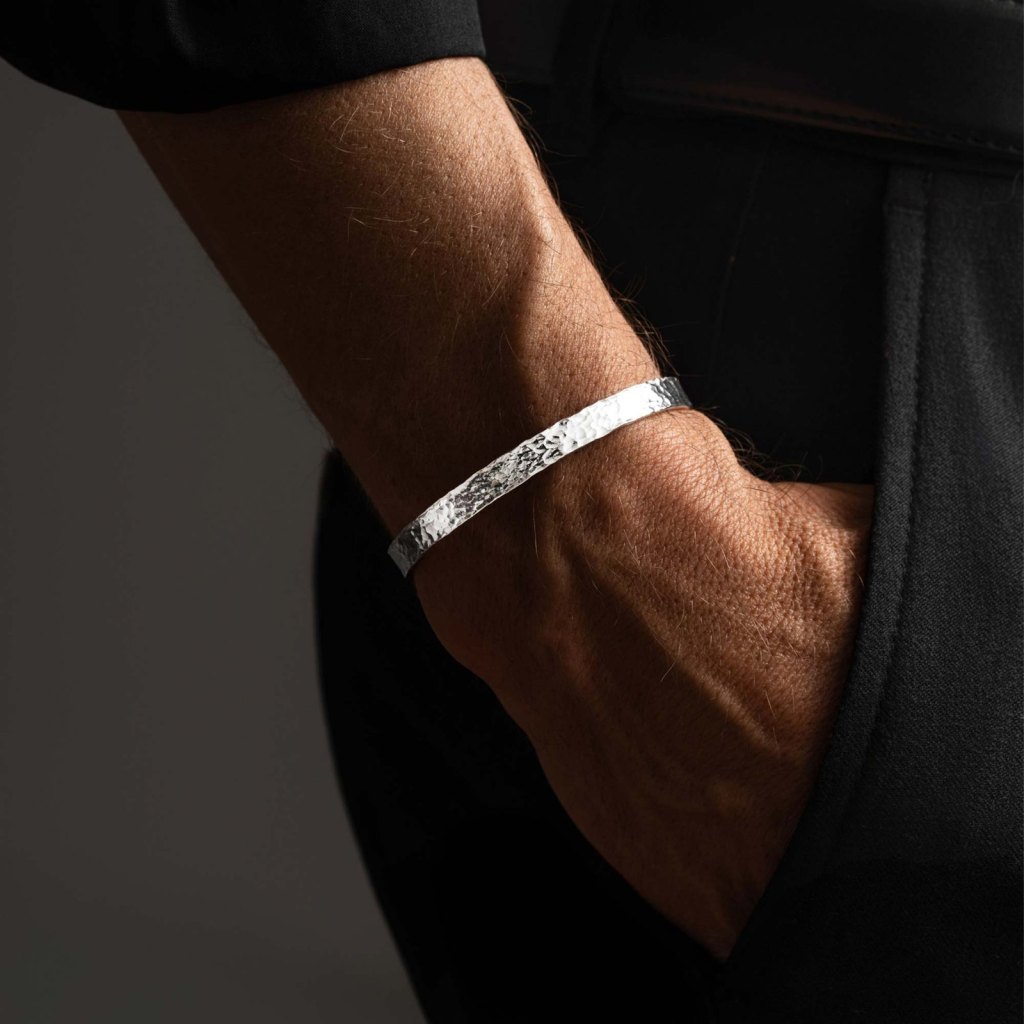
Prices as listed on ronatelli.com on October 28, 2026. Prices change, so check the product page.
Taking care of both
Sterling silver is softer than steel and titanium, so whatever the bracelet touches, the bracelet is what shows it. On a chain that is harmless: the fine scratches spread across the links and settle into a soft sheen within a few weeks, and a polishing cloth brings back the shine when you want it. Our guide to cleaning sterling silver at home covers the cloth and the two other methods that are safe on a bracelet.
- Take both off for weights and racket sports. A bar or a grip presses the bracelet into the case; that is the one situation that leaves a visible gouge rather than a hairline.
- Don’t sleep in both. Eight hours of the bracelet grinding against the clasp is where most same-wrist wear comes from.
- Keep the clasps apart. A steel watch clasp can catch a chain’s links. Turn the bracelet so its clasp sits on the underside of the wrist, away from the watch clasp.
- Sweat speeds up tarnish. Rinse the bracelet and dry it after a workout, and wipe it with the cloth every few weeks. Our guide to why sterling tarnishes explains what speeds it up.
FAQ
Can you wear a bracelet and a watch on the same wrist?
Yes, if the bracelet is slim (3.5 to 5 mm), fitted snug, and worn on the hand side of the watch, and the watch has a solid steel or titanium case. Wider bracelets, cuffs, and plated or aluminum watches belong on separate wrists.
Should the bracelet go above or below the watch?
Below it, on the hand side. A watch sits on or just above the wrist bone and a bracelet settles at the narrowest part of the wrist, which is below the bone, so that is where it ends up anyway. A snug fit keeps it there instead of sliding over the case.
Will a silver bracelet scratch my watch?
Not a solid steel or titanium case: those are harder than sterling, so the bracelet takes the marks, and they polish out. A bracelet can mark gold-plated, PVD-coated, and anodized aluminum cases, because the color there is a thin surface layer.
Can I wear a silver bracelet with a gold watch?
Yes, on the other wrist, and keep the bracelet slim and plain so the watch stays the main piece. Two metals on one wrist read as a clash; across two wrists they read as two separate choices.
What size bracelet should I buy for the watch wrist?
Your wrist measurement plus ½″ to ¾″, which is snugger than the usual ¾″ to 1″. On a 7″ wrist that means a 7.5″ bracelet rather than 8″. The snug fit keeps the bracelet beside the watch instead of sliding over it.
Which wrist should a man wear a bracelet on?
The one without the watch, which for most men is the right wrist. There is no meaning attached to either side in the US; the only practical difference is that the dominant wrist takes more knocks, which a chain bracelet handles better than a polished cuff.
Bottom line
Watch on one wrist, bracelet on the other, and any width works. If you want them together, keep the bracelet 3.5 to 5 mm, size it snug, let it sit on the hand side of the watch, and make sure the watch is solid steel or titanium, because the silver will take the scratches. Match proportions first, metals second: silver pairs with steel, titanium, and black watches without any effort, and with a gold watch only across two wrists.
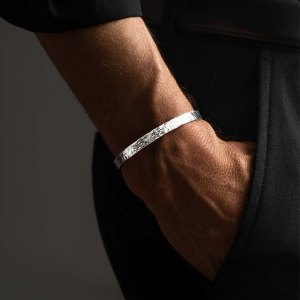
From the collection
Men’s sterling silver bracelets by Ronatelli
Thirty-one handmade 925 bracelets, from a 3.5 mm bamboo link to an 11 mm woven band, in sizes S to XL. Every cuff is adjustable.
Related guides
Widths, fits, and the scratch behavior of sterling against steel and titanium follow our bracelets, sizing, and metals guides. Watch case and lug measurements are typical ranges for men’s watches, not a rule for any one model. Ronatelli prices, widths, and sizes were checked on ronatelli.com on October 28, 2026, and may have changed since. Read our editorial policy.

