Disclosure:The example rings in this guide are from Ronatelli. Prices, ratings, and product details were read from ronatelli.com on October 29, 2026; the advice applies to any brand.
An adjustable ring is one size that fits many. The back of the band is left open or made to overlap, so you can ease it larger or press it smaller by hand, and that one detail takes the guesswork out of buying a ring online or as a gift. It comes with one condition: sterling silver hardens a little every time it bends, so the ring rewards being set once and left alone. This guide covers how the back works, how to fit one at home in a few minutes, how far it really moves, which fingers it suits, how to handle a stone ring, and when a sized ring or a jeweler is the better choice.
Key takeaways
- The back does the work. An open gap, overlapping ends, or a sliding band lets the ring change size by hand, while the front stays as it is.
- A few millimeters is a size. One US size is about 2.6 mm around the inside, so an adjustable ring covers a range of sizes, not every size.
- Set it once. Ease it over the knuckle, close it for the base of the finger with slow, even pressure, and leave it. Bending it back and forth hardens the silver and can eventually crack it.
- Press on the band, never the stone. On an onyx ring or a signet, hold the band near the back.
- Outside the usual 8 to 13, or for a pinky ring, check the seller’s range or buy a sized ring.
In this guide How it works Fit it How far, how often Fingers Stone rings Snag and spin Or a sized ring Examples FAQ
How an adjustable ring works
A sized ring is a closed circle, and changing its size means a jeweler cutting the band and adding or taking out metal. An adjustable ring is never closed. The back of the band, the part on the palm side of your finger, is built to move, and the front, with the stone, the signet face, or the pattern, stays exactly as it is.
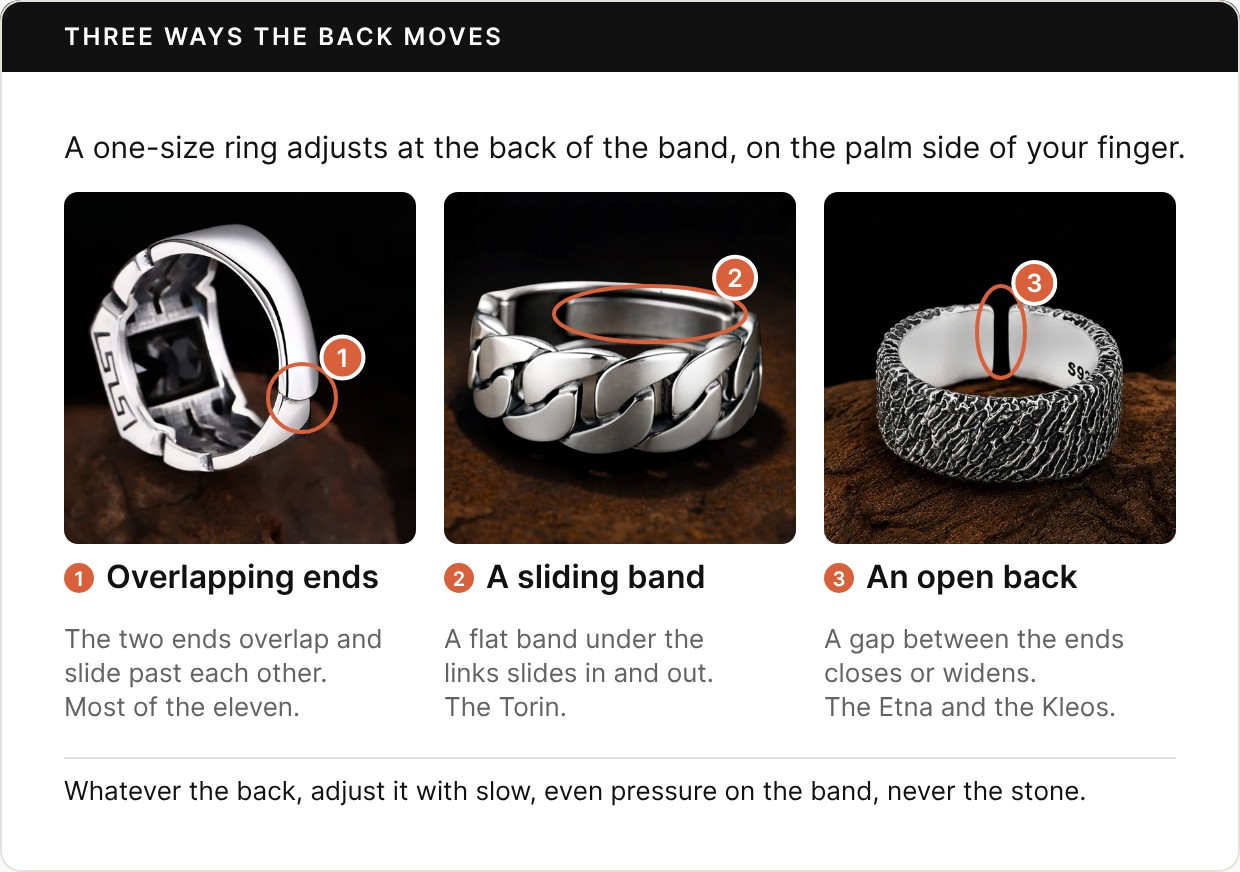
There are three common ways to build the back. On an open back, the two ends of the band stop short of each other, leaving a gap that closes or widens. On an overlapping back, the ends pass each other, so the join is a seam rather than a gap. A few designs hide a sliding section under the outer band: a buyer of Ronatelli’s Torin describes its back as “not a gap but rather overlapping sides.” All three change size the same way, by bending the back of the band a little, and none of them needs tools.
Sterling silver suits the idea. As our ring size guide puts it, it is soft enough to move without tools and firm enough to hold its shape once set.
How to fit it at home
Fit it once, properly, and you won’t need to touch it again. It takes a few minutes.
- Choose the finger and the time. Fit it on the finger you will wear it on, at the end of the day, when your hands are warm. Fingers are smaller in the cold and first thing in the morning, as our ring size guide explains.
- Open it just enough for the knuckle. If it won’t pass your knuckle, hold the band on either side of the back and ease the ends apart a little. Ronatelli’s own guide says the ring should slide on easily and shouldn’t be forced.
- Close it for the base of the finger. Take it off, squeeze the back between your thumb and fingers with slow, even pressure, and try it again. Several small squeezes work better than one big one.
- Check the fit. It should go over the knuckle with slight resistance, sit at the base without spinning, and come off with a gentle twist. Ronatelli’s test is much the same: comfortable, no spinning, and it stays put when you move your hand naturally.
- Check that it’s round. Look at it side-on. If squeezing has pushed it into an oval, press it gently back into a circle; a jeweler can true it on a ring mandrel if it won’t go.
- Then leave it. Put it on and take it off with a twist, the way you would a sized ring, instead of opening it each time.
If your knuckle is much larger than the base of your finger, set the ring to the smallest size that still passes the knuckle with a little resistance. Closing it tighter for the base means opening it every time you take it off, and that is exactly the back-and-forth that wears an adjustable ring out.
How far it moves, and how often
A few millimeters go a long way. On the standard US scale in our size chart, one size is about 0.8 mm across the inside of the ring and about 2.6 mm around it. Close the back by 2.6 mm and the ring is a size smaller; open it by the same amount and it is a size larger.
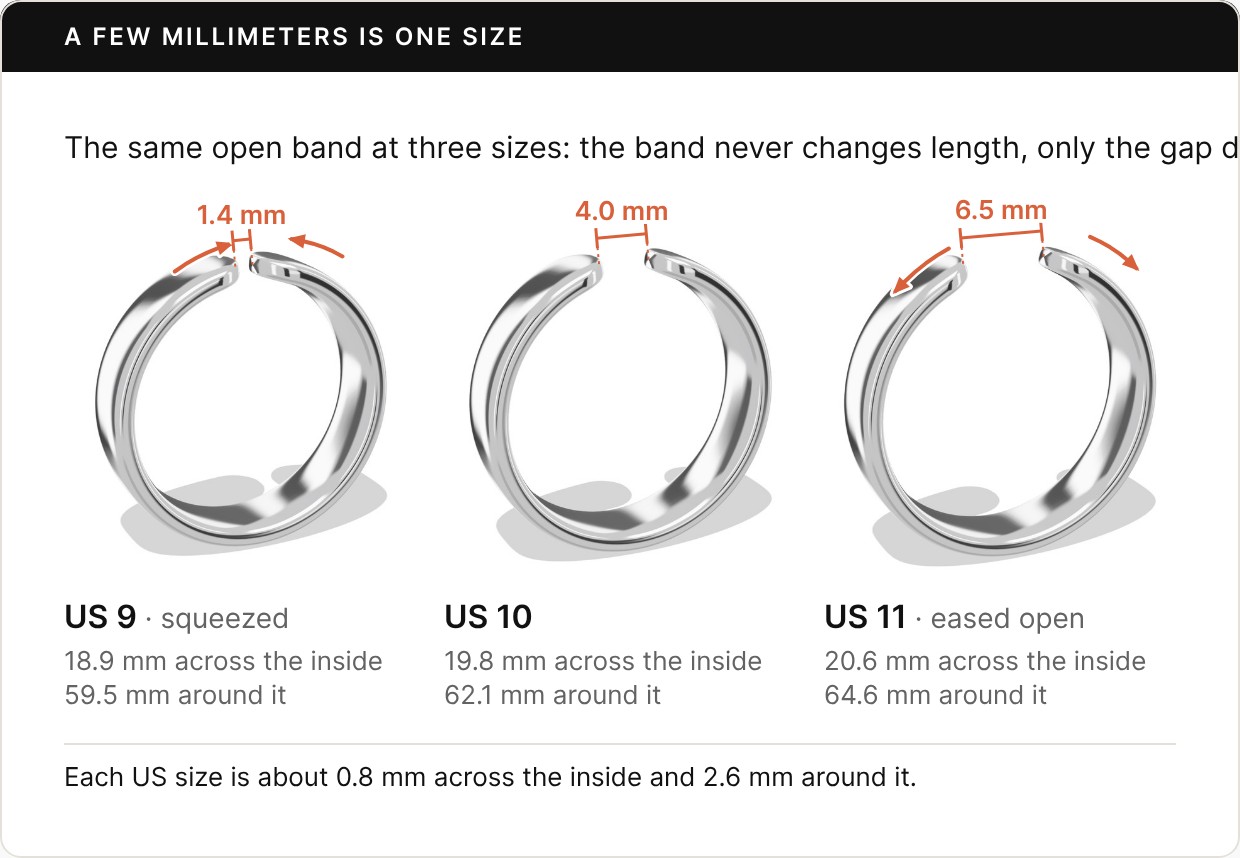
How many sizes a ring covers depends on the design, and most sellers don’t say. One jewelry retailer, The Diamond Guys, puts the usual range of an open-shank ring at two to four US sizes. Ronatelli says only that its rings fit any finger, so read that as the middle of the range: men’s rings are mostly sized 8 to 13, and if you wear well outside that, ask the seller before you order.
How often is the bigger question. Bending silver at room temperature hardens it. Each bend creates tiny defects in the metal’s crystal structure that get in each other’s way, so the next bend takes more force; metallurgists call it work hardening, and a University of Cambridge kitchen-science sheet shows it with a paperclip. Bend the same spot back and forth enough times and it cracks. Ronatelli’s care notes put it plainly: avoid bending the ring back and forth repeatedly, as this can weaken the metal over time.
That doesn’t make an adjustable ring fragile. Set once and worn, it is as sound as any silver ring, and Ronatelli says its rings are made to keep their shape after multiple adjustments. A sensible limit: adjust it when you first get it, again if you move it to another finger, and now and then if your fingers change with the seasons. Daily resizing, or opening it to take it off, is what to avoid.
If you see a fine line or a crack at the back, or the ring no longer holds its shape, stop adjusting it and take it to a jeweler. Ronatelli’s lifetime warranty covers manufacturing faults, not damage from bending or force.
Which fingers it suits
The ring finger and the middle finger are the easy ones. They sit in the middle of most ranges, and moving a ring between them usually takes a small adjustment. The index finger typically runs about a size larger than the ring finger and the pinky three to four sizes smaller, as our size guide notes, so the pinky is where a one-size ring is most likely to run out of range. That matters for a signet, which is traditionally worn there, as our signet ring guide explains. For the thumb, measure first: the size chart takes you from a strip of paper to a US size.
Ronatelli describes its rings as one ring for every finger, and they will move between fingers. Do it now and then rather than every day; each move is another bend.
Stone rings: press on the band, never the stone
On a plain band you can press anywhere on the back. On a ring with a stone or a signet face, hold it by the band near the back and keep your fingers off the front. Pressing on the head can bend a prong or the frame around a stone, and a face of tiny pavé stones is the most delicate of all: the jewelry brand Satinski warns that bending a ring too much can release its stones, especially on pavé designs.
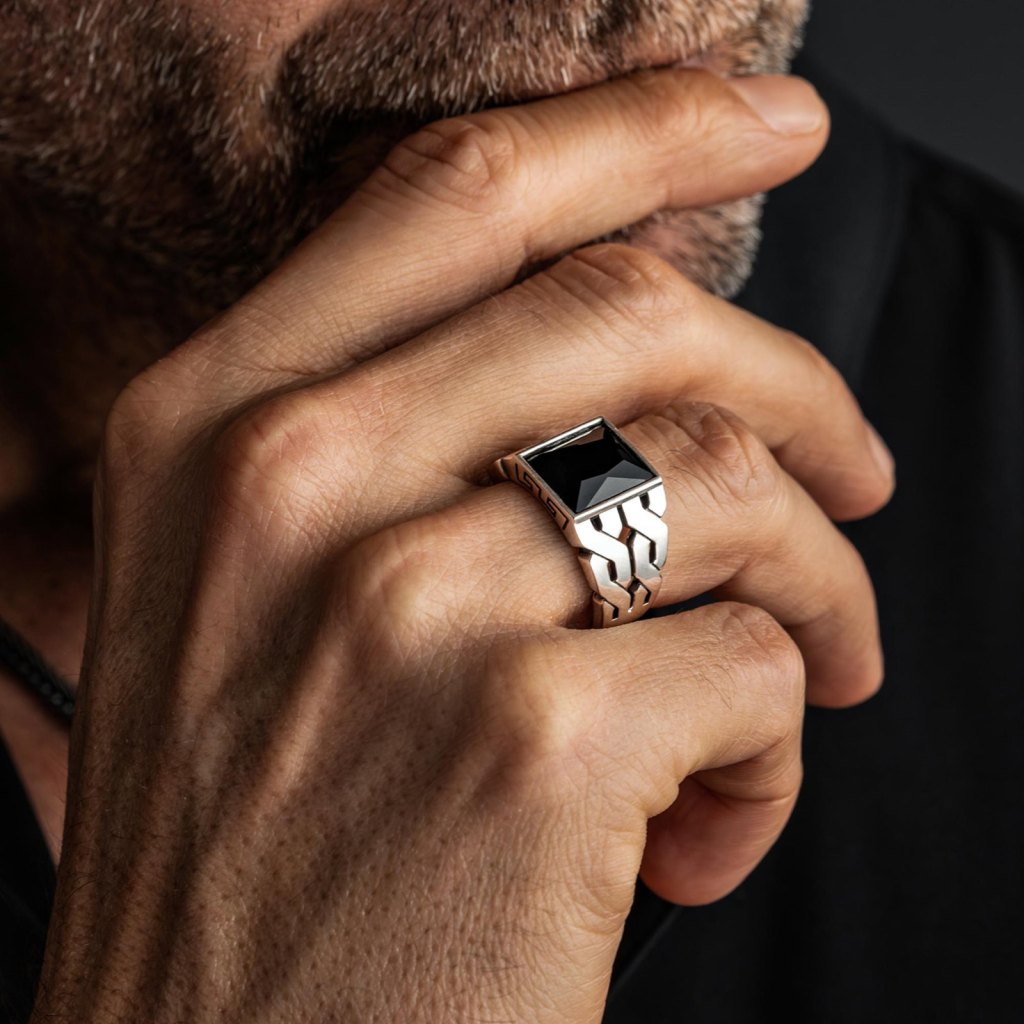
Ronatelli’s stone rings show the range. The Ragnar’s onyx sits in a square frame that wraps its edges, the Troy’s and Arco’s are held by prongs, and the faces of the Agno and Horus are set with small onyx stones. On all of them the adjustable back sits opposite the stone, so the advice is simply to press there. After adjusting, look over the prongs and the small stones, and have a jeweler check anything that seems to have moved. Our guide to black onyx rings covers each setting in more detail.
Does an open back snag or spin?
It can, if the ends are rough or the fit is loose. The ends of an open ring can catch on fabric and hair, as Mara Paris notes of its open rings, and repeated snags strain the band. Run a fingertip over the back: the ends should be smooth and rounded, and on an overlapping back the seam should lie flat, with no edge standing proud. A burr or a sharp corner is a small job for a jeweler.
A gap can also pinch. If the ends aren’t fully rounded, they can squeeze the skin between them, Satinski points out; closing the gap slightly usually stops it.
Spinning means the ring is too loose, and a heavy stone ring shows it first, rolling its stone toward the palm. Close the back a little at a time until it sits still when you move your hand. The join also collects soap and skin oil, so wash the ring now and then in warm water with mild soap and a soft brush, as our cleaning guide recommends, and dry it well.
Adjustable, sized, or resized?
An adjustable ring is one way to solve the fit. Here is how it compares with the others.
| Option | How the fit works | Best for | Watch out for |
|---|---|---|---|
| Adjustable, one size | How the fit worksThe back opens or closes by hand | Best forGifts, buying online, fingers that change between seasons | Watch out forA range, not every size; repeated bending wears it |
| Sized ring | How the fit worksMade in one US size | Best forA ring worn every day on one finger | Watch out forYou need the exact size |
| Sized, then resized | How the fit worksA jeweler cuts the band and adds or takes out metal, usually one to two sizes | Best forA ring you love that is a size off | Watch out for$20 to several hundred dollars; not for full patterns, stones all the way around, tungsten, or titanium |
| Hinged shank | How the fit worksA hinged section opens to clear the knuckle, then closes at the base | Best forKnuckles much larger than the base of the finger | Watch out forA mechanism to keep an eye on |
| Sizing beads | How the fit worksTwo small metal beads inside the band take up space | Best forA ring sized up for the knuckle that spins at the base | Watch out forFitted by a jeweler |
If you wear one size on one finger and the design comes in sizes, a sized ring is the simpler, sturdier choice; Jewelers Mutual notes that open rings in softer metals like silver should be handled with extra care. If you are buying for someone else, buying online, or your fingers change between seasons, adjustable wins. It is the one ring you can buy without knowing his size, which is why our guide to finding his ring size without asking recommends it. Leave the fitting to him, with a note of the two steps: over the knuckle, then close it for the base, slowly.
Adjustable rings at Ronatelli
Every ring in Ronatelli’s ring collection is sold in one adjustable size, from $129 to $169. These five show the main kinds of back, with and without a stone:
| Ring | Back | Style | Price | Rating (reviews) |
|---|---|---|---|---|
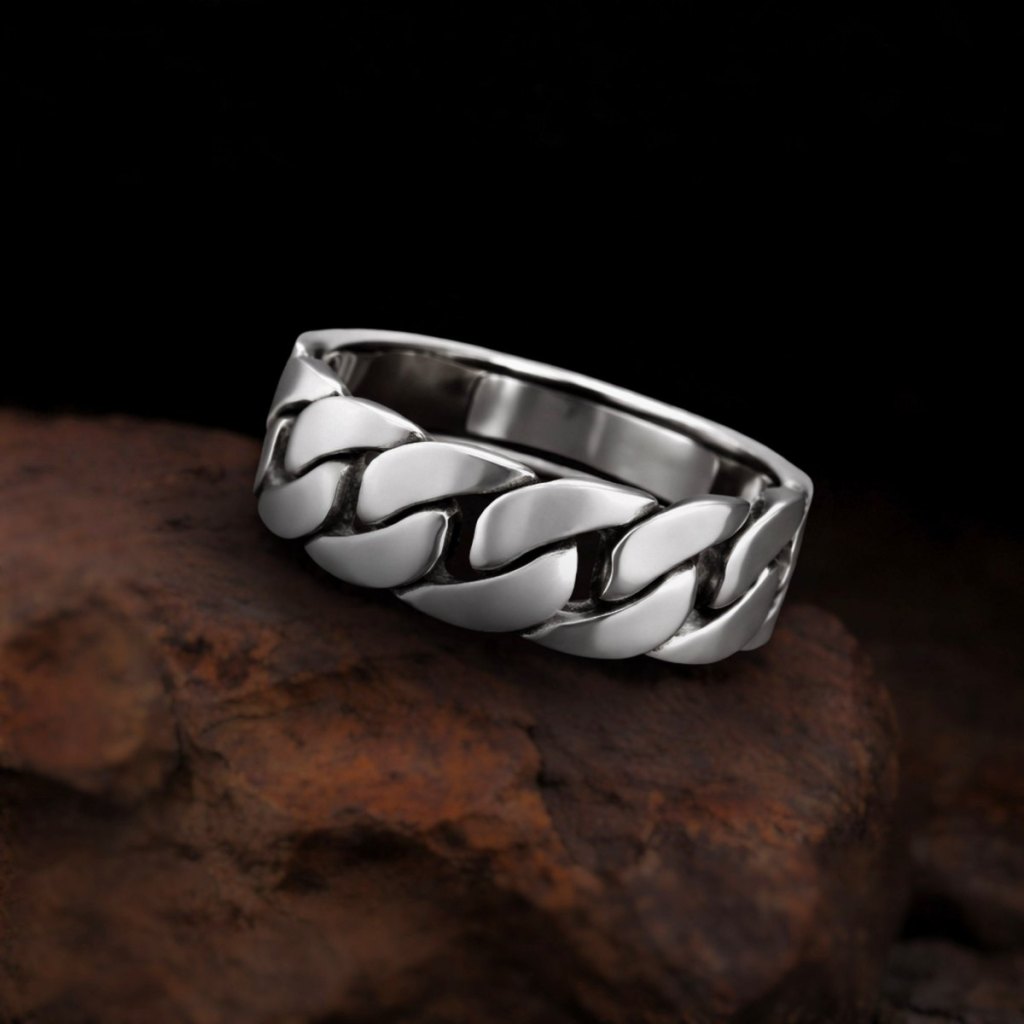
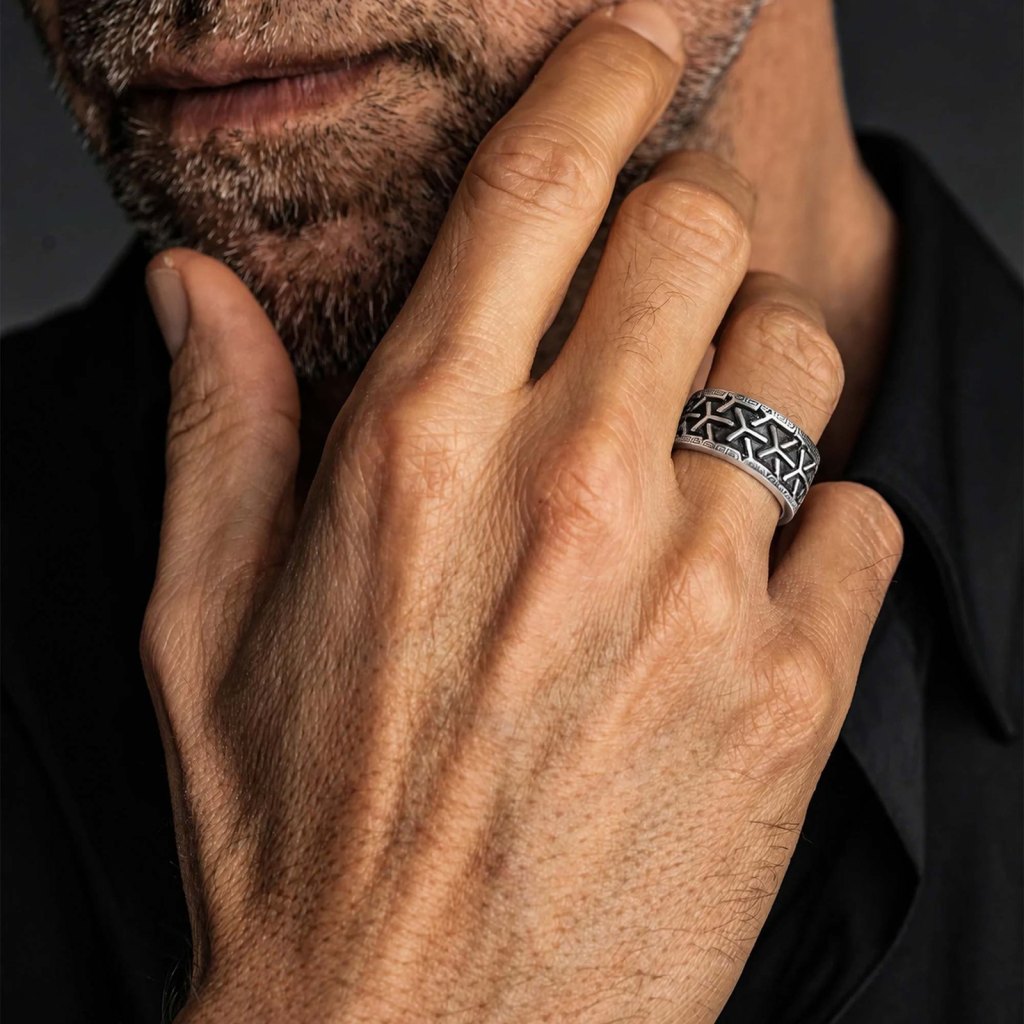
| Torin: Chain Link Ring | BackSliding band under the links | StyleCurb links, all silver | Price$129 | Rating (reviews)4.7 (7) |
| Etna: Rock Texture Band Ring | BackOpen back | StyleRock texture, all silver | Price$129 | Rating (reviews)5.0 (1) |
| Kleos: Greek Key Band Ring | BackOpen back | StyleGreek key, all silver | Price$149 | Rating (reviews)No reviews yet |
| Ragnar: Square Black Onyx Ring | BackOverlapping ends | StyleOnyx in a square frame | Price$149 | Rating (reviews)4.7 (93) |
| Agno: Hexagonal Signet Ring | BackOverlapping ends | StyleSignet, pavé onyx | Price$129 | Rating (reviews)4.7 (3) |
For a first adjustable ring, a plain band is the easiest to fit: you can press anywhere on the back, and there is no stone to worry about. Of the stone rings, the Ragnar has by far the longest review record, and its framed onyx is the best protected of the onyx settings while you adjust it. In the reviews, fourteen buyers mention the adjustable fit approvingly, and two of the Ragnar’s buyers said they couldn’t find instructions for adjusting it, which is what this guide is for. Our comparison of all eleven rings covers the rest of the collection.
FAQ
How do you adjust an adjustable ring?
Hold the band near the back and squeeze it with slow, even pressure to make it smaller, or ease the ends apart to make it larger. Work in small steps, try it on between them, and press on the band, never the stone.
How many sizes does an adjustable ring adjust?
It depends on the design. One retailer puts a typical open-shank ring at two to four US sizes. Each size is about 2.6 mm around the inside, so a few millimeters at the back makes a real difference.
Can you adjust a ring more than once?
Yes, but keep it to a few times. Each bend hardens the silver a little, and bending it back and forth repeatedly can eventually crack it. Set it once for the finger you wear it on.
Do adjustable rings break?
Not from normal wear. A well-made sterling ring that is set once and left alone wears like any silver ring. The risk comes from bending the same spot again and again, or forcing it far past its range.
Can a jeweler resize an adjustable ring?
There is usually no need, because it adjusts by hand. If it won’t reach your size, ask a jeweler; Jewelers Mutual notes that open bands can often be resized more easily than closed ones.
Is an adjustable ring a good gift?
Yes. It is the one ring you can buy without knowing his size. Let him do the fitting, and keep the box and packaging in case he would rather return it.
Bottom line
An adjustable ring trades a little care for a lot of freedom: no size to guess, a fit you set yourself, and room to move it to another finger. Fit it once, at the end of the day: over the knuckle, then closed for the base of the finger, with slow, even pressure on the band and never on the stone. Then leave it alone. If you wear well outside sizes 8 to 13, or want it for your pinky, check the range first or buy a sized ring.
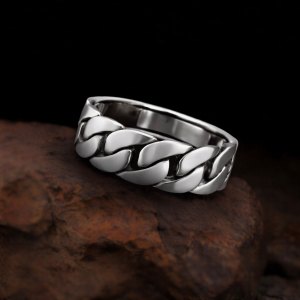
From the collection
Men’s sterling silver rings by Ronatelli
Eleven handmade 925 rings, $129 to $169, from a chain-link band to a black onyx statement ring. Every one is adjustable.
Related guides
Ronatelli’s size guide, care tips, prices, ratings, and warranty terms were read from its ring product and policy pages on October 29, 2026, and may have changed since; how each back is made is from the product photos, and the review counts from the Reviews.io feed for the eleven rings. Size measurements follow the standard US scale in our ring size guide. Work hardening follows the University of Cambridge’s “Stiffening paperclips” sheet; the typical open-shank range and hinged shanks follow The Diamond Guys; open-ring care follows Jewelers Mutual, Mara Paris, and Satinski; sizing beads follow Robinsons Jewelers. Read our editorial policy.

