Disclosure:The example pieces in this guide are from Ronatelli. The buying advice applies to any brand. Prices were checked on October 28, 2026.
Most men’s silver bracelets are chains: one row of links, each hooked through the next. A woven bracelet is built differently. Its links or rings pass through several others at once, so it reads as a solid, textured band rather than a line of links, and it wears, fits, and cleans differently from a curb. Three weaves cover nearly every woven men’s bracelet you will find: foxtail, the wider braids built from it, and Byzantine. This guide explains how each one is made, how it feels on the wrist, what it weighs, and how to size and clean it.
Key takeaways
- Foxtail is the everyday weave: oval links set in V-shaped rows. It is supple, slim, and easy to wear beside a watch at 3 to 6 mm.
- Braided bracelets are mostly foxtail made bigger: one wide braid, two side by side, or several twisted into a rope. At 8 to 12 mm they are statement pieces.
- Byzantine folds pairs of rings back on each other into a chunky rope. It is heavy for its width, so even 5 mm feels substantial.
- Size a thick weave up. It leaves less room inside, so add about ¼″ from 8 mm up; Ronatelli asks for 0.4″ (1 cm) more on its thickest braids.
- Wash the weave, keep the dark. Soapy water and a soft brush reach the recesses; a foil bath or a dip strips the darkening that makes the pattern show.
In this guide Woven vs. chain Foxtail Braids Byzantine Compared Weight Fit Wear Care Examples FAQ
Woven, not linked: what sets these bracelets apart
In a chain bracelet, each link connects only to the link before it and the link after it. In a woven bracelet, each link or ring passes through several others, so the bracelet holds together as a band and its texture covers the whole surface. That is why a 6 mm foxtail looks denser than a 6 mm curb, and why the three weaves below behave differently from chain on the wrist, on the scale, and at the sink.
Foxtail: the everyday weave
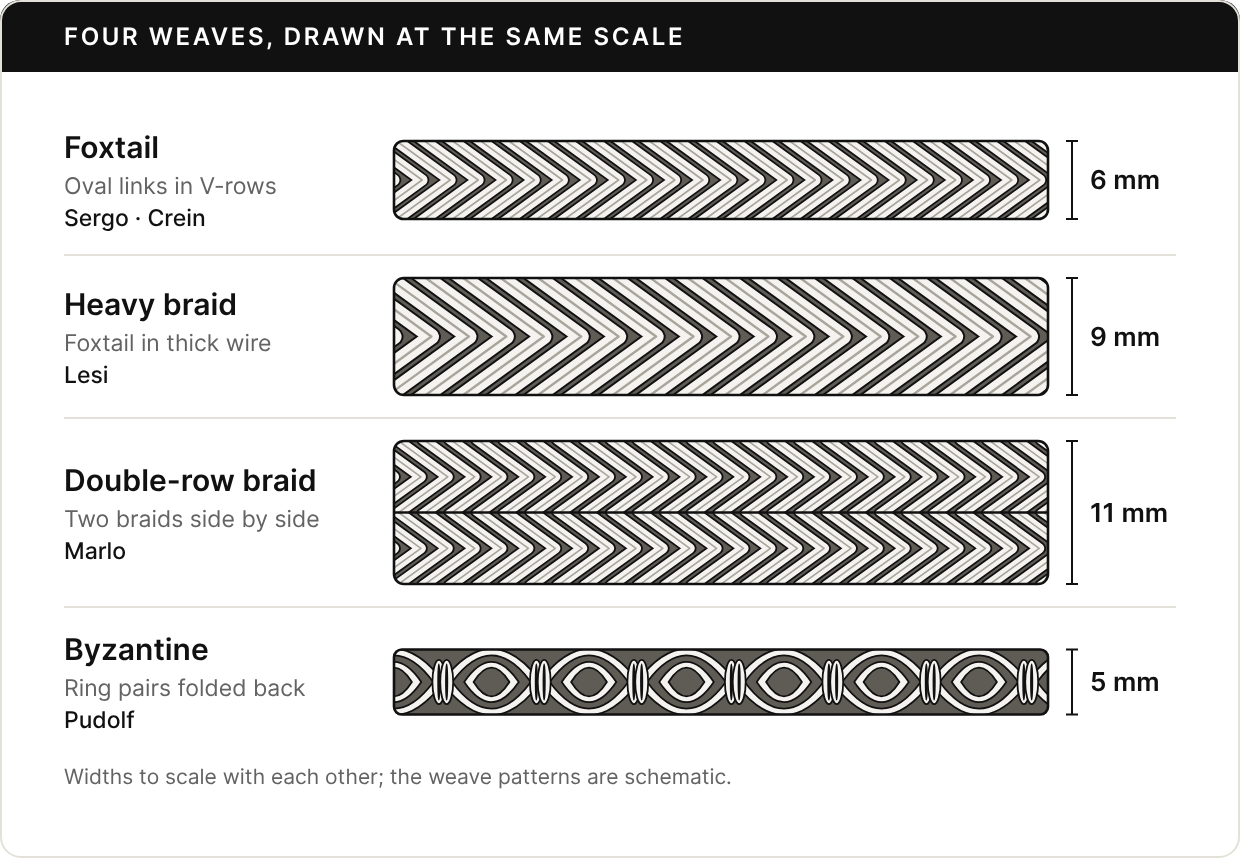
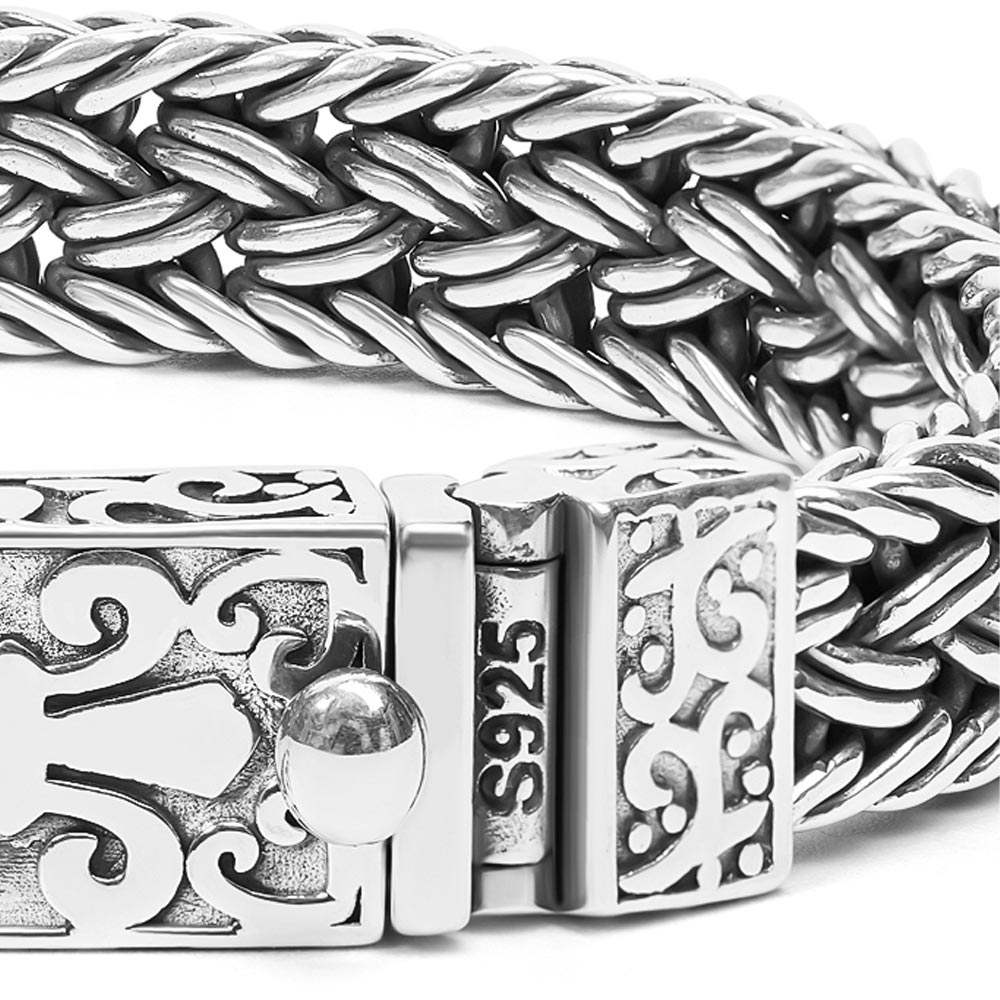
A foxtail is built from small oval links arranged in two rows at about 45 degrees to each other and tied together along the center, so the top of the bracelet shows a continuous run of V’s, like the hairs of a fox’s tail. Machine-made foxtail is assembled from stamped links with bent ends. Handmade foxtail is woven from loops of drawn silver wire, each pulled through the loops before it. Either way, the links nest tightly into each other, and the result is a square or rounded cord with a chevron texture along its length.
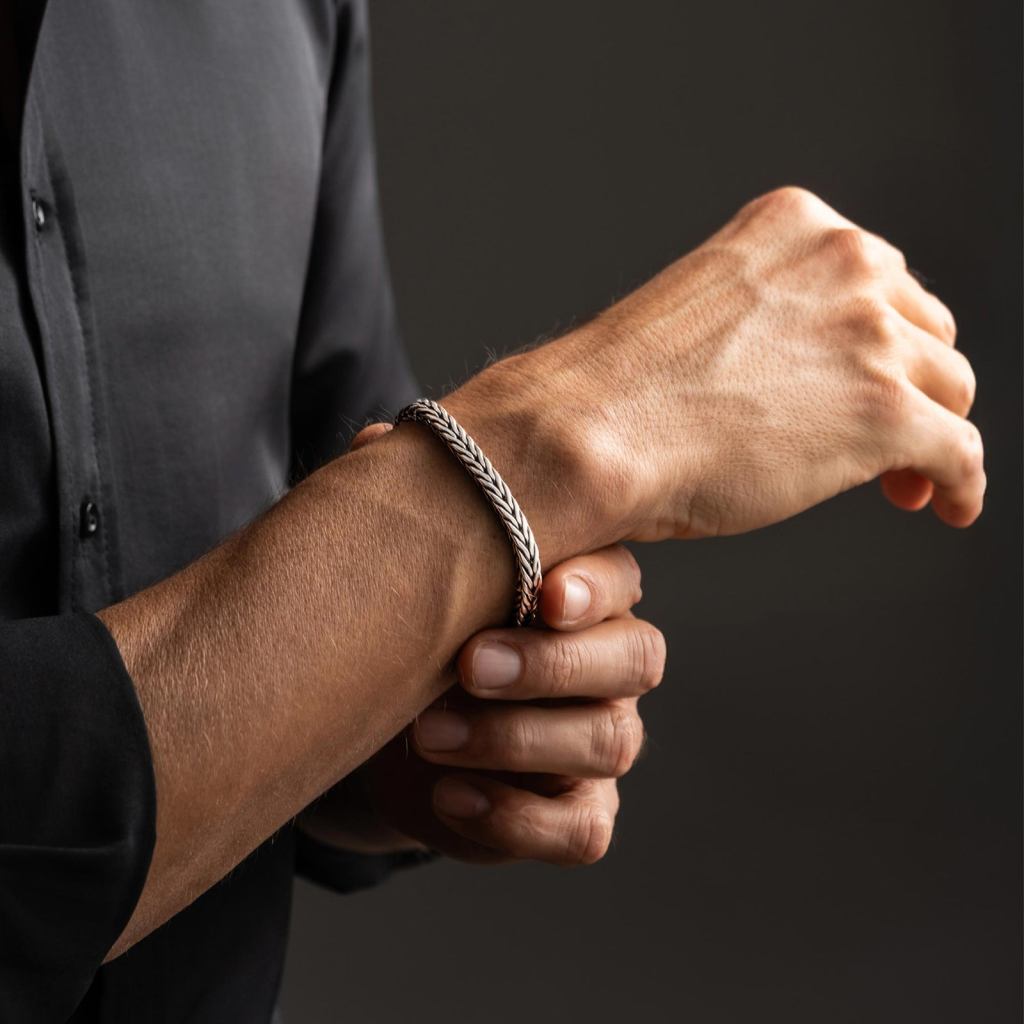
On the wrist a foxtail behaves like a cord. It bends easily, keeps its profile, and is far less prone to kinking than the flat chains, herringbone and snake. Most foxtail bracelets are 3 to 6 mm wide; wider weaves are often sold as braided. At 3 to 4 mm a foxtail is an accent or a watch-wrist piece, and at 6 mm it is a full everyday bracelet that holds its own.
Braided bracelets: foxtail, made wider
Most wide woven bracelets are foxtail weaves scaled up or combined, and brands use “braided” and “woven” loosely for all of them, so go by the photos rather than the name. Three builds are common:
- A single heavy braid. The same V-pattern in thicker wire and a wider band, usually 8 to 10 mm. It reads as one solid piece from across a room.
- Two rows side by side. Two braids joined along their length into a flat band, 10 to 12 mm wide, often with a wide box clasp to match.
- Twisted foxtail. Several foxtail chains twisted around each other into a rope, which gives a deeper, more irregular texture than a single braid.
A braided cuff is a different thing: strands of twisted wire plaited into an open band with no clasp, sized by its inside circumference like any other cuff; our size guide explains how. Braids of either kind are statement pieces. From 9 mm up the texture is the point of the bracelet, so wear one on its own or beside a slim, plain piece, on the wrist without your watch. Our guide to stacking bracelets covers the pairings that work.
Byzantine: rings folded into a rope
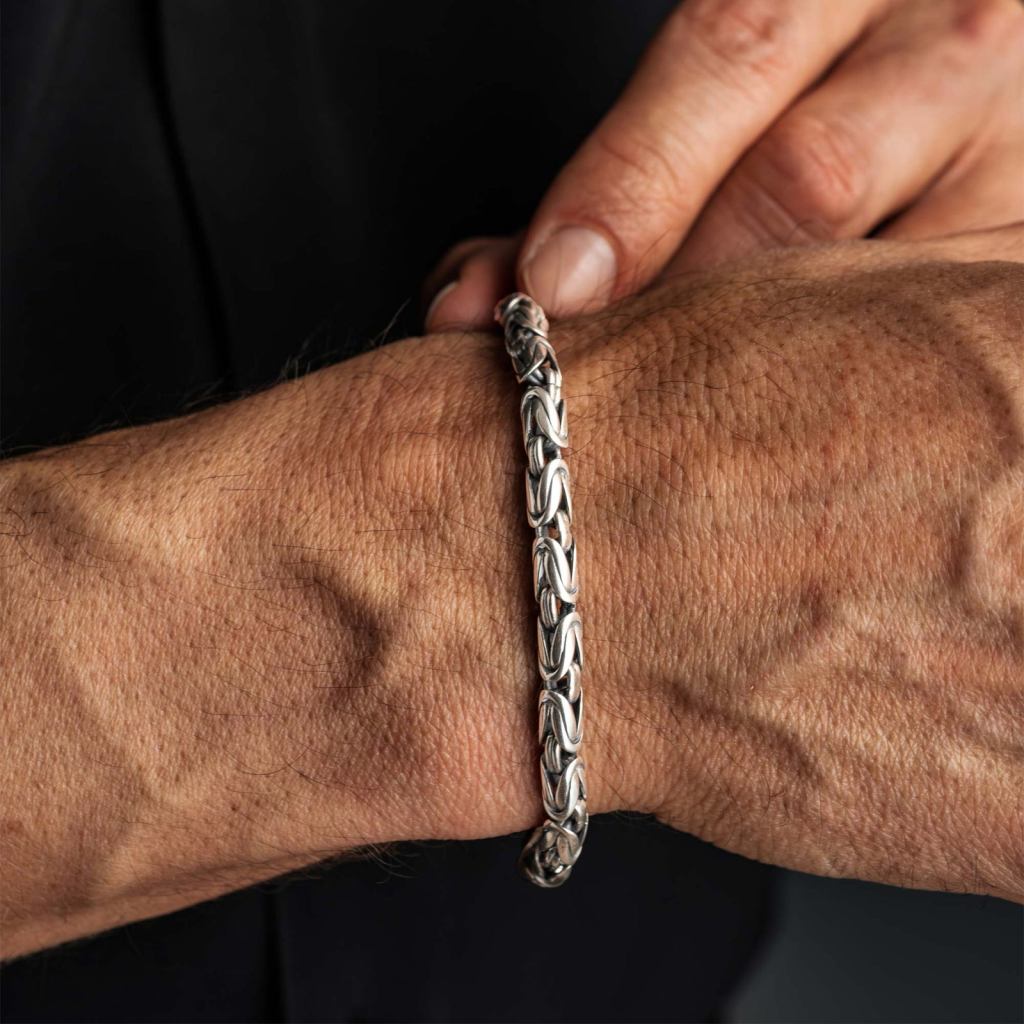
Byzantine is closer to chain mail than to chain. Pairs of round jump rings are linked and folded back over each other in a repeating pattern, so the bracelet alternates between tight clusters and small open windows along its length. It also goes by birdcage and Etruscan, and some jewelers sell it as king’s chain; where the name Byzantine came from is not known.
It is the heaviest of the three for its width, because so many rings stack up in every inch. That density makes even a slim Byzantine feel substantial, and it is strong and very hard to kink. It is also supple: each ring can move a little against its neighbors, so the bracelet drapes over the wrist rather than sitting stiffly. Byzantine looks best at 4 to 6 mm worn on its own; at 8 mm and wider it is a heavy statement. Some designs set two rows side by side, sometimes framing an engraved plate.
Foxtail, braid, and Byzantine compared
| Weave | Built from | On the wrist | Typical widths |
|---|---|---|---|
| Foxtail | Built fromOval links in two rows at about 45°, tied along the center | On the wristSupple and close to the skin; slides under a shirt cuff | Typical widths3–6 mm |
| Braid | Built fromFoxtail in thicker wire, two rows side by side, or several twisted together | On the wristDense and bold; reads as one solid band | Typical widths8–12 mm |
| Byzantine | Built fromPairs of rings folded back on each other | On the wristHeavy for its width; drapes; chunky texture | Typical widths4–8 mm |
Weight: compare grams, not looks
Woven bracelets fool the eye in both directions. A Byzantine is heavier than it looks: one 5 mm square Byzantine bracelet we checked is listed at 27.4 g at 8″, where a solid 5 mm curb at 8.5″ weighs 10 to 16 g in our bracelets guide. A handmade foxtail or braid is woven from fine wire, so part of its width is the space between the wires: one handmade foxtail we checked, half an inch wide and 8.5″ long, is listed at 1.48 oz, about 42 g, where a solid curb 10 to 12 mm wide runs 50 to 80 g.
Neither is better; they are built differently, and a lighter woven band is more comfortable to wear all day. If you want the heavy, solid feel, look for the gram weight on the listing and ask for it if it is missing. Ronatelli does not list weights for its bracelets.
Fit: woven bands need more room
The thicker a bracelet, the less room it leaves inside for the same listed length, and woven bands are thick. A 4 mm foxtail fits like any slim chain: your wrist plus ¾″ to 1″ for a comfortable fit. From about 8 mm up, add another ¼″, as our size guide recommends for wide links. Some brands ask for more on their thickest weaves: Ronatelli’s size chart tells buyers to add 0.4″ (1 cm) on top of their normal size for the Lesi, the Marlo, and similar thick braids.
Get the length right the first time. A curb can be shortened by taking out a link or two, but shortening a woven bracelet means cutting the weave and refitting the end cap, which is a jeweler’s job. Check the clasp, too. On a wide, heavy band, a box clasp holds best, ideally with a safety latch; judging by the product photos, all of Ronatelli’s wider weaves close with a box clasp, and the slim Sergo and Pudolf with a lobster clasp.
How a woven bracelet wears
Woven silver is tough day to day, but it has three habits worth knowing.
- It can catch fine knits. The crevices in a weave, and any wire end that works loose, can pull a thread on cashmere or fine merino. A tight, even weave and a smooth clasp keep it to a minimum; if a wire end ever sticks out, have a jeweler tuck it in before it snags.
- It gets dirty from the inside. Skin oil, soap, and lotion settle into the weave, where they dull the silver and speed up tarnish. A woven bracelet needs a wash more often than a curb does.
- It should come off for the gym. A bar or a dumbbell handle presses the weave against the wrist bone, and that is where dents and flattened sections come from.
Cleaning a woven bracelet
Tarnish shows first in the recesses of a weave, and a polishing cloth reaches only the high points. That is fine for a quick brighten, and on most woven bracelets it is exactly what you want, because the recesses are darkened on purpose to make the pattern show. Ronatelli’s woven pieces are finished this way, as the product photos show.
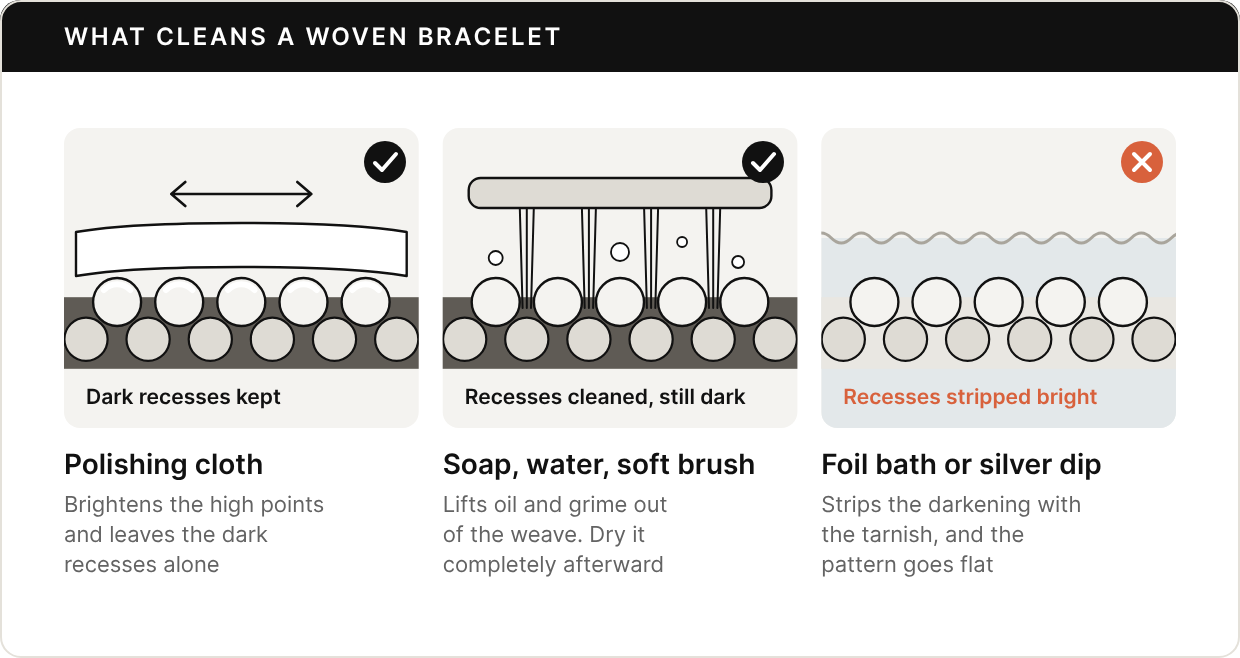
- Wash it. Warm water, a drop of dish soap, and a soft toothbrush worked along the weave lift out the oil and grime a cloth can’t reach.
- Dry it completely. Pat it with a lint-free cloth, then leave it flat on a towel for an hour. Water trapped in the weave is what makes a freshly cleaned bracelet tarnish again within days.
- Buff the high points. A polishing cloth brings up the shine on the tops of the weave and leaves the dark recesses alone.
- Skip the foil bath and dips. Both strip tarnish everywhere, including the darkening in the recesses, and a weave is hard to rinse clean of dip. An ultrasonic cleaner is fine for plain, bright sterling, but not for darkened pieces.
If the high points wear bright over the years, that is normal and part of the look; if the recesses lose their darkening, a jeweler can re-apply it. Our guide to cleaning sterling silver at home covers each method in detail.
Woven bracelets at Ronatelli
Examples from Ronatelli’s bracelet collection, at their listed prices. The chain bracelets come in S (7.1″), M (7.9″), L (8.7″), and XL (9.5″), and the brand’s extra 0.4″ applies to the Lesi and the Marlo; the Milan cuff is one adjustable size.
| Bracelet | Weave | Width | Clasp | Price |
|---|---|---|---|---|
| Sergo | WeaveFoxtail | Width4 mm | ClaspLobster | Price$169 |
| Crein | WeaveFoxtail | Width6 mm | ClaspBox | Price$249 (was $299) |
| Pudolf | WeaveByzantine | Width5 mm | ClaspLobster | Price$199 |
| Lesi | WeaveHeavy braid | Width9 mm | ClaspBox | Price$469 (was $539) |
| Parma | WeaveTwisted foxtail | Width10 mm | ClaspBox | Price$299 |
| Marlo | WeaveDouble-row braid | Width11 mm | ClaspBox | Price$499 (was $599) |
| Poseidon | WeaveDouble-row Byzantine with an engraved plate | Width11 mm | ClaspBox | Price$499 |
| Milan | WeaveBraided cuff | Width10 mm | ClaspNone (open cuff) | Price$299 (was $329) |
For a first woven bracelet, start with the Crein: a 6 mm foxtail with a box clasp, and the most-reviewed bracelet in the collection, at 4.8 stars from 405 reviews. The Sergo is the slim version for the watch wrist. The Lesi is the statement braid, with 290 reviews behind it, and the Pudolf is the way into Byzantine at 5 mm.
FAQ
What is a foxtail bracelet?
A bracelet woven from oval links set in two rows at an angle, so the top shows a continuous V pattern. It is supple, resists kinking, and is usually 3 to 6 mm wide.
What is the difference between foxtail and wheat chain?
Both look braided. Foxtail is built from two rows of oval links set at about 45 degrees; wheat, or spiga, from figure-eight links nested closely together. Some sellers use the names for the same chain, so judge by the photo.
Is a Byzantine bracelet heavy?
For its width, yes. It packs more silver into each inch than most chains, and a 5 mm Byzantine can weigh about twice as much as a solid 5 mm curb of similar length.
Can a woven bracelet be shortened?
Yes, but not at home. A jeweler cuts the weave and refits the end cap, which costs more than taking a link out of a curb. Order the right length instead, adding about ¼″ to your usual size from 8 mm up.
How do you clean a braided silver bracelet?
Wash it in warm water with a drop of dish soap, brush along the weave with a soft toothbrush, rinse, and dry it completely. Buff only the high points with a polishing cloth, and skip foil baths and dips if the recesses are darkened.
Do woven bracelets snag on sweaters?
They can catch fine knits more easily than a smooth curb or a cuff. A tight, even weave and a smooth clasp help; if you wear a lot of fine knitwear, a slim foxtail is the safer choice.
Bottom line
Choose the weave for the look and the width for your wrist. A 4 to 6 mm foxtail is the everyday woven bracelet; a 9 to 11 mm braid is a statement to wear on its own; a 5 mm Byzantine puts the most silver and texture into a slim width. Size any weave 8 mm and wider about ¼″ up, wash it rather than dipping it, and keep the darkened recesses that make the pattern show.
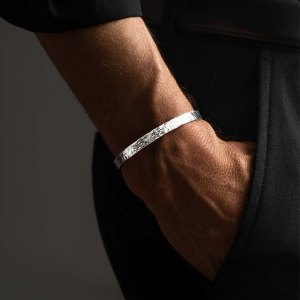
From the collection
Men’s sterling silver bracelets by Ronatelli
Thirty-one handmade 925 bracelets, from a 3.5 mm bamboo link to an 11 mm woven band, in sizes S to XL. Every cuff is adjustable.
Related guides
Construction descriptions follow the chain guides of the jewelry supplier Rio Grande and of MJSA, the trade association for jewelry makers; Byzantine’s other names follow common usage. The listing weights are from a 5 mm square Byzantine bracelet sold by Silver Palace and a handmade foxtail bracelet from Thailand listed on the Smithsonian Folklife Festival Marketplace; the curb weights are from our bracelets guide. Ronatelli widths, prices, ratings, and sizing notes come from its product pages and the clasps and finishes from its product photos. All were checked on October 28, 2026, and may have changed since. Read our editorial policy.

