Disclosure:The example pieces in this guide are from Ronatelli. The buying advice applies to any brand. Prices were checked on October 28, 2026.
A chain bracelet and a cuff do the same job in opposite ways. A chain is a flexible loop of links that closes with a clasp and is sized by its length. A cuff is a rigid, open band with no clasp at all, sized by its shape and the gap you slide it through. That one difference decides how each fits, how it sits under a shirt, how it ages, and what goes wrong with it. This guide sets the two side by side and ends with which to buy, and when.
Key takeaways
- A chain is the easier first bracelet. Sized by length, it flexes with the wrist, closes with a clasp, and can be shortened if it is too long.
- A cuff has no clasp to fail. It slides on in a second and stays where you put it, but it fits by inside circumference and gap, not by length.
- Put a cuff on sideways, never by pulling it open. Bending a sterling cuff open and shut is what cracks it; an adjustable cuff takes one gentle adjustment.
- Under a buttoned shirt cuff, a slim chain wins; with rolled sleeves or a T-shirt, a cuff shows what a chain can’t.
- For a gift without a wrist size, a cuff is the safer bet; for an everyday piece beside a watch, a slim chain.
In this guide Fit Compared Putting on a cuff Sleeves and watch How they age Cuff styles Which to buy Examples FAQ
Fit: length versus shape
A chain bracelet is sized by its length: your wrist, measured snug just below the wrist bone, plus ¾″ to 1″ for a comfortable fit. It rests on the top of the wrist and hangs with a little room underneath, so it moves as you do and settles just above the hand. Chains come in half-inch steps or brand sizes such as S to XL, and if one is too long, a jeweler can take out a link.
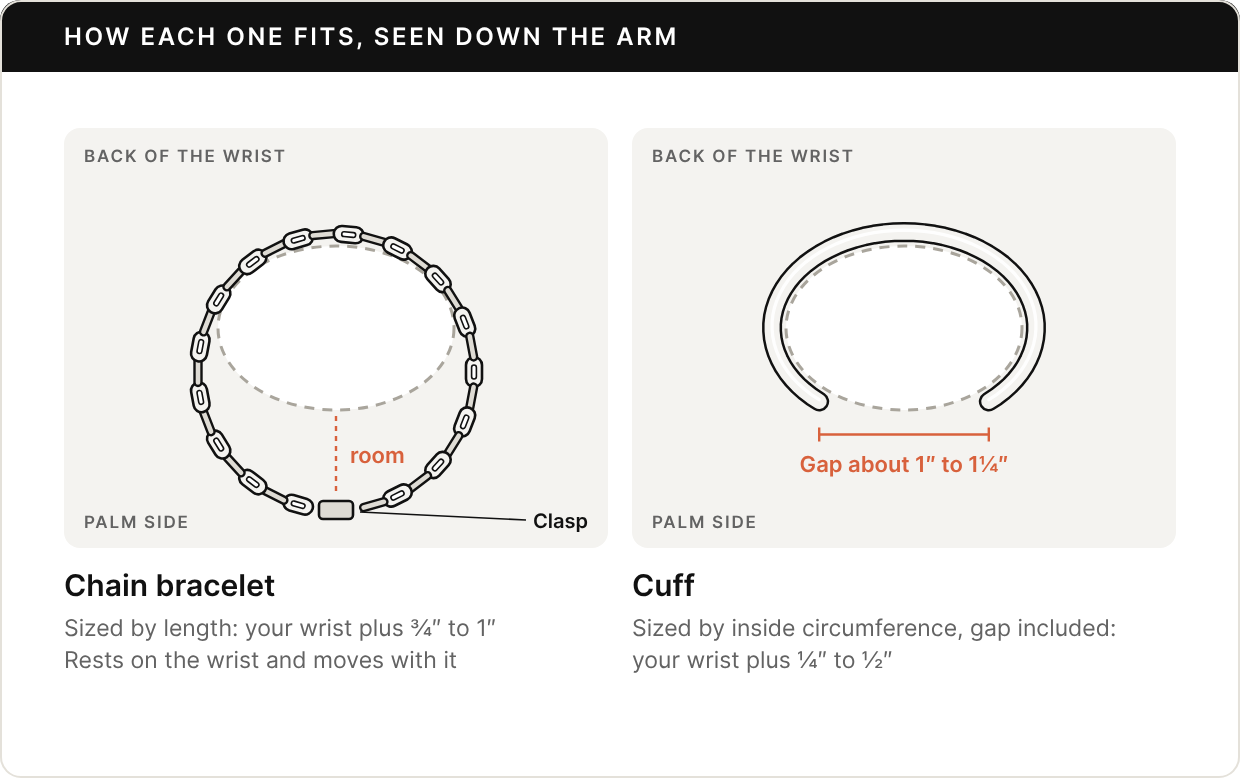
A cuff is sized by its inside circumference, which is the inside length of the band plus the gap. Aim for your wrist plus ¼″ to ½″, with a gap of about 1″ to 1¼″ for most men. It sits closer than a chain and stays where you put it, usually just above the wrist bone. Cuffs come in two or three sizes or in one adjustable size, and the shape matters as much as the number: a cuff is slightly oval, like a wrist, and should sit without pinching. Our bracelet size guide has the full method for both.
Cuff and chain bracelet compared
| Cuff | Chain bracelet | |
|---|---|---|
| Sizing | CuffInside circumference, wrist plus ¼″ to ½″; often one adjustable size | Chain braceletLength, wrist plus ¾″ to 1″; half-inch steps or S to XL |
| Putting it on | CuffSlides on sideways in a second; nothing to fasten | Chain braceletA clasp to fasten; a good lobster or box clasp works one-handed |
| How it sits | CuffStays where you put it, above the wrist bone | Chain braceletMoves and settles just above the hand |
| Under a shirt cuff | CuffFine if slim and close-fitting; a wide cuff catches | Chain braceletA slim chain slides under easily |
| With a watch | CuffOn the other wrist | Chain braceletA slim one can share the watch wrist |
| Scratches | CuffShow on the broad face; hammered and engraved surfaces hide them | Chain braceletSpread across the moving links |
| Repairs | CuffA crack from repeated bending is a jeweler’s repair | Chain braceletLinks can be taken out or replaced |
| As a gift | CuffAn adjustable cuff fits most wrists | Chain braceletNeeds a size guess; 8″ to 8.5″ is the safe default |
Putting on a cuff without bending it
A cuff goes on sideways. The narrowest part of the arm is just above the wrist bone, where the soft tissue gives a little, and that is where the gap goes through, not over the bone itself.
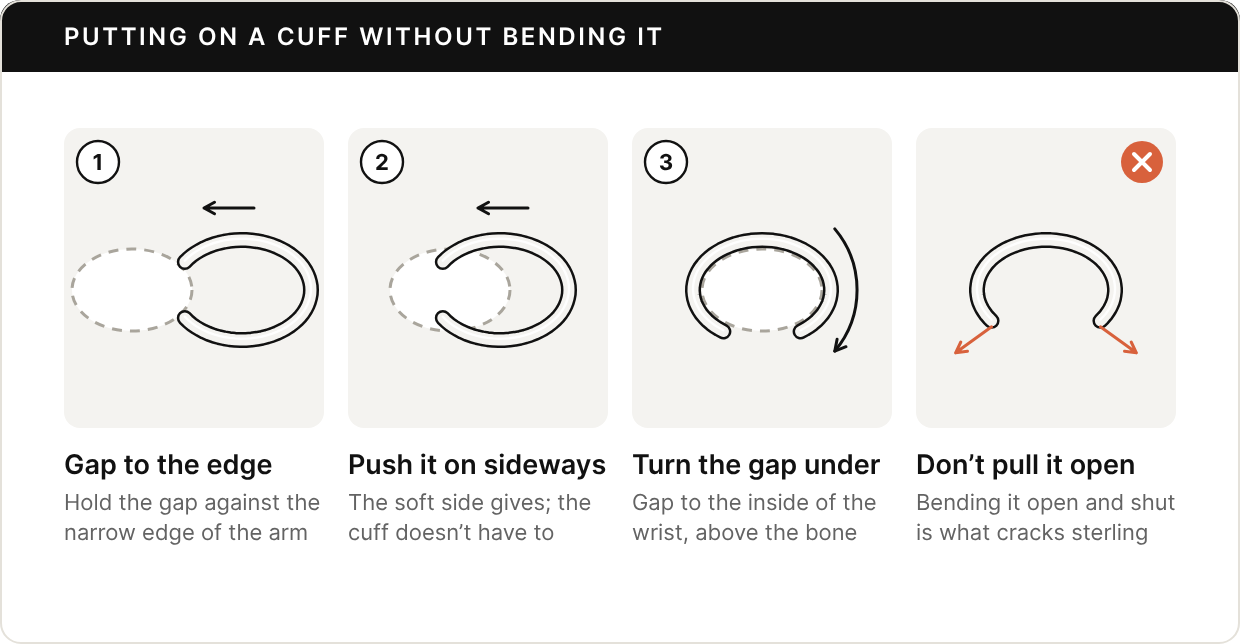
- Gap to the edge. Turn your hand so the thumb points up, and hold the cuff’s gap against the narrow edge of the arm, just above the wrist bone.
- Push, don’t pull. Press the cuff on sideways. The soft side of the arm gives, so the cuff doesn’t have to.
- Turn it. Rotate the cuff so the gap sits on the inside of the wrist, and let it settle above the bone. Take it off the same way, in reverse.
An adjustable cuff is meant to be shaped to your wrist once. If it is loose or tight, squeeze or open it a little at a time with even pressure along the whole band rather than at the ends, try it on, and stop when it fits. After that, leave it alone: each bend makes sterling harder and more brittle at that spot, and a cuff that is pulled open and squeezed shut every day eventually cracks at the back. A cuff set with stones or inlay shouldn’t be bent at all; take it to a jeweler.
Sleeves, watches, and stacking
- Under a shirt cuff. A chain up to about 5 mm slides under a buttoned cuff and moves out of the way. A cuff sits higher on the arm and stays put, so a slim, close-fitting one works under a looser shirt cuff, and a wide one is better with rolled sleeves.
- With a watch. Keep a cuff on the wrist without the watch: a rigid band and a watch case knock against each other, and the silver comes off worse. A slim chain can share the watch wrist; our guide to wearing a bracelet with a watch covers how.
- In a stack. A cuff is the easiest second piece beside a chain. It doesn’t slide, so it never rides into the links; our guide to stacking bracelets has pairings.
- At the gym. Take either one off. A bar can bend a cuff, and a grip presses a chain’s links and clasp into the wrist. Our guide to wearing a silver bracelet every day covers the shower, the pool, and sleep as well.
How each one ages
A chain bracelet wears evenly. Its links move against each other and against the desk, so fine scratches spread across them and settle into a soft sheen, and tarnish collects in the gaps between links. The clasp and the end links take the most strain, which is why they are the first thing to check on any chain.
A cuff wears on its face. A polished band shows every scratch, which is why hammered, textured, and engraved cuffs age better: the surface already has marks of its own. The other risk is fatigue. A cuff that is bent open every day cracks at the back of the band, opposite the gap, and fixing it is a jeweler’s repair rather than a link swap.
Fine silver cuffs, stamped 999, are softer still. Without the copper that hardens sterling, they bend and scratch more easily: simple to adjust, but quicker to lose their shape if you knock them or pull them open. They tarnish a little more slowly in return. Ronatelli’s Turin (999.9) and Como (999) are fine silver; its other cuffs are 925 sterling.
Cuff styles: hammered, twisted, engraved
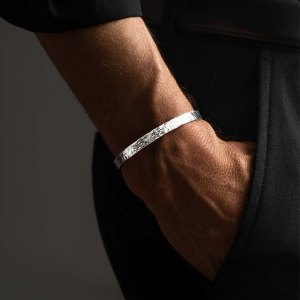
- Hammered. Worked by hand into small facets that catch the light and hide scratches. The plainest cuff, and the easiest to wear every day.
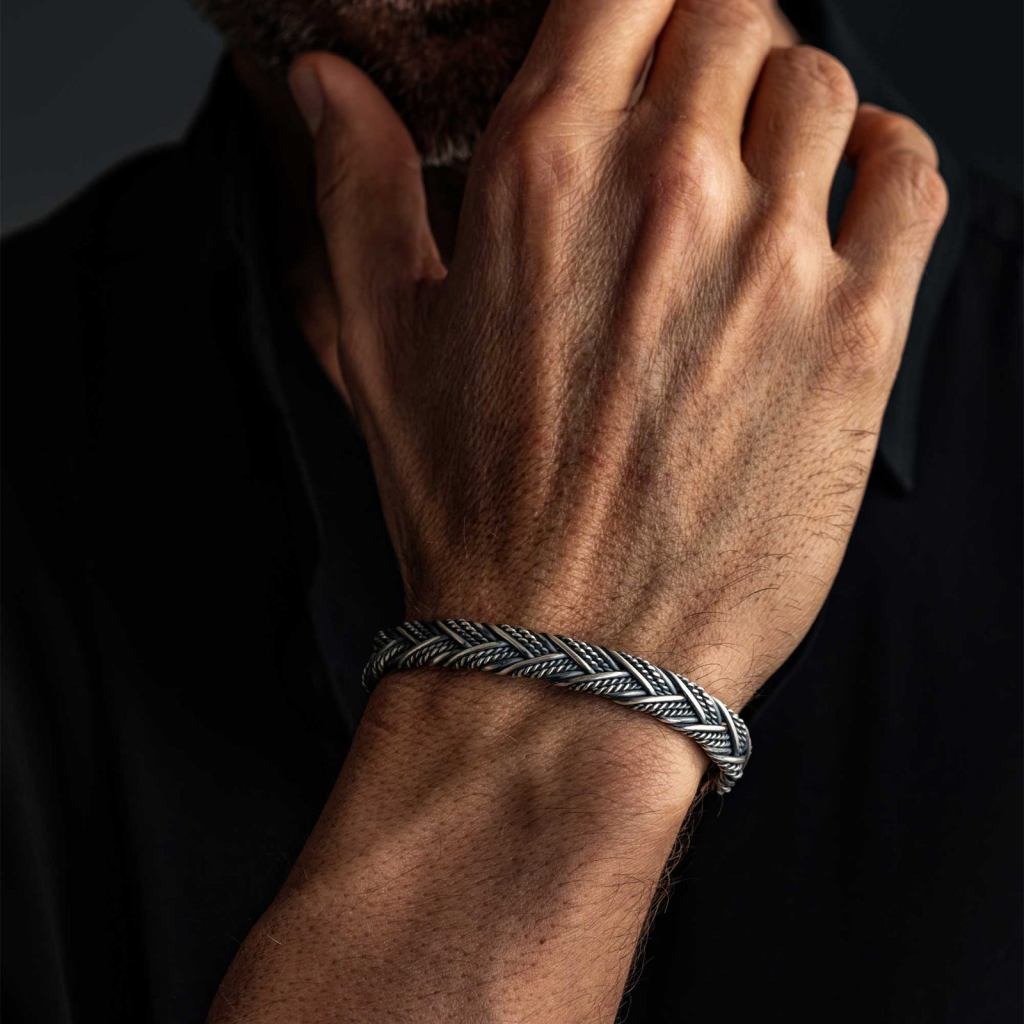
- Twisted or braided. Strands of wire twisted or plaited into an open band. More texture, and the same care as a woven bracelet.
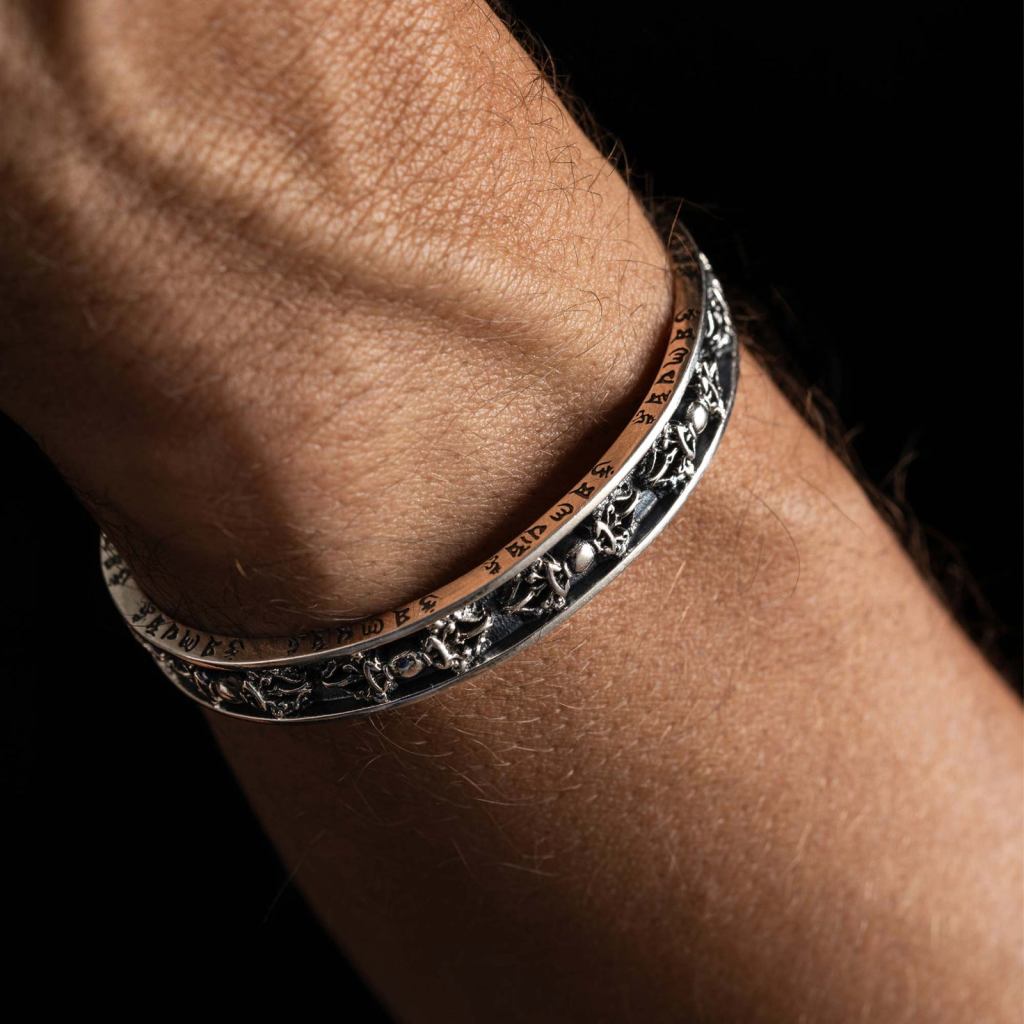
- Engraved. Script, symbols, or patterns cut or stamped into the band, usually darkened so they show. Our guide to the symbols on men’s silver bracelets explains what the common ones mean. Keep dips and foil baths away from the dark detail.
- Sculpted. A shaped design rather than a plain band, such as wings or a cross. The most decorative, and the one to wear on its own.
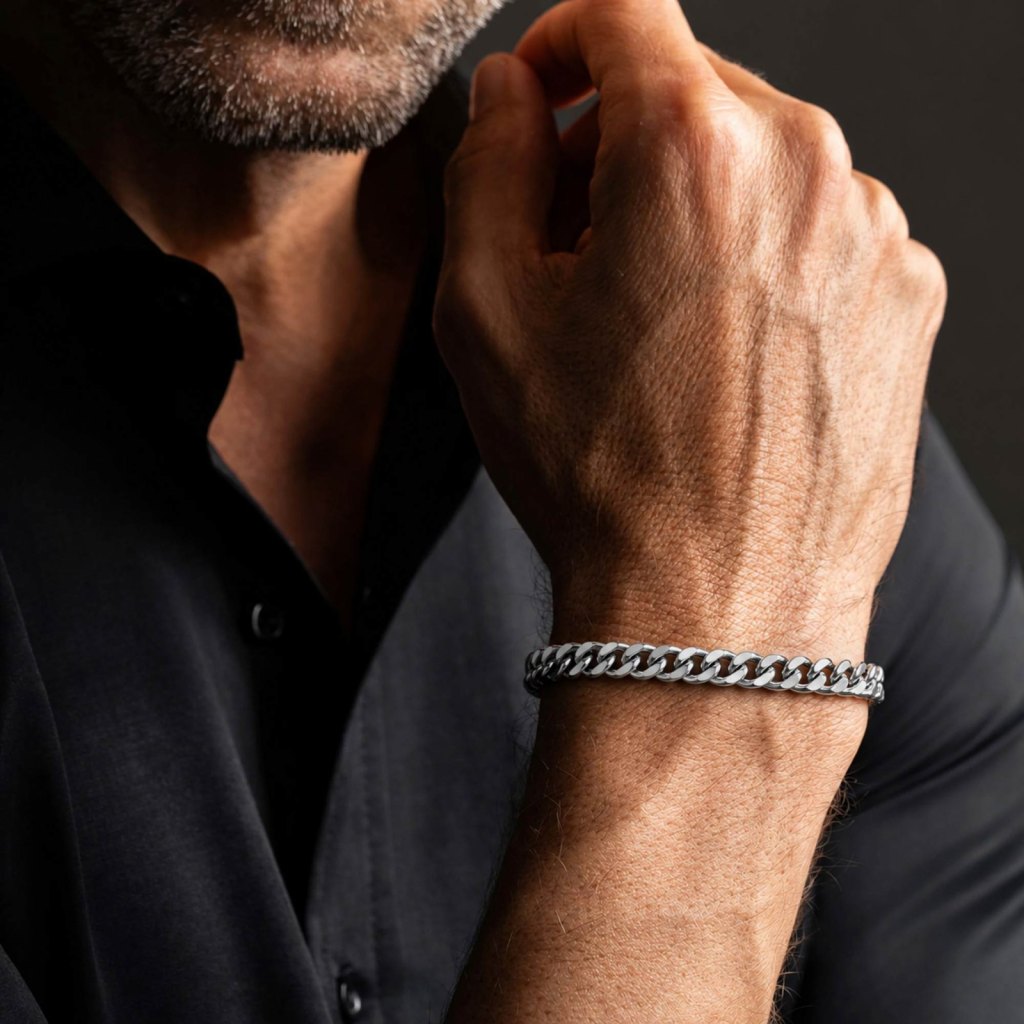
For chain bracelets, our guides to Cuban link bracelets and to foxtail, braided, and Byzantine bracelets cover the main styles.
Which should you buy?
- Buy a chain bracelet if it is your first bracelet, if you want to wear it beside your watch, if you work in buttoned shirt cuffs, or if you want something you can size exactly and repair link by link. A 5 to 7 mm curb or foxtail is the place to start.
- Buy a cuff if you want nothing to fasten, if you wear rolled sleeves and T-shirts more than shirt cuffs, if you are adding a second piece beside a chain, or if you are buying a gift and don’t know the wrist size; our guide to buying a bracelet as a gift covers the rest.
Many men end up with one of each: a chain on most days and a cuff when the sleeves are rolled up, or both together on the wrist without the watch.
Cuffs and chain bracelets at Ronatelli
Examples from Ronatelli’s bracelet collection, at their listed prices. Every cuff is one adjustable size and the brand doesn’t publish inside measurements, so if your wrist is much smaller or larger than average, ask for them before you buy. The chain bracelets come in S (7.1″), M (7.9″), L (8.7″), and XL (9.5″).
| Bracelet | Type | Width | Price |
|---|---|---|---|
| Lugo | TypeHammered cuff, 925 | Width6 mm | Price$249 |
| Milan | TypeTwisted cuff, 925 | Width10 mm | Price$299 (was $329) |
| Basel | TypeEngraved cuff, 925 | Width10 mm | Price$299 |
| Calvi | TypeSculpted winged-cross cuff, 925 | WidthNot listed | Price$349 |
| Turin | TypeEngraved zodiac cuff, 999.9 | WidthNot listed | Price$369 |
| Como | TypeEngraved Aztec cuff, 999 | WidthNot listed | Price$379 |
| Bari | TypeCuban chain | Width5 mm | Price$169 |
| Crein | TypeFoxtail chain | Width6 mm | Price$249 (was $299) |
| Cana | TypeCuban chain | Width7 mm | Price$199 (was $249) |
The Lugo is the everyday cuff: plain, 6 mm, and hammered, so scratches disappear into the texture. The Basel, at 4.7 stars from 19 reviews, is the engraved one, and the Calvi, at 5.0 from 54 reviews, is the best-rated cuff in the collection. On the chain side, the Bari is the classic 5 mm Cuban, and the Crein is the most-reviewed bracelet Ronatelli sells.
FAQ
Is a cuff or a chain bracelet better for men?
Neither is better; they suit different days. A chain is the easier first bracelet and the one to wear beside a watch. A cuff has no clasp, stays where you put it, and suits rolled sleeves.
How should a men’s cuff bracelet fit?
Close but not tight: an inside circumference of your wrist plus ¼″ to ½″, gap included, sitting just above the wrist bone without spinning or pinching.
Can you adjust a sterling silver cuff?
Once, gently. Squeeze or open it a little at a time with even pressure along the band, and stop when it fits. Repeated bending makes sterling brittle, and it eventually cracks.
Do cuff bracelets fall off?
Not if the size is right. A cuff that slides over the wrist bone onto the hand is too big; a smaller size or one gentle squeeze fixes it.
Can you wear a cuff with a watch?
Yes, on the other wrist. On the watch wrist, a cuff knocks against the case, and the silver comes off worse.
Is a 999 fine silver cuff a good idea?
For an occasional piece, yes; it is bright and tarnishes a little more slowly. For daily wear, sterling holds its shape better, because fine silver is much softer and bends and scratches more easily.
Bottom line
If you are buying one bracelet, make it a chain: a 5 to 7 mm curb or foxtail, sized at your wrist plus ¾″ to 1″, works with a watch, under a shirt cuff, and on its own. Add a cuff when you want a piece with no clasp for rolled sleeves, or a second piece beside the chain. Size it by inside circumference, put it on sideways, and adjust it once.
From the collection
Men’s sterling silver bracelets by Ronatelli
Thirty-one handmade 925 bracelets, from a 3.5 mm bamboo link to an 11 mm woven band, in sizes S to XL. Every cuff is adjustable.
Related guides
Fit figures follow our bracelets and size guides. The advice on putting on and adjusting a cuff reflects published guidance from jewelers, including Robinsons Jewelers and Lily Luna, and the point that repeated bending makes sterling brittle is basic metalworking. Ronatelli widths, prices, ratings, and metal grades come from its product pages, checked on October 28, 2026, and may have changed since. Read our editorial policy.

