Disclosure:The example pieces in this guide are from Ronatelli. The meanings are general and apply to any brand. Prices were checked on October 28, 2026.
Most silver bracelets are plain links. The rest carry something: a Greek key cut into every link, a vajra set at the center, a lion, a cross, the signs of the zodiac. These motifs are far older than the bracelets they decorate, and some still mean a great deal to the people they come from. This guide explains what each one is, where it comes from, and how it reads on a man’s wrist, then how to wear a statement bracelet so it looks chosen rather than loud.
Key takeaways
- Some motifs are symbols; others are ornament. A vajra, a cross, or a zodiac sign says something. Scrollwork, chevrons, and snake scales are pattern.
- The Greek key is the easiest to wear. It is a border from ancient Greek art, and it reads as geometry before it reads as anything else.
- A vajra is a ritual object in Tibetan Buddhism, and a cross is a statement of faith. Wear either knowing what it says.
- Wear one statement piece at a time, on the wrist without your watch, with plain clothes around it.
- Fit a centerpiece bracelet snug, so the medallion stays on top of the wrist instead of sliding to the side.
In this guide Symbol or ornament Greek key Vajra Lion Cross Zodiac Pattern How to wear one Examples FAQ
Symbol or ornament: reading a statement bracelet
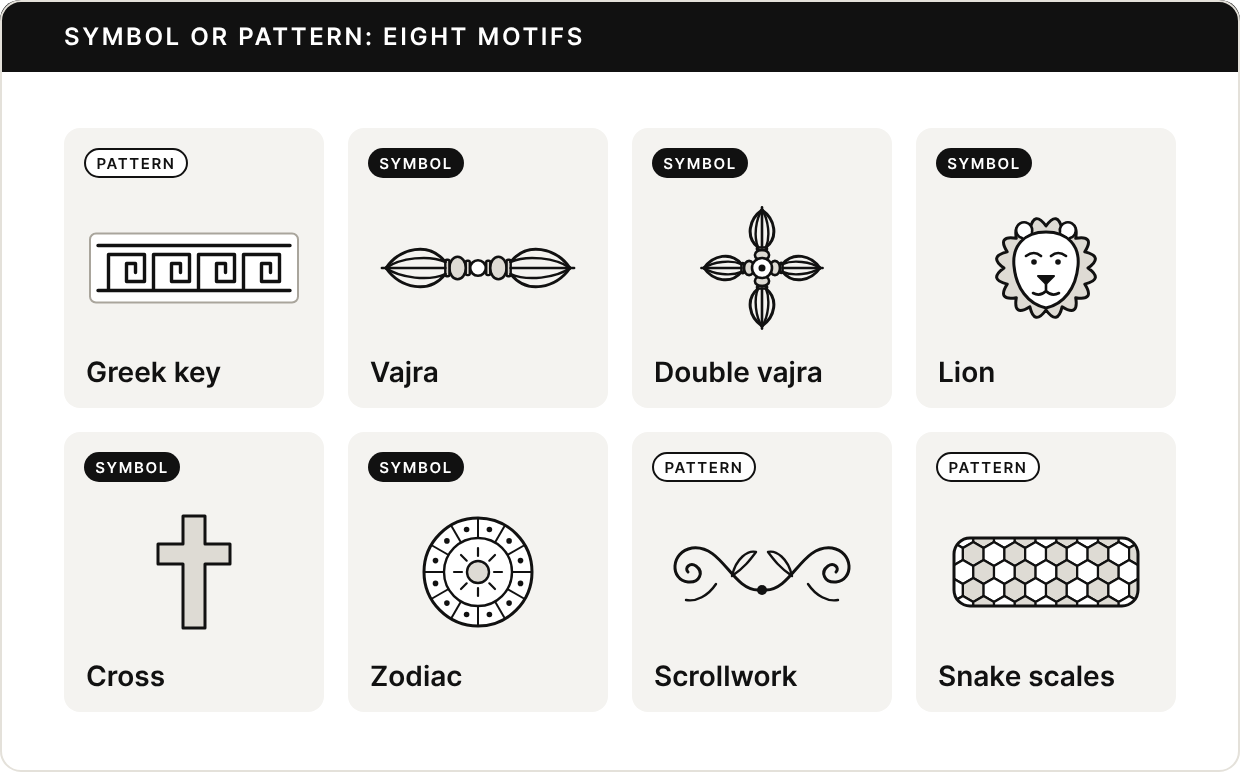
Before choosing one, it helps to know which kind of motif you are looking at. Some carry a meaning that other people will read: a cross is a statement of faith, a vajra is a Buddhist ritual object, a zodiac sign points to a birthday. Others are ornament with a long history and no fixed message, such as the Greek key, scrollwork, chevrons, and snake scales. Both kinds are fine to wear. The first kind just asks you to know what you are saying.
| Motif | Where it comes from | How it reads today |
|---|---|---|
| Greek key | Where it comes fromAncient Greek pottery and temples, from about 900 BC | How it reads todayOrder and continuity; pattern first |
| Vajra | Where it comes fromHindu and Buddhist ritual; the emblem of Vajrayana Buddhism | How it reads todayStrength that can’t be broken; sacred to Buddhists |
| Lion | Where it comes fromAncient royal imagery; European heraldry from the 12th century | How it reads todayCourage, strength, leadership |
| Cross | Where it comes fromChristianity | How it reads todayFaith |
| Zodiac | Where it comes fromBabylonian astronomy, with twelve signs by 419 BC | How it reads todayA birth sign, or the sky as a whole |
| Scrollwork, scales, chevrons | Where it comes fromClassical and folk ornament | How it reads todayTexture and craft; no fixed message |
The Greek key: one unbroken line
The Greek key, also called the meander, is a border drawn from a single continuous line that turns back on itself at right angles, over and over. The name comes from the Maeander, a winding river in what is now western Turkey, where it is called the Büyük Menderes. The pattern runs around Greek pottery from the Geometric period, roughly 900 to 700 BC, and later around the friezes of temples. Similar key patterns also appear on Chinese bronzes of the Shang dynasty and in Mesoamerican art.
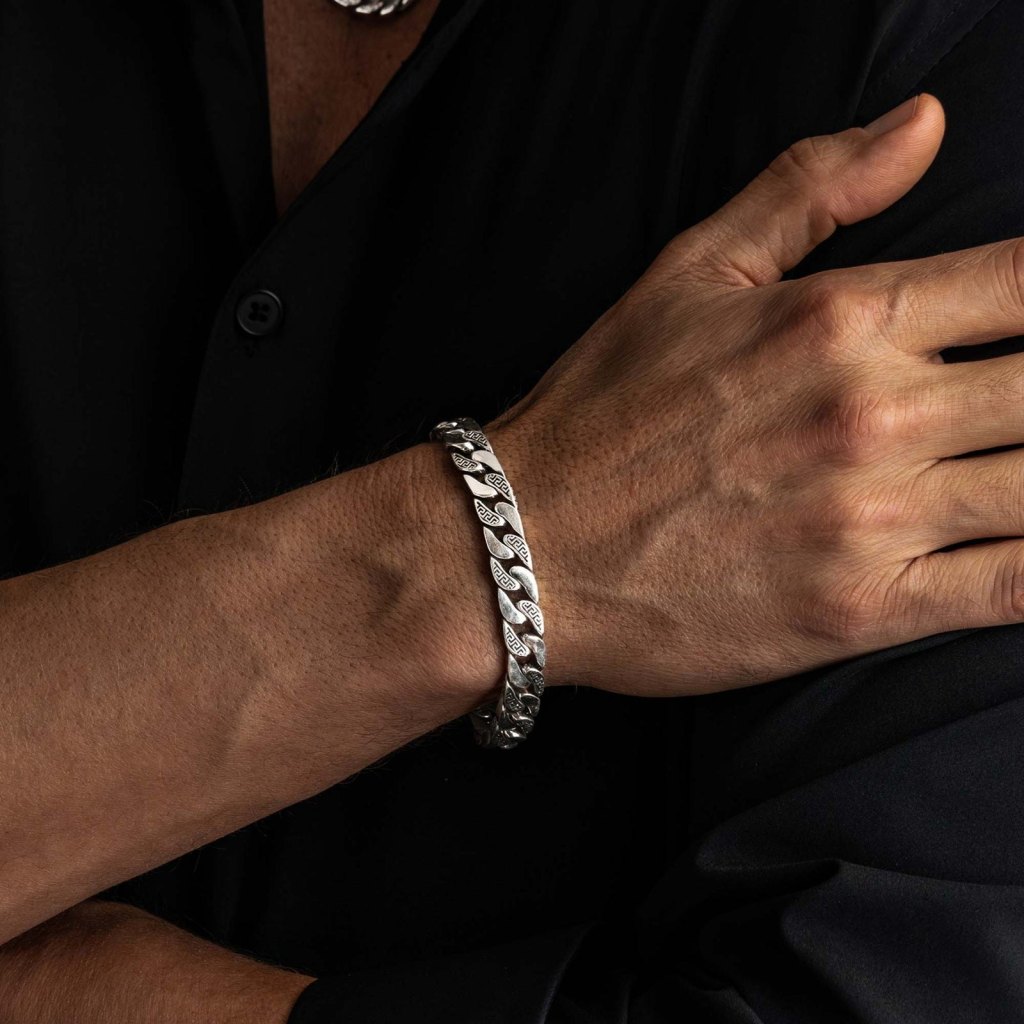
Scholars have linked the pattern to the river and to the labyrinth, and jewelers today often call it a symbol of eternity or unity, because the line never breaks. Take those as readings rather than a fixed meaning. On a bracelet, the Greek key reads first as precise geometry, which is why it is the easiest statement motif to wear to an office. Ronatelli’s Athena has the key engraved and darkened on every curb link and on the clasp.
The vajra: thunderbolt and diamond
Vajra is a Sanskrit word with two meanings, thunderbolt and diamond: a force nothing can stop and a stone nothing can break. It began as the thunderbolt of Indra, the Hindu god of rain and storms, and became the emblem of Vajrayana Buddhism, the form of Buddhism practiced in Tibet and across the Himalayas; in Tibetan it is called dorje. As a ritual object it is a short scepter with prongs that curve into a point at each end. In ceremonies it is held in the right hand and paired with a bell in the left; Britannica describes the two together as the male and female principles whose union leads to enlightenment.
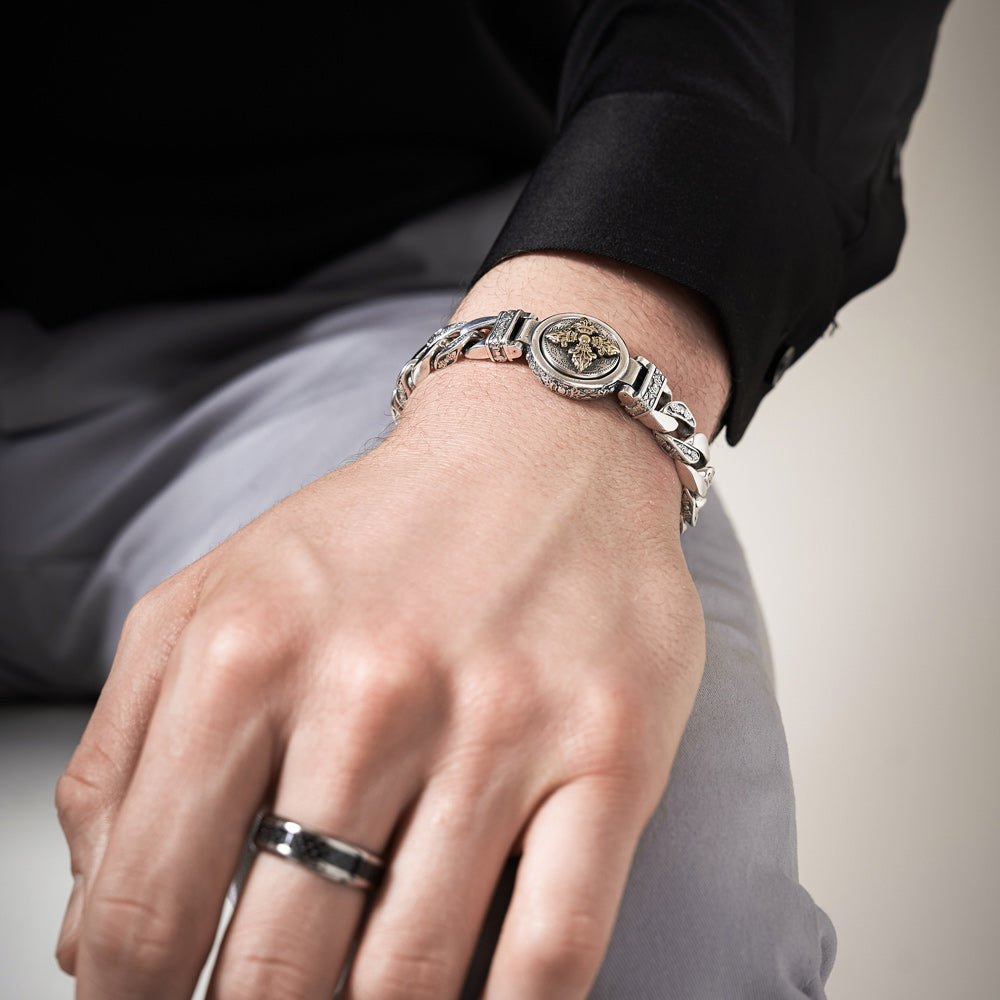
A double vajra, two crossed at right angles, is a related emblem. Museum collections describe it as a symbol of protection, the four directions, and the foundation of the physical world. Ronatelli’s Zeus carries a gold-accented double vajra on its center medallion, the Poseidon a single gold-accented vajra on an engraved plate, and the Basel cuff vajra motifs in an oxidized band, edged with script the brand describes as Sanskrit.
To Tibetan Buddhists, the vajra is a ritual object rather than a design. One Buddhist writer’s rule of thumb is that a modest piece worn with respect is fine, while sacred images worn purely as fashion, or low on the body on socks or shoes, are not. If you wear a vajra, treat it the way you would a cross: as a piece you chose for what it stands for.
The lion: courage and rank
The lion has stood for power for thousands of years. In European heraldry it has been one of the most common charges since coats of arms first appeared in the 12th century, and it traditionally stands for courage, strength, nobility, and royalty. It is also the sign of Leo, for birthdays from late July to late August. On a bracelet, a lion is the most outspoken motif in this guide: it reads as confidence, and it suits a man who is comfortable being noticed.
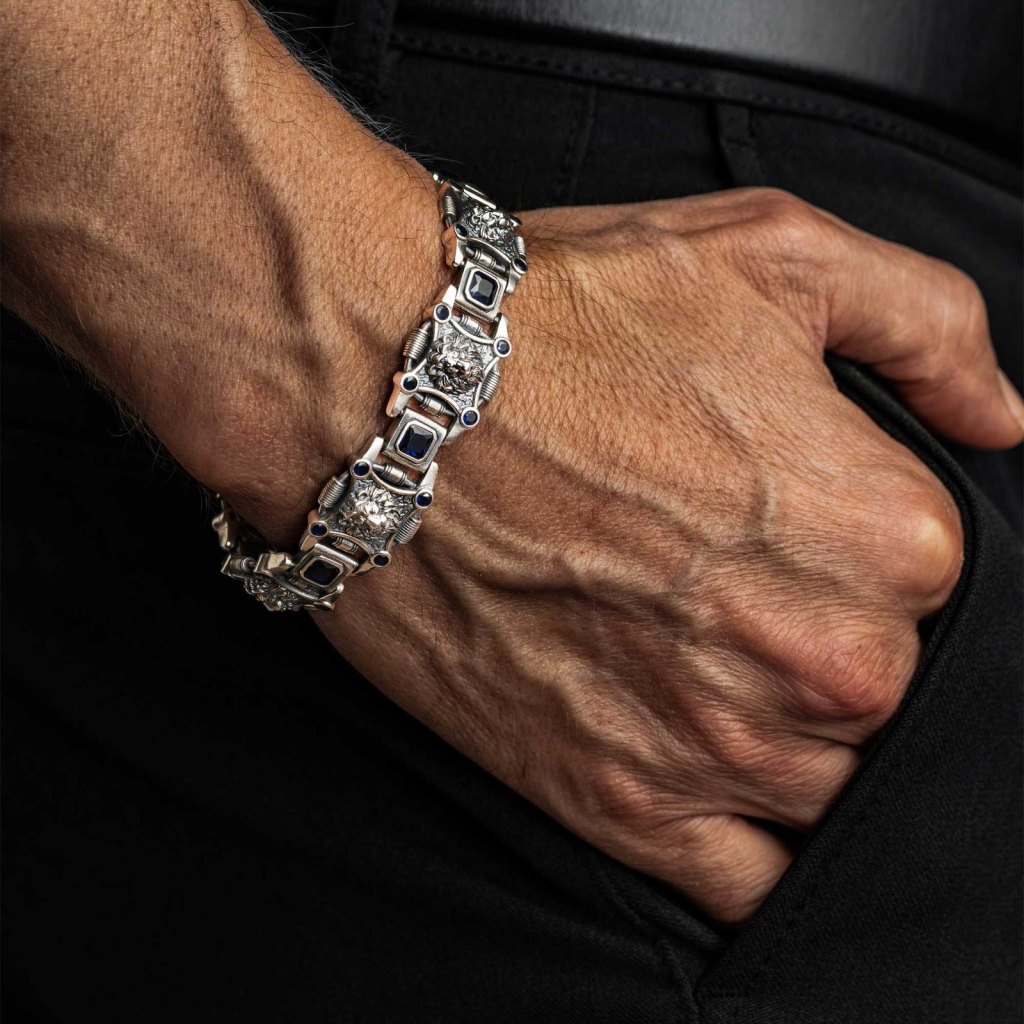
Ronatelli’s Leo sets sculpted lion heads between deep blue stones and scrollwork panels on an 18 mm band, the widest bracelet in the collection. The Magnus puts a single lion medallion at the center of a woven band, which makes it the quieter of the two.
The cross, with or without wings
A cross is the central symbol of Christianity, and whatever surrounds it, most people will read it as a statement of faith. For a man who shares that faith, that is the point. For one who doesn’t, it is worth knowing before he buys one, or before you buy one for him. Ronatelli’s Calvi sets a gold-accented cross between two sculpted wings on a cuff; the wings add drama, but the cross is what people will read.
The zodiac: twelve signs from Babylon
The twelve signs of the zodiac come from Babylonian astronomy. A Babylonian text from 419 BC is the earliest known list of all twelve, and Greek astronomers took them over from there. A single sign is personal, a birthday worn on the wrist. All twelve together, as on Ronatelli’s Turin cuff, read as a band of old astronomy rather than a statement about one person, which makes the Turin an easier gift: it doesn’t depend on knowing his sign. It is made of 999.9 fine silver, which is softer than sterling, so our guide to cuffs and chain bracelets is worth a read before you adjust it.
Pattern, not message: scrollwork, scales, chevrons, and stamps
- Scrollwork. Curling foliage engraved into the links, descended from the leaf scrolls of classical architecture. Ornament with a long pedigree and no fixed meaning; the Fulda and the Krun are the plainest examples.
- Snake scales. Hexagonal plates set like a snake’s skin, as on the Roma and the Ruvo. A texture first: the band moves like a second skin and catches light on every facet.
- Chevrons. Repeating V shapes, an ancient geometric pattern. On the Arno and the Vulcan, the recesses are darkened so the pattern reads sharply.
- Stamped marks. Ronatelli calls its Como cuff Aztec, a style label. The stamps on it are suns, fish, chevrons, and dots, simple marks found in folk ornament in many places. The stepped fret, a common motif in Aztec and other Mesoamerican art and a close cousin of the Greek key, isn’t among them, so read the Como as pattern.
- Dragons. The Ladon is named after the dragon of Greek myth that guarded the golden apples of the Hesperides until Heracles killed it. Its links are spear points and curves rather than a dragon you can see.
How to wear a statement bracelet
A statement bracelet does the work a whole stack would do, so the rules are mostly about giving it room.
- One at a time. Wear it alone, or beside one slim, plain chain at most, on the wrist without your watch. Two patterned bracelets compete, and neither wins. Our guide to stacking bracelets covers the plain partners that work.
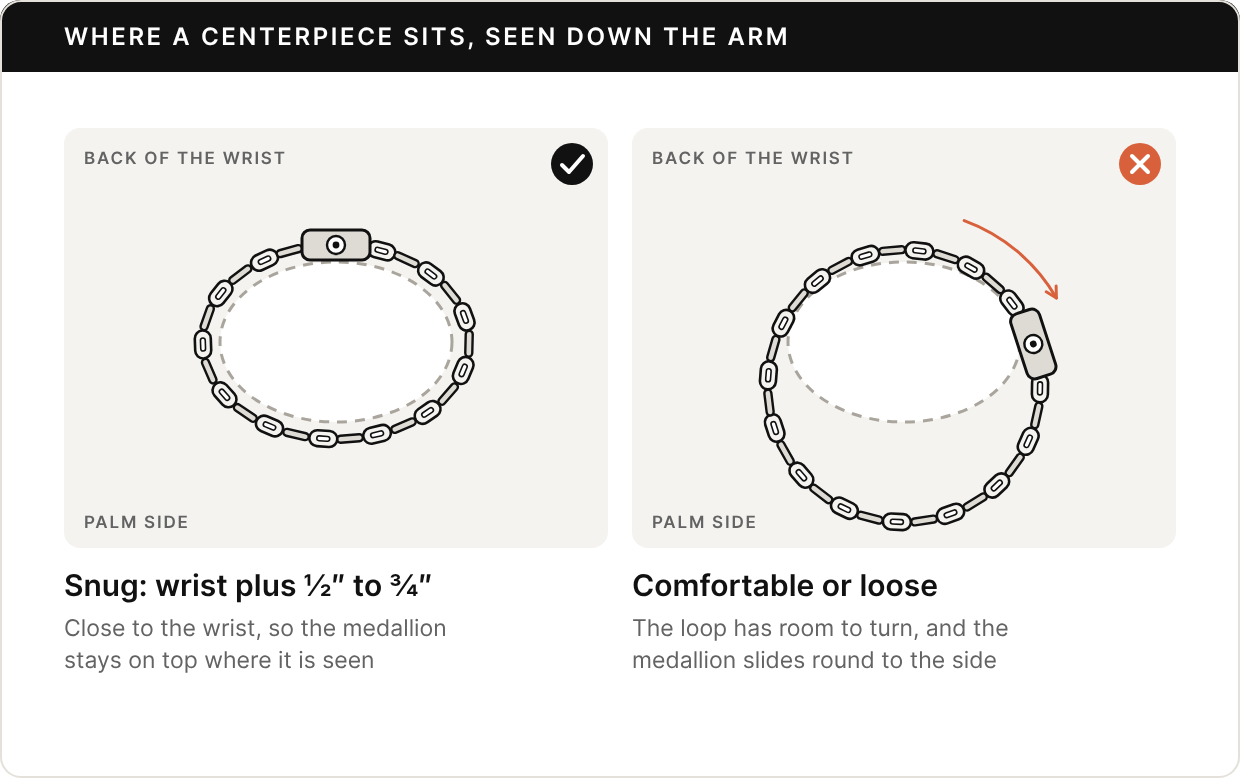
- Fit a centerpiece snug. A medallion or a plate should sit on top of the wrist. At a comfortable fit it slides around to the side; at a snug fit, your wrist plus ½″ to ¾″, it stays up. Wide bands take room on the inside, so add the usual ¼″ for anything over 8 mm; our bracelet size guide has the chart.
- Keep the clothes plain. A Greek key or a lion carries a dark shirt or a plain T-shirt. Beside a busy print or a big logo, it disappears.
- Let one accent lead. Several of these pieces have gold-accented details. They sit best with silver everywhere else and a steel watch on the other wrist; see our guide to wearing a bracelet with a watch.
- Clean around the detail. The dark finish in engraving is applied on purpose, and Ronatelli doesn’t say how its gold accents are applied, so treat both like a surface finish: warm, soapy water, a soft brush, and a polishing cloth on the high points only, with no dips and no foil bath. Keep stone-set pieces like the Leo out of hot water. Our cleaning guide has the details.
Statement bracelets at Ronatelli
Examples from Ronatelli’s bracelet collection, at their listed prices. The chain bracelets come in S (7.1″), M (7.9″), L (8.7″), and XL (9.5″); the cuffs are one adjustable size.
| Bracelet | Motif | Width | Price |
|---|---|---|---|
| Athena | MotifGreek key on every curb link | Width9 mm | Price$399 |
| Zeus | MotifGold-accented double vajra medallion, curb chain | Width11 mm | Price$539 |
| Poseidon | MotifGold-accented vajra plate, Byzantine chain | Width11 mm | Price$499 |
| Basel | MotifVajra motifs and script, cuff | Width10 mm | Price$299 |
| Leo | MotifLion heads and blue stones | Width18 mm | Price$439 |
| Magnus | MotifLion medallion, woven band | Width11 mm | Price$499 |
| Calvi | MotifGold-accented cross between wings, cuff | WidthNot listed | Price$349 |
| Turin | MotifAll twelve zodiac signs, 999.9 cuff | WidthNot listed | Price$369 |
| Como | MotifStamped suns, fish, and chevrons, 999 cuff | WidthNot listed | Price$379 |
For a first statement piece, the Athena goes with the most: geometric, darkened, and on a 9 mm curb chain that wears like any other. The Calvi has the strongest review record of the group, 5.0 stars from 54 reviews, and the Poseidon follows at 4.9 from 33. The Leo is the boldest bracelet in the collection, and the one to wear entirely on its own.
FAQ
What does the Greek key mean on a bracelet?
It is an ancient Greek border pattern named after the winding Maeander river. Jewelers often describe it as a symbol of eternity or unity because the line never breaks, but on the wrist it reads first as geometry.
What does a vajra bracelet mean?
The vajra, Sanskrit for both thunderbolt and diamond, is the emblem of Vajrayana Buddhism and stands for a strength that can’t be broken. A double vajra, two crossed, is associated with protection and stability.
Is it disrespectful to wear a vajra if you aren’t Buddhist?
It depends on how you wear it. The vajra is a ritual object to Tibetan Buddhists, so wear it as a piece you chose for its meaning rather than as a novelty. A bracelet is a respectful place for it; socks and shoes are not.
What does a lion bracelet symbolize?
Courage, strength, and leadership. The lion has been a symbol of royalty for thousands of years and is one of the most common emblems in heraldry; it is also the sign of Leo.
Can you wear a cross bracelet if you aren’t religious?
You can, but most people will read a cross as a statement of faith, wings or no wings. If that isn’t what you want to say, a Greek key or a plain engraved piece says less.
Can you wear a statement bracelet with a watch?
Yes, on the other wrist. A wide or patterned bracelet beside a watch crowds both, and the watch case scratches the silver.
Bottom line
Know what your bracelet says before you wear it. A Greek key, scrollwork, or snake scales read as pattern and go almost anywhere. A vajra, a cross, or a zodiac sign carries a meaning, so choose one you mean. A lion says confidence. Whichever you pick, wear it alone on the wrist without your watch, fit a centerpiece snug so it stays on top, and keep the dark detail out of dips and foil baths.
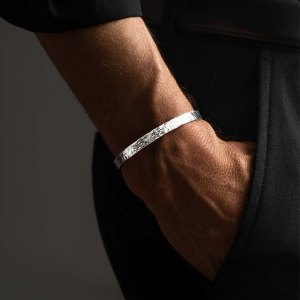
From the collection
Men’s sterling silver bracelets by Ronatelli
Thirty-one handmade 925 bracelets, from a 3.5 mm bamboo link to an 11 mm woven band, in sizes S to XL. Every cuff is adjustable.
Related guides
Origins and meanings follow Britannica (vajra), the Bowers Museum’s collection notes (double vajra), the University of Hamburg’s Centre for the Study of Manuscript Cultures (the Babylonian zodiac), Theoi Greek Mythology (Ladon), and standard references on the meander, the stepped fret, and the heraldic lion; the note on wearing Buddhist imagery reflects published guidance from a Buddhist writer. Ronatelli motifs come from its product pages and photos, and its widths, prices, and ratings from its product pages, checked on October 28, 2026. Read our editorial policy.

