Disclosure:The pairings in this guide use one brand’s chains as examples. Widths, lengths, and prices were read from ronatelli.com on October 28, 2026; the advice applies to any brand.
Layered chains look deliberate when each one has its own place: its own height on the chest, its own width, and its own texture. Two chains are the easy start, and three are as many as most men can wear without the stack turning into a tangle. Four rules cover almost every case: keep the lengths at least 2 inches apart, put the thinner chain on top, give a pendant the longest chain, and stick to one metal. This guide explains each one, shows which lengths and widths go together, and ends with five pairings built from one brand’s collection, with the lengths and the price together.
Key takeaways
- Two chains, or three at most: one should lead and the others support it.
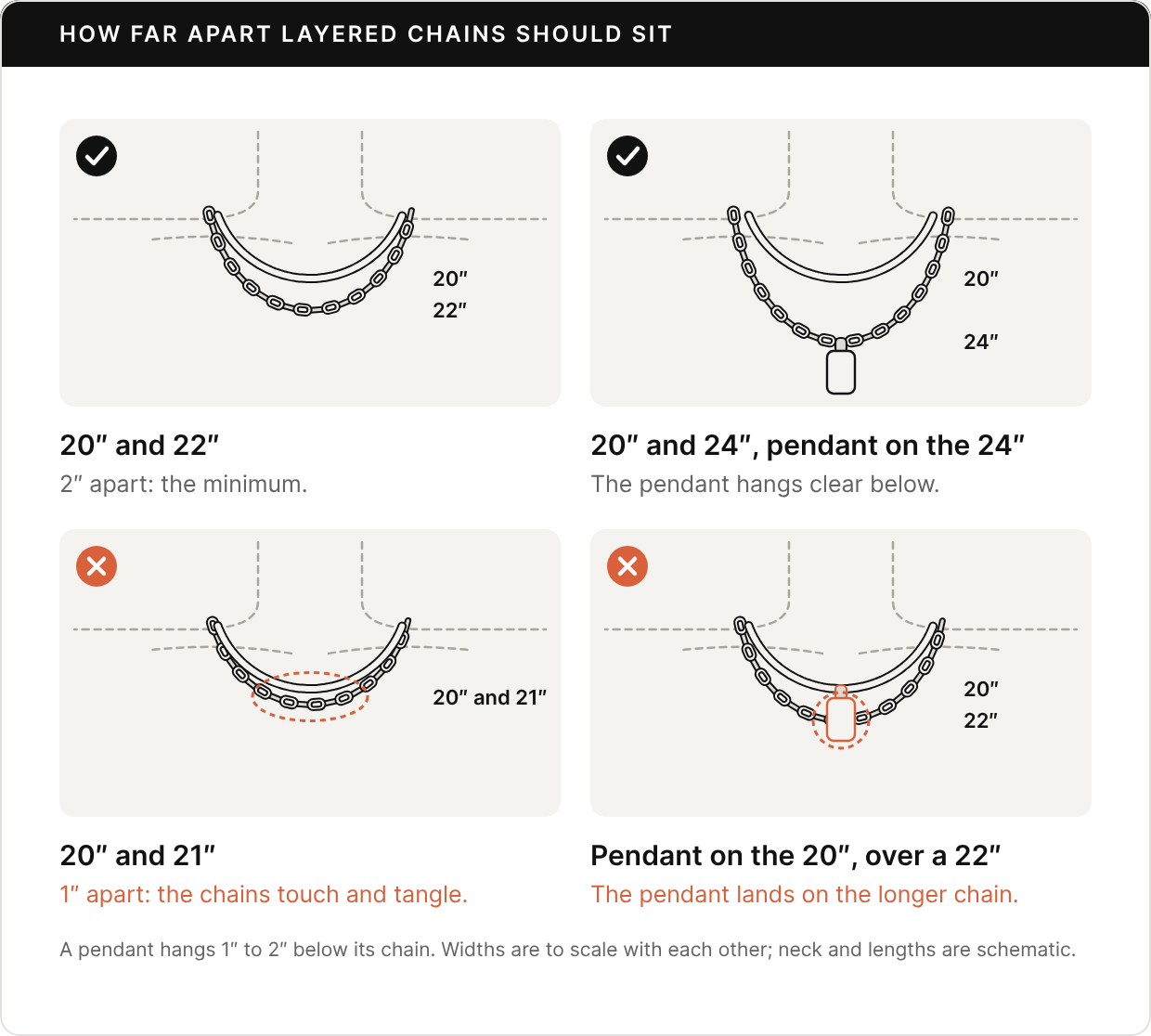
- At least 2″ apart: 20″ and 22″, or 20″ and 24″; for three, 20″, 22″, and 24″. Chains 1″ apart touch and tangle.
- Thinner on top, heavier below: the shorter chain is the slimmer one, one to three millimeters narrower.
- A pendant goes on the longest chain, because it hangs 1″ to 2″ below its own chain and would land on a longer one.
- Mix textures, not metals: pair a smooth chain with a textured one, all in silver.
In this guide How many Lengths Widths and textures Pendant Necklines Tangling Pairings FAQ
Two chains, or three
Start with two. A pair is easy to get right, works with a T-shirt or an open collar, and is the version most men keep wearing. A third chain works when each one still has a clear role: a fine chain close to the neck, a main chain below it, and a longer or heavier one at the bottom. Beyond three, the chains start to compete, and the stack reads as a costume rather than as jewelry. Whatever the number, let one chain lead, usually the widest or the one with a pendant, and keep the others quieter.
Lengths: at least 2 inches apart
Layered chains work when they don’t touch. Keep 2″ to 4″ between lengths so each chain sits at its own height: 20″ and 22″ is the closest pair that works, and 20″ and 24″ is the classic. For three chains, 20″, 22″, and 24″ is the usual spacing, or 18″, 22″, and 26″ where 18″ is sold. Chains 1″ apart sit on top of each other and tangle within the day. Our chain length guide shows where each length sits for your neck size.
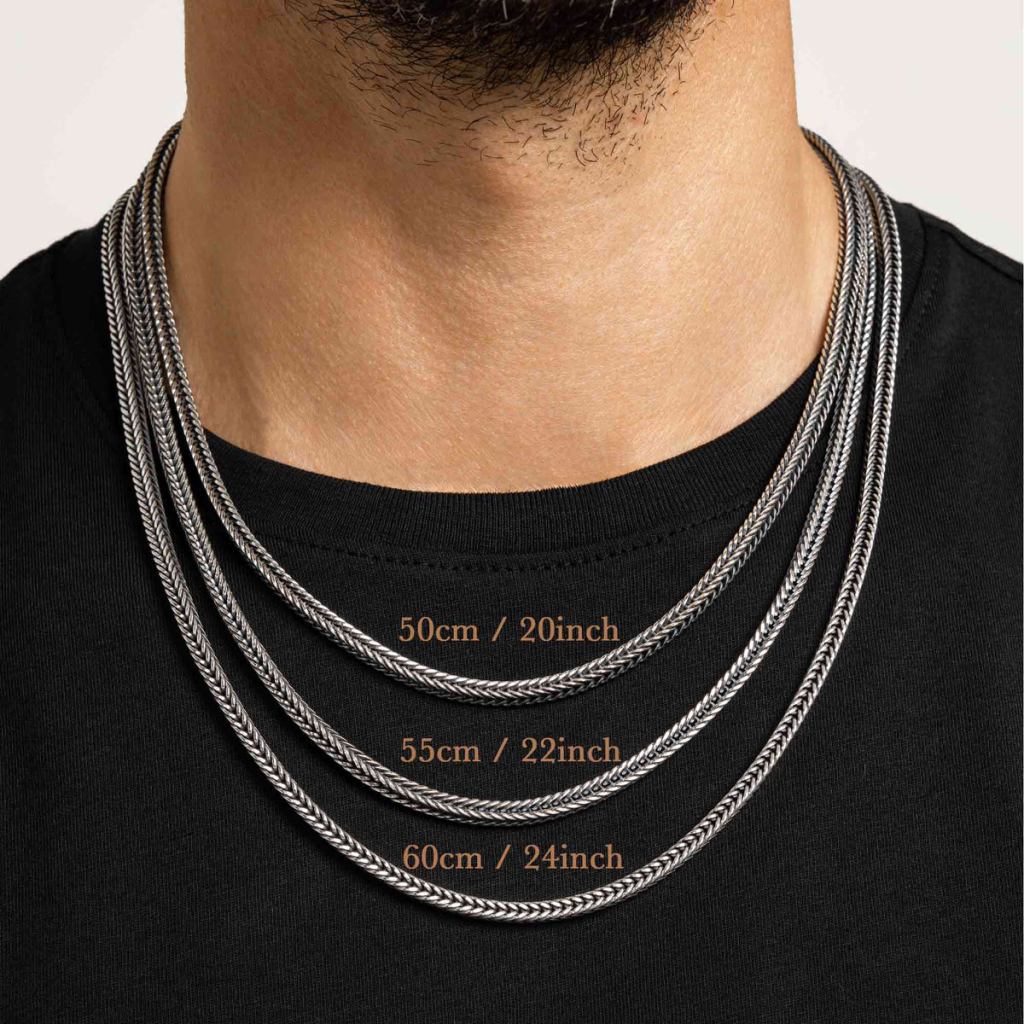
Most men’s chains come in 2″ steps, which makes the spacing easy: buy two sizes apart for a pair that reads clearly as two chains, or one size apart for a tighter stack. Ronatelli’s size guide gives the same minimum, at least 2″ between layered chains, and its size photos show what that looks like on one neck.
Widths and textures: thinner on top
Vary the width as well as the length. Put the thinner chain on top and the heavier one below, one to three millimeters wider: a 2 mm chain over a 4 mm one, or a 3 mm over a 5 mm. A heavy chain above a fine one buries it, and two chains of the same width read as one chain worn twice. Different widths also tangle less than two chains of the same weight.
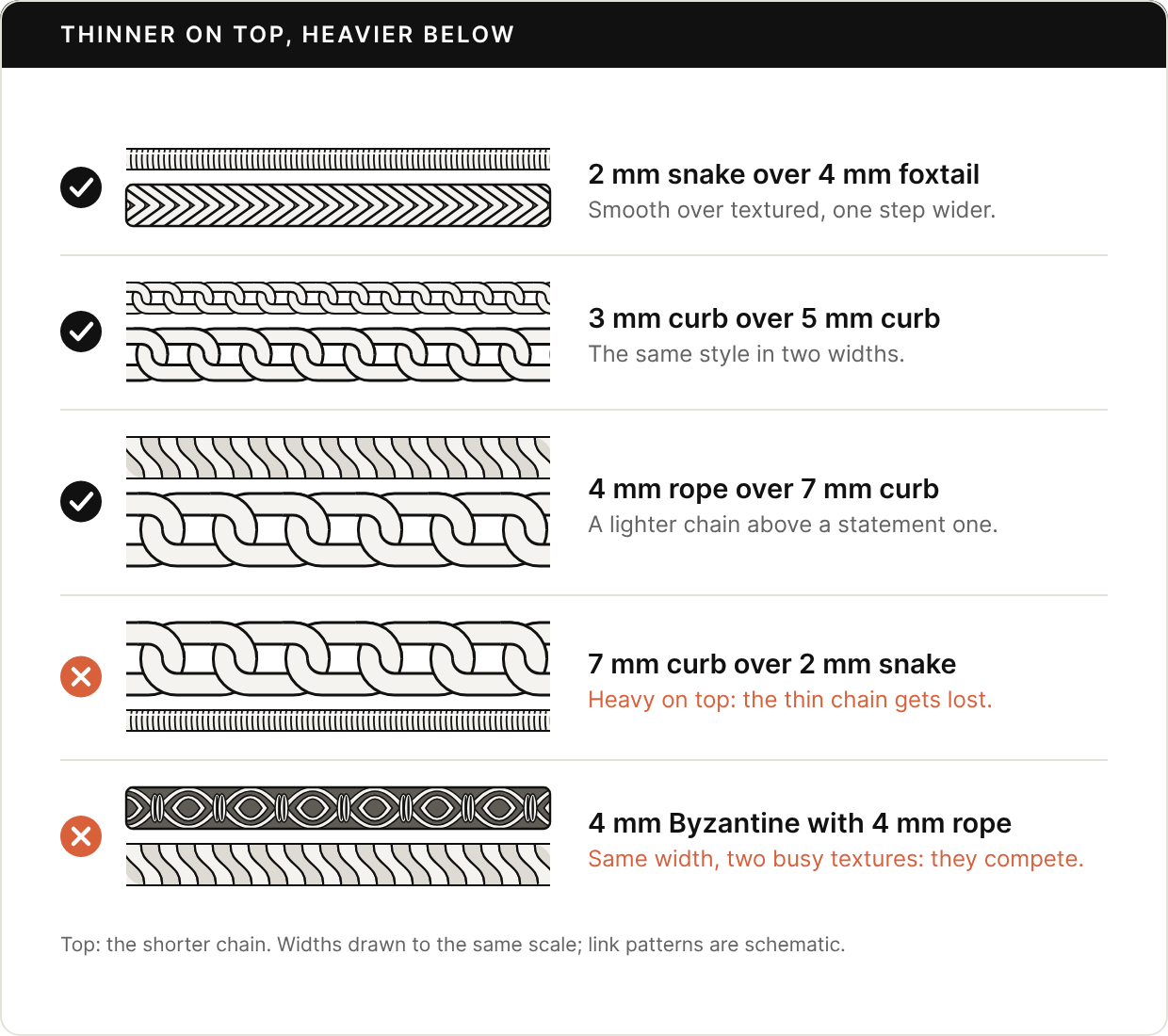
Keep the styles related but not identical. A smooth chain over a textured one is the safest contrast, such as a snake or box chain over a foxtail, rope, or curb. The same style in two widths, such as a 3 mm curb over a 5 mm curb, also works. Avoid two busy textures together, such as a Byzantine with a rope: they compete for attention. Stick to one metal: chains in the same silver tarnish and polish the same way, so the stack stays even. Our chain styles guide shows how each pattern looks.
Where the pendant goes
A pendant hangs 1″ to 2″ below the chain it is on. Put it on a 20″ chain over a 22″ one, and the pendant lands right on the longer chain. The simple fix is to hang it from the longest chain, so it sits clear below the others. If you want it on the shorter chain, leave at least 4″ to the next one, for example a pendant on 20″ over a plain 24″ chain. Wear one pendant per stack; two pendants close together look cluttered and knock against each other. Our guide to the best chain for a pendant covers the chain width and style that carry one.
Layering by neckline
| Neckline | Layer | Why |
|---|---|---|
| Crew-neck T-shirt | Layer20″ and 22″ or 24″ | WhyThe 20″ sits at the neckline and the longer chain over the shirt, so both show. |
| Open collar, one or two buttons | Layer20″ and 22″, both slim | WhyBoth chains show in the opening without fighting the collar. |
| V-neck or henley | Layer20″ and 24″, pendant on the 24″ | WhyThe pendant fills the V, and the shorter chain frames it. |
| Dress shirt and tie | LayerOne 20″ chain, no layering | WhyAnything longer than 20″ risks showing at the placket. |
| Over a hoodie or jacket | Layer24″ and 26″, heavier widths | WhyLonger, wider chains clear the neckline and hold their own against the fabric. |
How to keep layered chains from tangling
- Keep the gap. 2″ between plain chains, and more when a pendant is involved.
- Vary the weight. Two chains of the same width and weight tangle more easily than a fine chain with a heavier one.
- Put them on shortest first, and take them off in the same order.
- Stagger the clasps. Turn them to slightly different points at the back rather than lining them all up at the nape.
- Mind the fabric. Chains slide around more on smooth, slippery shirts than on cotton.
- Consider a layering clasp, a multi-strand connector that holds two or three chains apart at the back.
- Store them separately, laid flat with the clasps closed. If two do knot, lay them flat and ease the knot apart with a pin; pulling only tightens it.
Five pairings from one brand’s collection
Ronatelli sells ten men’s chains, from a 2 mm snake chain to a 7 mm curb, in 20″, 22″, 24″, and 26″ (the Monza in 24″ and 26″ only), and every length costs the same. These pairings follow the rules above; our comparison of all ten Ronatelli chains covers each one.
| Pairing | Chains and lengths | Price together |
|---|---|---|
| A quiet pair | Chains and lengthsFuli 2 mm snake at 20″, Sergo 4 mm foxtail at 22″ | Price together$478 |
| The everyday pair | Chains and lengthsAlfo 3 mm bamboo at 20″, Duomo 4 mm cable at 24″ | Price together$548 |
| With a pendant | Chains and lengthsFuli at 20″, Monza 4 mm rope at 24″ carrying the pendant | Price together$398, plus the pendant |
| A statement pair | Chains and lengthsSergo at 20″, Cana 7 mm curb at 24″ | Price together$828 |
| Three chains | Chains and lengthsFuli at 20″, Sergo at 22″, Parma 6 mm twisted at 24″ | Price together$807 |
Each pairing keeps the thinner chain on top, at least 2″ between lengths, and one smooth or plain chain against a textured or heavier one. The Fuli and the Sergo are the easiest pair to start with: the snake chain is slim and smooth, the foxtail is textured, and together they cost less than the Cana on its own.
FAQ
How many chains should a man layer?
Two is the easy start, and three is as many as most men can wear without the chains competing. Let one chain lead and keep the others quieter.
How far apart should layered chains be?
At least 2 inches, and 2 to 4 inches is the usual range: 20 and 22 inches, or 20 and 24. Leave 4 inches or more when the shorter chain carries a pendant.
Should layered chains be the same width?
No. Put the thinner chain on top and the heavier one below, one to three millimeters wider, such as a 2 mm chain over a 4 mm one.
What lengths are best for layering?
For two chains, 20 and 22 inches or 20 and 24. For three, 20, 22, and 24 inches, or 18, 22, and 26 where 18 is sold.
Where does the pendant go when you layer chains?
On the longest chain. A pendant hangs 1 to 2 inches below its chain, so on a shorter chain it would land on the next one.
How do I stop layered chains from tangling?
Keep at least 2 inches between them, mix widths, put them on shortest first, and stagger the clasps at the back. A layering clasp holds them apart.
Bottom line
Start with two chains, 20″ and 22″ or 20″ and 24″, with the thinner chain on top and a smooth chain against a textured one. Add a third only if each chain keeps its own height and role, hang a pendant from the longest chain, and keep everything in silver. If the stack tangles or looks busy, take one chain off rather than adding another.



From the collection
Men’s sterling silver chains by Ronatelli
Ten handmade 925 chains, from a 2 mm snake chain to a 7 mm curb, in 20 to 26 inches. Every length is the same price.
Related guides
Widths, lengths, prices, and the 2-inch layering minimum were read from ronatelli.com product pages and its size guide on October 28, 2026, and may have changed since. The tangling and storage tips follow Tanishq’s and Struga’s layering guides; length positions follow our chain length guide. Read our editorial policy.

