Disclosure:This guide uses one brand’s pendants and chains as worked examples. Weights, fits, and prices were read from ronatelli.com on October 28, 2026; the advice applies to any brand.
For most pendants, the right chain is a 3 to 4 mm box, franco, wheat, rope, or foxtail chain, about 22 inches long, with a lobster clasp. Three checks decide the details: the chain has to go through the pendant’s bail, it has to be strong enough for the pendant’s weight, and it has to put the pendant where you want it on your chest. This guide takes them in that order, then covers the chain styles that carry a pendant and the ones that fight it, the clasp, and, as a worked example, how one brand’s pendants pair with its chains.
Key takeaways
- Bail first: the bail’s opening has to clear the widest part that passes through it, usually the clasp, with about 1 mm to spare.
- Width follows weight: 2 to 2.5 mm for a small charm under 6 g, 3 mm up to about 12 g, and 4 mm for anything heavier.
- Smooth, dense chains carry a pendant best: box, franco, and wheat, then rope, foxtail, and curb. Skip snake and herringbone.
- Length: a pendant hangs 1″ to 2″ below the chain, so 22″ suits most men and 24″ a large pendant or a broad build.
- Clasp: a lobster clasp, or a box clasp with a safety latch on a wide chain. A spring ring only suits a small charm on a fine chain.
In this guide Bail fit Width and weight Chain styles Length Clasp Ronatelli pairings FAQ
Bail fit: will the chain go through?
The bail is the loop at the top of a pendant that the chain runs through, and its inside opening decides which chains can carry it. You thread the chain through once, end first, so what has to fit is the widest part that passes through the bail: usually the clasp, which is often wider than the chain itself. You only need one end to go through, so if the clasp is too big, try the ring at the other end.
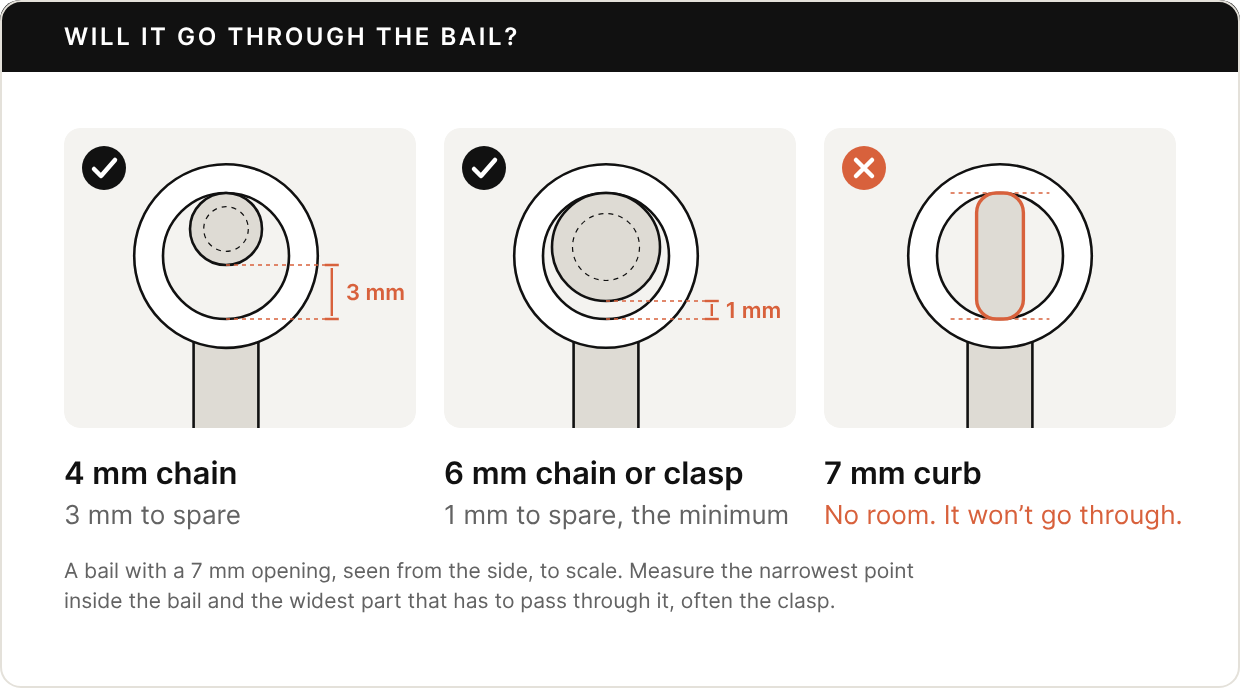
Leave about 1 mm between that widest part and the inside of the bail. A chain that only just squeezes through rubs the bail every time it moves and makes the pendant hard to slide to the center. Measure the opening at its narrowest point with a caliper or a millimeter ruler, or use the fit the listing gives: Ronatelli, for example, lists the same fit for all nine of its pendants, chains up to 6 mm. Too much room is a smaller problem, but a large bail on a thin chain lets the pendant slide and turn. Our chain buying guide covers clasps and end links in more detail.
Width: match the chain to the pendant’s weight
A thin chain under a heavy pendant stretches, kinks at the bail, and eventually breaks; it is one of the most common mistakes in our chain buying guide. The pendant’s weight in grams is the number to match. Many listings give it, and a kitchen scale will if not. A US quarter weighs 5.67 g, which makes a handy reference: a 12 g pendant weighs about as much as two quarters.
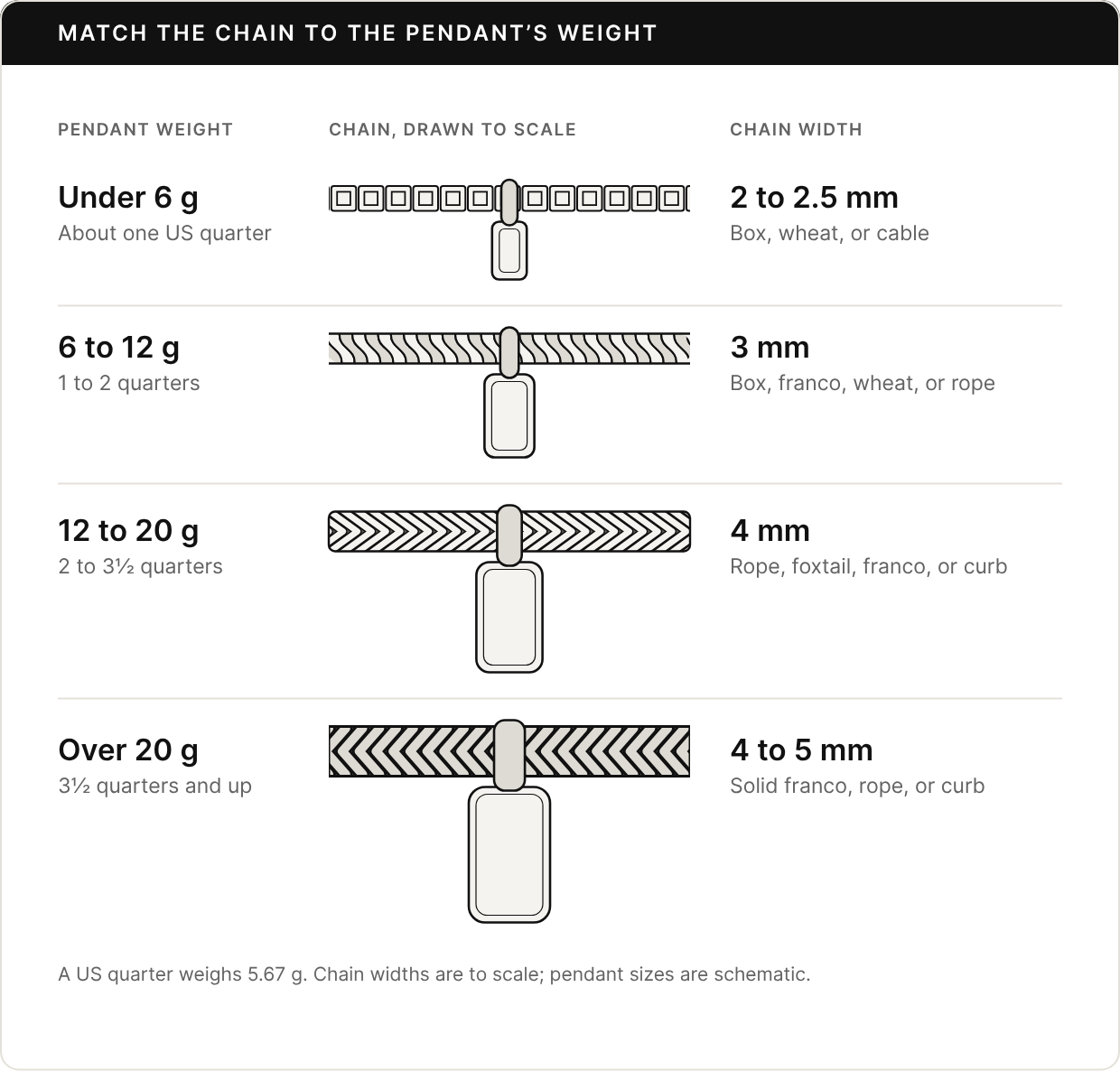
The first two bands follow published retailer guidance: about 6 g for a 2.5 mm chain, and up to about 12 g for a 3 mm box chain. Above that, step up to 4 mm. Men’s pendants are often heavier than they look; Ronatelli’s weigh 12 to 25 g where it lists a weight, which puts every one of them on a 4 mm chain.
The look follows the same logic. A large cross on a 2 mm chain looks precarious, and a 7 mm curb swamps a small charm. Choose the width for the weight first, then go one step wider if the pendant is large and you want the chain to show.
Chain styles: which ones carry a pendant
A pendant chain has two jobs: let the bail slide to the center, and keep the pendant facing forward. Smooth, dense chains do both. Open links let a pendant turn, and textured or very smooth chains fight the bail in other ways.
| Style | With a pendant | Why |
|---|---|---|
| Box | With a pendantExcellent | WhySmooth square links: the bail slides freely and the pendant stays facing forward. The classic pendant chain. |
| Franco | With a pendantExcellent, even heavy pendants | WhyDense V-shaped links, very strong and heavy for its width. |
| Wheat (spiga) | With a pendantExcellent | WhySmooth and braided, and it resists kinking. |
| Rope | With a pendantGood | WhyStrong when solid, and the bail slides freely. Choose a tight weave so the bail can’t catch in the twists. |
| Foxtail | With a pendantGood | WhyA dense woven chain that lies flat and resists twisting, so the pendant stays put. |
| Curb (Cuban) | With a pendantGood at 3 mm or more | WhyVery strong and lies flat. |
| Cable, Figaro, mariner | With a pendantLight pendants | WhyOpen links let a heavier pendant turn and slide. |
| Byzantine, Miami Cuban | With a pendantUsually worn alone | WhyThe texture or the bulk competes with the pendant, and a wide Miami Cuban won’t fit most bails. |
| Snake, herringbone | With a pendantNot recommended | WhyThe bail wears the smooth surface, and both chains kink where the pendant hangs. |
Length: size the chain for where the pendant lands
A pendant hangs below the chain, so it ends up 1″ to 2″ lower than the chain itself. Decide where you want the pendant and work back: a 22″ chain puts it around mid-chest on most men, 24″ suits a large pendant or a broad build, and 20″ keeps a small pendant under a shirt. Pendants over about 1½″ (38 mm) tall look crowded on anything shorter than 22″, and a heavy pendant pulls the chain lower, so a 20″ chain carrying a big pendant behaves like a 21″.
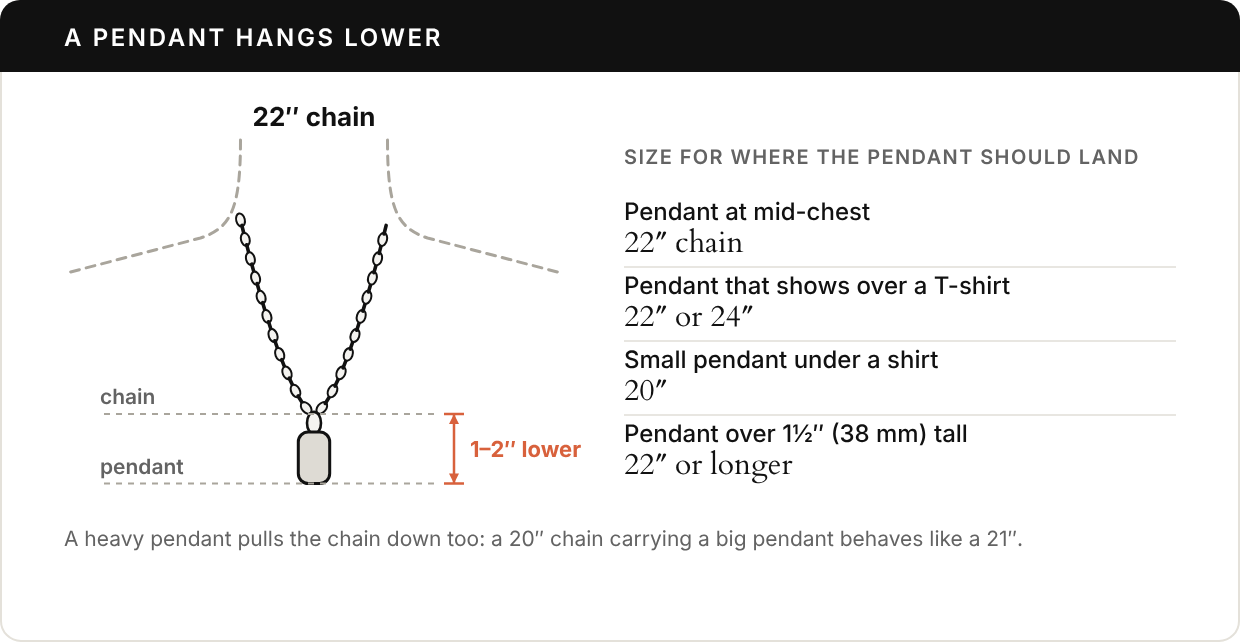
Ronatelli’s size guide gives the same advice in short: go one size longer for a pendant than you would for a plain chain. Our chain length guide has the measuring method and where each length sits by neck size.
Clasp and end links
Chains fail at the ends, not in the middle, and a pendant adds weight that the clasp and its rings carry every day. Choose a lobster clasp for a pendant chain, or a box clasp with a side safety latch on a wide one. A spring ring is fine on a chain up to about 2.5 mm carrying a small charm but too weak for anything heavier, and a toggle can slip under a pendant’s weight. Check that the rings joining the clasp to the chain are soldered closed: an open jump ring is the most common point of failure on inexpensive chains, as our chain buying guide explains.
Worked example: Ronatelli’s pendants and chains
Ronatelli sells nine pendants, $89 to $199, and none comes with a chain: each product page says the chain is sold separately. All nine list a fit of chains up to 6 mm, and seven list a weight.
| Pendant | Weight | Price |
|---|---|---|
| Salerno: Skull Cross | Weight12 g | Price$89 (was $129) |
| Norcia: Eagle Cross | Weight12.3 g | Price$149 |
| Poseidon: Trident | Weight14 g | Price$169 |
| Ravenna: Cross Sword | Weight14 g | Price$149 |
| Cervia: Eagle Cross | Weight17 g | Price$169 |
| Anzio: Tiger | Weight17.6 g | Price$169 |
| Cascia: Crucifix | Weight25 g | Price$199 |
| Fabro: Joker | WeightNot listed (small or medium) | Price$99 or $149 |
| Lyon: Arrowhead | WeightNot listed (small or large) | Price$99 or $149 |
At 12 to 25 g, every one of them belongs on a 4 mm chain in a dense weave, and two of Ronatelli’s ten chains fit that brief:
- Sergo, 4 mm foxtail, $329. Dense and flat, so the pendant stays facing forward; most of the pendant product photos show a foxtail chain. Sold in 20″ to 26″, with 22″ the length for most men.
- Monza, 4 mm rope, $249 (was $399). Strong, and the bail slides freely along it. It comes in 24″ and 26″ only, which suits the larger and heavier pieces, such as the 25 g Cascia, or a broad build.
The Duomo (4 mm cable, $249) suits a light pendant, but at 12 g and up a denser chain keeps these facing forward. The rest are a poor match: the Fuli is a 2 mm snake chain, too thin and prone to kinking at the bail; the 3 mm Alfo is light for these weights; the Pudolf’s Byzantine texture competes with a pendant; the Krun and Parma are statement chains worn on their own; and the 7 mm Fulda and Cana are wider than the 6 mm fit. Our comparison of all ten Ronatelli chains has the full lineup.
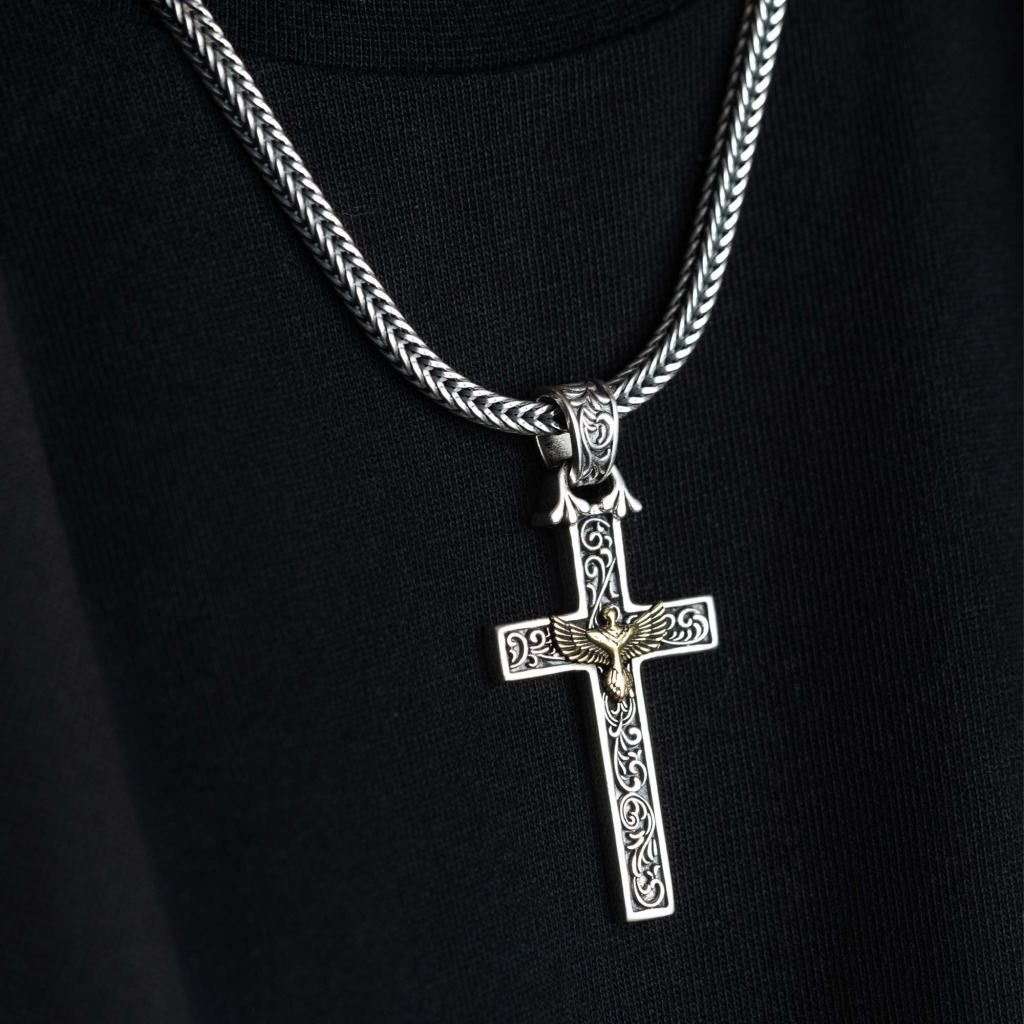
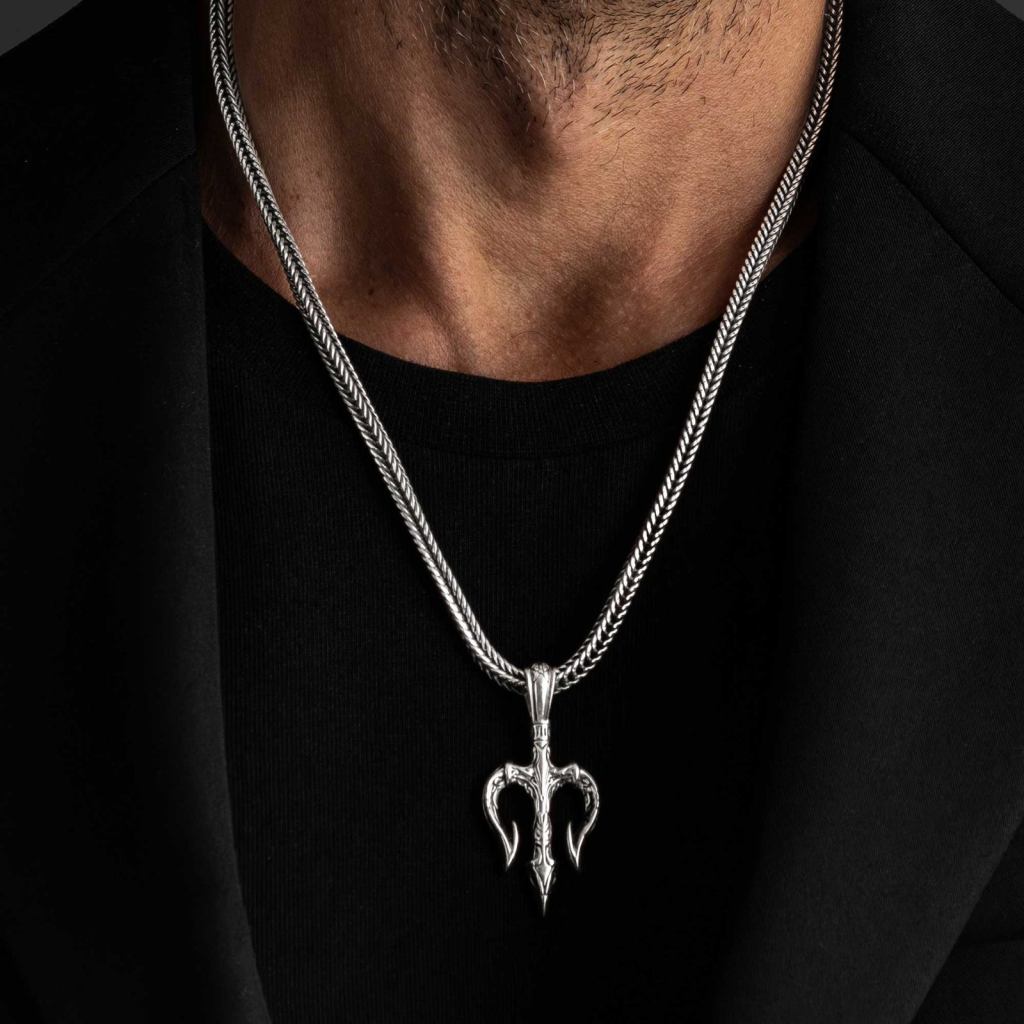
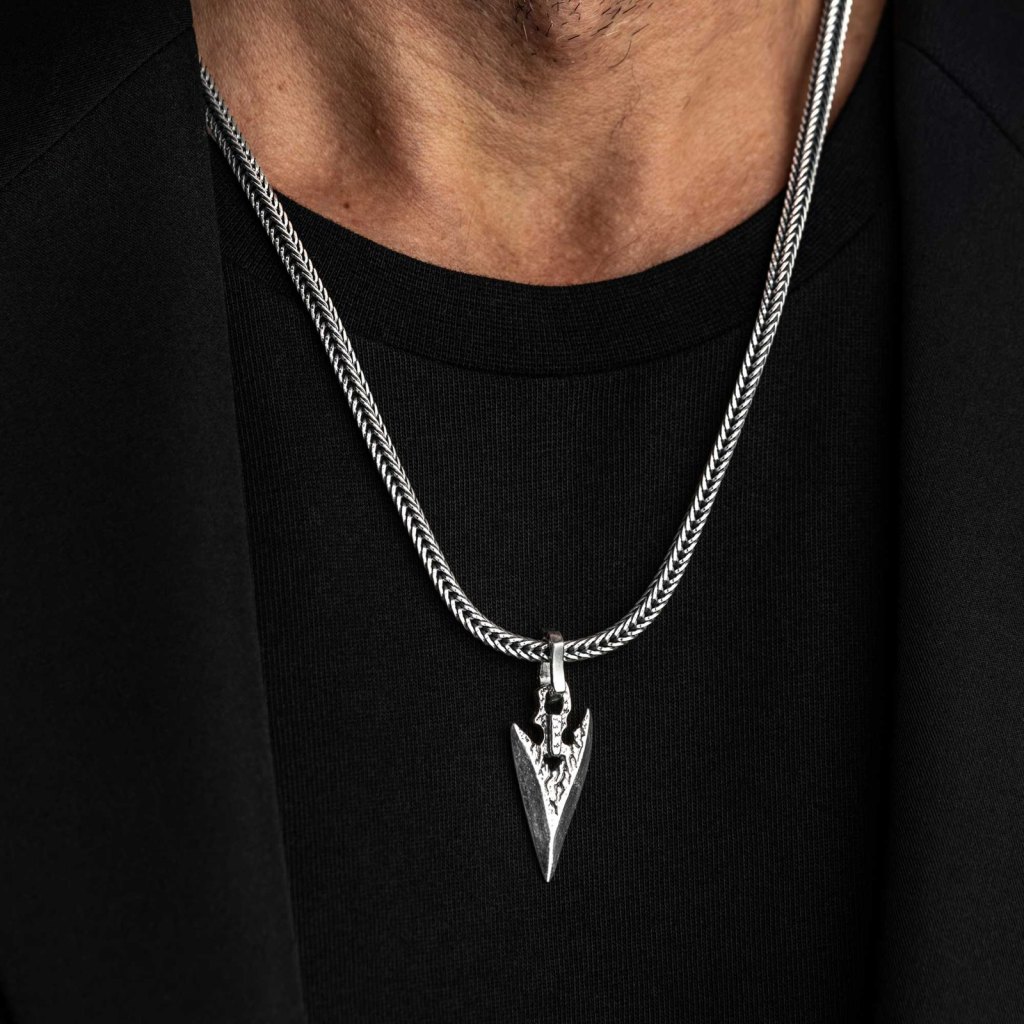
FAQ
What is the best chain for a pendant?
A box, franco, or wheat chain for most pendants, or a solid rope or foxtail chain for heavier ones, 3 to 4 mm wide and about 22 inches long, with a lobster clasp.
How thick should a chain be for a pendant?
Match it to the pendant’s weight: 2 to 2.5 mm for a small charm under 6 g, 3 mm up to about 12 g, and 4 mm above that. Then check that the chain and its clasp fit through the bail.
How do I know if a chain will fit through the bail?
Measure the bail’s opening at its narrowest point and compare it with the widest part that has to pass through, usually the clasp. Leave about 1 mm of room. You only need one end to go through, so try the smaller end.
What length chain should I get for a pendant?
For most men, 22 inches, which puts the pendant around mid-chest. Choose 24 inches for a large pendant or a broad build, and 20 inches for a small pendant worn under a shirt.
Can you put a pendant on a snake chain?
It isn’t recommended. The bail wears the snake chain’s smooth surface, and the chain tends to kink where the pendant hangs. A box or wheat chain gives a similar clean look and carries a pendant well.
Do Ronatelli pendants come with a chain?
No. Each pendant page says the chain is sold separately, and every listing gives a fit of chains up to 6 mm. At 12 to 25 g, they suit a 4 mm chain such as the Sergo foxtail or the Monza rope.
Bottom line
Check the bail first, then the weight, then the length. For most pendants that means a 3 to 4 mm box, franco, wheat, rope, or foxtail chain, 22″ long, with a lobster clasp and about 1 mm of room in the bail. Go to 4 mm once the pendant passes about 12 g, to 24″ for a large pendant or a broad build, and leave snake and herringbone chains for wearing on their own. When the listing gives a fit or a weight, start from those numbers.
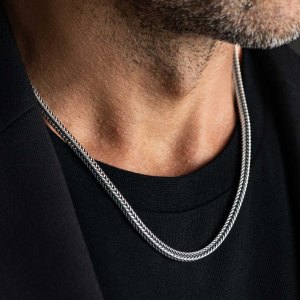

From the collection
Men’s sterling silver chains by Ronatelli
Ten handmade 925 chains, from a 2 mm snake chain to a 7 mm curb, in 20 to 26 inches. Every length is the same price.
Related guides
Pendant weights, the 6 mm fit, prices, chain widths, and lengths were read from ronatelli.com product pages and listings on October 28, 2026, and may have changed since. The weight guidance for 2.5 mm and 3 mm chains follows NineTwoFive’s guide to chains for pendants, and the 1 mm clearance follows NineTwoFive and USA Jewels’ guide to bail sizes; the 4 mm step is our own rule of thumb. Style ratings follow our chain styles guide. A US quarter weighs 5.67 g, per the US Mint. Read our editorial policy.

