
Wear it or carry it, but don’t check it. TSA has said that jewelry generally doesn’t need to come off at the checkpoint, and it recommends putting heavy pieces on after screening. It also asks travelers to keep valuable jewelry with them rather than in checked bags, where airlines can exclude valuables from their liability altogether. Here is how to get silver through security, pack it so it arrives untangled and untarnished, look after it on the trip, and what to do before you take a foreign-made piece abroad.
Key takeaways
- Light pieces can stay on. “In general, jewelry doesn’t need to be removed,” TSA has said.
- Heavy chains and cuffs go in your carry-on and back on after screening, as TSA recommends.
- Never in a checked bag. Airline liability for a domestic bag tops out at $4,700, and airlines often exclude valuables entirely.
- Pack each piece in its own zip-top bag, air pressed out and clasp closed.
- Off for the pool, the hot tub, and the sea.
- Check your insurance: a standard homeowners policy’s theft limit for jewelry is often about $1,500.
- Taking a foreign-made piece abroad? Register it with CBP before you go.
In this guide Security Carry-on Packing On the trip Abroad Insurance FAQ
Can you wear jewelry through airport security?
Usually, yes. “In general, jewelry doesn’t need to be removed before going through security,” TSA said through its AskTSA account, as InStore reported, adding: “we recommend putting on heavy jewelry after you go through security.” That advice is aimed at pieces like a thick Cuban chain or a wide cuff. Pack those inside your carry-on, in a zipped pocket rather than loose in a bin, and put them back on at the other end of the belt.
If you are carrying something valuable, you can ask the officer to screen you and your valuables in private, TSA says, though the final decision on any item rests with the officer.
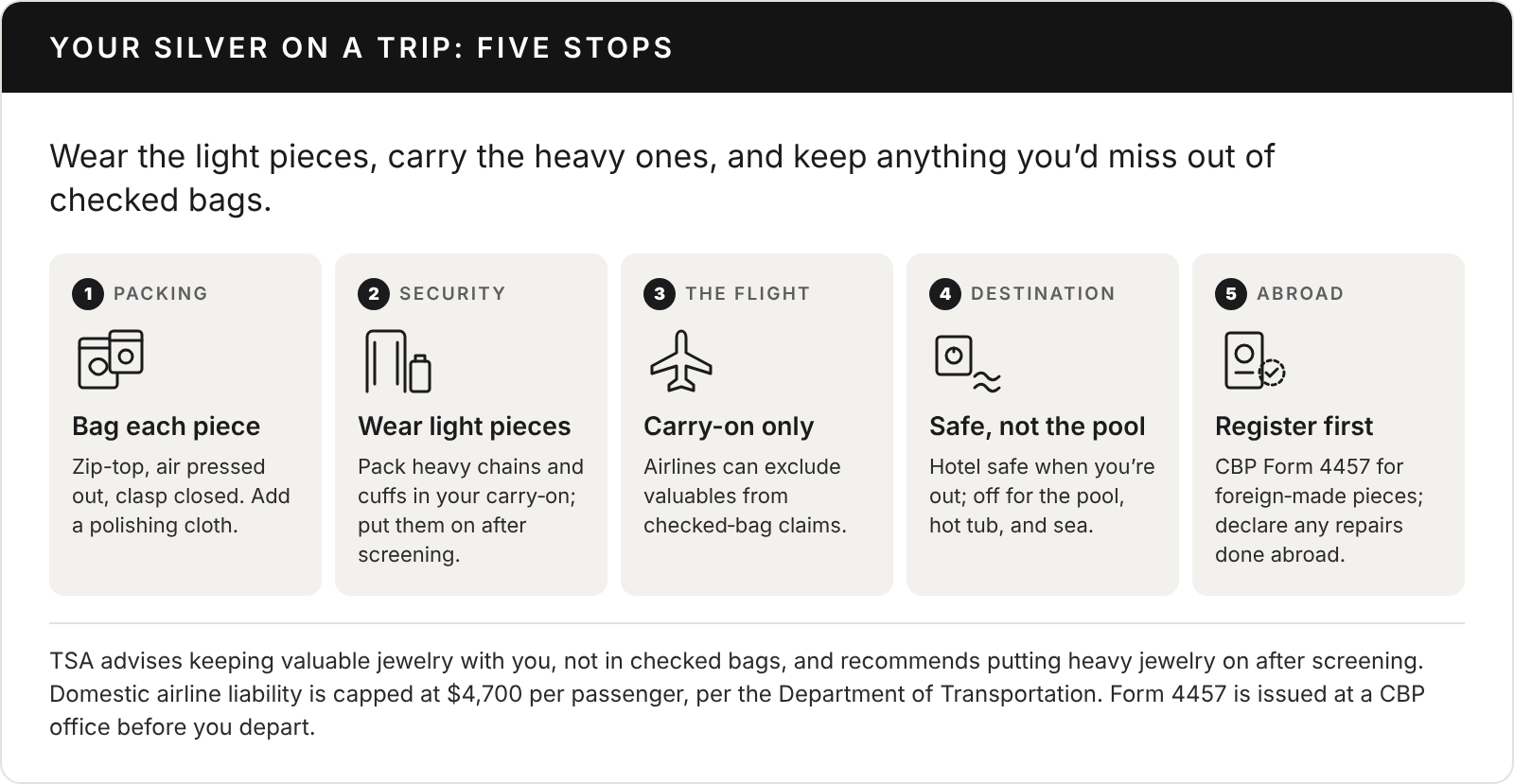
Carry it on, never check it
TSA allows jewelry in both carry-on and checked bags, but asks travelers with valuables to “please keep those items with you at all times.” The money is the reason. For lost or damaged bags on domestic flights, the maximum liability the regulation allows is $4,700 per passenger, and airlines often exclude liability for certain categories of items, valuables among them, the Department of Transportation explains. On international trips under the Montreal Convention, the limit is 1,519 Special Drawing Rights, about $2,175. Read your airline’s contract of carriage, but plan as if a ring in a checked bag isn’t covered at all.
How to pack silver
- One piece per bag. A small zip-top bag with the air pressed out slows tarnish and keeps pieces from scratching each other, the same way our tarnish guide recommends storing silver at home.
- Close every clasp and lay each chain flat in its bag, so it can’t knot.
- Add an anti-tarnish strip if you have one, and pack a polishing cloth for the trip.
- Keep the bags together in one zipped pocket of your carry-on, away from keys and toiletries.
- Photograph each piece before you leave, and keep the photos and receipts somewhere other than your luggage, in case you need to make a claim.
On the trip
- Use the hotel safe for anything you aren’t wearing, not the nightstand or the edge of the sink.
- Take it off for the pool and the hot tub. Chlorine damages sterling rather than just tarnishing it, and a hot tub carries more chlorine than a pool, as our guide to wearing a silver chain every day explains.
- And for the sea. Salt water speeds tarnish, sand scratches the polish, and cold water shrinks your fingers, so a ring can slip off in the waves, as our guide to wearing a silver ring every day notes.
- Sunscreen first, silver second. Let it dry before you put your jewelry back on.
- On a ski trip, cold fingers shrink and a ring can spin or slip; our guide to why your ring is loose in winter has the fixes.
Taking jewelry abroad: register it with CBP
If you are leaving the US with a piece made in another country, you can register it before you go. Take the pieces to a CBP office before departure; the officer gives you Form 4457, you fill in a description of the articles, and the officer checks them against it and completes the form, CBP explains. The certificate shows a CBP officer that you owned the pieces in the US, stays valid for as long as it is legible, and can’t be transferred.
If you have a piece repaired, resized, or altered abroad, declare it when you come home: foreign repairs and alterations are dutiable whether or not the piece is registered, CBP says, even if the work was free. For pieces you order from overseas instead, our guide to duty on silver jewelry shipped to the US covers the rates.
Check your insurance before you go
A standard homeowners policy has a relatively low limit for theft of jewelry, “generally about $1,500,” according to the South Carolina Department of Insurance, which suggests a floater policy that schedules valuables one by one; the pieces have to be professionally appraised first. Check your own policy’s limit before a trip, especially if you are traveling with more than one good piece.
FAQ
Do I have to take off my jewelry at airport security?
Generally not. TSA has said jewelry doesn’t need to be removed in general, but it recommends putting heavy pieces on after screening, so pack a heavy chain or cuff in your carry-on.
Can I put jewelry in checked luggage?
TSA allows it but advises against it for valuables, and airlines often exclude valuables from their liability for lost or damaged bags. Keep silver you care about in your carry-on.
How do I keep silver from tarnishing while traveling?
Pack each piece in its own zip-top bag with the air pressed out, add an anti-tarnish strip if you have one, and bring a polishing cloth.
Can I swim in the ocean with a silver ring?
Better not. Salt water speeds tarnish, sand scratches the polish, and cold water shrinks your fingers, so a ring can slip off in the waves.
Do I need to register my jewelry with customs before traveling?
It isn’t required, but for a piece made abroad, CBP Form 4457 shows that you owned it in the US before your trip. You get it at a CBP office before you leave.
Does homeowners insurance cover jewelry lost while traveling?
Often only up to a low limit for theft, generally about $1,500 on a standard policy. Scheduling valuable pieces on a floater gives broader cover.
Bottom line
Wear light pieces through security, carry heavy ones and put them on afterward, and keep everything you’d miss out of checked bags. Pack each piece in its own sealed bag, take it off for chlorine and the sea, check your insurance, and register foreign-made pieces with CBP before a trip abroad.



From the collection
Men’s sterling silver chains by Ronatelli
Ten handmade 925 chains, from a 2 mm snake chain to a 7 mm curb, in 20 to 26 inches. Every length is the same price.
Related guides
TSA’s guidance follows its “What Can I Bring?” page for jewelry and its AskTSA statements as reported by InStore (June 2022); baggage liability follows the Department of Transportation; Form 4457 and foreign repairs follow CBP’s certificate of registration page and the form itself; and the insurance limit follows the South Carolina Department of Insurance. Water and tarnish advice follows our own care guides linked above. Airline contracts and insurance policies differ; check yours. All were checked on October 30, 2026. Read our editorial policy.

