Disclosure:The example chains in this guide are from Ronatelli. Widths, prices, and ratings were read from ronatelli.com on October 29, 2026; the style comparisons apply to any brand.
A thin chain is the easiest chain to wear. At 2 to 4 mm it slips under a shirt, carries a small pendant, and goes with a T-shirt as easily as a suit. At these widths, though, the style matters more than it does on a heavy chain. A 3 mm snake chain and a 3 mm rope chain look nothing alike, and they don’t wear alike either: one is a smooth, liquid line that can crease for good, the other a twisted spiral that catches the light and, when solid, rarely kinks. This guide compares six styles at thin widths (snake, bamboo, cable, rope, foxtail, and Byzantine) on how each looks, how it handles a pendant, how likely it is to kink, and whether it disappears under a shirt.
Key takeaways
- Under a shirt: a snake or bamboo chain, 2 to 3 mm wide. Smooth chains lie flattest.
- For a pendant: a solid rope or a foxtail, 3 to 4 mm. Cable carries a light one; snake is the one to avoid.
- For a chain you wear every day: cable, foxtail, or Byzantine, which rarely kink. A snake chain can crease for good if it is folded sharply.
- To be seen: rope, foxtail, or Byzantine. Texture makes a thin chain read as jewelry.
- Buy solid and check the clasp. At these widths a hollow chain dents and crushes, and a spring ring only suits chains up to about 2.5 mm.
In this guide Short answer Width Snake Bamboo Cable Rope Foxtail Byzantine Box, wheat, curb Pendants Kinks Examples FAQ
The short answer: choose the style for the job
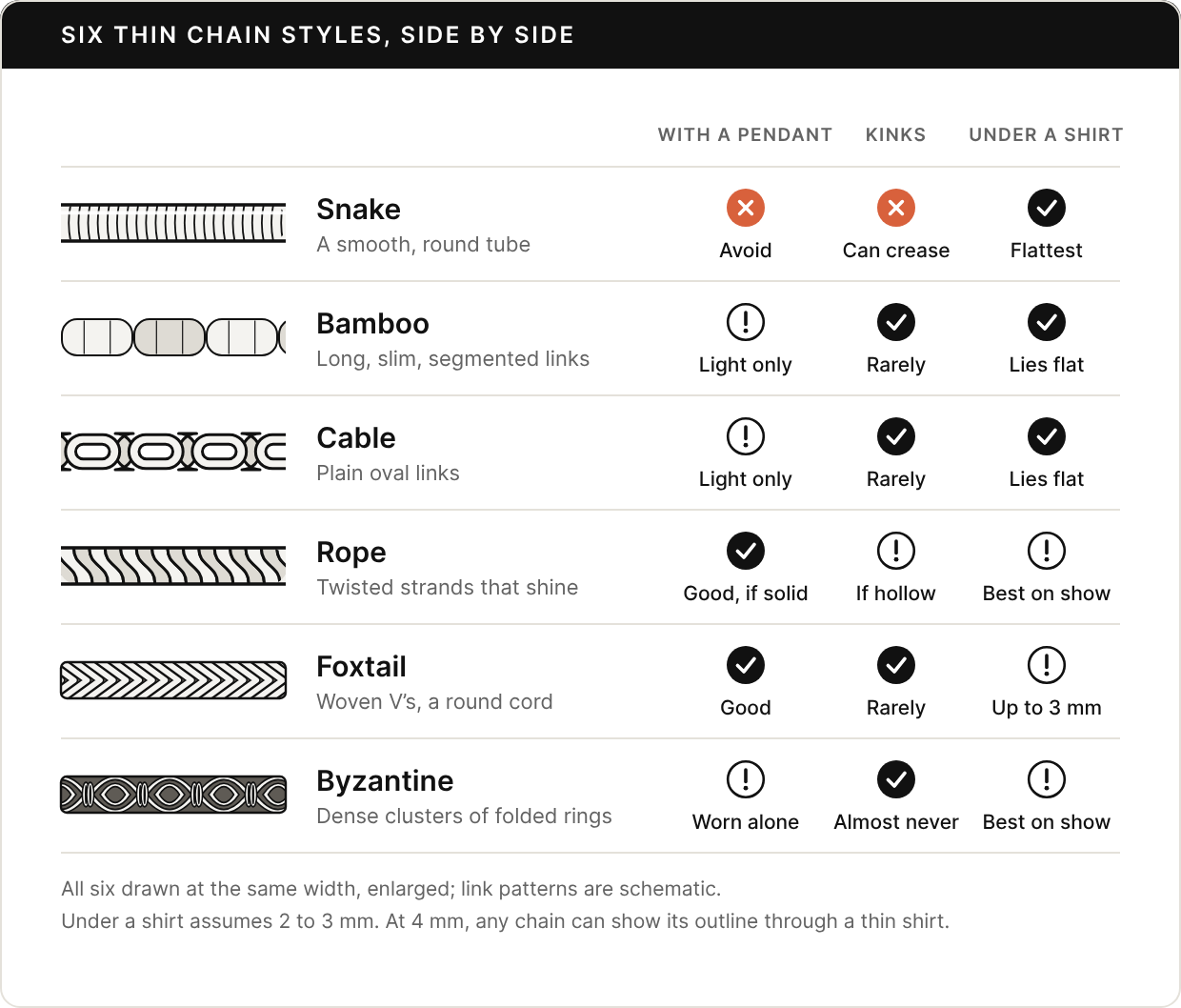
At 2 to 4 mm, pick the style by what the chain has to do. To stay out of sight under a shirt, wear a smooth snake or bamboo chain. To carry a pendant, choose a solid rope or a foxtail, which let the bail slide freely and keep the pendant in place. For a chain you wear every day, choose one that rarely kinks: cable, foxtail, or Byzantine. And for a thin chain that still reads as jewelry, go for texture: rope, foxtail, or Byzantine.
| Style | How it looks | With a pendant | Kink risk | Under a dress shirt |
|---|---|---|---|---|
| Snake | How it looksA smooth, round tube: a liquid line | With a pendantNot recommended | Kink riskHigh: a sharp fold can leave a crease | Under a dress shirtLies flattest |
| Bamboo | How it looksLong, slim links, each tucked into the next | With a pendantLight pendants | Kink riskLow | Under a dress shirtLies flat |
| Cable | How it looksPlain oval links: the simplest chain | With a pendantLight pendants | Kink riskLow | Under a dress shirtLies flat up to 3 mm |
| Rope | How it looksTwisted strands that catch the light | With a pendantGood, if solid | Kink riskLow if solid; hollow rope crushes | Under a dress shirtBetter on show |
| Foxtail | How it looksA woven cord of V’s | With a pendantGood | Kink riskLow | Under a dress shirtFine up to 3 mm |
| Byzantine | How it looksDense clusters of folded rings | With a pendantUsually worn alone | Kink riskVery low | Under a dress shirtBetter on show |
What 2, 3, and 4 mm look like
Thin covers a real range. Our chain buying guide sorts widths this way: up to about 2.5 mm a chain is fine, a line that disappears under a pendant, and 3 to 4 mm is visible but understated, the everyday range. On the neck, that works out like this:
- 2 mm: a fine line. It slips under any collar and suits a small charm, but worn alone over a T-shirt, or on a broad build, it can look slight.
- 3 mm: the in-between. Out of sight under most dress shirts, and a neat, deliberate line at an open collar.
- 4 mm: the everyday width. It shows over a T-shirt and carries most men’s pendants, but under a thin shirt it can show its outline.
Texture shifts these lines. A rope looks brighter and bigger than its width suggests, and a Byzantine chain packs so much silver into its clusters that it reads as substantial even at 4 mm, while a snake chain stays a fine line at any thin width. If this is your first chain, start at 3 to 4 mm. A thin chain is also the one that goes on top when you layer two, as our guide to layering chains explains.
Snake chain: the smoothest line
A snake chain is a run of tightly fitted rings and plates that forms a smooth, round tube, with the joints hidden inside. At 2 to 3 mm it is the sleekest of the thin chains, a single liquid line. The jeweler CRAFTD notes that it slips under a shirt collar without pulling and is the easiest chain of all to clean, and calls 3 mm the snake width that works best for daily wear.
Its weakness is a sharp bend. A hollow snake chain kinks easily. A solid one is far tougher, but folded tightly against an edge, crushed in a drawer, or caught at an angle, the tube can collapse into a kink that stays. It is also a poor pendant chain: the bail wears the smooth surface, the chain tends to kink where the pendant hangs, and with so little friction the pendant slides from side to side.
Choose it if you want the cleanest, quietest chain, under a shirt or with a suit. Check that it is solid, wear it without a pendant, and hang it or lay it flat when it comes off.
Bamboo chain: slim links with a segmented look
A bamboo chain is made of long, slim, polished links, each tucked into the next, so the chain looks segmented, like a bamboo cane with a ridge at every joint. It sits between the smooth chains and the textured ones: smoother than a cable or a rope, so it lies flat under a shirt, but with enough relief along its length to catch more light than a snake chain.
Because it is made of separate links, it bends at every joint and doesn’t kink the way a snake chain can. It is at its best worn on its own. A 3 mm bamboo chain can carry a light pendant, but men’s pendants are often heavier than they look, and from about 12 g a 4 mm chain is the safer carrier.
Choose it if you want a slim chain with a little more life than a snake chain, worn on its own or under a shirt. Check for even links and a consistent finish along the whole length.
Cable chain: the simplest and most forgiving
Cable is the simplest chain: uniform oval links, each joined at a right angle to the next. It is light for its width, inexpensive, and easy to repair, and because the links are evenly spaced, there is little room for them to snag; Robinsons Jewelers rates it among the chains least likely to kink. It isn’t a flat chain, so it turns freely and shows a different face as it moves.
At 2 to 3 mm, cable is the usual carrier for a small pendant or a dog tag, and it lies flat under a shirt. At 4 mm the links read clearly, which suits an open collar. A heavier pendant can turn and slide along the links, so from about 12 g, move to a denser chain.
Choose it if you want one thin chain that forgives almost anything: daily wear, a light pendant, or a place on top of a layered pair. Check that each link is soldered shut, with no gap where the wire meets; the cheapest cable chains skip that step.
Rope chain: the most shine for the width
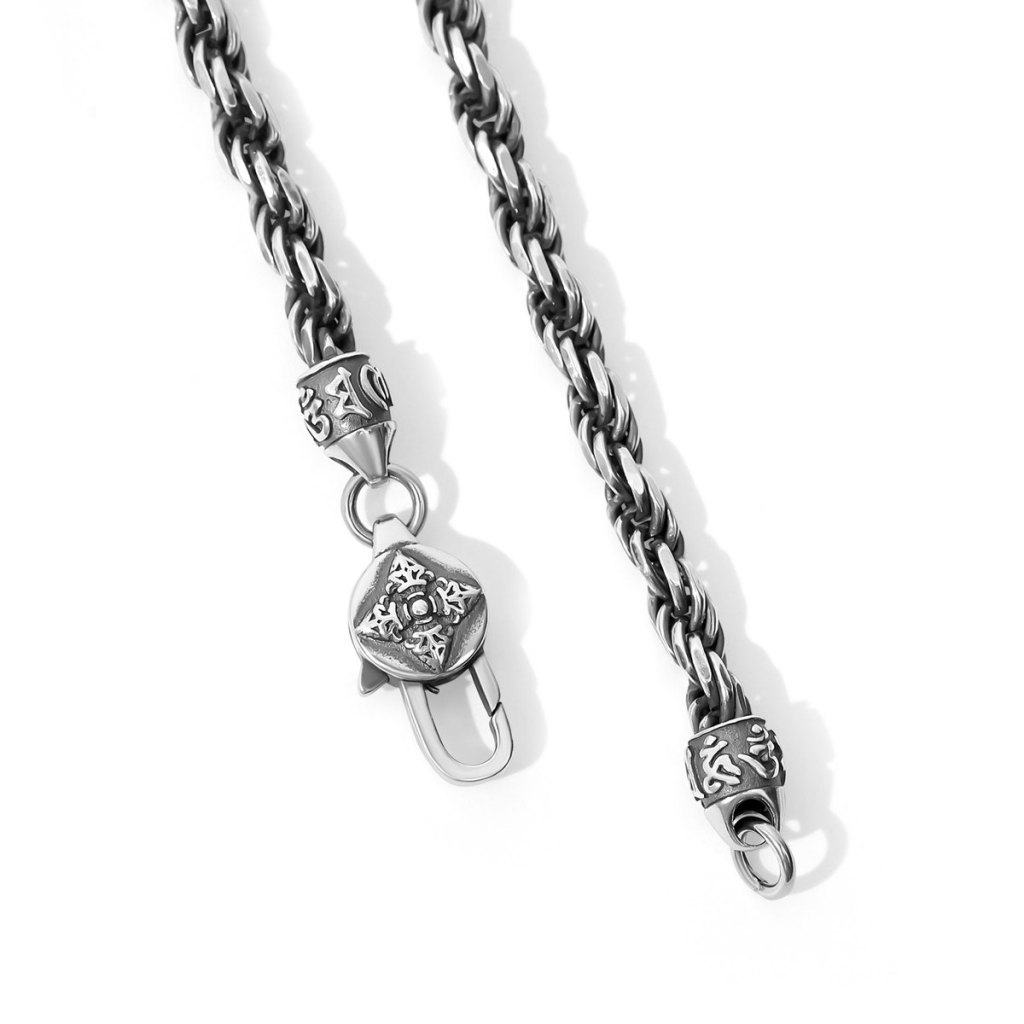
A rope chain is made of small links twisted into strands that spiral around each other. The spiral throws light in every direction, so a rope looks brighter and bigger than its width suggests, and even at 3 mm it reads as a deliberate piece of jewelry.
At thin widths, construction is everything. Hollow rope is common because it keeps the price down, but its thin tubular links dent, and a crushed section stops spiraling and kinks. Solid rope is strong and carries a pendant well, as long as the weave is tight enough that the bail can’t catch in the twists. Keep the pendant in proportion, though: Robinsons Jewelers notes that a heavy pendant on a fine rope can twist as you move. Our buying guide puts a solid 3 mm rope at 22″ at about 18 to 25 g, so one far lighter is hollow. Like other textured chains, a rope is better worn on show than under a dress shirt. Our rope chain guide covers solid and hollow rope in detail.
Choose it if you want a thin chain that still catches the eye, alone or with a pendant. Check that the listing says solid, and compare the weight for the length.
Foxtail chain: a woven cord
A foxtail is woven rather than linked: oval links set in rows at an angle, so the top shows a continuous V pattern along a round cord. Each link holds several of its neighbors, so a bend spreads along the weave; a foxtail drapes like a cord and rarely kinks. Our foxtail chain guide covers how it is built.
At 2 to 3 mm a foxtail is a fine, textured line that can go under a shirt or carry a light pendant; at 4 mm it is the everyday foxtail, dense enough to keep a pendant of up to about 20 g facing forward. Two things to know: the end caps are usually the widest part of a woven chain, so a pendant’s bail has to clear them, and a tight weave holds soap and lotion, so wash it every couple of months.
Choose it if you want texture that wears as easily as a plain chain, with or without a pendant. Check that the V’s run evenly along the whole length and the end caps sit flush.
Byzantine chain: the densest thin chain
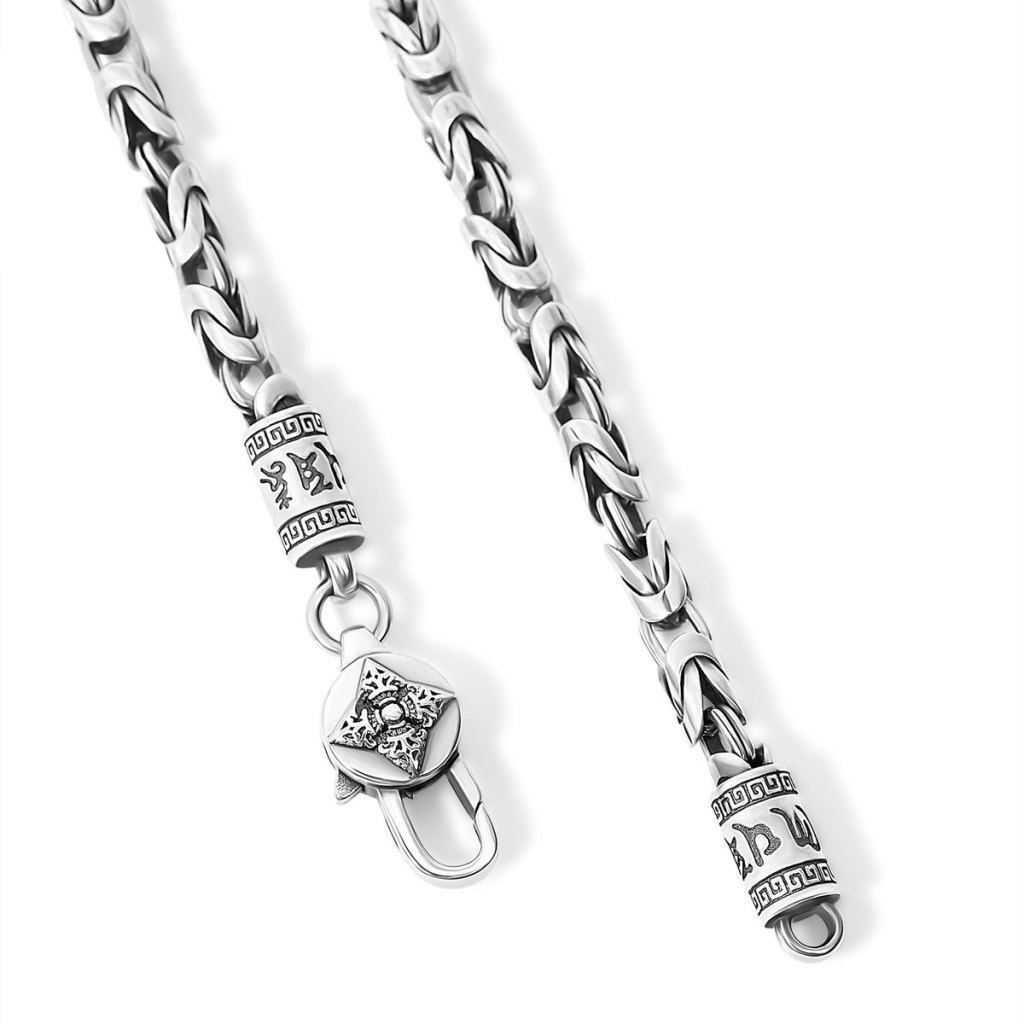
A Byzantine chain is built from rings folded back into each other in clusters, which gives it a rope-like, three-dimensional texture and a lot of silver for its width. It is heavy, very durable, and nearly impossible to kink. So much work goes into it that it costs more than a plain chain of the same width.
Byzantine is usually made from about 4 mm up, so 4 mm is as thin as it usually goes, and even at that width it reads as a substantial piece of jewelry from across a room. It is worn on its own, because the texture competes with a pendant. Its many interlocking loops can snag on other chains, Robinsons Jewelers points out, so store it by itself.
Choose it if you want a thin chain that looks substantial and stands up to daily wear. Check the weight: a real Byzantine feels heavy in the hand for its width.
Box, wheat, and curb at thin widths
Three more styles are common at 2 to 4 mm. Our chain styles guide covers each in detail.
- Box. Square links in a smooth, square line: the classic pendant chain, usually sold at 1.5 to 3 mm. A sharp yank can kink a single link.
- Wheat (spiga). Four strands of oval links braided into a rounded chain, usually 2 to 4 mm. It resists kinking and carries a pendant as well as a box does.
- Curb. Twisted oval links that lie flat on the chest. From 3 mm it carries a pendant, and a solid 3 mm curb at 22″ weighs about 12 to 18 g.
A pendant on a thin chain
A thin chain can carry a pendant, but only a light one. Our guide to the best chain for a pendant sets the limits: about 6 g on a 2.5 mm chain, up to about 12 g on a 3 mm box chain, and a 4 mm chain above that. For scale, a US quarter weighs 5.67 g, so a pendant that outweighs a quarter is already too heavy for a 2.5 mm chain.
Style matters as much as width. Of the six, rope and foxtail carry a pendant best, because the bail slides freely and the pendant stays in place; cable and bamboo suit a light one; Byzantine is usually worn alone; and snake is the one to avoid. Whatever the chain, the bail has to pass over the clasp and any end caps with about 1 mm to spare. On a thin chain, a lobster clasp is the one to trust: a spring ring only suits chains up to about 2.5 mm carrying a small charm.
Why thin chains kink, and how to prevent it
Kinks and tangles trouble thin chains most. Robinsons Jewelers singles out fine, interlocking links as the worst for tangling, and thicker, flatter links as the most durable. A tangle is a knot you can work loose; a kink is a bend the chain can’t undo on its own, and how likely one is depends on the style.
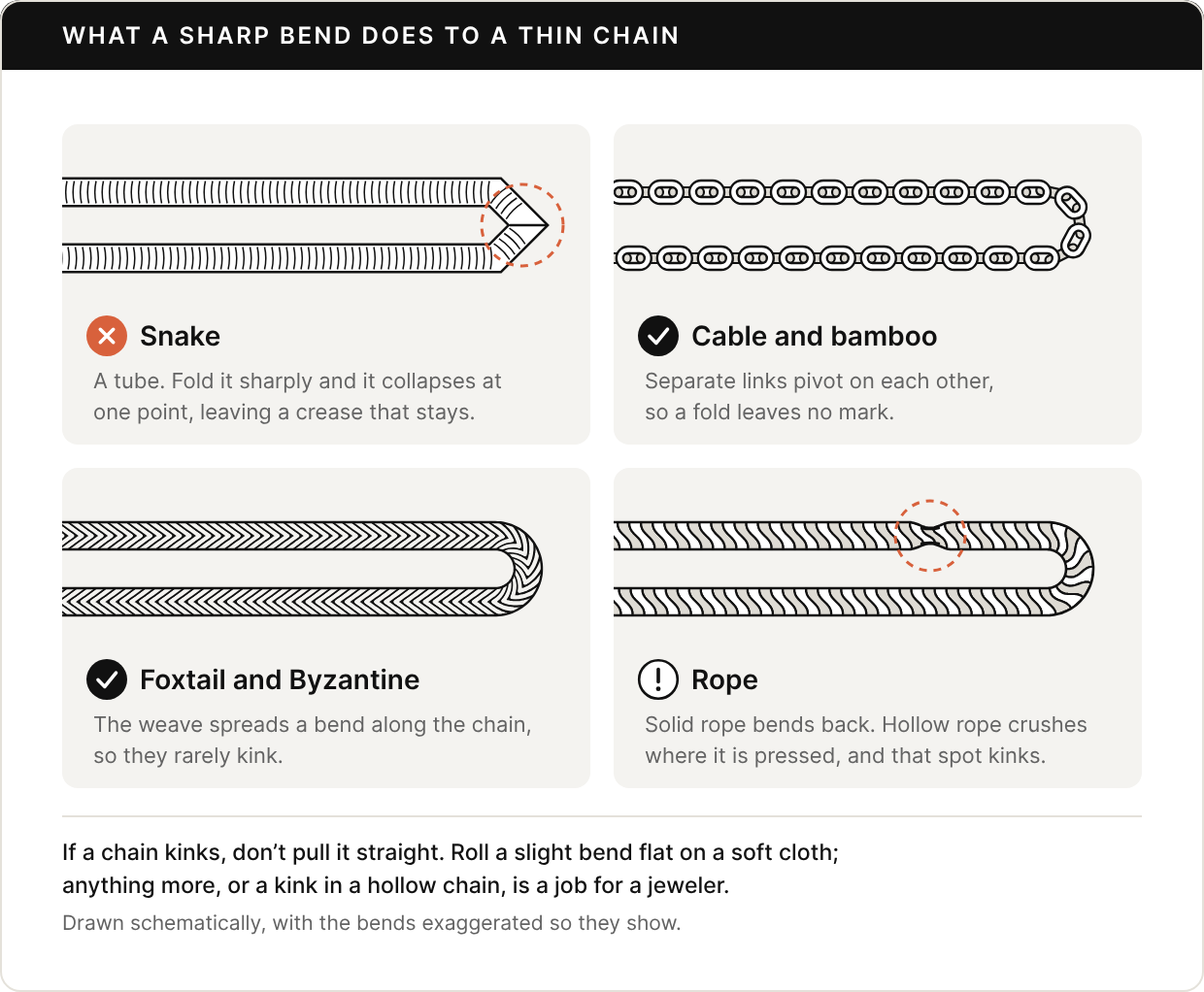
A snake chain is a tube, so a sharp fold collapses it at one point and leaves a crease. Cable and bamboo chains are made of separate links that pivot on each other, so a fold leaves no mark. Foxtail and Byzantine weaves spread a bend along their length. Rope is strong when solid, but a hollow rope crushes where it is pressed, and the crushed section kinks.
- Store it on its own, hanging or laid flat in a pouch, never loose in a box with other chains.
- Put it on last. Lotion, cologne, and hair products leave the links sticky, and sticky links catch on each other and knot.
- Take a snake chain off for bed. A night of turning can fold it sharply; our guide to wearing a chain every day covers which chains are fine to sleep in.
- Don’t pull a kink straight. Roll a slight bend flat on a soft cloth with a pencil. Anything more, and any kink in a hollow chain, is a job for a jeweler.
Thin chains at Ronatelli
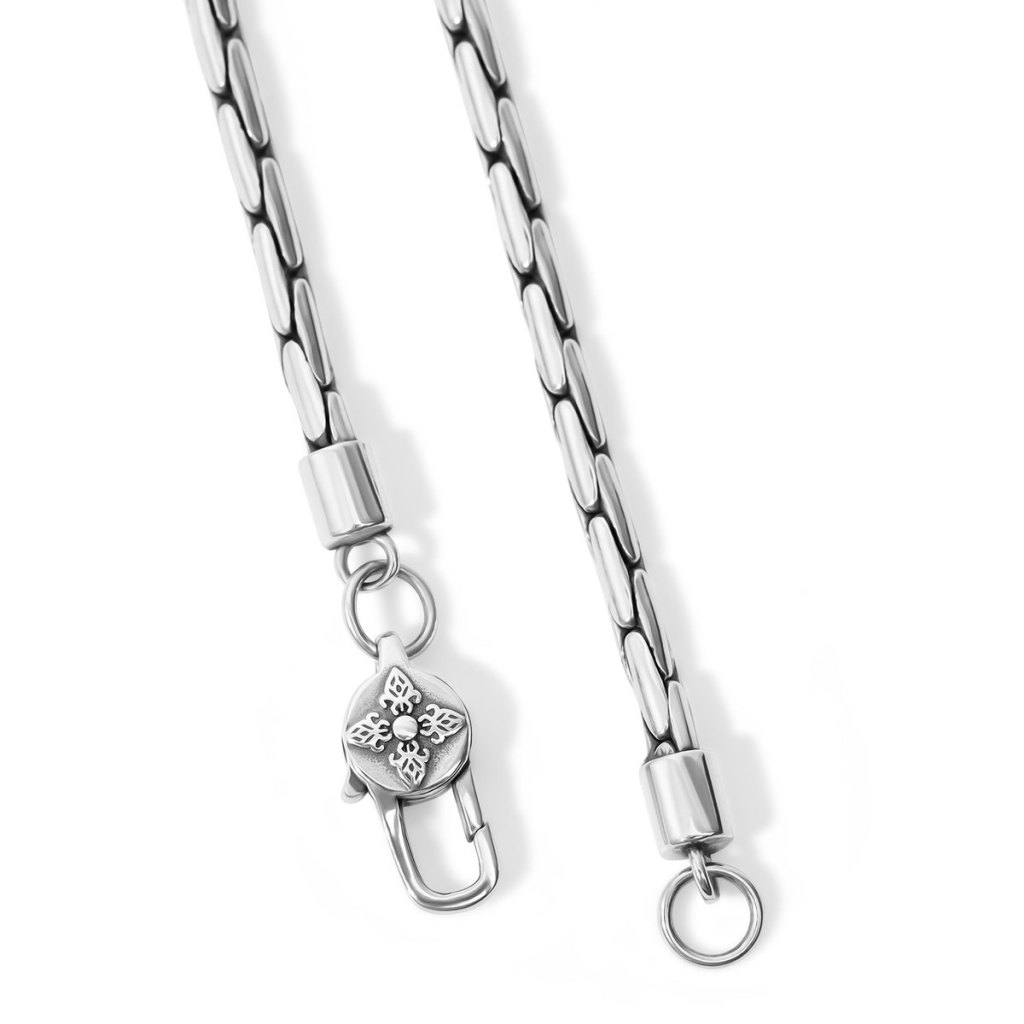
Here are examples from Ronatelli’s chain collection, at their listed prices. Six of its ten chains are 2 to 4 mm wide, one in each of the styles above. All six are 925 sterling silver, and the Fuli adds a platinum plating. Every length costs the same, and all but the Monza come in 20″, 22″, 24″, and 26″; the Monza comes in 24″ and 26″ only.
| Chain | Width | Price | Rating (reviews) | Choose it for |
|---|---|---|---|---|
| Fuli snake | Width2 mm | Price$149 | Rating (reviews)4.7 (57) | Choose it forUnder a shirt, or with a suit |
| Alfo bamboo | Width3 mm | Price$299 | Rating (reviews)4.8 (79) | Choose it forA slim chain worn on its own |
| Duomo cable | Width4 mm | Price$249 | Rating (reviews)4.8 (84) | Choose it forEvery day, or a light pendant |
| Monza rope | Width4 mm | Price$249 (was $399) | Rating (reviews)4.7 (26) | Choose it forA pendant, over a T-shirt |
| Sergo foxtail | Width4 mm | Price$329 | Rating (reviews)4.8 (200) | Choose it forA pendant, or texture every day |
| Pudolf Byzantine | Width4 mm | Price$339 | Rating (reviews)4.8 (71) | Choose it forWorn alone, to be seen |
The Duomo is the one to start with if you want a single thin chain for everything: cable links rarely kink, and it carries a light pendant. For a pendant of 12 g or more, choose the Sergo or the Monza; Ronatelli’s own pendants fit chains up to 6 mm, and our pendant guide pairs them with both. The Fuli is the dress chain: 2 mm, smooth, and platinum-plated, made to sit under a shirt, and best taken off for the shower and for bed, as our guide to wearing a chain every day explains. The Alfo is the slim chain to wear on its own, and the Pudolf the 4 mm chain that looks most like jewelry from a distance.
FAQ
What width is a thin chain for men?
Usually 2 to 4 mm. Up to about 2.5 mm a chain reads as a fine line; 3 to 4 mm is the everyday range, visible but understated.
Is a 2 mm chain too thin for a man?
Not under a shirt or with a small charm, where it is meant to almost disappear. Worn alone over a T-shirt, or on a broad build, a 3 to 4 mm chain looks more in proportion.
Which thin chain is the strongest?
Of the six here, Byzantine: dense, heavy for its width, and nearly impossible to kink. A solid rope and a foxtail are strong too. Cable is light for its width, and snake is the most easily damaged. Whatever the style, a chain is only as strong as its clasp and the rings beside it.
Which thin chains don’t kink?
Cable, foxtail, and Byzantine rarely do. A snake chain is the most likely to, and a hollow rope can kink where it has been crushed.
Can you put a pendant on a 2 mm chain?
Only a small, light one, a few grams at most, and not on a snake chain. A 2.5 mm chain carries about 6 g; anything heavier needs 3 to 4 mm.
What thin chain is best under a dress shirt?
A smooth one, 2 to 3 mm wide, at 20″: snake or bamboo, or a fine cable. Textured chains such as rope and Byzantine are better on show. Our guide to wearing a chain with a suit covers ties and open collars.
Bottom line
At 2 to 4 mm, choose the style before the width. A snake chain is the smoothest line and the one for under a shirt, as long as it stays away from pendants and sharp bends. Cable is the most forgiving everyday chain, rope and foxtail are the ones for a pendant, and Byzantine is the thin chain that looks most substantial. Whatever you choose, buy it solid, close it with a lobster clasp, and store it hanging or flat, on its own.

From the collection
Men’s sterling silver chains by Ronatelli
Ten handmade 925 chains, from a 2 mm snake chain to a 7 mm curb, in 20 to 26 inches. Every length is the same price.
Related guides
Construction, kink risk, weights, and pendant limits follow our chain styles guide, buying guide, and pendant guide; the snake chain details follow CRAFTD’s guide to snake chains, and kinks, tangles, and storage Robinsons Jewelers’ guide to why chains kink. Ronatelli widths, prices, and ratings come from its product pages and clasps from its product photos, checked on October 29, 2026. Read our editorial policy.

