Disclosure:The example chains in this guide are from Ronatelli. Widths, prices, and ratings were read from ronatelli.com on October 29, 2026; the buying advice applies to any brand.
An oxidized chain has been darkened on purpose. The recesses of an engraved, pressed, or woven pattern are turned dark, the high points are polished bright, and the contrast between the two is what makes the pattern readable. It is a finish full of character, and the easiest to ruin: the dip that brightens a plain chain in seconds strips the dark just as fast. This guide covers what the finish is, how it ages, the three ways a chain gets its pattern, which width and length to wear, and how to clean it without losing the look.
Key takeaways
- Oxidized means darkened on purpose. The dark is silver sulfide, the same compound as tarnish, formed from the silver’s own surface. It isn’t a plating, so it can’t chip or peel.
- It ages well. Wear rubs the high points bright while the recesses stay dark, so the pattern gets sharper, not weaker.
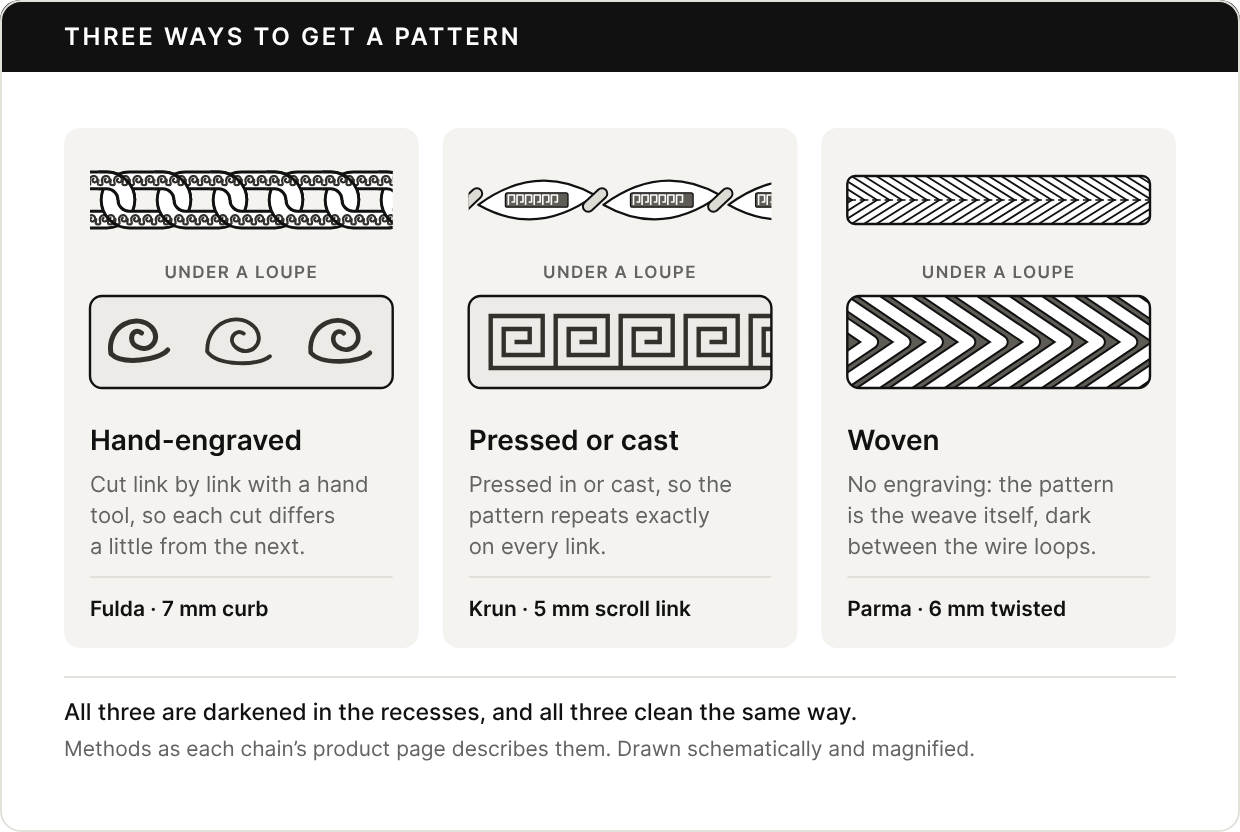
- A pattern is engraved by hand, pressed or cast in, or woven. All three are darkened, and cleaned, the same way.
- Wear it as the piece: on its own over a T-shirt or an open collar, at 20″ or 22″, without a pendant.
- Wash it, don’t dip it. Soap, warm water, and a soft brush; a polishing cloth only on the high points; no foil bath, dip, paste, or ultrasonic cleaner.
In this guide What it is How it ages Engraved, pressed, woven Motifs Width and length Care Re-darkening Examples FAQ
What oxidized silver is
Oxidized silver is sterling silver whose surface has been darkened on purpose, usually in liver of sulfur or a similar sulfide solution, as German Kabirski explains. The dark is silver sulfide, the same compound that forms when silver tarnishes on its own; our guide to why sterling silver tarnishes covers the chemistry. The name is loose, because the reaction is with sulfur rather than oxygen. On jewelry, the dark is applied and then polished off the high points, so it stays in the recesses of an engraving or a weave. Listings call the same finish oxidized, antiqued, blackened, or darkened, and the dark itself a patina. The metal underneath is still 925 sterling silver; only the surface has changed.
It isn’t the same as a black plating. Black rhodium or ruthenium is a thin coat of another metal electroplated over the silver, and Struga notes that such coatings chip at the edges and wear away in patches. The sulfide film can’t chip, because it forms from the silver’s own surface instead of being laid on top as a separate coat. It can only be worn back, slowly, by friction, and that difference decides how an oxidized chain ages and how it should be cleaned.
How the finish ages
Skin and cloth keep rubbing the raised parts of a chain, so the dark lifts there first while the recesses stay dark. Struga, which sells chains already darkened, says the finish starts at its darkest and lightens, fastest on sharp edges and wherever the chain lies against the body. That is the appeal: over months, the contrast between bright high points and dark recesses grows, and the pattern reads more sharply than it did on the first day.
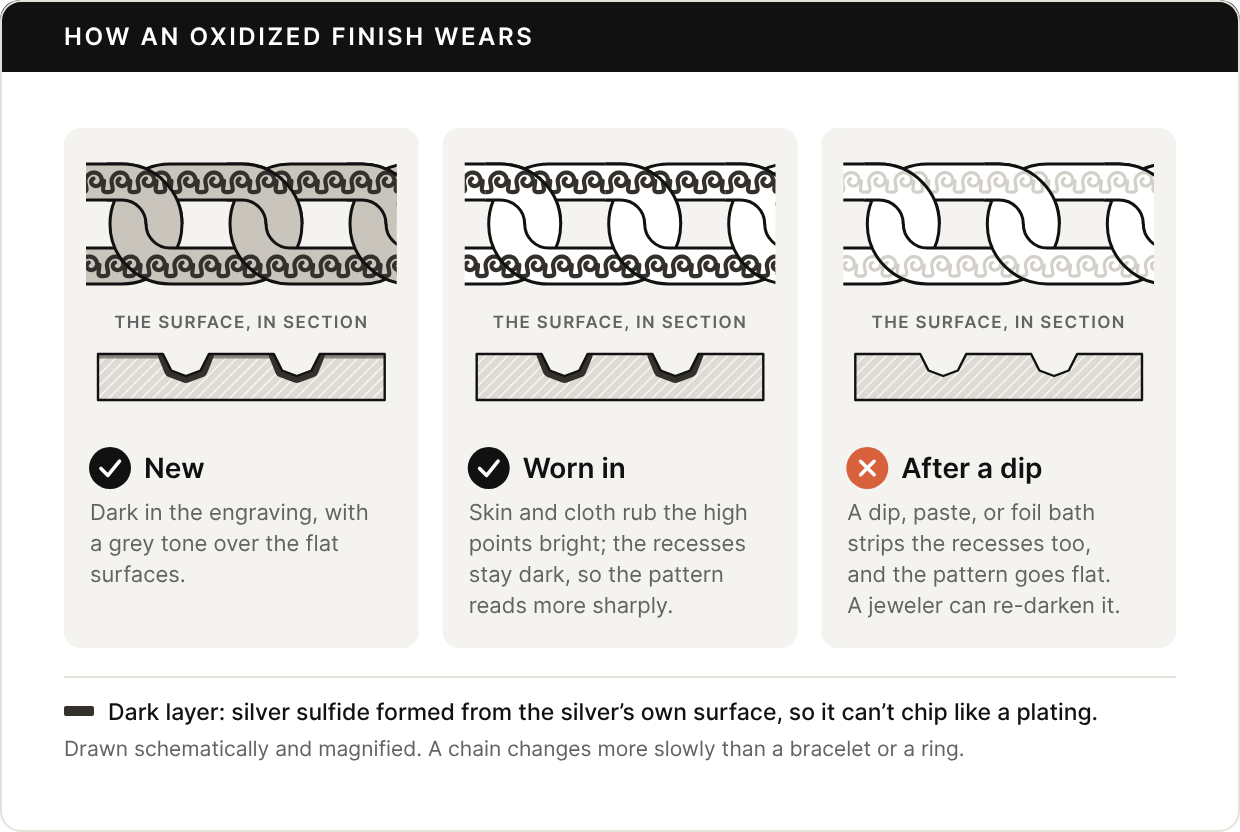
How fast it changes depends on the piece and on the wearer. Skölland Jewelry notes that rings and bracelets, which see more wear, change faster than necklaces, and Gardens of the Sun that some people’s skin clears the dark faster than others’. Between cleanings, humidity and sulfur in the air can also darken the bright parts again, as ordinary tarnish. None of that is damage. What strips the finish is chemistry and abrasion: a silver dip, a foil bath, polishing paste, toothpaste, or the chlorine in a pool.
Engraved, pressed, or woven: three ways to get a pattern
The dark only shows where it has somewhere to sit. The flat, polished face of a plain curb has nowhere to hold it, so an oxidized chain needs texture, and there are three ways to give it one.
| Pattern | How it’s made | How to tell | Example |
|---|---|---|---|
| Hand-engraved | How it’s madeCut into each link with a graver, a hand-held steel tool, one stroke at a time | How to tellUnder a loupe, the lines vary a little in width and depth along their length | ExampleFulda, 7 mm curb |
| Pressed or cast | How it’s madeFormed in a die or a mold, so the pattern comes with the link | How to tellThe pattern repeats exactly from one link to the next | ExampleKrun, 5 mm scroll link |
| Woven | How it’s madeWoven or linked into a textured chain such as a foxtail, rope, or Byzantine; no engraving | How to tellThe texture is the construction: look for an even weave with no gaps or loose loops | ExampleParma, 6 mm twisted foxtail |
None of the three is a quality grade on its own. Hand engraving takes the most labor and leaves small differences from link to link that show up close; a pressed or cast pattern is crisp and perfectly regular; a woven chain gets its texture from its build. Look instead at how deep the pattern is. Friction reaches the bottom of a recess last, so a deeper pattern keeps its dark longer than a shallow one.
Motifs: ornament or symbol
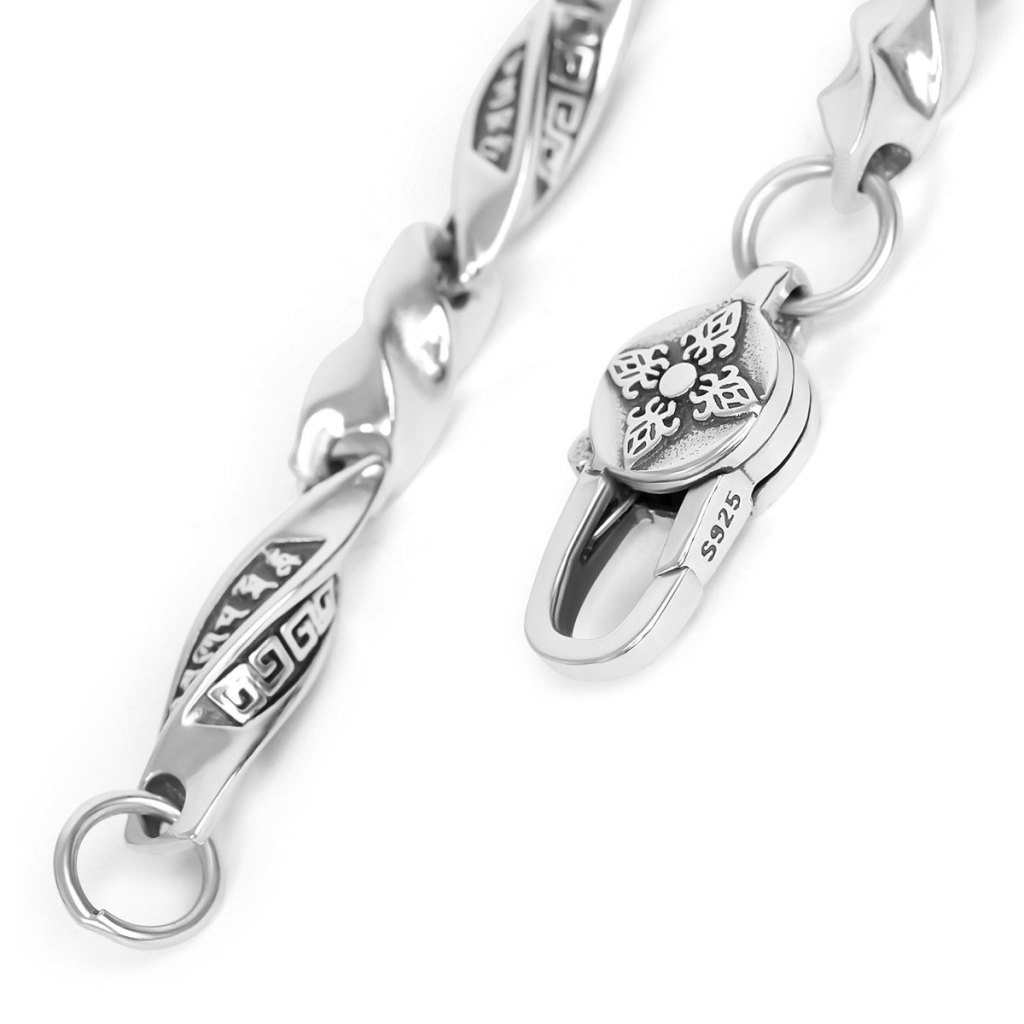
Most patterns on oxidized chains are ornament. Scrollwork, curling foliage descended from the leaf scrolls of classical architecture, carries no message, and neither does the Greek key, a border from ancient Greek art that reads as geometry first. A few motifs do say something. The Krun’s clasp carries a double vajra, a ritual object in Tibetan Buddhism, as the product photos show, and the same clasp disc appears on several other Ronatelli chains. Wear it knowing what it is. The Krun’s links also carry a band of script-like characters, which Ronatelli calls ancient-style engravings without saying what they are. Our guide to symbols on men’s silver bracelets explains each motif, and the meanings are the same on a chain.
Which width and length
An engraving needs a link face wide enough to carry it, while a darkened weave or rope shows its texture at 4 mm. Our chain buying guide calls 5 to 6 mm clearly a piece of jewelry, a single chain worn over a T-shirt or an open collar, and 7 to 10 mm a bold statement worn as the focus of the outfit. Even at 7 mm, engraving is a close-up detail: from a few feet away a patterned chain reads as texture, and up close it reads as craft.
Wear it where it can be seen. On a 15″ to 16″ neck, 20″ sits just below the collarbone and 22″ a couple of inches lower, on the upper chest, as our chain length guide explains; over a T-shirt, a knit, or an open shirt, either works. With tailoring, our guide to wearing a chain with a suit stops at 4 to 5 mm with the tie off and keeps the chain under the shirt once a tie goes on, so most patterned chains are weekend chains rather than suit chains.
A patterned chain is the piece, so wear it without a pendant, which would cover the pattern at the front, where it shows most; our pendant guide counts the Krun and Parma among the statement chains worn on their own. To layer, add one plain, thinner chain above it, as our layering guide recommends: the thinner chain on top, at least 2″ between them, and one patterned chain at a time.
How to clean an oxidized chain
The aim is to clean the chain without touching the dark. Lay it in warm water with a drop of mild dish soap for a few minutes, work a soft toothbrush gently along the links, rinse, and dry it completely on a towel, as our cleaning guide recommends for oxidized pieces. A soft, untreated cloth lifts fingerprints between washes. If the bright parts turn yellow, run a polishing cloth lightly over the high points only, and keep it out of the recesses.
| Method | On an oxidized chain | Why |
|---|---|---|
| Soap, warm water, soft brush | On an oxidized chainYes | WhyLifts skin oil and grime from the recesses without touching the finish |
| Soft, untreated cloth | On an oxidized chainYes | WhyTakes off dust and fingerprints between washes |
| Polishing cloth | On an oxidized chainHigh points only | WhyIt lifts the dark wherever it touches |
| Foil bath or silver dip | On an oxidized chainNo | WhyStrips the dark from the recesses along with the tarnish |
| Paste, baking soda, toothpaste | On an oxidized chainNo | WhyAbrasive: lightens the finish and scratches the silver |
| Ultrasonic cleaner | On an oxidized chainNo | WhySpeeds the loss of the dark |
| Pool or hot tub | On an oxidized chainTake it off | WhyChlorine strips the dark and, over time, attacks the joints between links |
Store it dry and on its own, in a soft pouch, so heavier pieces can’t rub its high points or scratch it. A sealed bag with an anti-tarnish strip slows new tarnish on the bright surfaces, as our tarnish guide explains, and leaves the dark recesses as they are. For the shower and the gym, our guide to wearing a chain every day applies to an oxidized chain as to any other.
If the dark wears off
After years of wear, or one trip through a dip, a chain can end up bright all over. A jeweler can re-apply the finish, and some makers re-darken their own pieces on request: Struga does it as a custom order, and Skölland Jewelry for a small fee. Skölland adds that other jewelers may not be willing to refinish a piece, so ask the seller first. A chain that comes out of a dip too bright has lost only its contrast; the silver itself is unharmed.
Oxidized chains at Ronatelli
Here are examples from Ronatelli’s chain collection, at their listed prices. None of the product pages uses the word oxidized, but the product photos show each of these darkened in the recesses; the plain Cana is listed for contrast. All are 925 sterling silver.
| Chain | Pattern | Width | Lengths | Price | Rating (reviews) |
|---|---|---|---|---|---|
| Fulda | PatternHand-engraved curb | Width7 mm | Lengths20–26″ | Price$439 | Rating (reviews)4.9 (56) |
| Krun | PatternPressed scroll link | Width5 mm | Lengths20–26″ | Price$439 | Rating (reviews)4.8 (64) |
| Parma | PatternTwisted foxtail | Width6 mm | Lengths20–26″ | Price$329 | Rating (reviews)4.9 (32) |
| Sergo | PatternFoxtail | Width4 mm | Lengths20–26″ | Price$329 | Rating (reviews)4.8 (200) |
| Pudolf | PatternByzantine | Width4 mm | Lengths20–26″ | Price$339 | Rating (reviews)4.8 (71) |
| Monza | PatternRope | Width4 mm | Lengths24″, 26″ | Price$249 (was $399) | Rating (reviews)4.7 (26) |
| Cana | PatternPlain curb, not darkened | Width7 mm | Lengths20–26″ | Price$499 | Rating (reviews)4.8 (79) |
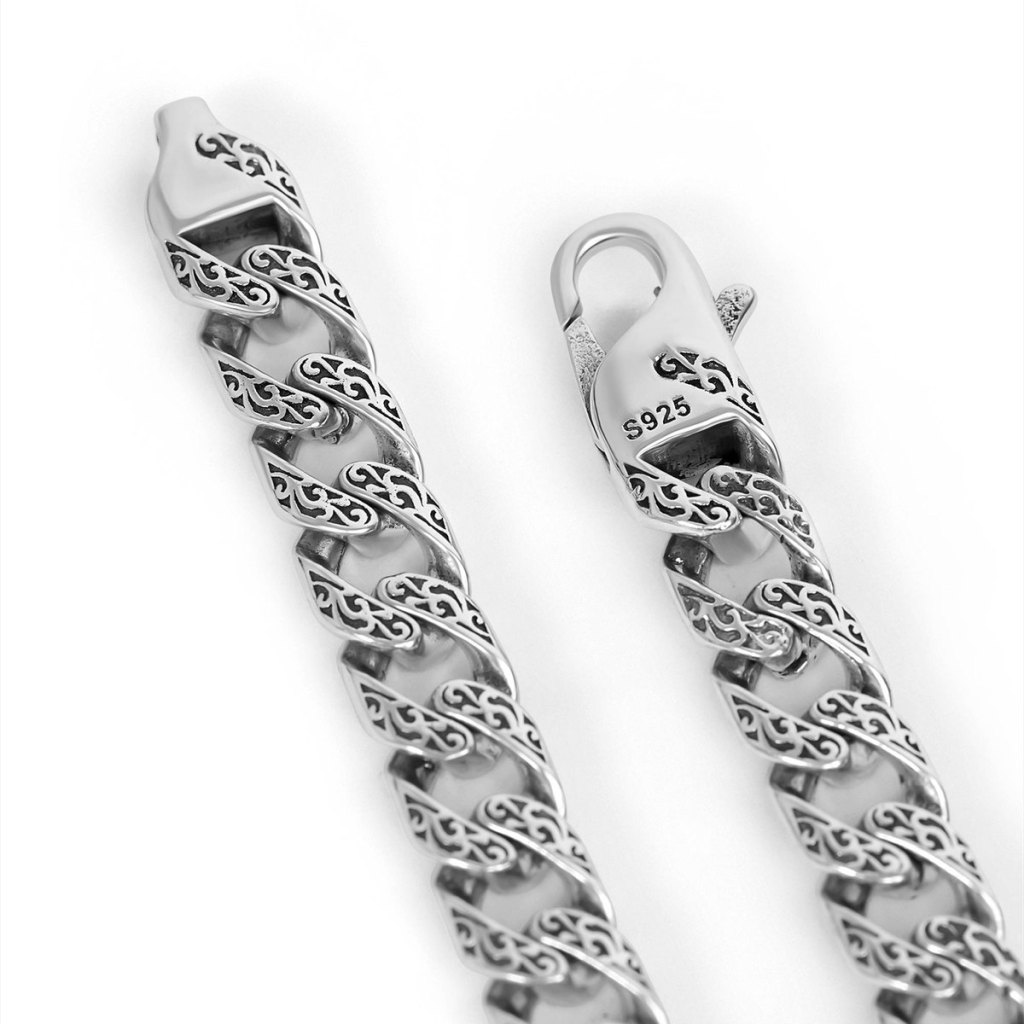
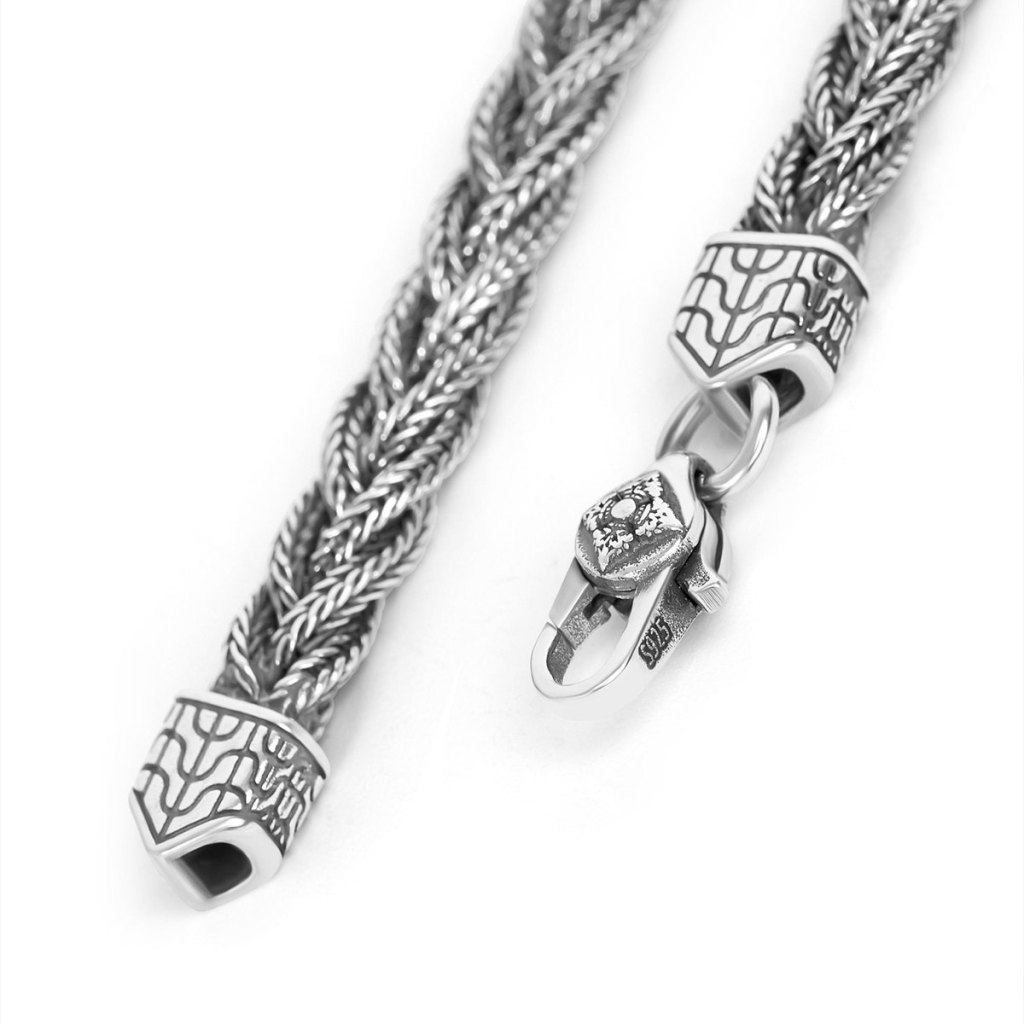
The Fulda is the clearest example of hand engraving: Ronatelli says every link is engraved by hand with scrollwork by master silversmiths, and the photos show the scrolls darkened against bright edges and a lobster clasp stamped S925. As our comparison of Ronatelli’s chains notes, it lies flat like any curb, and the pattern shows up close. The Krun’s links are flat bars twisted half a turn, with what Ronatelli calls ancient-style engravings pressed into the silver; the photos show darkened panels of Greek key and script-like characters, and the double vajra clasp. The Parma has no engraving at all. It is several foxtail chains twisted and woven together, according to the product page, darkened in the weave and finished with engraved end caps, and it shares the collection’s highest average, 4.9, with the Fulda.
For the same look at an everyday width, the 4 mm Sergo, Pudolf, and Monza are darkened in the recesses too; the Sergo is the most-reviewed chain in the collection, with 200 reviews, and our foxtail guide covers it in detail. The Monza comes in 24″ and 26″ only, and it was the only chain on sale when we checked. For contrast, Ronatelli describes the Cana as having no engravings and no embellishments: a polished 7 mm curb with nothing to darken.
FAQ
What is oxidized silver?
Sterling silver darkened on purpose with a sulfur compound, so its recesses turn dark while its high points stay bright. The dark is silver sulfide, the same compound as tarnish, and the metal underneath is still 925 sterling silver.
Does oxidized silver wear off?
Slowly, on the high points, where skin and cloth rub it; the recesses stay dark much longer, which sharpens the pattern. A dip, a foil bath, an abrasive paste, or chlorine strips it all at once.
Is oxidized silver the same as black rhodium?
No. Black rhodium is a plating over the silver, and a plating can chip at the edges and wear through in patches. An oxidized finish forms from the silver’s own surface, so it can’t chip or peel.
How do you clean an oxidized silver chain?
Soak it in warm water with a drop of mild dish soap, brush it gently with a soft toothbrush, rinse, and dry it fully. Use a polishing cloth only on the high points, and skip dips, foil baths, paste, and ultrasonic cleaners.
Can oxidized silver be re-darkened?
Yes. A jeweler can re-apply the finish, and some makers re-darken their own pieces on request. Ask the seller first, since other jewelers may not take the job.
Can you wear an oxidized chain every day?
Yes. Daily wear is what brightens the high points and builds the contrast. Take it off for the pool and the hot tub, where chlorine strips the dark, and dry it after the shower.
Bottom line
An oxidized chain is darkened on purpose, and the dark forms from the silver itself rather than coating it, so it ages by getting sharper: the high points brighten and the recesses stay dark. Choose the pattern you like, hand-engraved, pressed, or woven, at 5 to 7 mm for a chain worn on its own or 4 mm for a quieter weave. Then wash it with soap and a soft brush, keep the polishing cloth on the high points, and keep it away from dips, foil baths, and chlorine.
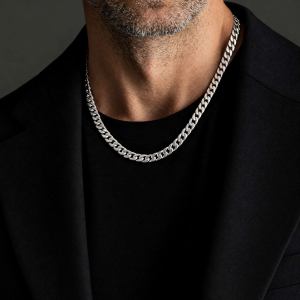
From the collection
Men’s sterling silver chains by Ronatelli
Ten handmade 925 chains, from a 2 mm snake chain to a 7 mm curb, in 20 to 26 inches. Every length is the same price.
Related guides
The chemistry of the finish follows our guide to why sterling silver tarnishes, German Kabirski’s guide to oxidized silver, and Gardens of the Sun’s comparison of black rhodium and oxidized silver. How the finish wears, what strips it, and re-darkening follow Struga’s pages on oxidized silver chains and oxidized silver care and Skölland Jewelry’s guide to caring for jewelry with patina; hand engraving follows Skyjems’ encyclopedia entry on it. Cleaning follows our guide to cleaning sterling silver, widths our chain buying guide, and motifs our guide to symbols on men’s silver bracelets. Ronatelli widths, making methods, prices, and ratings come from its product pages and finishes and clasps from its product photos, checked on October 29, 2026. Read our editorial policy.

