For most men, a large lobster clasp. At 12 mm or longer, it closes with one hand once he has done it a few times, and it suits most chains and bracelets up to about 6 mm wide, or 8 mm if it is a big one. On a heavier Cuban, a box clasp with a safety catch is as easy to close and more secure. Skip the small spring ring, which takes a fingernail and steady fingers, and save a magnetic clasp for one situation: a man whose hands make every other clasp a struggle. Here is how each clasp works, which suits a chain or a bracelet, and how to check one before you wrap it.
Key takeaways
- The safe pick is a large lobster clasp, 12 mm or longer, on chains and bracelets up to about 6 mm, or 8 mm if it is a big one.
- On a heavy Cuban, from about 7 mm, choose a box clasp with a safety catch. It clicks shut and is the most secure of the five.
- Skip the spring ring for him. It is small, needs a fingernail, and suits only fine chains up to about 2.5 mm.
- A magnetic clasp is the easiest and the least secure. Keep it for light pieces and hands that struggle.
- Before you wrap it, open and close the clasp a few times and check that the end links are soldered shut.
In this guide The clasps On a chain On a bracelet If his hands struggle Before you wrap it FAQ
The five clasps, compared
Almost every men’s chain or bracelet closes with one of five clasps. For a gift, what matters is whether he can work it himself: a bracelet goes on with one hand, and a chain closes behind his neck, by feel.
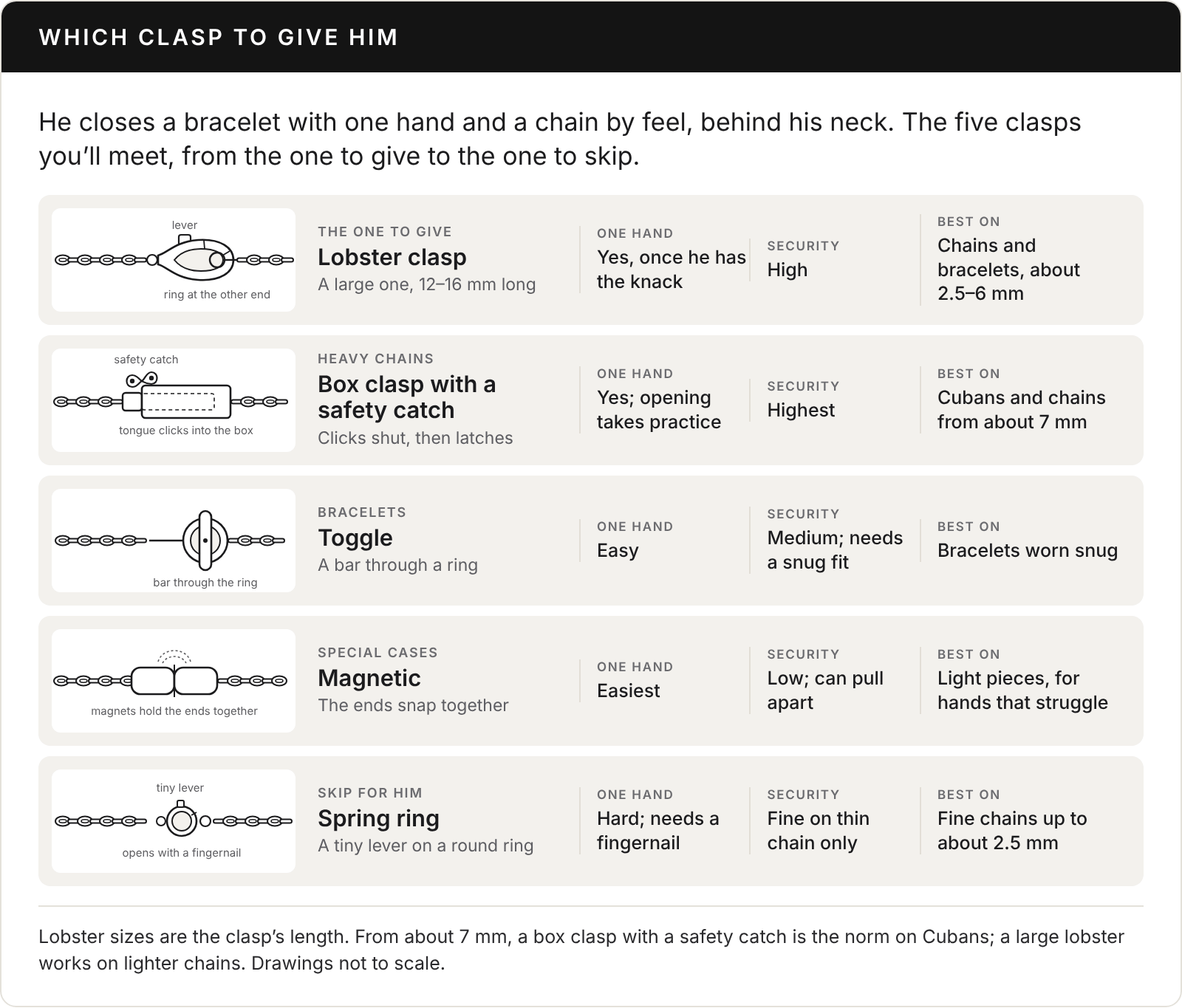
| Clasp | How it closes | One hand? | Security | Best on |
|---|---|---|---|---|
| Lobster clasp | How it closesPull back the lever, hook the ring at the other end, let go | One hand?Yes, once he has the knack; easier the larger it is | SecurityHigh, if it snaps shut firmly | Best onChains and bracelets, about 2.5 to 6 mm; a large one to about 8 mm |
| Box clasp with a safety catch | How it closesPush the tongue into the box until it clicks, then close the catch | One hand?Yes; opening takes practice | SecurityHighest | Best onCubans and other chains from about 7 mm |
| Toggle | How it closesPass the bar through the ring | One hand?Easy | SecurityMedium; can slip if worn loose or under a pendant | Best onBracelets worn snug |
| Magnetic | How it closesThe two ends snap together | One hand?Easiest | SecurityLow; a tug can pull it apart | Best onLight pieces, for hands that struggle |
| Spring ring | How it closesPull back a tiny lever, hook the ring, let go | One hand?Hard; needs a fingernail | SecurityFine on thin chain, weak on anything heavier | Best onFine chains up to about 2.5 mm |
| Hook or S-clasp | How it closesHook through a link or ring | One hand?Easy | SecurityLow; can bend open | Best onNothing he values |
On a chain: the clasp he closes by feel
A chain closes behind his neck, where he can’t see it, so the clasp has to work by touch. A large lobster does: he pulls the lever back with a fingertip, slips the claw over the ring at the other end, and lets go. A small spring ring is where most men give up, because its lever is tiny and has to be held open while the ring goes on. If he struggles at first, the old trick works: close the clasp at the front, where he can see it, then turn the chain until the clasp sits at the back.
Not every seller sees it that way. LHC Jewelry, an online silver retailer, says in its fall 2026 report that men return chains with lobster clasps more often than chains with spring rings, because men with larger hands find them fiddly. The lesson we draw is size: a small lobster is as fiddly as a spring ring, so look for one 12 mm or longer, and if he has struggled with lobsters before, a box clasp is the alternative.
On a Cuban of about 7 mm or more, a box clasp with a safety catch is the norm. The tongue clicks into the box, then a side latch or a figure-eight catch closes over it as a backup. It is the most secure clasp on a chain, and once he has done it a few times, it is no harder to close than a lobster; opening it, by lifting the catch and pressing the tab, takes a little practice. Of the four Ronatelli chains whose reviews we read in full, the Cana’s box clasp with a side latch was the best liked.
If a pendant is going on, the clasp matters twice. The bail has to pass over the clasp end, which is often wider than the chain, and a toggle can slip under a pendant’s weight. Our guide to the best chain for a pendant covers the fit.
On a bracelet: one hand only
He fastens a bracelet with his other hand, so the test is simple: can it be closed one-handed? A large lobster can, and so can a box clasp, which only needs a push. A toggle is the easiest of all on a bracelet that fits snugly; on a loose one, the bar can work its way back through the ring. On flat curb bracelets you may also meet a fold-over clasp, two hinged plates that fold flat and snap shut like the folding clasp on a metal watch bracelet, which also closes one-handed.
A box clasp on a bracelet should have a second catch. A push-button box clasp with nothing backing it up can open when the button is pressed by accident, against a table edge or a seat belt. If a bracelet you love lacks one, a jeweler can add a small figure-eight safety catch; it is routine bench work.
If you doubt he’ll manage any clasp, a cuff has none: he slides it on at the narrow side of his wrist. Our bracelet gift guide explains how to choose one.
If his hands make clasps hard
Arthritis, large fingers, or a tremor can make even a lobster a struggle. These options run from the smallest change to the biggest.
- A bigger lobster. The larger the clasp and its lever, the easier it is to grip, and a jeweler can swap a small clasp for a larger one.
- A push-button clasp. Some clasps open with a press of a button rather than a small lever, which takes less fingertip strength. Ask a jeweler what fits his chain.
- A magnetic clasp or converter. The ends snap together, which is as easy as a clasp gets, and a converter clips onto an existing clasp to add one, at the cost of a little extra length. The trade-off is security: a tug or a snag can pull the ends apart, so keep it for a light chain or bracelet, not a heavy Cuban or a pendant he would hate to lose.
- No clasp at all. A cuff for the wrist, or a chain long enough to go over his head.
One caution on magnets: if he has a pacemaker or an implanted defibrillator, Medtronic advises keeping jewelry with magnetic closures at least 6 inches (15 cm) from the device. A necklace clasp can slide around to the front, so check with his doctor before you give him one.
Check it before you wrap it
- Open and close it five times. It should snap shut firmly every time; a clasp that closes softly will one day open on its own.
- Check the end links. The small rings joining the clasp to the chain should be soldered shut, with no gap you can see.
- Find the stamp. A 925 and a maker’s mark usually sit on the clasp or a small tag beside it; our guide to what 925 means explains the marks.
- Match the clasp to the piece. On a bracelet or a chain of 4 mm or more, a lobster should be 12 mm or longer; a chain of about 7 mm or more should close with a box clasp and a catch.
- Try the pendant. If one is going on, slide its bail over the clasp end before the tags come off.
- Keep the tags and the box. If he can’t work the clasp, you can still exchange it. A jeweler can change a clasp later, but altering a piece usually ends the return window.
FAQ
What is the easiest clasp for a man to put on himself?
A large lobster clasp, 12 mm or longer, on most chains and bracelets, or a box clasp on a heavy one. A magnetic clasp is easier still but the least secure, and a cuff has no clasp at all.
Is a lobster clasp better than a spring ring?
For most men, yes. A lobster is larger, easier to grip, and stronger on anything heavier than a fine chain. A spring ring is fine on a chain up to about 2.5 mm, but its tiny lever needs a fingernail.
What is the most secure clasp for a chain?
A box clasp with a safety catch: the tongue clicks into the box, and a side latch or a figure-eight catch backs it up. It is the standard on Cubans from about 7 mm.
Are magnetic clasps secure enough for a man’s chain?
On a light chain or bracelet, usually; on a heavy Cuban, or with a pendant he values, no. A tug or a snag can pull the ends apart.
Can a jeweler change the clasp on a chain?
Yes. Swapping a spring ring for a lobster, fitting a larger clasp, or adding a safety catch is routine work. On a gift, wait until you know he’s keeping it, since altering a piece usually ends the return window.
What size lobster clasp does a men’s chain need?
Big enough to grip: 12 to 14 mm on a 4 to 5 mm chain, and 12 to 16 mm on a chain bracelet. A small one needs a fingernail.
Bottom line
Give him a large lobster clasp on most chains and bracelets, and a box clasp with a safety catch on a heavy Cuban. Both close with one hand, and both stay closed. Leave the spring ring to fine chains, keep a magnetic clasp for hands that need it, and open and close any clasp a few times before you wrap it.
From the collection
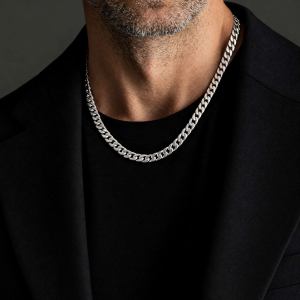
Men’s sterling silver chains by Ronatelli
Ten handmade 925 chains, from a 2 mm snake chain to a 7 mm curb, in 20 to 26 inches. Every length is the same price.
Related guides
Clasp size ranges follow our chain and bracelet buying guides. Ease and security ratings draw on Greenwich St. Jewelers’ guide to necklace clasps; the return pattern follows LHC Jewelry’s fall 2026 sales report; and the distance for magnetic closures follows Medtronic’s guidance for people with heart devices. This article is not medical advice. The Cana clasp finding comes from our reading of every verified-buyer review of Ronatelli’s four most-reviewed chains. All were checked on October 30, 2026. Read our editorial policy.

