Ancient Roman coins are turning up in men’s jewelry: Esquire, reporting from the industry’s two biggest trade shows, counted them among this season’s new status symbols. A Roman coin pendant can hold a genuine coin, often around 2,000 years old, or a modern replica, and the two differ in price, in what US law requires of the seller, and in how they should be set. Here is how to tell which you are looking at, what Roman “silver” actually contains, and how to wear one without damaging it.
Key takeaways
- Genuine or replica: get it in writing. In the US, a replica coin must be plainly and permanently marked “COPY.”
- Roman silver wasn’t always silver. Early denarii were essentially pure; by the 270s, the antoninianus held about 5 percent silver.
- Set it, don’t drill it. A frame or bezel holds a coin by its edge; drilling, soldering, or polishing it is permanent.
- Buying from abroad? Coins of Italian types are under US import restrictions through January 2031.
- Hang it on a chain made for a pendant, and take it off for the gym.
In this guide Why coins Roman silver Real or replica Buying from abroad Setting Wearing it FAQ
Why ancient coins are back
Esquire’s report on the new status symbols in men’s jewelry, republished by MR Magazine in October, named ancient Roman coins among them, alongside a turn from diamonds toward colored gems. The idea is older than the trend. Bulgari introduced its Monete collection, which sets ancient Greek and Roman coins in gold, in the 1950s, Coin World reported, and GIA’s Gems & Gemology has described a fifth-century BC silver Athenian tetradrachm set in an 18K gold pendant made so either side of the coin can face out.
How much silver is in a Roman coin
It depends on the date. Roman denarii were pure silver until about 90 BC; within a few years some were cut with up to 10 percent copper, and some fell as low as 86 percent, a study led by the University of Warwick found. By the third century AD the slide was steep. The antoninianus, introduced in 214, went from about 33 percent silver to some 5 percent under the emperor Probus, who ruled from 276 to 282, which made it “a mere copper coin with a thin silver layer,” the MoneyMuseum in Zurich notes.
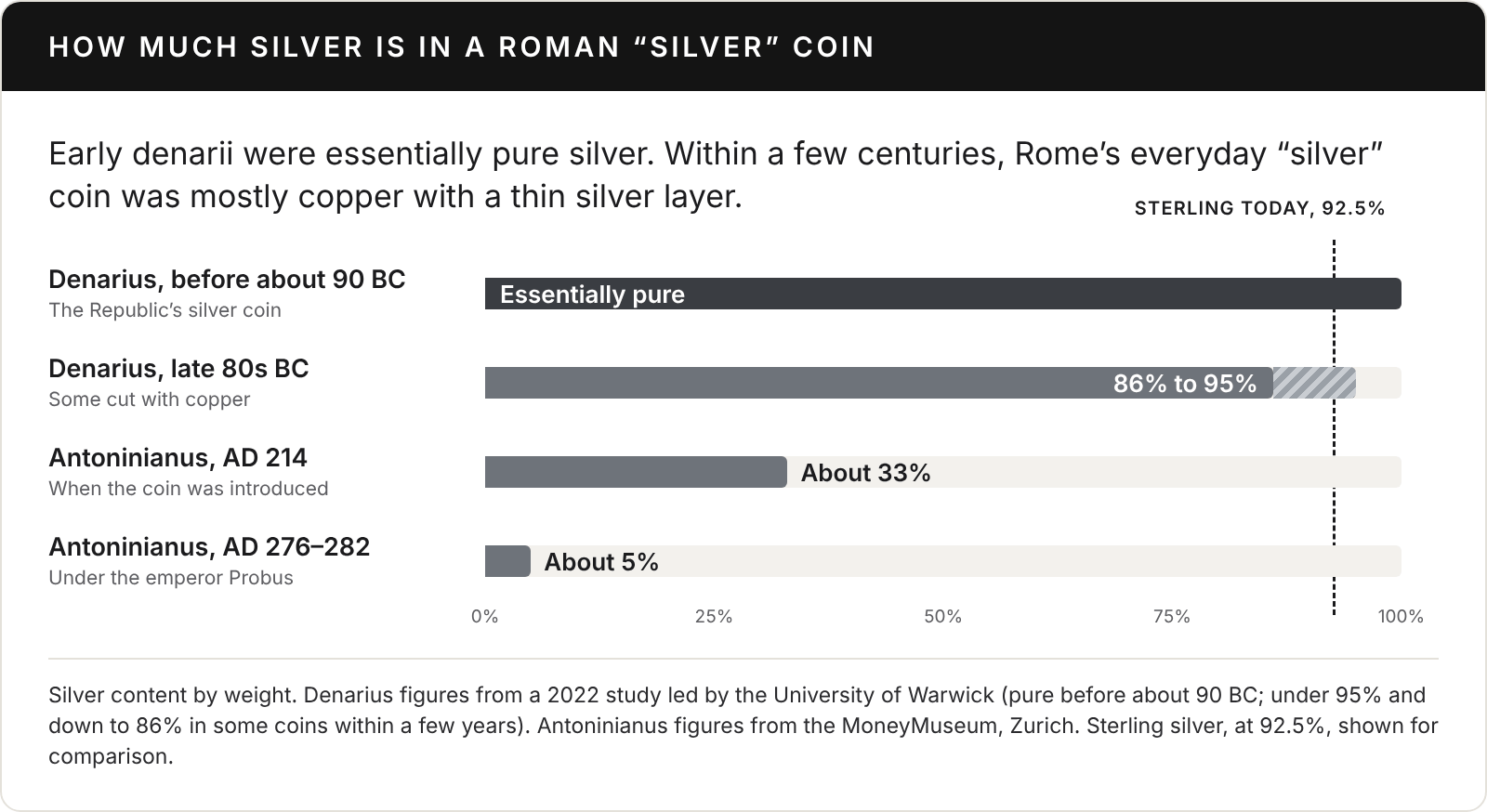
That matters on a pendant. A late antoninianus can show copper where its thin silver surface has worn, and its value lies in its age and condition, not its metal. If a listing says “Roman silver coin,” ask which coin, which ruler, and roughly when it was struck.
Real coin or replica?
A pendant should say which it holds, and in the US, a replica has to. Under the Hobby Protection Act, it is unlawful to make, import, or sell an imitation numismatic item, a term that covers any reproduction, copy, or counterfeit of a coin, unless it is “plainly and permanently marked ‘copy.’” A replica sold in the US without that mark tells you something about the seller, whatever the price.
- Ask in writing whether the coin is genuine, and for its identification: the ruler, the denomination, and the approximate date.
- For a genuine coin, buy from a coin dealer who guarantees authenticity in writing. Photos alone rarely settle it.
- A replica is a perfectly good choice when it is sold as one: it costs far less, it can be made of sterling silver throughout, and it can be set any way you like.
Buying a genuine coin from abroad
Some ancient coins can’t simply be shipped into the US. US Customs and Border Protection extended its import restrictions on archaeological material from Italy, which include a category of “coins of Italian types,” through January 12, 2031, according to a rule published in the Federal Register in January 2026. Restricted pieces can enter only when the conditions of US law are met, which generally means paperwork showing the coin left its country legally or before the restrictions applied. If you are buying from a seller overseas, ask whether the coin falls under a US restriction and what documents come with it; buying from a US dealer who already holds the coin avoids the question.
Set it, don’t drill it
How a coin is mounted decides whether it survives the pendant. A frame or bezel holds the coin by its edge and can be opened later; drilling a hole or soldering on a bail damages it for good. So does polishing: cleaning a coin “can reduce both its value and grade,” APMEX warns, because it strips the coin’s patina and tone.
- Fit the frame to the coin. Ancient coins were struck by hand and are rarely perfectly round, so the frame should be made or adjusted for that coin.
- Consider an open back, so the reverse shows too, like the tetradrachm pendant GIA described.
- Clean the frame, not the coin. A soft cloth on a sterling mount is enough; keep silver dips and polish away from the coin itself.
Wearing a coin pendant
Treat it like any pendant. Measure the coin in its frame: a medium pendant is just under 1″, about 23 to 25 mm, as our guide to pendant size explains. The chain has to pass through the bail and carry the weight, which our guide to the best chain for a pendant matches by width, and a pendant usually wants a chain one size longer than he wears alone, as our pendant gift guide notes. Take it off for the gym and contact sports, and keep a genuine coin off at night, when a chain is pulled and twisted most.
If you want a symbol rather than a piece of history, our guide to men’s pendant meanings traces the Roman eagle and other motifs that carry the same mood in solid sterling.
FAQ
Are Roman coin necklaces real coins?
Some are genuine; many are replicas. In the US a replica must be plainly and permanently marked “COPY,” so ask the seller in writing which you are buying.
Is a Roman coin pendant solid silver?
It depends on the coin. Denarii were pure silver until about 90 BC, but by the 270s the antoninianus held about 5 percent silver over a copper core.
Can I buy an ancient Roman coin from overseas?
Check first. US import restrictions on archaeological material from Italy, including coins of Italian types, run through January 2031, and restricted coins need documentation to enter.
Should I clean or polish a Roman coin?
No. Cleaning strips a coin’s patina and can reduce both its value and its grade. Clean the frame around it instead.
Can a coin go in a pendant without damage?
Yes, in a frame or bezel that holds it by the edge. Avoid drilling the coin or soldering a bail to it, which damages it for good.
What chain goes with a coin pendant?
A solid chain wide enough for the pendant’s weight, with links that fit through the bail, usually one size longer than the chain he wears alone.
Bottom line
A Roman coin pendant is a piece of history only if the coin is genuine, so get that in writing; a replica is a fine choice when it is marked COPY and sold as one. Know what “silver” means for the coin’s date, keep it in a frame rather than drilled or polished, check the import rules before buying from abroad, and hang it on a chain made for its weight.

From the collection
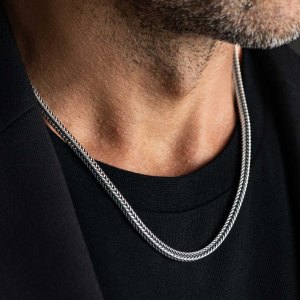
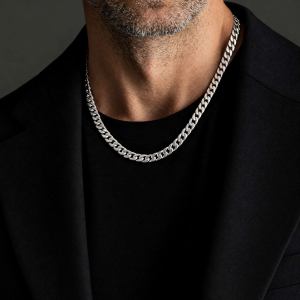
Men’s sterling silver chains by Ronatelli
Ten handmade 925 chains, from a 2 mm snake chain to a 7 mm curb, in 20 to 26 inches. Every length is the same price.
Related guides
The trend note follows Esquire’s report as republished by MR Magazine (October 2026); Bulgari’s Monete history follows Coin World; the tetradrachm pendant follows GIA’s Gems & Gemology (Spring 2024); denarius fineness follows a 2022 study led by the University of Warwick; antoninianus fineness follows the MoneyMuseum, Zurich; replica marking follows the Hobby Protection Act, 15 U.S.C. 2101; import restrictions follow CBP’s January 2026 rule in the Federal Register; and the cleaning warning follows APMEX. This is general information, not legal advice. All were checked on October 30, 2026. Read our editorial policy.

