Disclosure:The example pieces in this guide are from Ronatelli. The advice applies to any brand. Prices, weights, and product details were checked on ronatelli.com on October 30, 2026.
Many pendant listings give a price, photos, and sometimes a weight, but no height, which makes size one of the harder things to judge online. Buyers notice: in the reviews of one brand’s pendants, 20 mention size, and 9 of them found theirs large or larger than they expected. This guide covers what small, medium, and large mean, how to match a pendant to a build and a neckline, how to judge size when a seller lists only a weight, and how to keep a pendant facing forward, with that brand’s eight pendants as examples.
Key takeaways
- Just under 1″ is medium: three jewelers’ size guides all count a pendant of about 23 to 25 mm, roughly the width of a US quarter, as medium or standard. Where large begins varies, from just over 1″ (26 mm) to about 1.4″ (36 mm).
- Size it to his build: smaller on a slim frame, larger on a broad one. Above about 1½″ (38 mm), wear it on a chain of 22″ or longer.
- No dimensions? Use the weight: a quarter weighs 5.67 g, so a 12 g pendant weighs about as much as two quarters. Then check photos of it worn and what reviewers say, and ask the seller for the height.
- Over or under: over a T-shirt or a V-neck, under a collared shirt, and under a tie, small and flat or not at all.
- Facing forward: a bail that fits the chain and a dense chain keep a pendant from turning.
In this guide Sizes Build Weight only Small or large Over or under Facing forward By weight FAQ
Pendant sizes: small, medium, and large
Jewelers don’t share one scale for pendant sizes, and their guides draw the lines in different places. Three examples, in millimeters as they give them (1 inch is 25.4 mm):
| Jeweler | Small | Medium | Large |
|---|---|---|---|
| USA Jewels | Small15 to 22 mm | Medium23 to 35 mm | Large36 to 55 mm, and extra large above that |
| Greenwich Jewelers | Small8 to 15 mm | Medium16 to 25 mm | Large26 mm and up (“statement”) |
| H.E. Phillips | Small5 to 10 mm (“discreet”) | Medium15 to 25 mm (“standard”) | Large30 mm and up (“statement”) |
The only range all three call medium or standard is about 23 to 25 mm, just under 1 inch. That is about the size of a US quarter, which the US Mint lists at 0.955 inch (24.26 mm) across, so a quarter held to the chest is a fair preview of a medium pendant. Large is where they part, from just over 1″ (26 mm) at Greenwich to about 1.4″ (36 mm) at USA Jewels. Our chain length guide adds a practical line: a pendant over about 1½″ (38 mm) tall looks crowded on a chain shorter than 22″.
Match the size to his build
USA Jewels ties pendant size to the man wearing it: “Pendant size should be proportional to your build and chosen chain,” with a medium pendant “proportional on most builds” and a large one “best on larger builds.” The Modest Man makes the same point about necklaces in general: a slim man suits a thinner piece, and a stockier one can carry larger pieces more easily. None of these guides ties pendant size to height; frame and neckline do the work. In Ronatelli’s reviews, a 6′5″ buyer found the Norcia larger than he expected and right for his size.
Keep the chain in proportion too. “A bold pendant needs a chain with comparable presence,” as Greenwich Jewelers puts it, and USA Jewels adds a quick test: “If your chain is wider than your pendant is tall, the chain overwhelms the piece.” For the width a pendant’s weight needs, our guide to the best chain for a pendant has the numbers.
When a seller lists only a weight
Many listings give a weight but no height. Ronatelli is one: its search listings give weights of 12.3 to 25 g for six of its eight pendants and no dimensions for any, and its FAQ says listed weights can vary by about 5 g either way. The weight is still useful. A US quarter weighs 5.670 g, per the US Mint, so a 12 g pendant weighs about as much as two quarters and a 25 g one about four and a half. A heavier pendant is usually bigger or thicker, but not always: a hollow or openwork piece weighs less than a solid one of the same size, and one Anzio buyer notes that it is hollow inside.
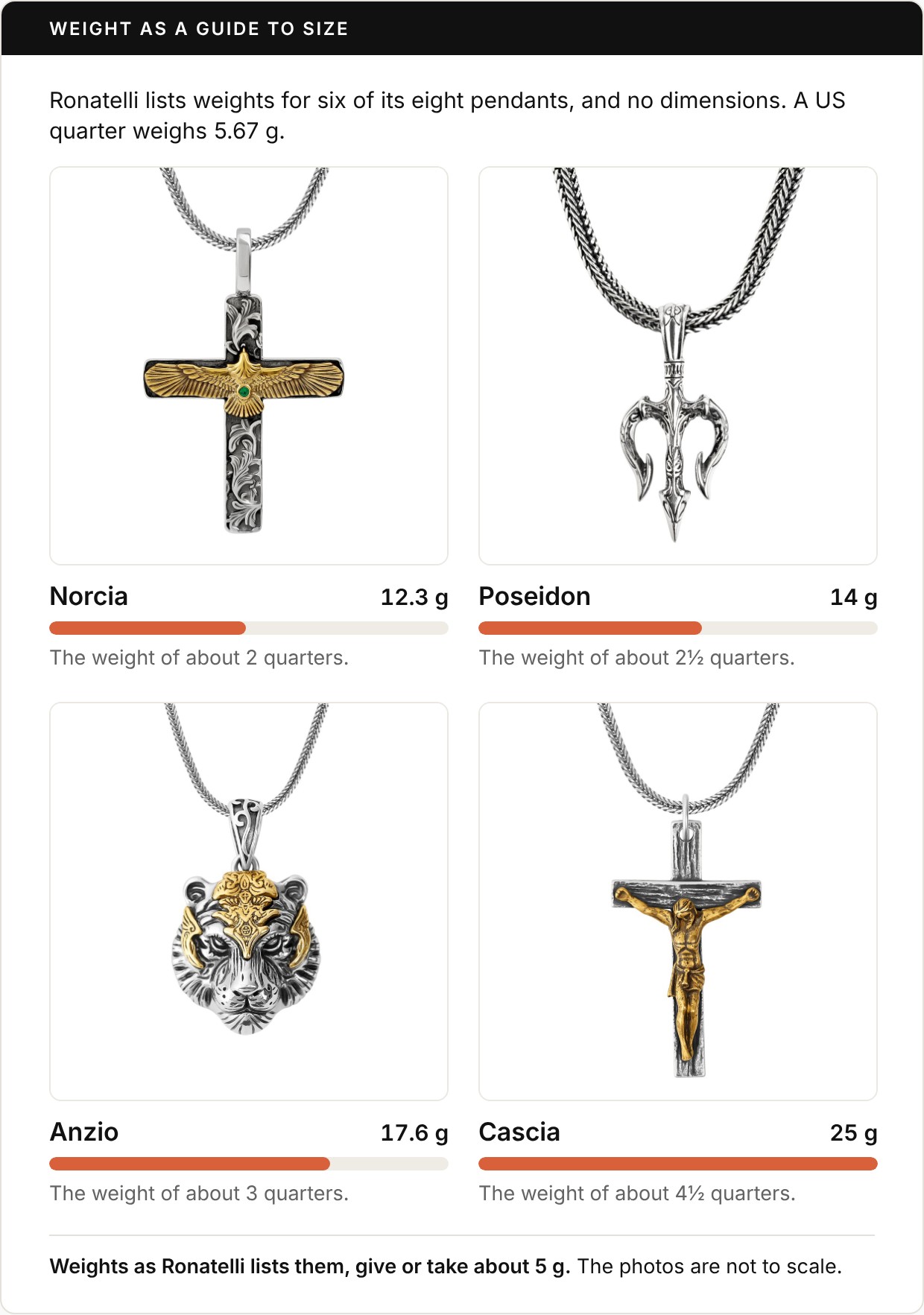
Then check three more things before you buy:
- Photos of it worn. “It’s not easy to visualize the scale of an item by its listed measurements and specifications alone,” as National Jeweler’s online secret shopper put it; a photo of the pendant around someone’s neck shows it better. Ronatelli shows each of its pendants worn, though for the Lyon and the Fabro the photos don’t say which size is shown.
- What reviewers say about size. Of the 238 reviews of Ronatelli’s pendants, 20 mention size: 11 call it right and 9 found theirs large or larger than they expected, most of them for the Cervia and the Ravenna.
- The height, from the seller. Most jewelers “can be reached via email, phone and website chat,” as the jewelry insurer Jewelers Mutual notes; ask for the height including the bail, and the width. Once you have them, Greenwich Jewelers suggests you “cut a paper oval in the listed length and width, then hold it where the pendant would sit.”
Small or large: when there is a choice
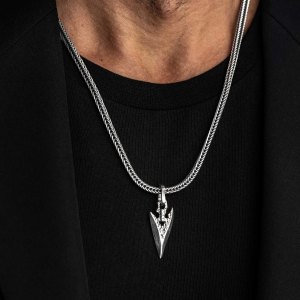
Some pendants come in more than one size. Ronatelli sells two that way, with no measurements for either: the Lyon arrowhead (small $99, large $149) and the Fabro joker (small $99, medium $149). One Lyon photo shows both sizes side by side, the best guide to the difference:
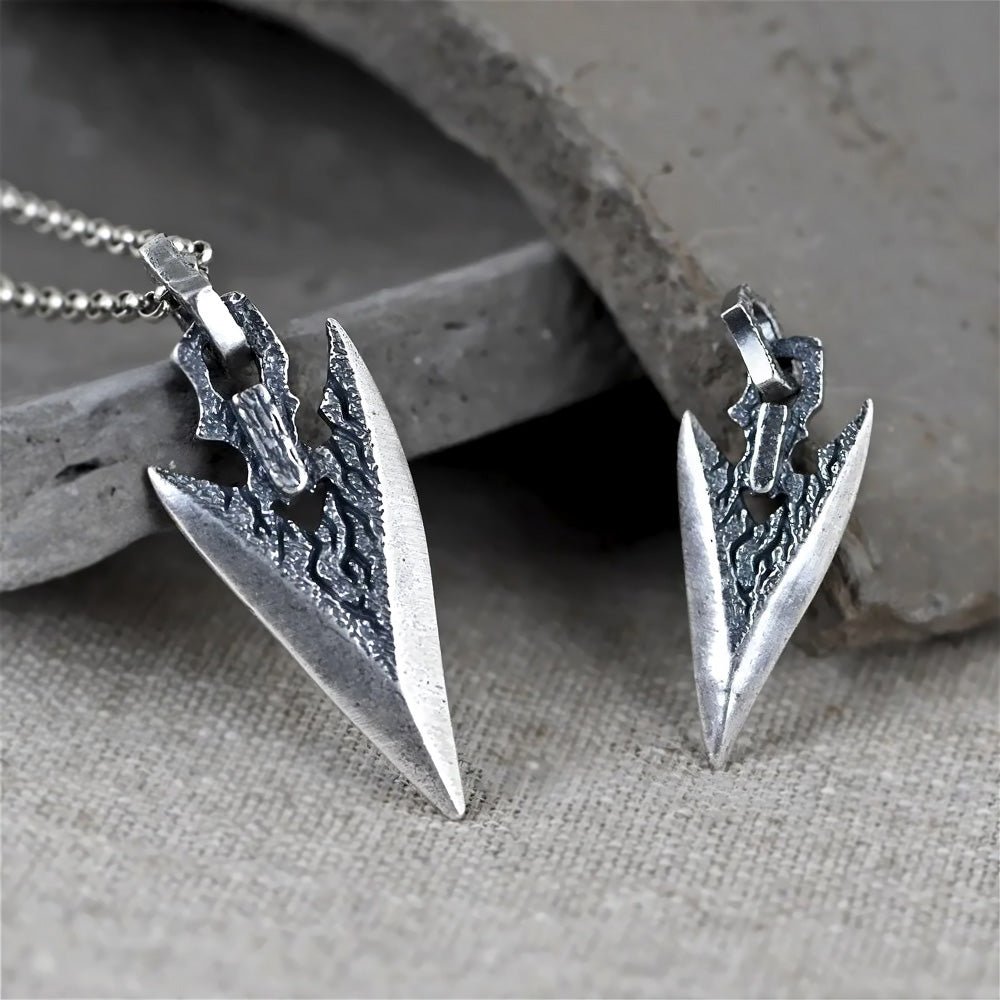
Choose the smaller one for a slim frame, for wearing under a shirt, or as a first pendant, and the larger for a broad frame or for wearing over a T-shirt. One gift buyer chose the small Fabro, thinking the medium would be too big. Ronatelli’s refund policy says the fastest way to change a size is a return and a new order, so decide before you buy.
Over or under the shirt
The neckline decides how much of a pendant shows, and so how big it can be:
| Neckline | The pendant | Why |
|---|---|---|
| Crew-neck T-shirt | The pendantOver the shirt; medium or large | WhyPendants “can be worn outside casual shirts like T-shirts,” as Real Men Real Style notes |
| V-neck or henley | The pendantOver the shirt, filling the opening | WhyA pendant on a 22″ to 24″ chain fills the V, as our chain length guide explains |
| Open-collar shirt | The pendantSmall or medium; small and flat with a suit | WhyUSA Jewels says a medium pendant “works with open collars and V-necks”; The Modest Man and Real Men Real Style tuck it under any collar |
| Collared shirt, buttoned | The pendantUnder the shirt | Why“Any time you’re wearing a collared shirt, your necklace should be tucked,” in The Modest Man’s words |
| Shirt and tie | The pendantUnder, small and flat, or left at home | WhyA pendant under a tie can show as a bump below the knot, as our guide to a chain with a suit explains |
| Gym and bed | The pendantOff, or small and flat in bed | WhyIt swings during exercise and twists overnight, as our guide to wearing a chain every day explains |
Keeping it facing forward
A pendant that keeps turning around usually has one of three problems:
- The bail doesn’t fit the chain. “If the bail is too wide, the pendant may flip or wander,” Greenwich Jewelers notes. Our chain guide suggests about 1 mm of room between the bail and the widest part that has to pass through it, usually the clasp; a bail much bigger than the chain lets the pendant slide and turn.
- The chain lets it spin. “A flexible cable chain allows a pendant to spin freely, often ending up face-backwards,” as the chain retailer NineTwoFive puts it, while a box chain keeps it facing forward. Our chain guide rates box, franco, and wheat highest for a pendant, then rope, foxtail, and curb. Jewelers differ on cable chains: Greenwich Jewelers finds cable and curb keep a pendant stable. It also warns that smooth styles such as snake chains “may encourage flipping with certain pendants” and suggests slightly textured links, such as curb.
- The pendant is top-heavy. A tall pendant with a high center of gravity “will have a tendency to roll and turn over,” as Bradney Simon writes in a Bench magazine article on Ganoksin, and Interweave notes that a bail set lower than the top quarter of the back lets a pendant fall forward. Both come down to design, so check where the bail sits in the photos; on a pendant you already own, a denser chain helps with turning but won’t change how it hangs.
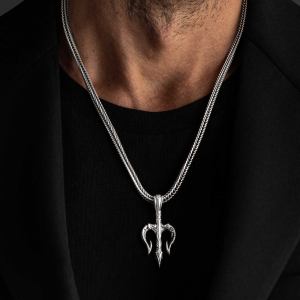
Ronatelli’s photos show most of its pendants on a foxtail chain, which is dense and lies flat, and our chain guide pairs them with Ronatelli’s Sergo foxtail and Monza rope.
Ronatelli’s eight pendants by weight
- 12.3 g. The Norcia eagle cross ($149), the lightest listed weight.
- 14 g. The Poseidon trident ($169) and the Ravenna sword cross ($149).
- 17 to 17.6 g. The Cervia eagle cross ($169) and the Anzio tiger ($169).
- 25 g. The Cascia crucifix ($199), the heaviest; one parent who bought it for a 19-year-old son called it “a bit heavy.”
- No weight listed. The Lyon arrowhead (small $99, large $149) and the Fabro joker (small $99, medium $149).
By the weight rule in our chain guide, the five from 12.3 to 17.6 g belong on a 4 mm chain, and the Cascia, above 20 g, on a solid, dense chain 4 to 5 mm wide. Our comparison of all eight has their ratings and details, and our guide to men’s pendant meanings covers what each motif stands for.
FAQ
What size pendant should a man wear?
For most men, a medium pendant, about 1 inch (25 mm) or just under, the width of a US quarter. Go smaller for a slim frame or for wearing under a shirt, and larger for a broad frame or over a T-shirt; above about 1½″ (38 mm), wear it on a chain of 22″ or longer.
How big is a 1-inch pendant?
About the size of a US quarter, which is 0.955 inch (24.26 mm) across. Hold a quarter where the pendant would hang to see it.
How can I tell a pendant’s size if the seller lists only a weight?
Compare the weight with a US quarter, which weighs 5.67 g, look for photos of it worn, read what reviewers say about size, and ask the seller for the height. A hollow pendant weighs less than a solid one of the same size.
Should a pendant be worn over or under the shirt?
Over a T-shirt or a V-neck, under a collared shirt, and under a tie, small and flat or not at all.
Why does my pendant keep flipping?
Usually one of three things: the bail is too big for the chain, the chain lets it spin (a cable chain can), or the pendant is top-heavy. A bail that fits the chain and a dense chain help with the first two.
What chain length does a large pendant need?
22″ or longer once the pendant is over about 1½″ (38 mm), and 24″ for a large pendant or a broad build, as our chain length guide explains.
Bottom line
Start around 1 inch (25 mm), about the size of a quarter, then adjust for his build and how he will wear it: smaller under a shirt or on a slim frame, larger over a T-shirt or on a broad one. When a seller lists only a weight, use it, the photos, and the reviews together, and ask for the height before you buy.
From the collection
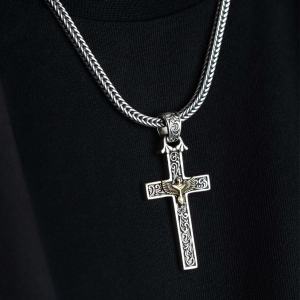
Men’s sterling silver pendants by Ronatelli
Eight handmade 925 pendants, $99 to $199. Each fits chains up to 6 mm; the chain is sold separately.
Related guides
Size bands come from the pendant size guides of USA Jewels, Greenwich Jewelers, and H.E. Phillips; the build and neckline advice from USA Jewels, The Modest Man, and Real Men Real Style; the coin figures from the US Mint; the notes on flipping from Greenwich Jewelers, NineTwoFive, Ganoksin, and Interweave; the note on photos from National Jeweler; and the note on asking the seller from Jewelers Mutual. Ronatelli weights, prices, and policies were read from ronatelli.com on October 30, 2026, and may have changed since; review counts and quotes come from the Reviews.io feed for each pendant. Read our editorial policy.

