
Fine scratches on a sterling silver ring can usually be polished out at home with a silver polishing cloth. Deeper ones, the kind that catch a fingernail, are a job for a jeweler, who sands and polishes the surface down to the bottom of the scratch, and that takes a little silver every time. Before you rub anything, check the finish: a polishing cloth leaves shiny patches on a brushed ring, a darkened ring should only be polished on its high points, and toothpaste or a baking soda paste will add scratches rather than remove them.
Key takeaways
- Run a fingernail across the scratch. If it glides over, the scratch is fine and a polishing cloth can usually handle it. If it catches, the scratch is deep and needs a jeweler, or can simply be left.
- A polishing cloth is a mild abrasive. It levels a fine scratch by removing a very thin layer of silver, so use it when the ring needs it, not every day.
- Every polish costs a little silver. Sanding out a deep scratch means bringing the surface around it down to its bottom, so on a thin band, ask how much metal a refinish will take.
- Check the finish first. Brushed rings need re-brushing, not a cloth; hammered rings hide marks; darkened rings get the cloth on their high points only; plated and stone-set rings get the gentlest treatment.
- Never toothpaste or a baking soda paste. Both are abrasives, and on polished silver they leave a haze of new scratches.
In this guide Fine or deep? Polishing cloth Not toothpaste At a jeweler By finish Prevention FAQ
Fine scratch or deep scratch? The fingernail test
Every silver ring scratches. Sterling is softer than steel, and rings hit more things than any other jewelry, so a polished band shows marks quickly, as our ring buying guide notes. Most of those marks are cosmetic. What to do about one depends on two things: how deep it is, and what finish the ring has.
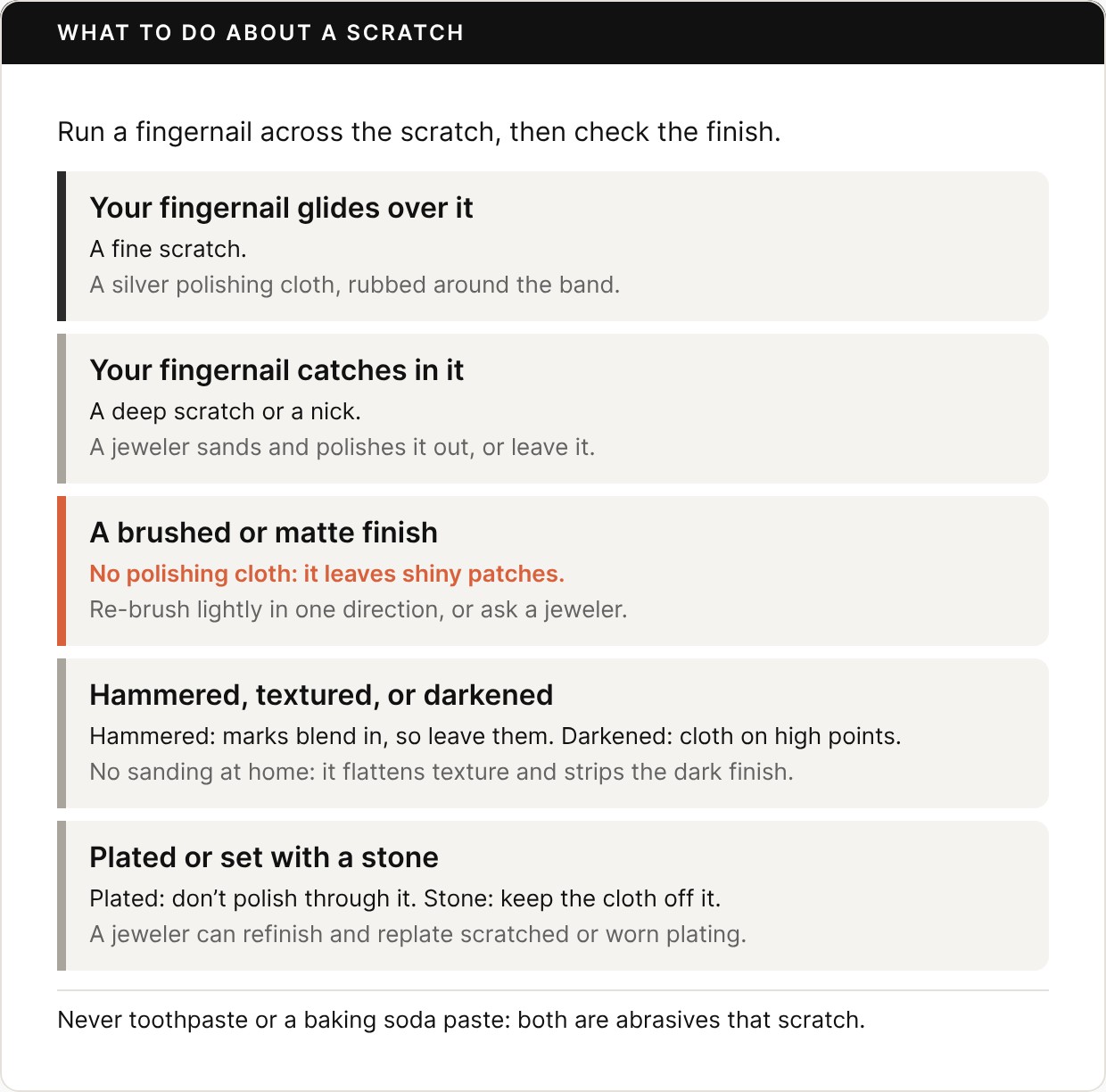
To judge depth, run a fingernail lightly across the scratch. If your nail glides over it, it is a fine scratch in the surface of the polish. If your nail catches, the scratch is deep enough that a cloth won’t reach the bottom of it. It is a rough test rather than a measurement, but it matches the line jewelers draw: superficial scratches “affect only the metal’s surface and can be polished away,” while deeper ones may need more comprehensive repair, as Robinson’s Jewelers explains.
Fine scratches: a silver polishing cloth
For fine scratches on a plain, polished ring, a silver polishing cloth is the right tool, and often the only one you need. It is more than a soft cloth: “Silver polishing cloths are impregnated with an abrasive material,” the Canadian Conservation Institute (CCI) notes. That mild abrasive levels the edges of a fine scratch, and the mark fades into the shine.
- Clean the ring first. Wash it in warm water with a drop of dish soap and dry it completely, as our cleaning guide describes. Grit left on the surface “may be more abrasive than the polish you will be using” and “can actually scratch the silver if rubbed into the surface,” silver restorer Jeffrey Herman warns.
- Rub with the treated side, around the band. Work in straight, back-and-forth strokes rather than circles. Herman gives the same advice for applying silver polish: rub “in a straight, back-and-forth manner so as to maintain a uniform appearance.”
- Check in good light, and stop when the mark fades. Rubbing on after that only takes more silver.
- Buff with the untreated side. And don’t wash the cloth: washing removes the polish it is treated with, our cleaning guide notes.
A cloth won’t erase everything. Its abrasive is mild, so it works on marks in the surface; on a scratch that catches your nail, harder rubbing only takes more silver from around it. That is the point to stop and decide between a jeweler and leaving it.
Conservators, whose job is to preserve old silver, are stricter still: Herman’s abrasion ratings put several polishing cloths and rouge cloths among the products not to use on silver at all. On a ring you wear, losing a trace of silver to soften a scratch is usually a fair trade, but it is the reason to polish only when the ring needs it.
Why not toothpaste or baking soda?
Toothpaste is the classic home remedy, and it is the one to skip. It cleans teeth because it contains abrasives: the American Dental Association lists calcium carbonate, dehydrated silica gels, hydrated aluminum oxides, magnesium carbonate, phosphate salts, and silicates, and notes that abrasives can remove surface stains. Silver is soft, about 2.5 on the Mohs scale for pure silver, as our black onyx rings guide notes, and on a polished ring those particles leave a haze of fine scratches that only re-polishing removes, as our cleaning guide explains.
Herman is emphatic: “Toothpaste should NEVER be used as a silver polish,” he writes, because some toothpastes contain baking soda or other ingredients “which are much too abrasive.” His abrasion ratings list toothpaste (“virtually all brands”) and baking soda among the products to keep away from silver. Baking soda dissolved in water, as in the foil bath in our cleaning guide, is a different matter; it is as a paste, rubbed on, that it scratches.
Even proper silver polishes are abrasive. “There are currently NO silver polishes on the market that are non-abrasive, though, many proclaim to be,” Herman writes, and the CCI notes that polishes leave behind “a pattern of fine scratches.” Use the gentlest thing that works.
Deep scratches: what a jeweler does
A scratch that catches your fingernail has to be worked out, not buffed. The bench method, as the jewelry supplier Cooksongold describes it, is to file around a deep scratch, sand from a coarse grit, such as 400, through to a fine one of 1200 or higher, then polish with tripoli first and rouge for a mirror finish. Hobbyists do this at home, but on a curved band it takes practice to keep the surface even, so for a ring you value, it is a job for a jeweler.
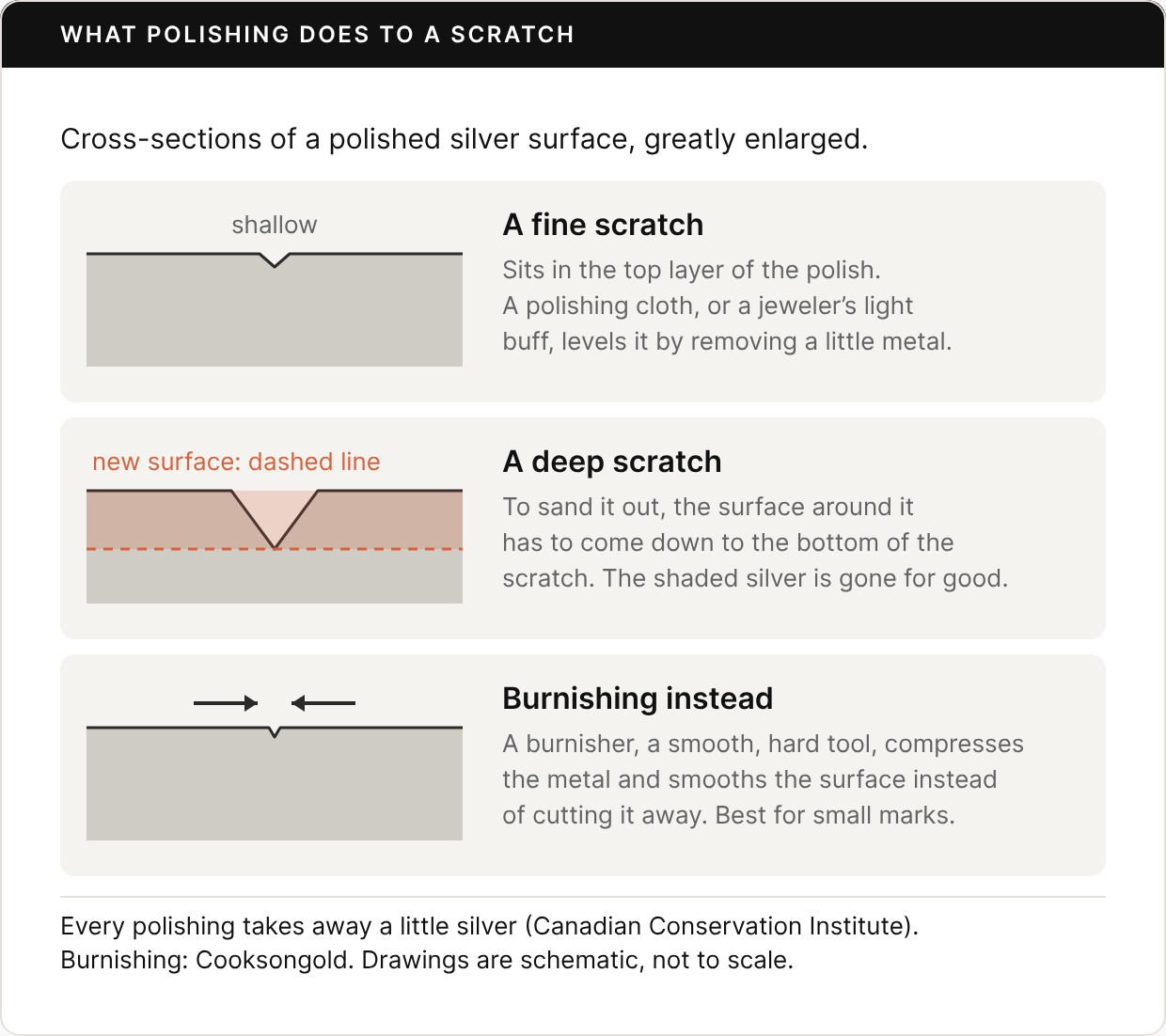
That is also why deep scratches cost silver. To sand one out, the surface around it has to come down to the bottom of the scratch. Polishing “removes a thin layer of metal, so it should be done sparingly,” Robinson’s Jewelers notes, and the CCI says the same of silver: each polishing “takes away a certain amount of underlying silver.” On a heavy band that hardly matters. On a thin one, it can: our ring buying guide recommends 1.5 mm of thickness or more, so ask the jeweler how much metal a refinish will take before you go ahead.
For a small mark there is a gentler option. A burnisher, a smooth, hard tool, is used “to compress the metal and smooth out the surface,” as Cooksongold puts it, rather than cutting metal away. For a nick deep enough to matter, Robinson’s notes, a jeweler can fill it with compatible metal or reshape the area.
Or leave it. A scratch on sterling is cosmetic, and on a high-polish ring the marks settle over time into a soft sheen, as the finishes table in our ring buying guide describes. Some men prefer a ring that looks worn in.
When not to polish: finishes, plating, and stones
Everything above is for a plain, polished ring. A ring with any other surface needs a different approach, and some shouldn’t be polished at all.
| Ring | Fine scratches | Deep scratches | Avoid |
|---|---|---|---|
| High polish | Fine scratchesA polishing cloth | Deep scratchesA jeweler sands and polishes it | AvoidToothpaste, baking soda paste |
| Brushed or satin | Fine scratchesUsually hidden by the grain; re-brush lightly in one direction | Deep scratchesA jeweler restores the brushed finish | AvoidA polishing cloth or polish: it leaves shiny patches |
| Hammered or textured | Fine scratchesUsually hidden by the texture; leave them | Deep scratchesAsk a jeweler before any repair | AvoidSanding, which flattens the texture |
| Darkened (oxidized) | Fine scratchesCloth on the raised high points only | Deep scratchesA jeweler, who can re-darken the recesses | AvoidSanding, the foil bath, and silver dips |
| Rhodium-plated | Fine scratchesLeave them; clean with the soft side of the cloth only | Deep scratchesA jeweler refinishes and replates it | AvoidThe treated side of the cloth, dips |
| Set with a stone | Fine scratchesCloth on the silver, kept off the stone | Deep scratchesA jeweler; mention the stone first | AvoidPaste, dips, the foil bath |
Brushed and satin. Robinson’s is blunt about it: “never, ever use a standard jewelry polishing cloth or abrasive polish on a matte or brushed piece,” because it “will create uneven, shiny patches that permanently alter the finish.” For light scuffs, its advice is a brand-new, clean Scotch-Brite pad, very light pressure, and strokes in one consistent direction to match the grain; try it first on a spot that doesn’t show. The pad is abrasive on purpose, since it re-cuts the grain. Herman lists Scotch-Brite pads among the products not to use on silver, and on any polished surface he is right, so keep the pad off the polished parts of a ring. A jeweler restores a brushed finish with tools such as radial bristle discs and satin finishing machines.
Hammered and textured. These hide wear best of all, as our ring buying guide notes: new marks blend into the surface. Sanding would flatten the very texture you chose, so leave fine marks alone. Our guide to textured silver bands shows how each kind wears.
Darkened. The dark finish in the recesses is tarnish applied on purpose, and the high points are meant to wear bright. Run the cloth lightly over the raised surfaces only, and keep the foil bath and dips away from it, as our cleaning guide explains. If the dark finish wears away, a jeweler can apply it again.
Plated and stone-set. Rhodium plating is a thin layer, so don’t try to polish scratches out of it: clean it with soap and water and only the soft side of a cloth, and when it is scratched or worn through, a jeweler can refinish and replate it. On a stone ring, polish the band and the frame, keep the cloth off the stone, and keep pastes away from it, as our black onyx rings guide advises.
How to keep a silver ring from scratching
A silver ring will always pick up marks; the aim is fewer deep ones.
- Take it off for the gym and for tools. The knurled grip on a barbell is steel, which is harder than sterling, so it scratches the polish, and a hard grip can dent a thin band, as our guide to wearing a silver ring every day explains.
- Mind the grit. Dust and sand contain quartz, which rates 7 on the Mohs scale, as our guide to black onyx and other black stones notes; pure silver is about 2.5. Rinse a ring before you wipe it, so you don’t rub grit across the polish.
- Store rings apart. Rings tossed together in a dish or drawer scratch each other. A separate bag for each piece prevents that and slows tarnish too, as our tarnish guide explains.
- Choose a finish that hides wear. High polish shows scratches first, and brushed and hammered finishes hide them, our ring buying guide notes; on a darkened ring, bright high points are part of the look.
FAQ
Can you get scratches out of sterling silver?
Fine ones, usually yes, with a silver polishing cloth. Deep ones, the kind that catch a fingernail, need a jeweler to sand and polish the surface down to the bottom of the scratch, which takes a little silver with it.
Does a polishing cloth remove scratches?
It can remove or soften fine surface scratches, because the cloth is impregnated with a mild abrasive. It won’t remove a scratch that catches your fingernail, and it shouldn’t be used on brushed or matte rings.
Does toothpaste remove scratches from silver?
No. Toothpaste contains abrasives designed for teeth, and on polished silver it leaves a haze of fine scratches. Silver restorer Jeffrey Herman says it should never be used as a silver polish.
Does baking soda remove scratches from silver?
Not as a paste. Rubbed on, baking soda is abrasive and scratches silver. Dissolved in water, as in the foil bath for tarnish, it is a different matter, but that removes tarnish, not scratches.
Does polishing make a silver ring thinner?
Very slightly, each time. Every polishing removes some silver, so a ring polished regularly for years loses a little metal. On a solid band that hardly matters; on a thin one, polish only when the ring needs it.
How do you get scratches out of a brushed silver ring?
Not with a polishing cloth, which leaves shiny patches. Robinson’s Jewelers suggests a new, clean Scotch-Brite pad, very light pressure, and strokes in one direction, or a jeweler for a full refinish.
Is it normal for a silver ring to scratch?
Yes. Sterling is softer than steel, and a polished band shows marks within weeks before settling into a soft sheen. The scratches are cosmetic.
Bottom line
Run a fingernail across the scratch. If it glides over, a silver polishing cloth, rubbed around a clean band, will usually make the mark fade. If it catches, take the ring to a jeweler, or live with it, since every refinish costs a little silver. Leave the cloth off brushed rings, the polish off darkened recesses and stones, and the toothpaste in the bathroom.
From the collection
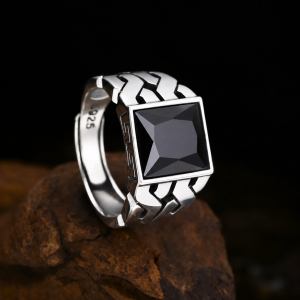
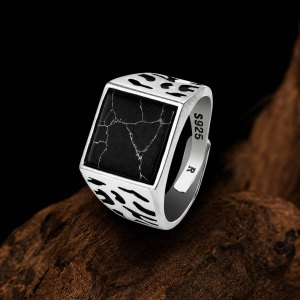
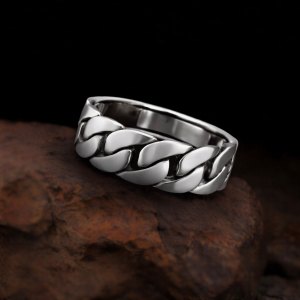
Men’s sterling silver rings by Ronatelli
Eleven handmade 925 rings, $129 to $169, from a chain-link band to a black onyx statement ring. Every one is adjustable.
Related guides
Polishing cloths, polishes, and the silver each polishing removes follow the Canadian Conservation Institute’s CCI Notes 9/7, “Silver – Care and Tarnish Removal.” Toothpaste, baking soda, rinsing before polishing, and polish abrasion follow silver restorer Jeffrey Herman’s care guide and abrasion ratings at hermansilver.com; toothpaste abrasives follow the American Dental Association’s “Toothpastes” page. Sanding, polishing compounds, and burnishing follow Cooksongold’s “How to Fix Scratches or Imperfections in Metal.” Surface and deep scratches and brushed finishes follow Robinson’s Jewelers. Ring finishes, thickness, cleaning methods, daily wear, storage, and hardness follow our own ring buying, cleaning, black onyx ring, everyday wear, tarnish, and black stones guides. Read our editorial policy.

