Black onyx, obsidian, jet, and black agate can look identical in a polished ring, but they are different materials. Black onyx is chalcedony, a fine-grained form of quartz, almost always dyed black, and a stone sold as “black agate” is often the same dyed chalcedony under another name. Obsidian is natural volcanic glass, and jet is fossilized wood. Hardness and weight are the real differences: onyx is the hardest and the best choice for a ring worn every day, obsidian chips more easily, and jet is soft and remarkably light. A few checks at home can rule things out; for a definite answer, take the piece to a gemologist or a gem lab.
Key takeaways
- Onyx and “black agate” are often the same stone. Both names are used for solid black chalcedony, and most of it is dyed with a stable treatment that probably dates to Roman times.
- Obsidian is glass, made by a volcano. At 5 on the Mohs scale against about 7 for onyx, it is softer, brittle, and chips into razor-sharp edges.
- Jet is fossilized wood. It weighs about half as much as onyx, feels warm to the touch, and is soft enough to scratch easily.
- Black glass and plastic are the usual fakes. Bubbles, swirls, mold seams, and rounded edges give many of them away under a loupe.
- For a ring you wear daily, choose onyx. It is the hardest of these, about as hard as the quartz grit in everyday dust; the others scratch sooner.
In this guide Side by side Onyx and agate Hardness and weight Obsidian Jet Fakes Home checks For a ring FAQ
Black onyx, obsidian, jet, and look-alikes side by side
| What it is | Hardness (Mohs) | Weight (specific gravity) | How to spot it | In a ring | |
|---|---|---|---|---|---|
| Black onyx | What it isChalcedony, a form of quartz, almost always dyed black | Hardness (Mohs)7 | Weight (specific gravity)2.57 to 2.64 | How to spot itAn even black with a glassy polish; cool to the touch | In a ringThe most durable choice for daily wear |
| Black agate | What it isOften the same dyed black chalcedony, under another name | Hardness (Mohs)7 | Weight (specific gravity)2.57 to 2.64 | How to spot itIdentical to black onyx | In a ringSame as onyx |
| Obsidian | What it isNatural volcanic glass | Hardness (Mohs)5 | Weight (specific gravity)2.30 to 2.50 | How to spot itGlassy; may show white “snowflakes” or a sheen; chips into very sharp edges | In a ringBrittle; best for occasional wear |
| Jet | What it isFossilized wood, a form of lignite | Hardness (Mohs)2.5 to 4 | Weight (specific gravity)1.20 to 1.30 | How to spot itVery light and warm to the touch; leaves a brown streak (vulcanite does too) | In a ringSoft; needs a protective setting |
| Black glass | What it isMan-made glass | Hardness (Mohs)5 to 6 | Weight (specific gravity)2.51 to 3.21 | How to spot itBubbles, swirl marks, or mold marks under a loupe | In a ringA common onyx substitute; scratches sooner |
| Plastic or resin | What it isMan-made | Hardness (Mohs)Low | Weight (specific gravity)1.05 to 1.55 | How to spot itLight and warm, like jet; mold seams or rounded edges | In a ringCostume jewelry |
| Hematite | What it isAn iron oxide mineral | Hardness (Mohs)5 to 6.5 | Weight (specific gravity)4.95 to 5.16 | How to spot itMetallic shine; very heavy; leaves a red streak | In a ringBrittle; needs a protective setting |
Black onyx and black agate: often the same stone
Onyx and agate are both chalcedony, the fine-grained form of quartz. Gemologists separate them by pattern: onyx has straight, parallel bands, and agate has curved or irregular ones, as the International Gem Society (IGS) and JCK explain. A stone that is black from edge to edge has no bands at all, so strictly it is neither. “When the gem is completely black, it’s supposed to be called black chalcedony—not onyx,” gemologist Gary Roskin wrote in JCK, but “generally it’s simply called black onyx.” Some sellers use “black agate” for the same dyed black chalcedony, so a black onyx ring and a black agate ring often hold the same stone.
Pure black chalcedony is rare, Roskin notes, so most of it is colored. According to the IGS, most of the solid black onyx sold today is dyed chalcedony: grayish slabs are soaked in a sugar solution and then heated in sulfuric acid, which leaves carbon in the stone’s pores. JCK calls the process “penetrating and permanent” and says it probably dates back to the Roman Empire. The IGS adds one caveat: the black goes only a few millimeters deep, so heavy repolishing can expose lighter stone. Our guide to black onyx rings explains why a dyed onyx is still a real stone.
Hardness and weight: where they really differ
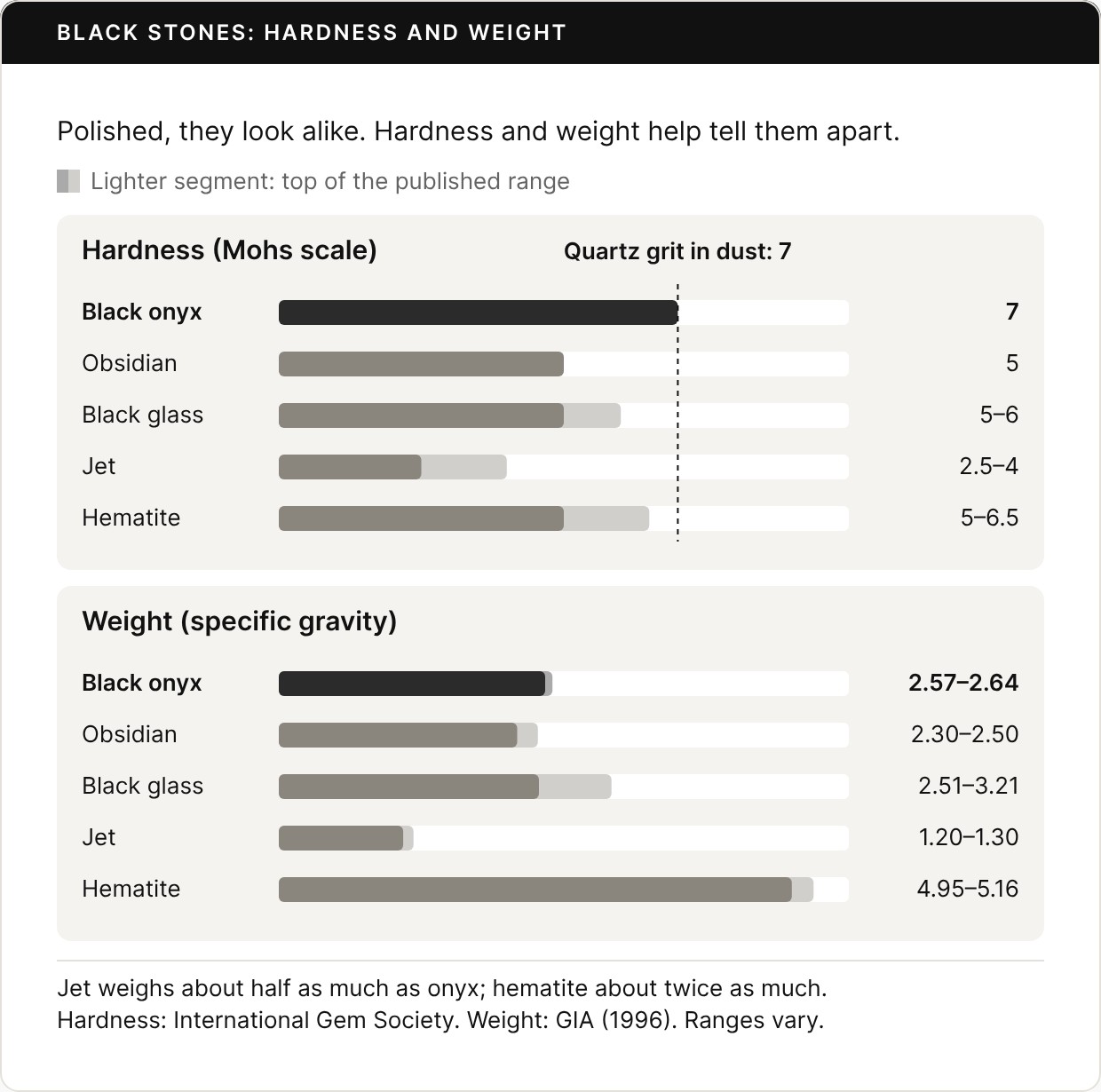
Polished and set, these materials can look the same. Two properties separate them. Hardness, on the Mohs scale, is resistance to scratching. Quartz rates 7 and is common in dust and sand, so a material softer than 7 gradually picks up fine scratches from everyday grit, while onyx, at about 7, holds its polish longest. Weight is measured as specific gravity: how heavy a material is compared with the same volume of water. Onyx is about 2.6. Jet, at about 1.25, weighs half as much, and hematite, at about 5, weighs twice as much. Obsidian and black glass are close to onyx, so weight won’t separate those three.
Obsidian: natural glass from volcanoes
Obsidian forms when volcanic lava cools too quickly to crystallize, so it is a glass rather than a mineral; the IGS calls it the most common form of natural glass. It takes a bright, glassy polish, and when it breaks it forms smooth, shell-shaped surfaces with very sharp edges, the textbook example of what geologists call a conchoidal fracture.
At 5 on the Mohs scale, obsidian is noticeably softer than onyx, and it is brittle and sensitive to heat; the IGS rates its wearability as poor. It also comes in looks onyx never has: snowflake obsidian with white, flower-like spots, rainbow obsidian with bands of color, and sheen obsidian, which shimmers under light. Plain black, highly polished obsidian, though, is easy to mistake for onyx, and banded “onyx obsidian” is volcanic glass, not onyx, as the IGS guide to onyx points out.
In a ring, obsidian is best kept for occasional wear and a setting that wraps its edges; our guide to onyx ring settings explains which settings protect a stone best.
Jet: fossilized wood, light and warm
Jet isn’t a mineral at all. It is a form of lignite, a kind of coal, as the IGS notes, formed from wood that fell into stagnant water and fossilized, according to Whitby Museum in England; the trees were similar to today’s monkey puzzle. People have worn jet since about 1400 BC, and jet from Whitby, on the Yorkshire coast, is particularly prized. Whitby jet was a mainstay of Victorian mourning jewelry, as our guide to black onyx meaning describes.
Jet is easy to tell from onyx once you hold it. With a specific gravity of about 1.25, it weighs half as much as onyx of the same size. It is a poor conductor of heat, so it feels warm to the touch, and rubbed on unglazed porcelain it leaves a brown streak, Whitby Museum notes, though vulcanite does too. It is also soft, 2.5 to 4 on the Mohs scale by the IGS’s figures, and brittle, so it scratches and chips far more easily than onyx.
Jet has many imitations: vulcanite (hard rubber), Bakelite, black glass, epoxy resin, and even coal, according to Whitby Museum. Molded fakes tend to have rounded edges rather than the sharp ones left by carving, and some fade to khaki in sunlight. The museum is firm about one test: never use a hot needle on jet, because it permanently damages the surface.
Black glass, plastic, hematite, and other look-alikes
Black glass is a common stand-in for onyx: “black, opaque, devitrified glass is commonly used as an onyx substitute,” the IGS notes. Glass rates 5 to 6 on the Mohs scale, and black glass is close to onyx in weight. Under magnification it often shows round gas bubbles or swirl marks, and molded pieces may have mold marks, rounded facet edges, or slightly concave facets, according to the IGS guide to glass. Victorian jewelers used black glass to imitate jet and sold it as “French jet,” though most of it came from Bohemia.
Plastic and resin turn up in costume jewelry. Like jet, they are light and feel warm in the hand, and molded pieces show seams or rounded edges. Gemologists have used a hot point to separate them, since jet gives off an oily smell and plastic an acrid one, according to the IGS. But the IGS calls hot point testing a destructive last resort, and Whitby Museum considers the smell test unreliable, since burning coal and many jet simulants smell much the same.
Hematite is the odd one out: an iron oxide with a metallic shine. At a specific gravity of about 5 it is twice as heavy as onyx, and it leaves a red streak. Natural hematite isn’t magnetic, the IGS notes, and GIA lists it as only sometimes magnetic; beads sold as “hematine” or “magnetic hematite” contain no hematite at all, and a strong pull gives them away.
Other black materials are sometimes sold as onyx, including black cubic zirconia, spinel, and augite, according to the IGS, which also lists black tourmaline among the stones that can be mistaken for obsidian. Telling those apart takes a gemologist’s instruments.
How to tell them apart at home
Gemologists count black, opaque materials among the hardest to identify. In a 1996 study in Gems & Gemology, GIA researchers noted that almost any gem material can be black and opaque because of inclusions, that any porous one can be dyed, and that in most cases advanced tests such as X-ray diffraction are necessary, “and even these may not be conclusive.” Home checks can’t match that, but four of them can rule things out without harming the piece.
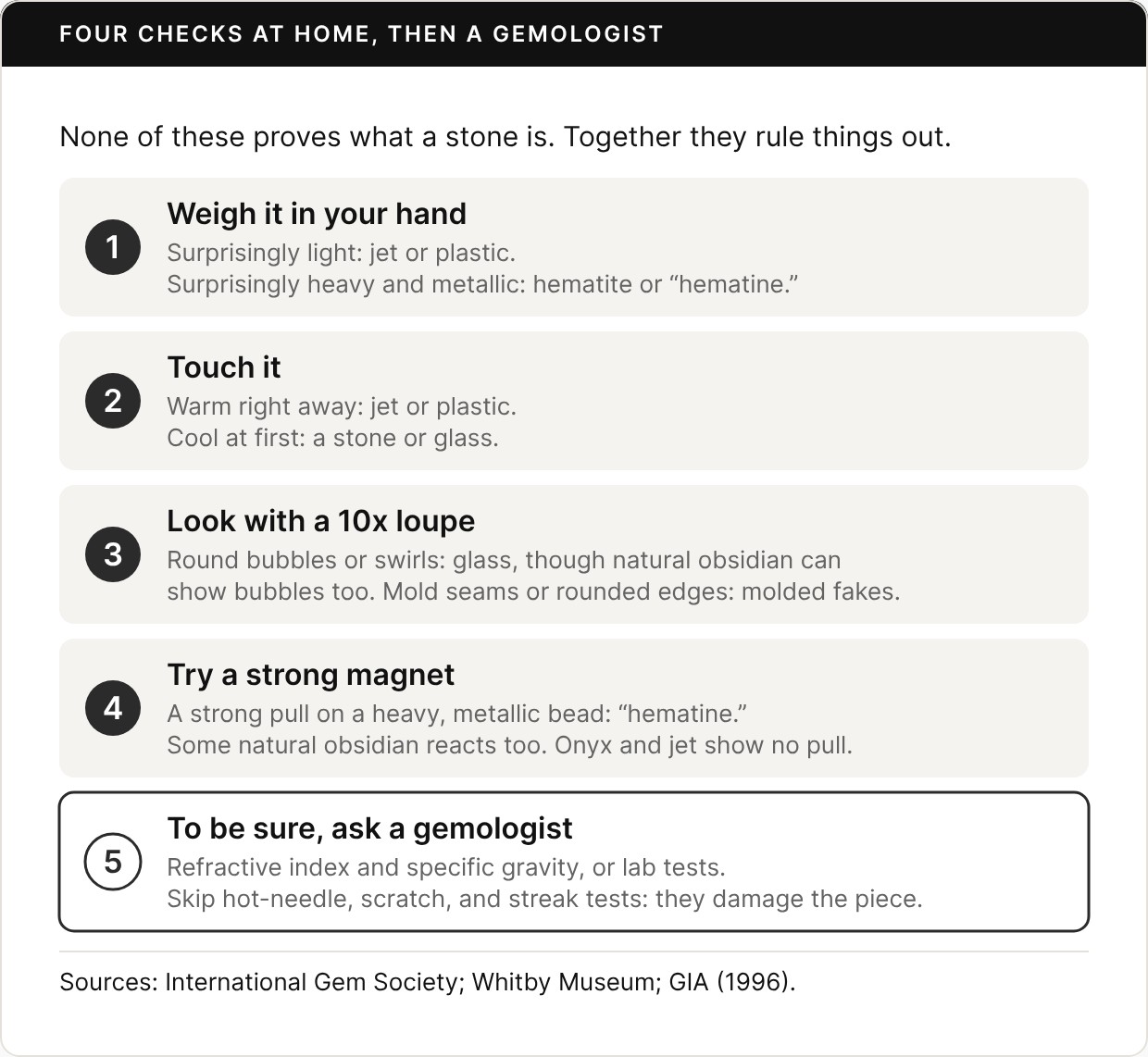
- Weigh it in your hand. A piece that feels surprisingly light for its size is likely jet or plastic; one that feels surprisingly heavy and shines like metal is likely hematite or “hematine.” Onyx, obsidian, and black glass feel similar.
- Touch it. Jet and plastic feel warm right away. Stone and glass feel cool at first.
- Look with a 10x loupe. Round bubbles or swirl marks suggest glass, though natural obsidian can contain bubbles too, and mold seams or rounded edges suggest molded glass or plastic. White “snowflakes” or a sheen under a light point to obsidian. On an opaque stone you can see only the surface, so finding nothing proves little.
- Try a strong magnet. On a heavy, metallic bead, a strong pull suggests “hematine” rather than hematite, which is at most weakly magnetic. Some natural obsidian reacts too, the IGS notes. Onyx and jet show no pull. Bring the magnet close slowly, so a magnetic bead doesn’t snap onto it and chip, and keep strong magnets away from pacemakers.
Skip the rest. A hot needle damages the surface, a scratch test damages the piece you are testing, and a streak test means rubbing the piece on porcelain, which is only reasonable on a hidden spot of a loose bead. For a definite answer on a piece that matters, a gemologist can examine it under magnification and measure refractive index and specific gravity, and a gem lab can go further.
Which is best for a ring?
For a ring you’ll wear every day, black onyx is the practical choice. Chalcedony is tough, and the IGS rates its wearability as excellent; at about 7 on the Mohs scale it is as hard as the quartz in dust, though grit still dulls the polish over the years, as our black onyx rings guide explains. Obsidian, which the IGS rates poor for wearability, and jet, which is soft and brittle, suit pendants and rings worn now and then, ideally in a setting that wraps the stone’s edges. Hematite is brittle too, and the IGS recommends protective settings for hematite rings.
Care is much the same for all of them: warm water, mild soap, and a soft brush, with no ultrasonic or steam cleaners, as the IGS advises for onyx, obsidian, and jet. On a silver ring, keep silver dips and foil baths away from the stone; our guide to onyx ring care covers cleaning both.
FAQ
Is obsidian the same as onyx?
No. Obsidian is natural volcanic glass, and onyx is chalcedony, a form of quartz. Onyx is harder, about 7 on the Mohs scale against 5 for obsidian, and less brittle, which makes it the better stone for a ring.
Is black agate the same as black onyx?
Often, yes: both names are used for solid black chalcedony, usually dyed. Strictly, onyx has straight bands and agate curved ones, and a black stone with no bands is black chalcedony.
Is black onyx natural?
The stone is natural chalcedony; the color usually isn’t. Most black onyx is dyed with a stable sugar-and-acid treatment, which is standard practice and doesn’t make it fake. Naturally black chalcedony is rare.
How can you tell real onyx from glass?
Not with certainty at home. Glass often shows round bubbles or swirl marks under a 10x loupe, and molded glass may have rounded edges or mold marks. A gemologist can usually tell them apart with magnification, refractive index, and specific gravity, and a lab can confirm.
Is jet a stone?
Not strictly. Jet is fossilized wood, a form of lignite, so it is organic rather than a mineral, though it is still considered a gem. It is very light, feels warm, and is much softer than onyx.
Does obsidian scratch easily?
More easily than onyx. At 5 on the Mohs scale it is softer than the quartz in everyday dust, and it is brittle, so edges can chip if the stone is knocked.
Which black stone is best for a men’s ring?
Black onyx. It is the hardest and toughest of these materials and works in any setting, from a flat signet face to a raised stone; our guide to stone signet rings shows the main styles.
Is hematite magnetic?
Usually not, or only weakly: the IGS says natural hematite isn’t magnetic, and GIA lists it as sometimes magnetic. Beads sold as “magnetic hematite” or “hematine” contain no hematite at all, according to the IGS, and their strong pull gives them away.
Bottom line
Black onyx and black agate are often the same dyed chalcedony, and the best of these stones for a ring you wear every day. Obsidian is volcanic glass, softer and more brittle; jet is fossilized wood, light, warm, and soft. Weight, warmth, a loupe, and a magnet can rule out the usual fakes; for a definite answer, ask a gemologist.
From the collection
Men’s sterling silver rings by Ronatelli
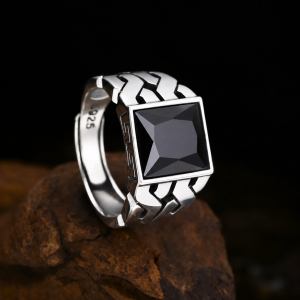
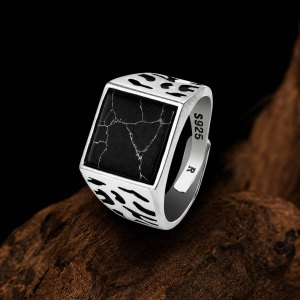
Eleven handmade 925 rings, $129 to $169, from a chain-link band to a black onyx statement ring. Every one is adjustable.
Related guides
Specific gravity follows Johnson, McClure, and DeGhionno, “Some Gemological Challenges in Identifying Black Opaque Gem Materials,” Gems & Gemology (GIA, Winter 1996); hardness and other properties follow the International Gem Society’s guides to onyx, chalcedony, obsidian, jet, glass, and hematite and its article on hot point testing. Jet’s origin, history, imitations, and tests follow Whitby Museum’s jet FAQ; naming and dyeing follow Gary Roskin in JCK and the IGS. Published ranges for hardness and specific gravity vary slightly by source. Read our editorial policy.

