Disclosure:The example rings in this guide are from Ronatelli. Prices, ratings, and product details were read from ronatelli.com on October 29, 2026; the advice applies to any brand.
A signet ring is defined by its flat face. Most signets are solid metal, engraved with initials or a crest, and that is the ring our guide to wearing a signet ring covers. A stone signet sets stone into the face instead: one polished stone, rows of tiny stones, or a silver motif over a bed of them. The style goes back to the seal rings of the ancient world, it reads darker and more graphic on the hand, and it needs slightly different care. This guide covers the three kinds of stone face, where the style comes from, what size and finger to choose, how to wear one, the Faravahar motif on one of Ronatelli’s signets, and how to keep a stone face clean.
Key takeaways
- Three kinds of face. A single flat stone in a frame, pavé rows of tiny stones, or a silver motif over a bed of stones.
- A stone face is rarely personalized. Engraving stone is specialist gem work, and a pavé or motif face can’t be engraved at all; if you want initials, choose a metal face.
- The signet proportions still apply. A face of 10 to 12 mm suits most men’s pinky; 13 to 16 mm looks right on the ring finger.
- Let it lead the hand. Pair a stone signet with a plain or textured band, not a second stone ring beside it.
- Soap and water, then a look at the setting. No dips, foil bath, or ultrasonic; check the frame and the pavé each time you clean it.
In this guide Three faces History Size and finger Wearing it The Faravahar Care Examples FAQ
Three kinds of stone face
On an engraved signet, the design is cut into the metal. On a stone signet, the face is set with stone, and the way the stone is set decides the look, the care, and what can go wrong. Ronatelli’s three signets show the three main kinds.
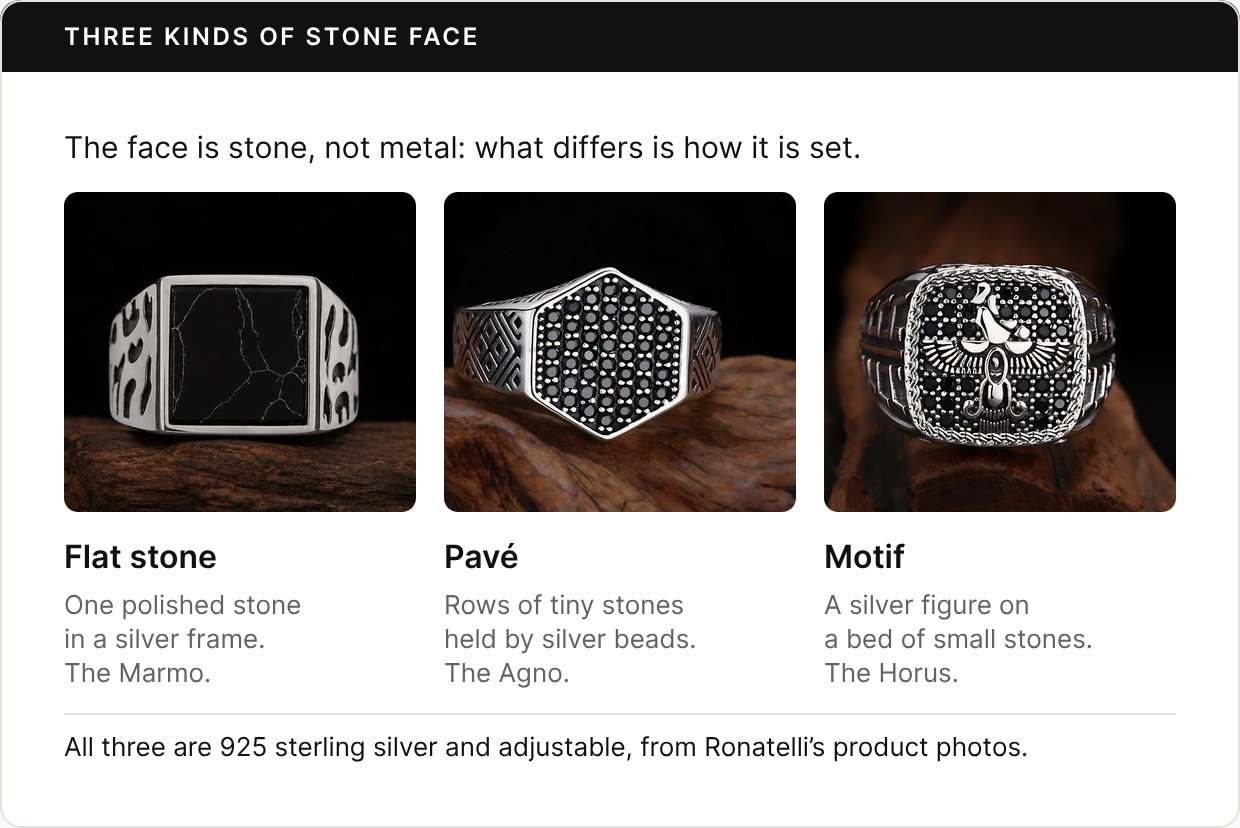
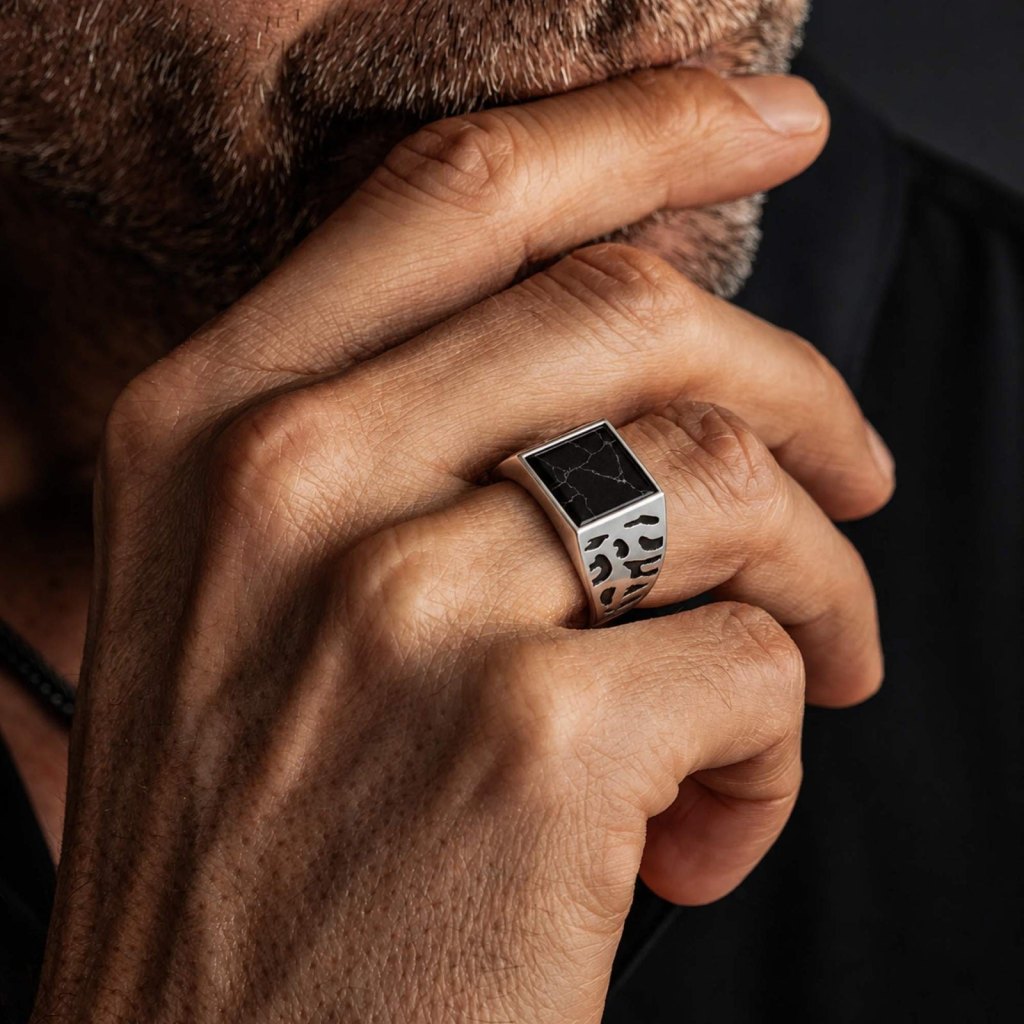
- A flat stone. One stone, cut flat and polished, held in a silver frame. It is the classic stone signet, often black onyx, and the cleanest look: a dark, even tablet with a bright edge. A frame around the whole stone is also the best-protected way to set it, as our guide to black onyx rings explains. The Marmo is this kind: a square black stone marked by natural white veining, in Ronatelli’s words, matte and set in a smooth frame. Ronatelli doesn’t name the stone.
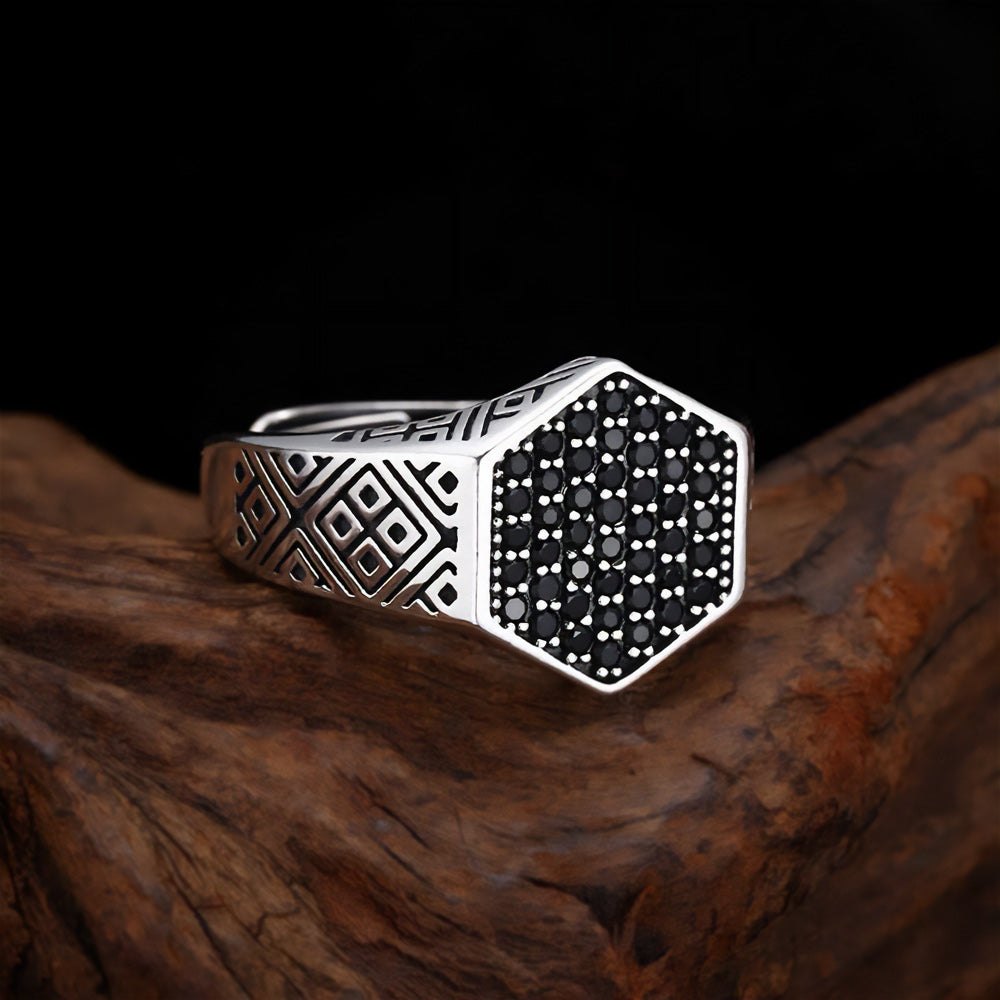
- Pavé. Many tiny stones set close together. GIA describes pavé as stones set in three or more rows with hand-raised beads that hold them in place, so the face glitters with points of light instead of reading as one dark surface. The Agno’s hexagonal face is filled with pavé-set black onyx stones, Ronatelli says. Each bead holds a very small stone, which makes pavé the most delicate of the three.
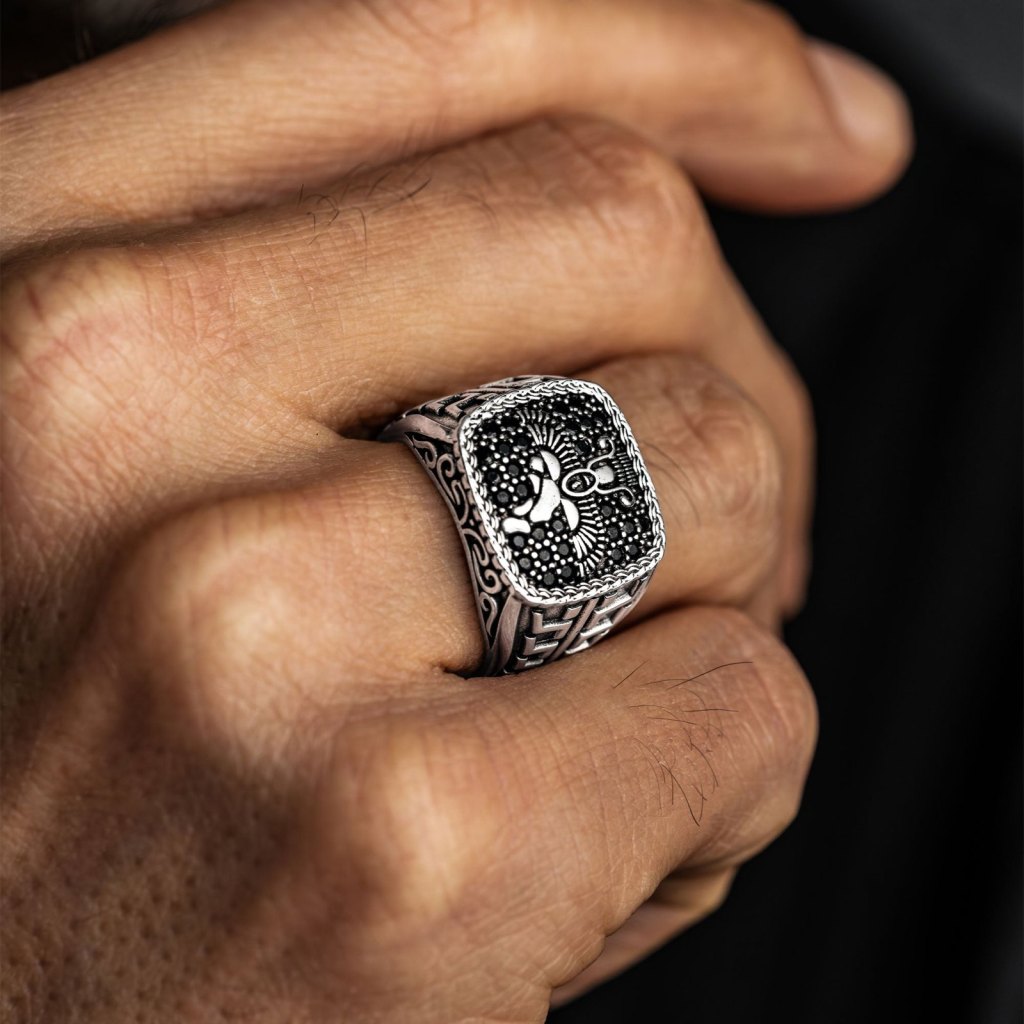
- A motif. A raised silver design over a ground of stones. The silver carries the design and the stones are the background, so the face reads as a picture. The Horus sets a winged figure, which Ronatelli names as the Faravahar, on a bed of black onyx stones inside a braided silver border; what the figure means is covered below.
A seal in stone: where the style comes from
The stone signet is older than it looks. In the ancient world, the stone itself was often the seal: a design was cut into it in reverse, a technique called intaglio, so that pressed into wax or clay it left a positive impression that authenticated a document, as the gem encyclopedia at Skyjems explains. Intaglios were the dominant personal seal across the ancient Near East and the Greek and Roman worlds, and the stones that dominate the surviving record are the chalcedony family of quartz: carnelian, sard, chalcedony, agate, onyx, and sardonyx. The Metropolitan Museum of Art holds one such ring, a Roman gold ring of the third century CE set with a carnelian intaglio; its massive cast hoop, the museum notes, is typical of late Roman jewelry.
Black onyx has a long place in that story, which our guide to black onyx rings traces from Roman seals to Art Deco. The signet ring itself, Skyjems notes, is the surviving form of the practice, in continuous use from antiquity to the present, though today it is worn largely as ornament rather than as a legal signature.
That history explains one practical point. On a metal signet, engraving initials is routine, as our signet guide describes. On a stone face, it means carving the stone, which is intaglio again: specialist gem work, and a separate skill from engraving metal. A pavé or motif face can’t be engraved at all. So choose a stone signet for its face as it is. If you want your initials on the face, a metal signet is the simpler route.
Face size and the finger
The proportions in our signet ring guide apply to stone faces too. On the pinky, a face of 10 to 12 mm sits in proportion for most men, and 13 to 14 mm reads bolder but still works; on the ring or index finger, 13 to 16 mm looks right. Black stone against bright silver is high contrast, so a stone face draws the eye more than a plain metal face of the same size; if you are between two face sizes, the smaller is the safer choice.
Ronatelli doesn’t publish face sizes for its signets. In the worn photos, the faces of the Horus and the Marmo each sit about as wide as the finger; the Agno has no worn photo. The shapes differ too. The Marmo’s square and the Horus’s rounded square, called a cushion, are two of the five common signet shapes in our signet guide; the Agno’s hexagon is not one of them, which makes it the most unusual of the three.
The pinky is the traditional finger for a signet, and the ring finger of the right hand the usual alternative. A pinky typically runs three to four sizes smaller than the ring finger, according to our ring size guide, and Ronatelli doesn’t publish how far its rings adjust, so before you settle on the pinky, check that the ring closes far enough to stay on. Our adjustable ring guide explains how to set it, and why you should press on the band at the back, never on the face.
How to wear a stone signet
Treat it as the ring that leads. When you wear more than one ring, let one be the statement and keep the rest quieter, as our guide to how to wear rings puts it, and a stone signet is a statement. Pair it with a plain or textured band rather than another stone ring; our guide to silver band rings covers the quieter half of that pairing. If you do wear two stone rings on one hand, keep a finger between them so the stones don’t rub.
The classic two-ring arrangement still works: a signet on the right hand and a wedding band alone on the left, as our signet guide suggests. Like a black onyx ring, a black stone face goes with black, gray, navy, and dark denim, and with a suit it reads traditional.
The Faravahar on the Horus
One of Ronatelli’s three carries a symbol rather than a pattern. The Horus’s winged figure is the Faravahar, as Ronatelli names it (it is also spelled Fravahar or Farohar): a male figure within a winged ring. The winged disk itself is older and appears across the ancient Near East and Egypt, but the figure in its present form first appears in the Achaemenid Persian Empire, around 550 to 330 BCE, and Darius I placed it on the Behistun Inscription and at Persepolis, as World History Encyclopedia explains.
What it meant to the Persians who carved it is debated. The standard reading is that it represents Ahura Mazda, whom Zoroastrians worship as God; the Parsis, the Zoroastrians of the Indian subcontinent, traditionally saw it as the fravashi, a guardian spirit, as the Encyclopaedia Iranica notes; and other readings link it to the divine glory of kings.
Today it is a living symbol. The Federation of Zoroastrian Associations of North America lists it among the religious symbols of the faith, much as the cross and the Star of David are for Christians and Jews, and its teaching material reads the three parts of the wings as good thoughts, good words, and good deeds. It is also one of the best-known pre-Islamic symbols of Iran: the same material notes that it is often worn as a pendant among Iranian peoples, and that despite its religious nature it has become a secular and cultural symbol.
So wear it as you would a cross or a vajra: knowing what it is. Many Zoroastrians wear it as a sign of faith, and many Iranians as a sign of heritage and national identity. If you are neither, remember that it is the sacred symbol of a living faith, and wear or give it with that in mind, as with the vajra in our guide to symbols on silver bracelets. If you would rather wear a pattern than a meaning, the Agno and the Marmo carry none.
Keeping a stone face clean
Clean a stone signet the way you clean any stone ring: warm water with a drop of mild dish soap, a soft brush worked around the face and into the setting, a rinse, and a thorough dry with a soft cotton cloth, as our guide to black onyx rings describes. Keep the polishing cloth on the silver and off the stone. Skip the foil bath and silver dips, which our cleaning guide keeps away from stone-set pieces, and skip the ultrasonic cleaner too, since you can’t know how a stone was treated.
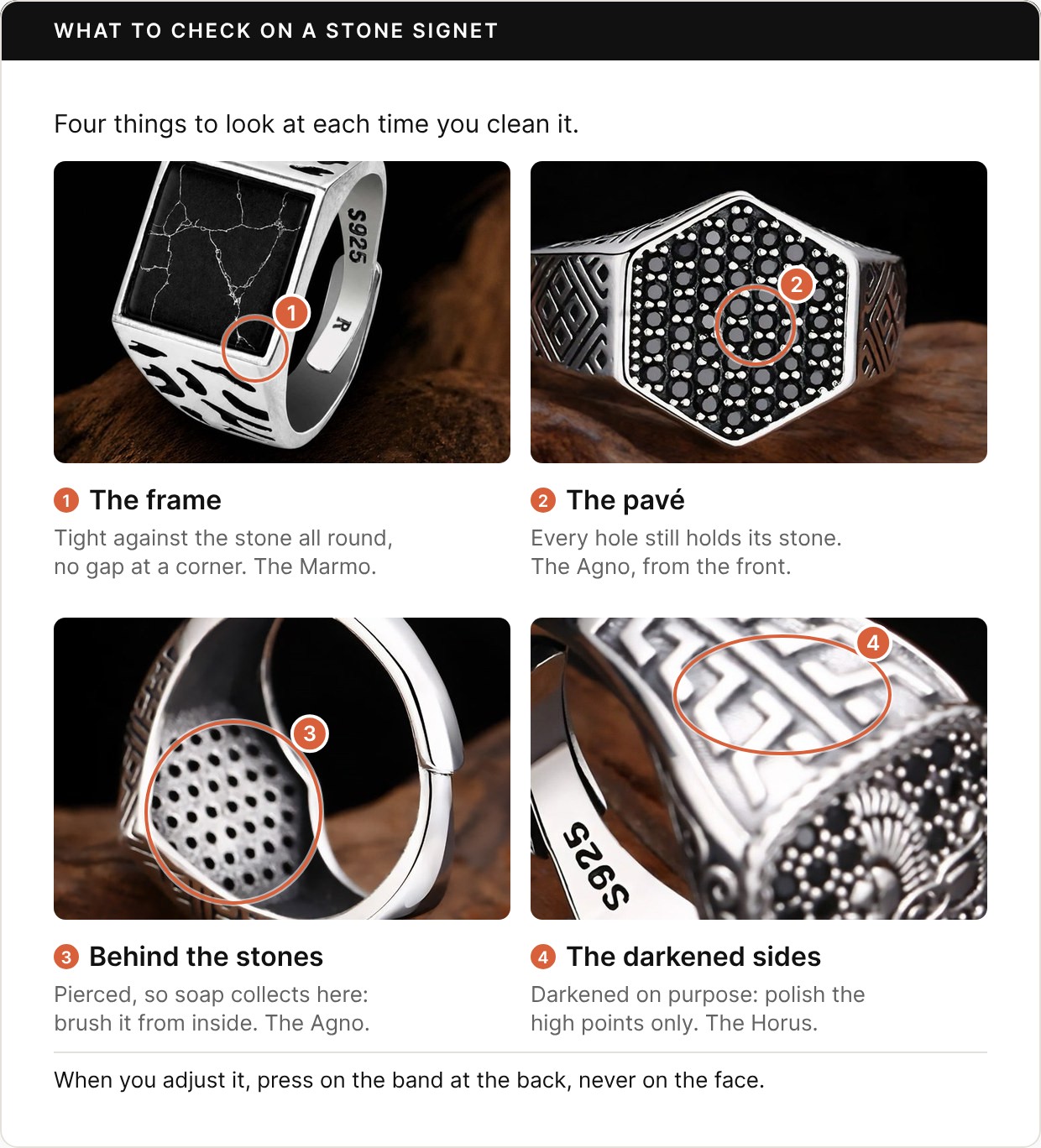
Then look at the setting while the ring is clean:
- The frame. On a flat stone, the silver frame should sit tight against the stone all the way round, with no gap at a corner.
- The pavé. Every hole should still hold its stone. The Agno’s photos show the back of its face pierced behind each stone, so soap and skin oil collect there too; brush it from the inside as well as the front.
- The darkened recesses. The engraved sides of all three are dark in the recesses, as the photos show, and the dark is there on purpose, so run the cloth over the high points only; our guide to oxidized silver has more.
- The fit. If the ring spins until the face turns toward your palm, it is too loose. Close the back a little at a time, pressing on the band rather than the face, as our adjustable ring guide describes.
If a stone works loose or goes missing, stop wearing the ring and keep any pieces. Ronatelli’s lifetime warranty covers verified manufacturing defects but excludes repairs by anyone other than its own technicians, so contact Ronatelli before you take the ring to a local jeweler.
Ronatelli’s three stone signets
Every ring in Ronatelli’s ring collection is 925 sterling silver and adjustable, from $129 to $169. Its three signets are all set with stones, so none has a metal face for initials:
| Ring | Face | Best for | Worth knowing | Price |
|---|---|---|---|---|
| Horus: Faravahar Signet Ring | FaceA winged Faravahar on black onyx stones, in a braided border; cushion shape | Best forA man who wants the symbol, or a gift for one | Worth knowingA sacred Zoroastrian symbol and an Iranian cultural emblem | Price$139 |
| Agno: Hexagonal Signet Ring | FacePavé-set black onyx stones filling a hexagonal face | Best forSparkle, and an unusual shape | Worth knowingThe most delicate setting: check for empty holes | Price$129 |
| Marmo: Veined Stone Signet Ring | FaceA square, matte black stone with white veining in a smooth frame | Best forThe cleanest look, with a suit or every day | Worth knowingThe stone isn’t named: soap and water only | Price$129 |
All three have short review records: the Horus has 4.8 stars from five reviews, the Agno 4.7 from three, and the Marmo 4.0 from two. For a first stone signet, the Marmo is the most versatile, with one flat stone and nothing raised; the Agno is the one for sparkle, if you will check its pavé; and the Horus is the one to choose for what it means. Our comparison of all eleven Ronatelli rings sets them beside the onyx statement rings and the bands.
FAQ
What is a stone signet ring?
A signet whose flat face is set with stone instead of engraved metal: a single polished stone in a frame, rows of tiny pavé stones, or a raised silver motif over a bed of stones. Black onyx is a long-standing choice for men.
Can you engrave an onyx signet ring?
Only as specialist work. Cutting a design into stone is intaglio, gem engraving, a separate skill from engraving metal, so a stone face is usually worn as it is, and a pavé face can’t be engraved at all. For initials, a metal signet is the simpler choice.
Which finger should a stone signet go on?
The pinky is the traditional signet finger and the ring finger of the right hand the usual alternative. On the pinky, keep the face around 10 to 12 mm, and with an adjustable ring, check that it closes far enough before you settle there.
What does the Faravahar mean?
It is one of the best-known symbols of Zoroastrianism and of pre-Islamic Iran. In the teaching of FEZANA, the Federation of Zoroastrian Associations of North America, the three parts of its wings stand for good thoughts, good words, and good deeds; what it meant to the ancient Persians who first carved it is still debated.
Is a pavé signet ring good for everyday wear?
It can be, with a little care. Each stone is held by tiny beads of silver, so pavé is the most delicate kind of face: take it off for the gym and manual work, and look for an empty hole whenever you clean it.
How do you clean a stone signet ring?
Warm water, a drop of mild dish soap, and a soft brush around the face and into the setting, then a rinse and a thorough dry. Keep the polishing cloth off the stone, and skip dips, the foil bath, and ultrasonic cleaners.
Bottom line
Choose a stone signet for its face, not for engraving. A single flat stone in a frame is the cleanest and the best protected, pavé gives sparkle in return for a little care, and a motif carries a picture, sometimes with a meaning worth knowing. Keep the proportions of an engraved signet, 10 to 12 mm on the pinky and larger on the ring finger, let it lead the hand beside a plain band, and clean it with soap and water rather than dips.
From the collection
Men’s sterling silver rings by Ronatelli
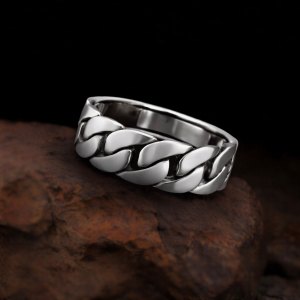
Eleven handmade 925 rings, $129 to $169, from a chain-link band to a black onyx statement ring. Every one is adjustable.
Related guides
Proportions, fingers, and styling follow our signet ring guide; settings and care follow our black onyx rings and cleaning guides; pinky sizing follows our ring size guide. The history of intaglio follows the gem encyclopedia at Skyjems and the Metropolitan Museum of Art’s collection, and pavé follows GIA’s “Design with Melee.” The Faravahar follows Joshua J. Mark in World History Encyclopedia, Abolala Soudavar’s “Farr(ah) ii. Iconography of Farr(ah)/Xᵛarənah” in the Encyclopaedia Iranica, and FEZANA’s lesson plan on the Fravahar. Ronatelli’s descriptions, prices, and ratings come from its product pages, and face shapes and settings from its product photos, all checked on October 29, 2026. Read our editorial policy.

