Disclosure:The example rings in this guide are from Ronatelli. Prices, ratings, and product details were read from ronatelli.com on October 29, 2026; the advice applies to any brand.
Wearing rings well comes down to three decisions: which finger, which hand, and how many. In the United States only a few of those choices carry real meaning, chiefly the wedding band on the left ring finger, so the rest is a matter of balance and proportion. This guide covers what each finger says, how to split rings between your hands, how many is enough, how to mix a stone ring with a band or a signet, how rings work with a watch and a bracelet, and how to size each finger.
Key takeaways
- Only a few rules carry weight. In the US, the left ring finger is for a wedding band, and a signet traditionally goes on the pinky. Everything else is preference.
- Two or three is plenty. Spread them across both hands: one ring per finger, and one statement ring per hand.
- Balance the hands. A wedding band on the left and a statement ring on the right is the classic pairing, and a watch on one wrist balances rings on the other hand.
- Pair loud with quiet. A stone ring beside an all-silver band, or a signet beside a texture, works; two big stones on neighboring fingers compete.
- Every finger is a different size. The index finger runs about a size larger than the ring finger and the pinky three to four sizes smaller, so measure the finger you mean to wear it on.
In this guide Fingers Which hand How many Mixing Watch and bracelet Sizing Examples FAQ
Which finger: what each one says
Only a handful of conventions carry real weight in the United States. A wedding band goes on the fourth finger of the left hand, a custom David’s Bridal traces to the Western European traditions early settlers brought with them; in Russia, Greece, and Serbia it goes on the right, and in Germany couples move the ring from the left hand to the right when they marry. A signet traditionally goes on the pinky, as our signet ring guide explains. A class ring is traditionally worn on the ring finger opposite the wedding band, according to Gentleman’s Gazette, and engineers who join the Order of the Engineer wear a stainless steel ring on the little finger of their working hand, as NYU’s engineering school describes it. Everything else is preference.
| Finger | What it says | Suits | Watch out for |
|---|---|---|---|
| Thumb | What it saysStrength and status; the least expected place | SuitsA wide, simple band | Watch out forIt takes the most knocks; Gentleman’s Gazette suggests the non-dominant hand |
| Index | What it saysAuthority; historically the usual finger for a man’s signet | SuitsA bold ring, or a signet face of 14 mm and up | Watch out forThe busiest finger, and usually about a size larger than the ring finger |
| Middle | What it saysBalance; the center of the hand | SuitsA bold ring that anchors the hand | Watch out forA big ring can crowd the fingers on either side |
| Ring, right hand | What it saysUnderstated; leaves the left free for a wedding band | SuitsA statement or stone ring for every day | Watch out forLittle: it is the most comfortable place for a daily ring |
| Pinky | What it saysClassic and deliberate; the traditional signet finger | SuitsA signet or a slim band | Watch out forUsually three to four sizes smaller than the ring finger, with the knuckle and base close in size |
Read the meanings lightly. Several come from palmistry, which links each finger to a planet, and few people will read them into your ring. What people do notice is whether a ring looks deliberate: the right size for the finger, and in proportion to the hand.
Which hand
In the US the left hand belongs to the wedding band, so a ring that isn’t one usually goes on the right. If you aren’t married, either hand is fine, but a plain band on the left ring finger will read as a wedding band; a distinctive ring there is less likely to be mistaken for one, The Art of Manliness notes.
Your watch matters too. Most men wear a watch on the non-dominant wrist, as our guide to wearing a bracelet with a watch explains, and Gentleman’s Gazette suggests letting a watch on one wrist balance rings on the other hand. The trade-off is wear: the dominant hand does more work and takes more knocks, which matters most for stones and prongs. If you work with your hands, keep a stone ring on the non-dominant hand and an all-silver band on the busy one.
Size each hand separately. The dominant hand is usually about half a size larger, according to our ring size guide.
How many rings to wear
Fewer than you might think. The Art of Manliness puts the safe maximum at two or three, spread across both hands, with one ring per finger; Gentleman’s Gazette says that in classic style a man would usually wear one or two, and three only in particular circumstances. Our ring buying guide gives the same advice: fewer, better rings.
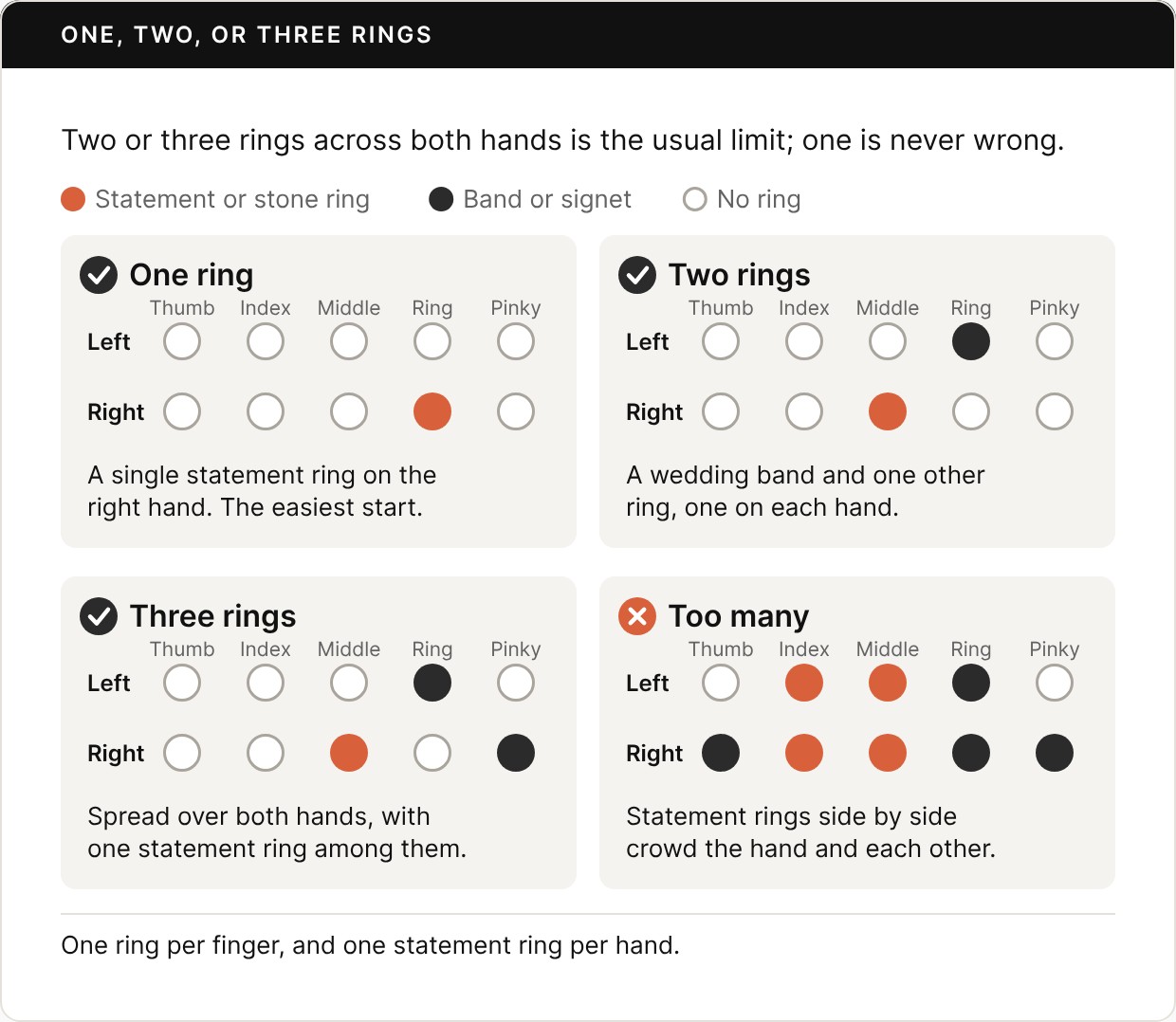
- One ring. A statement or stone ring on the right ring finger or middle finger. It is never wrong, and it works with a T-shirt or a suit.
- Two rings. One on each hand: a wedding band on the left and a statement ring or a signet on the right, the classic arrangement our signet ring guide describes.
- Three rings. Add a pinky signet or a slim band, and leave a finger free between two rings on the same hand. Keep it to one statement ring per hand.
- More. It can work as a deliberate look, usually with slimmer bands, but it stops reading as classic. Two statement rings on neighboring fingers is where most combinations go wrong.
Mixing a stone ring, a signet, and a band
When you wear more than one, let one ring lead. A black onyx ring or a large signet is the statement, and the others should be quieter: a plain or textured all-silver band, or a slim signet. Two rings of the same weight on neighboring fingers fight for attention.
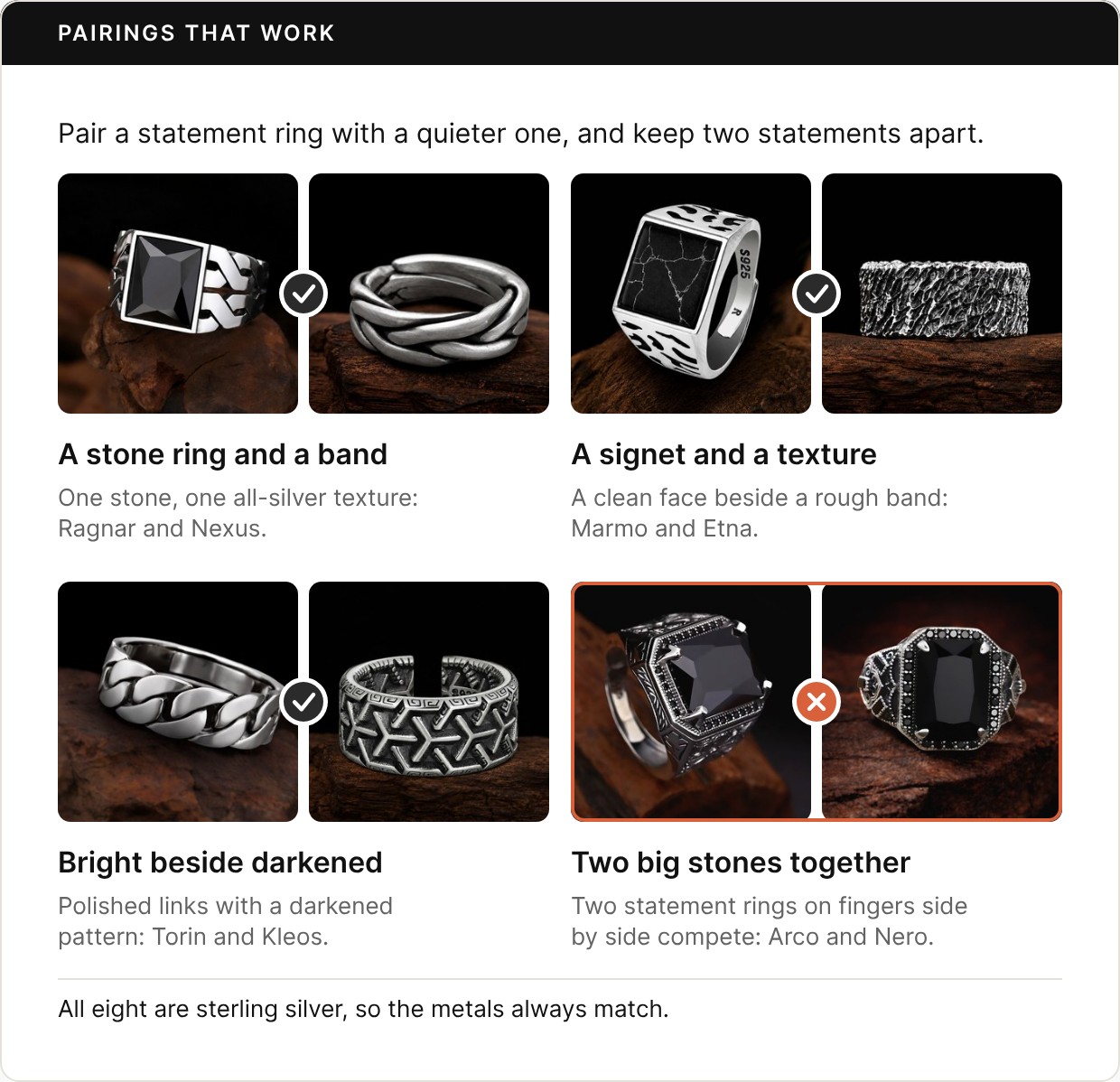
Texture and finish give you variety without clutter. A polished band beside a darkened one reads as intentional, and so does a rough texture beside a clean signet face; our guide to oxidized silver explains how the darkened finish is made and kept. Keep the metal consistent: Gentleman’s Gazette’s classic advice is to match your metals, with the exception of one or perhaps two rings, and our signet ring guide adds that silver beside a gold wedding band is fine when each piece has its own job.
Two stone rings on the same hand should have a finger between them, so the stones don’t rub; a diamond or sapphire will scratch black onyx, as our guide to black onyx rings explains.
Rings with a watch and a bracelet
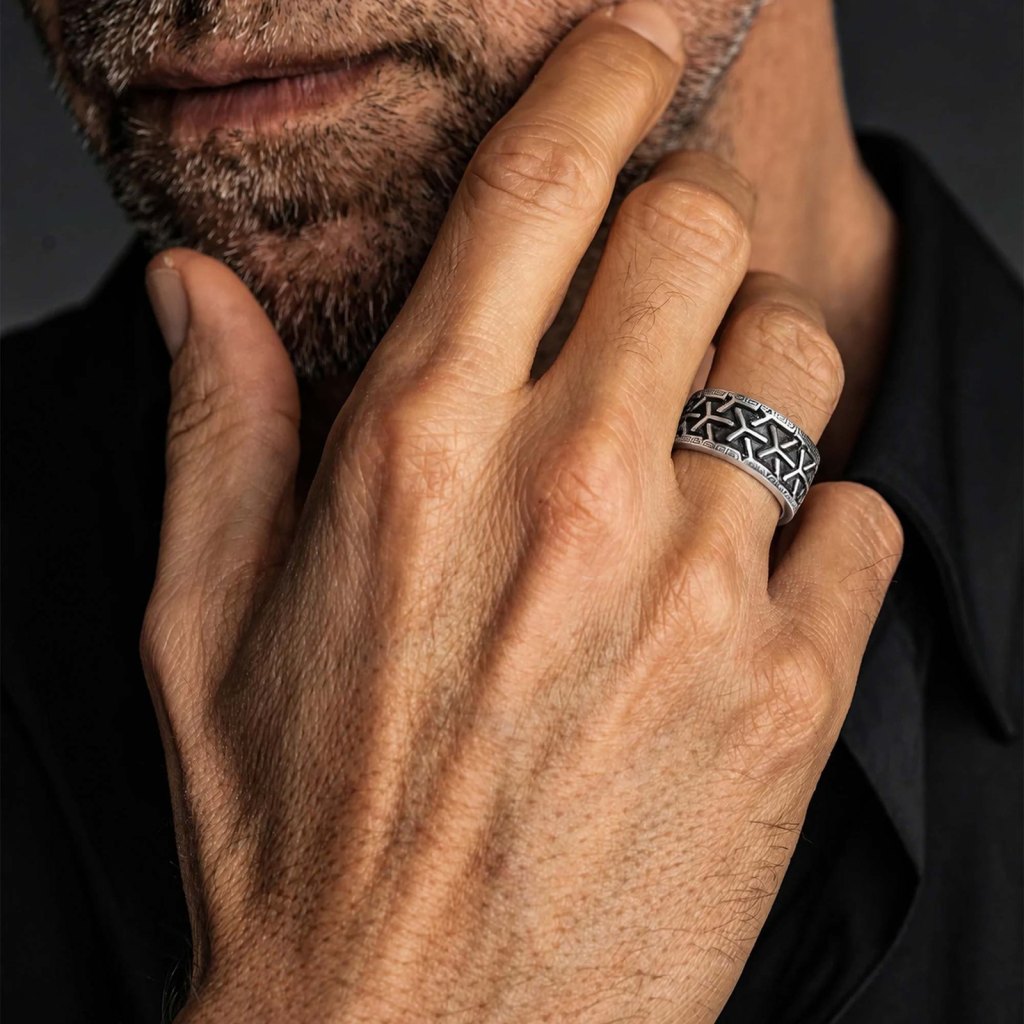
A watch and a ring rarely compete; they sit at opposite ends of the hand. The simplest arrangement mirrors the one in our guide to wearing a bracelet with a watch: the watch on the non-dominant wrist, the statement ring on the other hand. If you also wear a bracelet, it goes on the wrist without the watch, as that guide recommends, so let the ring on that hand either stay quiet or echo the bracelet: a Greek key band with a Greek key bracelet, a curb-link band with a curb bracelet. Our comparison of Ronatelli’s rings pairs some of them up, and our guide to stacking bracelets covers the wrist.
Sizing each finger
Each finger needs its own size. Our ring size guide puts the index finger at about one size larger than the ring finger and the pinky at three to four sizes smaller, with the dominant hand about half a size larger, so always measure the finger the ring is for. Knuckles matter too: a ring has to pass over the knuckle, which is often larger than the base of the finger on index fingers and pinkies, and the guide explains how to split the difference.
An adjustable ring can move between fingers, which makes it handy while you work out where you like it. Move it now and then rather than every day, since each move bends the silver, and check the range before you plan on a pinky or a thumb; our guide to adjustable rings covers both.
Ronatelli rings for each finger
Every ring in Ronatelli’s ring collection is adjustable and costs $129 to $169. Here is where six of them sit best, by the finger notes above:
| Where | Ring | Why | Price |
|---|---|---|---|
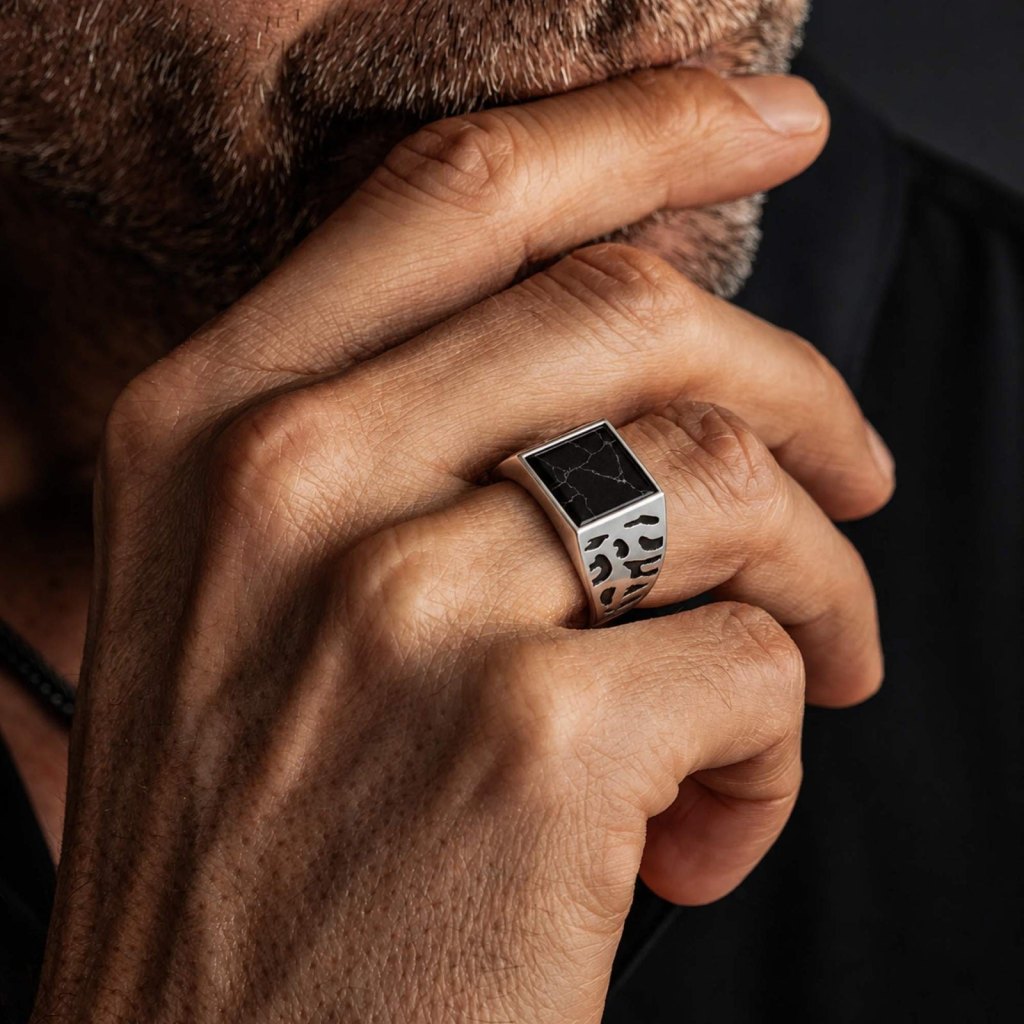
| Right ring finger, every day | RingRagnar: Square Black Onyx Ring | WhyA framed onyx that protects the stone; the brand’s most reviewed ring | Price$149 |
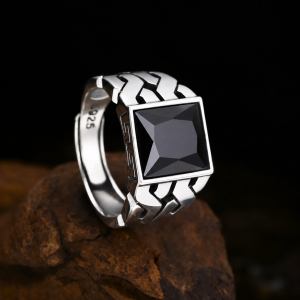
| Middle finger, the statement | RingArco: Faceted Black Onyx Ring | WhyThe largest stone in the collection, on the finger that anchors the hand | Price$169 |
| Index finger, a bold signet | RingHorus: Faravahar Signet Ring | WhyA detailed face for the finger that shows a ring off | Price$139 |
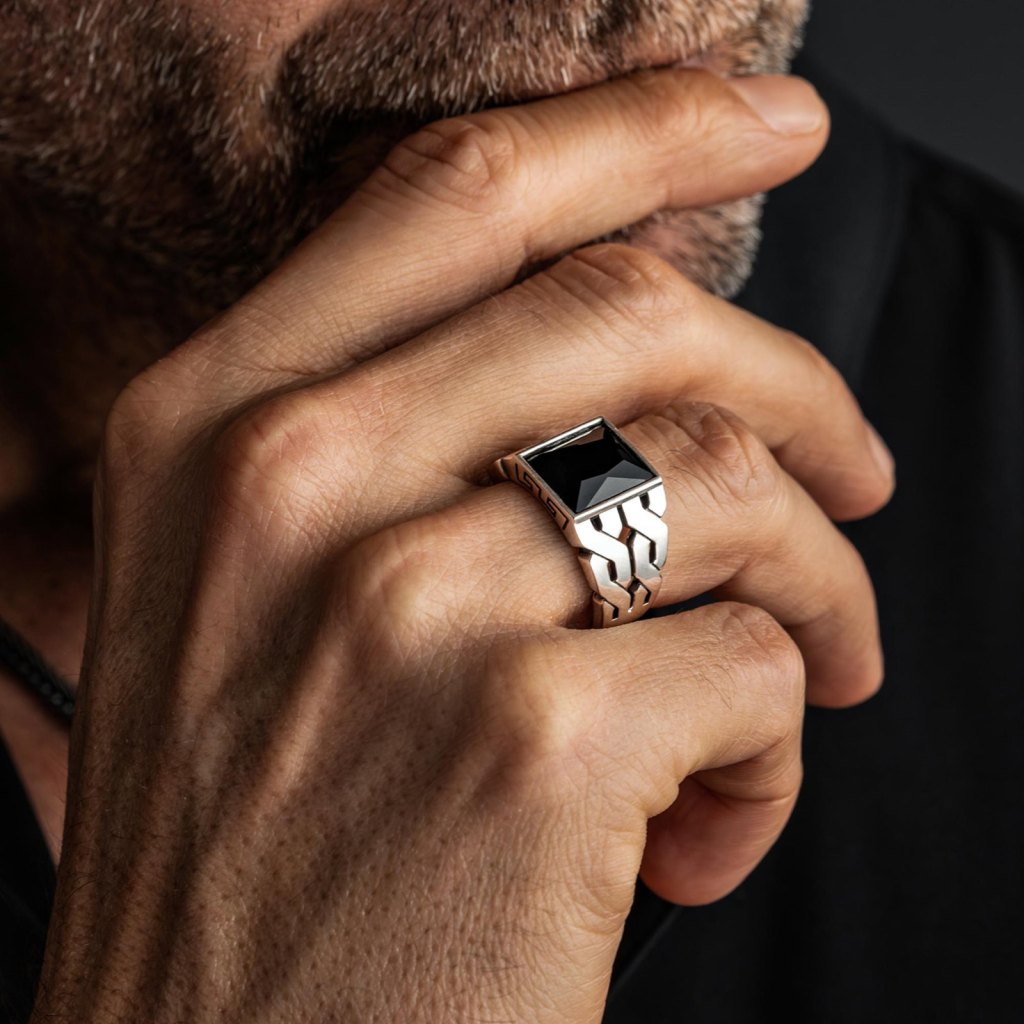
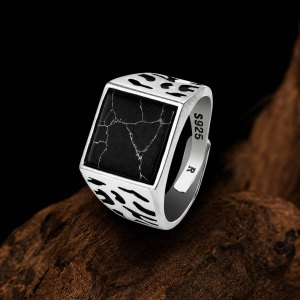
| Pinky, the signet | RingMarmo: Veined Stone Signet Ring | WhyA clean square face; check that it closes far enough for a pinky | Price$129 |
| Other hand, beside a wedding band | RingTorin: Chain Link Ring | WhyAll-silver links with nothing to catch | Price$129 |
| Thumb or a second band | RingEtna: Rock Texture Band Ring | WhyA wide band with a rough texture; measure your thumb first | Price$129 |
For a three-ring look that follows every rule above: a wedding band on your left ring finger, the Ragnar on your right middle finger, and the Marmo on your right pinky. Our comparison of all eleven rings covers the rest of the collection, and our guide to black onyx rings covers the stone rings in detail.
FAQ
Which finger should a man wear a ring on?
Any finger, though in the US the left ring finger is read as the place for a wedding band. The right ring finger and the middle finger are the easiest places for a single ring, and the pinky is the traditional finger for a signet.
Can a man wear a ring on his left ring finger if he isn’t married?
He can, but a plain band there will read as a wedding band. A distinctive ring, such as a stone ring, is less likely to be mistaken for one.
What does a pinky ring mean on a man?
Traditionally, a signet: the pinky is the classic signet finger. Some professions use it too; members of the Order of the Engineer wear a steel ring on the pinky of their working hand. The mob association has little evidence behind it, The Art of Manliness notes.
How many rings should a man wear?
One to three, spread over both hands, with one ring per finger and no more than one statement ring per hand.
Can you wear two rings on one finger?
Thin stacking bands, 2 to 3 mm wide, are made to be worn two or three together, as our ring buying guide notes. Wider bands and statement rings look best alone on a finger.
Should my rings match my watch?
Loosely. Sterling silver sits with stainless steel, titanium, and white gold without any effort. With a gold watch, keep the rings plain or wear them on the other hand.
Bottom line
Start with one ring on the right hand, on the ring finger or the middle finger, and build from there: a wedding band on the left, a signet on a pinky, never more than one statement ring per hand, and rarely more than three rings in all. Pair a stone ring with a quieter band, keep the metals consistent, and size each finger on its own. Do that, and every ring you wear will look chosen rather than collected.
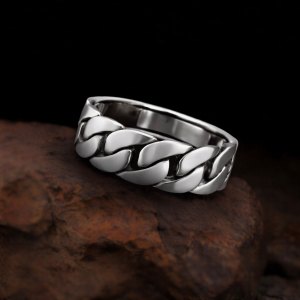
From the collection
Men’s sterling silver rings by Ronatelli
Eleven handmade 925 rings, $129 to $169, from a chain-link band to a black onyx statement ring. Every one is adjustable.
Related guides
Finger meanings follow The Art of Manliness (“Ring Finger Symbolism”) and Gentleman’s Gazette (“What Rings Mean on Each Finger”); wedding-band customs follow David’s Bridal; the Order of the Engineer ring follows NYU Tandon School of Engineering; fit and sizing follow our ring buying, signet ring, ring size, and adjustable ring guides. Ronatelli’s prices and product details were read from ronatelli.com on October 29, 2026, and may have changed since. Read our editorial policy.

