Disclosure:The example pieces in this guide are from Ronatelli. The advice applies to any brand. Prices, weights, and product details were checked on ronatelli.com on October 30, 2026.
A pendant hangs on its own at the center of the chest, so people notice what it shows. Some motifs carry a meaning others will recognize: a cross reads as faith, and a trident can be a sea god’s weapon, a sacred Hindu emblem, or part of an insignia the US Navy awards to qualified SEALs. Others are mostly myth and style. This guide takes six motifs found on men’s pendants, the trident, arrowhead, eagle, tiger, sword, and joker, and explains where each comes from and how it reads today, with the pieces in one brand’s collection as examples.
Key takeaways
- Symbol or ornament: some motifs carry a meaning other people will read, such as a cross or a trishula; others are mostly myth and style. Both are fine to wear; the first kind asks you to know what you are saying.
- Trident: Poseidon’s weapon in Greek myth and Neptune’s to the Romans. In Hinduism the trishula is a sacred symbol associated with Shiva, and the Navy’s SEAL Trident is an insignia that is earned.
- Arrowhead: stone points go back at least 500,000 years, and in the National Park Service emblem the arrowhead stands for “historical and archeological values.” “Direction” and “staying on course” are sellers’ readings.
- Eagle and tiger: the eagle was Rome’s legionary standard, is on the Great Seal of the United States, and is St. John’s symbol in Christian art. The tiger is a Chinese zodiac sign and, in Chinese folklore, a protector.
- Sword and joker: a sword recalls saints and knighthood, and Ronatelli’s forms a cross. The joker card dates from the 1860s and reads as humor and the wild card.
In this guide Symbol or ornament Trident Arrowhead Eagle Tiger Sword and joker Choosing a motif FAQ
Symbol or ornament: how a pendant reads
Our guide to symbols on men’s bracelets sorts motifs into two kinds, and the split works for pendants too. Some carry a meaning that other people will read; others are ornament or myth with no fixed message. A pendant makes the difference easier to see than a bracelet does, because it hangs alone at the center of the chest. The six motifs in this guide, in brief:
| Motif | Where it comes from | How it reads today |
|---|---|---|
| Trident | Where it comes fromGreek and Roman myth; the trishula of Hinduism | How it reads todayThe sea and myth; sacred to Hindus as the trishula |
| Arrowhead | Where it comes fromStone points, made for at least 500,000 years | How it reads todayThe outdoors and the past; “direction” is a sellers’ reading |
| Eagle | Where it comes fromRoman legion standards; the Great Seal of the United States; St. John in Christian art | How it reads todayStrength and country, or faith on a cross |
| Tiger | Where it comes fromThe Chinese zodiac; a protector in Chinese and Korean folklore | How it reads todayCourage, or a birth year |
| Sword | Where it comes fromSaints and knighthood in European tradition | How it reads todayStrength; faith when it forms a cross |
| Joker | Where it comes fromA card believed to have been invented by American euchre players in the 1860s; the court jester before it | How it reads todayHumor and the wild card |
The trident: Poseidon, Shiva, and the SEAL Trident
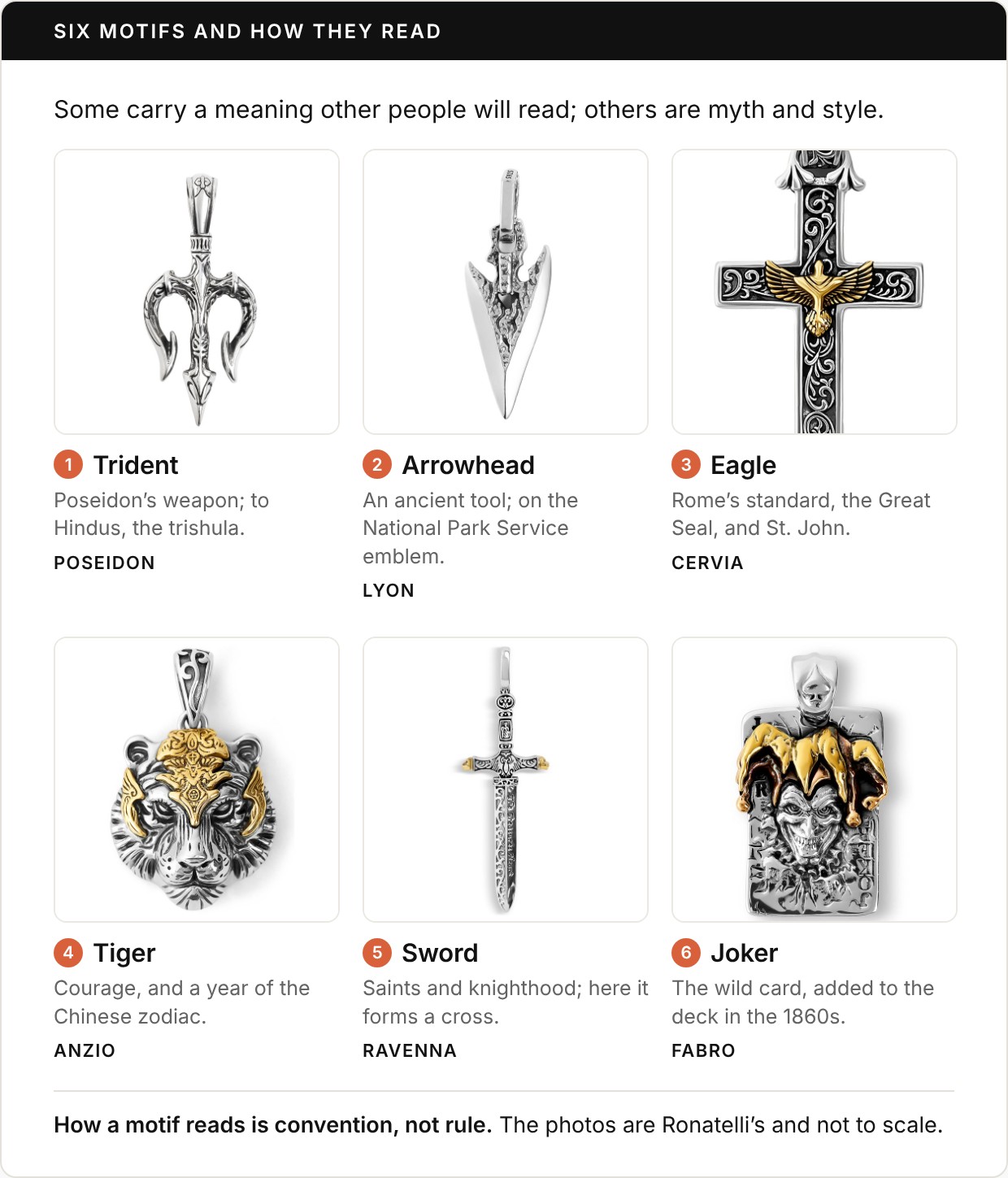
In Greek myth the trident belongs to Poseidon, god of the sea. Britannica calls it his “weapon and main symbol,” “perhaps once a fish spear,” and notes that the Romans identified him with Neptune as sea god. In one story he struck a rock on the Acropolis with it and brought up a well of seawater, in a contest with Athena for Attica, the region around Athens, as Wikipedia’s entry on the trident of Poseidon recounts.
In Hinduism the trident is the trishula, which Wikipedia describes as “one of the principal symbols in Hinduism,” most often associated with Shiva. Its three points are commonly said to stand for trinities such as creation, preservation, and destruction, though readings vary. That makes it a sacred emblem, like the vajra in our bracelet guide: to most people who recognize it, it reads as faith, so wear one only if you know what it stands for.
The US Navy uses a trident too. The SEAL Trident combines an eagle, an anchor, a trident “symbolic of Neptune,” and a cocked flintlock pistol, as the Pritzker Military Museum describes it. Sailors receive it when they graduate from SEAL Qualification Training, and it “signifies a qualified SEAL,” in the Navy’s words. A plain trident is a different symbol; the insignia is earned, and we would leave it to those who earned it.
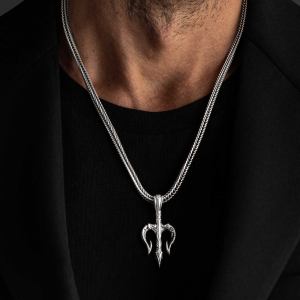
Ronatelli’s Poseidon ($169, 14 g) is the sea god’s: three prongs rising from an engraved shaft, with “every curve carved with tribal detail from bail to tip,” all silver and darkened in the recesses, as the photos show. Ronatelli added it in January 2026, and its four reviews are all five stars; one buyer has “gotten a ton of compliments on this piece.”
The arrowhead: an ancient tool and an emblem
Stone points go back a long way. Researchers dated stone-tipped spears from Kathu Pan 1 in South Africa to about 500,000 years ago, as Arizona State University reported, and a study in the journal Antiquity found signs of bows and stone-tipped arrows at Sibudu Cave, in the same country, about 64,000 years ago. Not every “arrowhead” is one: as the Maryland Archaeological Conservation Laboratory at Jefferson Patterson Park and Museum puts it, “in general, lance, spear, and dart tips are the oldest projectile points, while arrowheads are the youngest.”
In the United States the arrowhead is also an emblem. The National Park Service’s arrowhead, authorized in 1951, holds a sequoia, a bison, mountains, and water; the tree and the bison represent vegetation and wildlife, the mountains and water scenic and recreational values, and the arrowhead itself “historical and archeological values.”
The meanings jewelry sellers give an arrowhead, such as strength, protection, or staying on course, have no clear historical source; Ronatelli, for one, writes that its Lyon is for “those who point forward and never look back.” Read those as sellers’ lines. And if a seller says a piece was made by a Native American artist, that has to be true: the Indian Arts and Crafts Act makes it illegal to sell work “in a manner that falsely suggests it is Indian produced.”
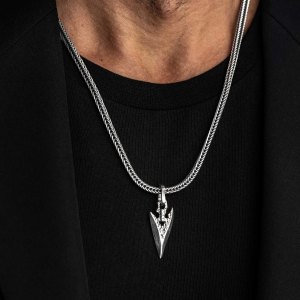
Ronatelli’s Lyon is shaped “like an ancient arrowhead pulled straight from the earth,” with a raw, weathered texture, in two sizes: $99 small and $149 large, all silver. No weight or measurements are published for either size; one of its photos shows the two side by side, and one buyer’s small came fully polished, without the dark weathering in the photos. 4.9 from 11 reviews.
The eagle: Rome, the Great Seal, and St. John
From about 104 BC, each Roman legion marched behind an eagle, the aquila, which had “quasi-religious importance to the Roman soldier,” as Wikipedia’s entry puts it; losing one was a grave disgrace.
The United States chose the bald eagle for its Great Seal, adopted on June 20, 1782. On the seal the eagle holds an olive branch and 13 arrows, which “denote the power of peace and war,” as the State Department’s history of the seal explains, and in December 2024 a federal law made the bald eagle the national bird. On its own, then, an eagle reads as strength, and to many Americans as country.
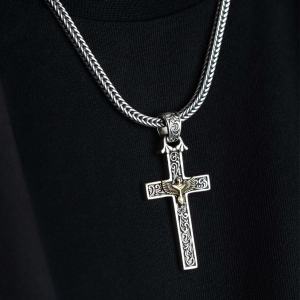
In Christian art the eagle is the symbol of St. John the Evangelist, “the creature that dwells closest to heaven,” in the words of the Fitzwilliam Museum. Both of Ronatelli’s eagles sit on crosses: the Cervia ($169, 17 g) sets a gold-tone eagle at the center of a cross covered in scrollwork, and the Norcia ($149, 12.3 g) a gold-tone eagle with outstretched wings and a green stone at its heart. Ronatelli doesn’t say what its eagles stand for, and on a cross most people will read the cross first, as our guide to cross necklaces explains.
The tiger: courage and a birth year
The tiger is one of the twelve signs of the Chinese zodiac. The Metropolitan Museum of Art describes it as “brave, heroic, resolute, and vigorous” and notes that in China it was “regarded as the king of all wild animals and used on military banners to illustrate bravery and swiftness.”
Since 1950 the Years of the Tiger have been 1950, 1962, 1974, 1986, 1998, 2010, and 2022, and the next is 2034. Each begins at Chinese New Year, between late January and mid-February, as China Highlights explains, so check a birthday in those weeks against the exact date.
In folklore the tiger is a guardian. “In Chinese folklore, the tiger is a protective deity able to dispel harmful spirits,” the Met notes, and children wore caps or shoes with tiger ears so that evil spirits would take them for tiger cubs, as BiblioAsia, the journal of Singapore’s National Library Board, describes. In Korean art, the National Museum of Korea writes, tigers have been portrayed as “auspicious creatures that expel evil spirits.” Those are beliefs, not promises a pendant can keep.
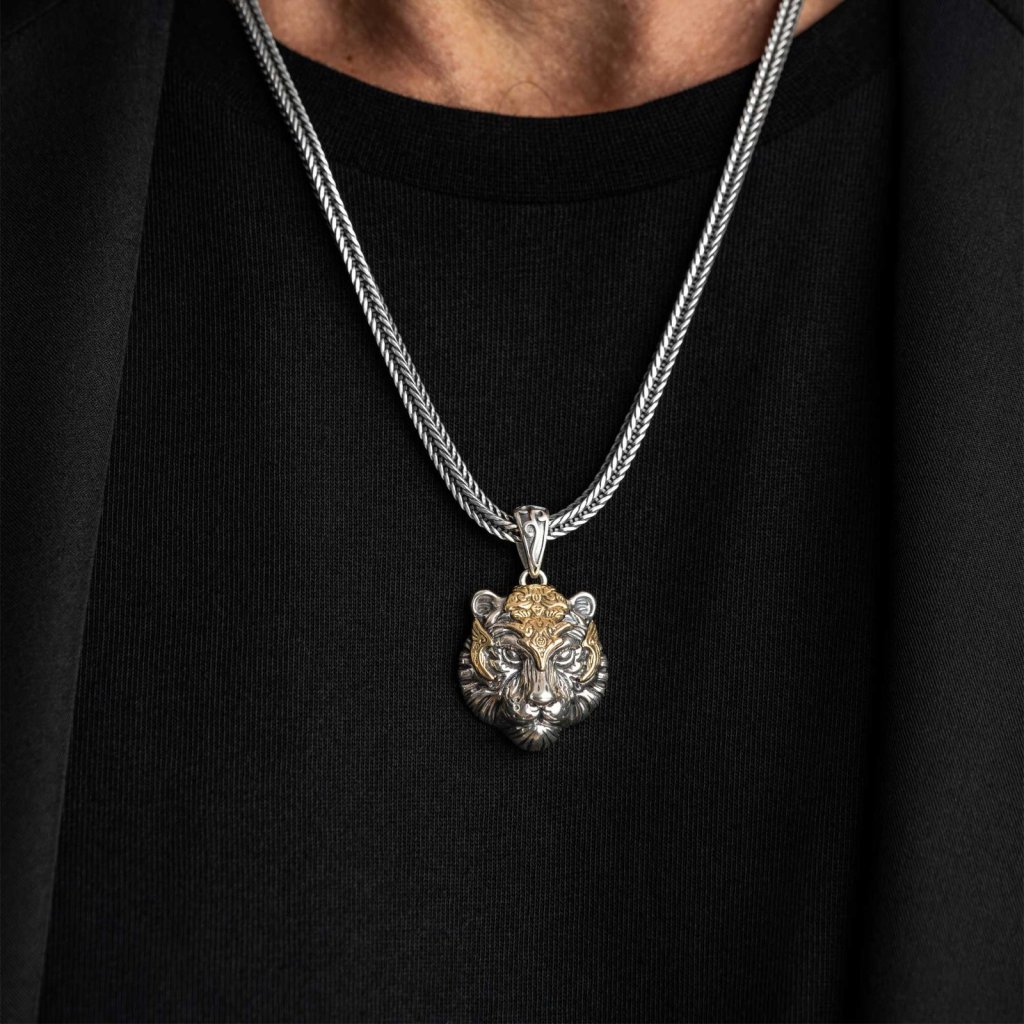
Ronatelli’s Anzio ($169, 17.6 g) is a sculpted tiger’s head with gold-tone markings across the top of the head and an openwork grid on the back, as the photos show; one buyer notes that it is hollow inside. It has 4.7 from 24 reviews, and one parent bought it for a son. As a gift, it suits a man born in a Year of the Tiger, or one for whom the tiger already means something, as our pendant gift guide says.
The sword and the joker
A sword in European art usually tells a story. St. Paul is shown with one as “a reminder of the means of his martyrdom,” as the National Gallery explains, and St. Michael is “often armed with a lance or sword,” as the Fitzwilliam Museum notes, usually trampling a dragon. A sword also has a part in knighthood: in the British investiture, the royal household explains, the King dubs the knight by laying “a bare sword blade on the knight’s right shoulder, then the left.” Ronatelli’s Ravenna ($149, 14 g) is a medieval-style sword with “The Treasures Heart” engraved into the silver, and its crossguard turns it into a cross; most people will read it as one first, as our cross necklace guide explains.
The joker is believed to have been invented by American euchre players in the 1860s, first as the “Best Bower,” and was first introduced into American packs around 1863, as the World of Playing Cards history explains. Before the card there was the court jester, kept in the households of kings, whose folly “gave them the right to abuse and poke fun at even the most esteemed members of their audiences,” as Britannica Kids puts it.
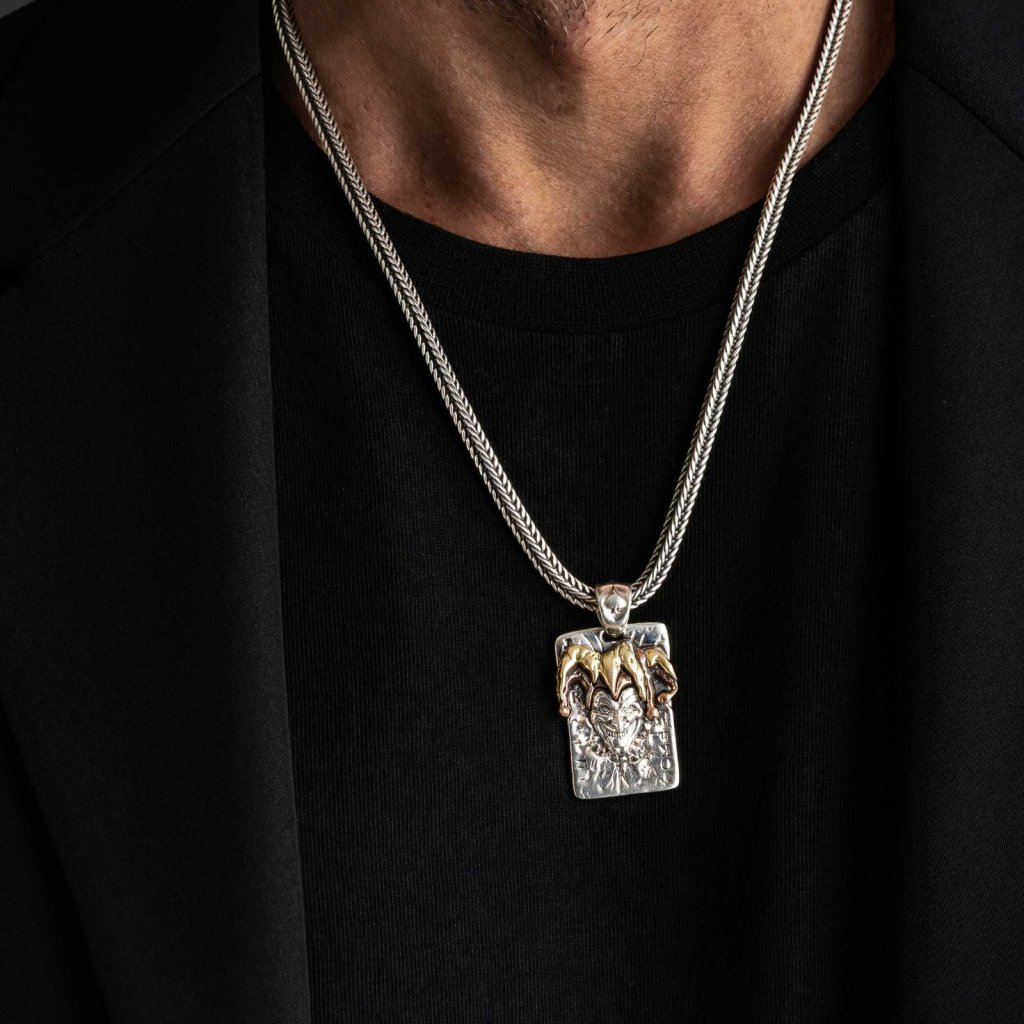
A joker pendant reads as humor and as the wild card, and Ronatelli calls its Fabro “the wildcard in every deck.” It is a joker’s face under a gold-tone jester’s crown, on a plate shaped like a playing card, with the words Joker and Clown engraved on the back, as the photos show; it comes in two sizes, $99 small and $149 medium, and has 5.0 from 34 reviews. One buyer says it “kinda goes with the tattoo of the joker I had already.”
Choosing a motif
- Choose one you would explain. If someone asks what it means, you should be glad to answer. For a symbol of faith, a cross or a trishula, that means knowing what it stands for and wearing it with respect, not as a novelty; our bracelet guide says the same of the vajra.
- Leave insignia to those who earned them. A plain trident is Poseidon’s or Shiva’s; the SEAL Trident, with its eagle, anchor, and pistol, is awarded, not bought.
- For a gift, the symbol has to be his. He wears one, has pointed one out, or it ties to something he loves, like a Year of the Tiger birthday. Otherwise give a plain chain, as our guide to buying a pendant as a gift explains.
- Wear one at a time. Two pendants close together look cluttered and knock against each other, as our layering guide notes. Over a T-shirt the motif shows; under a shirt it stays private.
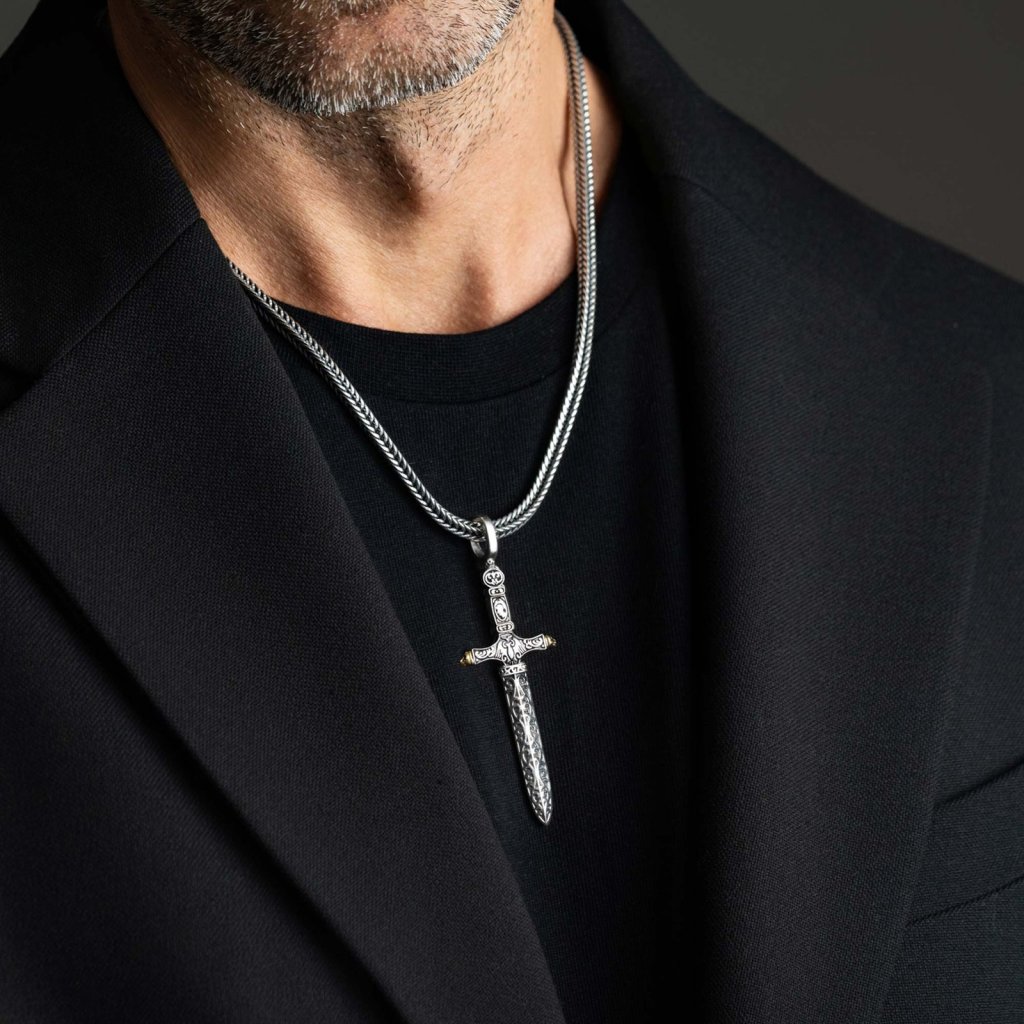
Our comparison of all eight Ronatelli pendants has their prices, weights, and ratings side by side. None comes with a chain, and our guide to the best chain for a pendant covers the width each weight needs.
FAQ
What does a trident pendant mean?
In Greek myth the trident is Poseidon’s weapon and symbol, and the Romans gave it to Neptune, so most people read it as the sea and myth. In Hinduism the trident is the trishula, a sacred symbol associated with Shiva.
Is it disrespectful to wear a trishula if you aren’t Hindu?
It is one of the principal symbols of Hinduism, so most people who recognize it will read it as faith. If it isn’t your faith, wear one only if you know what it stands for, and with respect, not as a novelty.
What does an arrowhead necklace mean?
Historically, a tool and a weapon: stone points go back at least 500,000 years and arrows about 64,000. The National Park Service uses an arrowhead for historical and archeological values. Meanings such as direction or protection are readings that jewelry sellers give it.
What does an eagle pendant symbolize?
Strength and, in the United States, country: the bald eagle has been on the Great Seal since 1782 and became the national bird by law in December 2024. On a cross it also recalls St. John the Evangelist, whose symbol in Christian art is the eagle.
What does a tiger pendant mean?
Courage, in the Chinese zodiac, and a birth year for anyone born in a Year of the Tiger, such as 1974, 1986, 1998, or 2010, counted from Chinese New Year. In Chinese and Korean folklore the tiger was believed to drive away evil spirits.
What does a joker pendant mean?
Humor, and the wild card that can stand for anything. The joker card is believed to have been invented by American euchre players in the 1860s, and before it the court jester was free to poke fun at the powerful.
Bottom line
Pick a motif you would be glad to explain. Most of the motifs here read as myth, history, and style; a cross and a trishula read as faith, and the SEAL Trident as an insignia someone earned. Then size the pendant to his build and hang it on a chain that suits its weight, one size longer than he wears a plain chain.
From the collection
Men’s sterling silver pendants by Ronatelli
Eight handmade 925 pendants, $99 to $199. Each fits chains up to 6 mm; the chain is sold separately.
Related guides
Prices, weights, ratings, and product descriptions were read from ronatelli.com on October 30, 2026, and may have changed since; review quotes come from the Reviews.io feed for each pendant. Origins and meanings follow Britannica (Poseidon), Britannica Kids (the jester), Wikipedia (the trident of Poseidon, the trishula, the Roman eagle), the US Navy and the Pritzker Military Museum (the SEAL Trident), Arizona State University, the journal Antiquity, and the Maryland Archaeological Conservation Laboratory (early points), the National Park Service (its emblem), the US Department of the Interior (the Indian Arts and Crafts Act), the State Department and Public Law 118-206 (the Great Seal and the national bird), the Fitzwilliam Museum and the National Gallery (saints’ symbols), the royal household (knighthood), the Metropolitan Museum of Art, China Highlights, BiblioAsia, and the National Museum of Korea (the tiger), and the World of Playing Cards (the joker). Read our editorial policy.

