Disclosure:The example pieces in this guide are from Ronatelli. The advice applies to any brand. Prices, weights, and product details were checked on ronatelli.com on October 30, 2026.
Most people read a cross as a statement of faith, which makes it the pendant to choose with the most care. The first choice is which cross: a crucifix carries the figure of Christ and a plain cross doesn’t, and churches lean one way or the other. Then come the choices any pendant brings: a size that suits his build, a chain strong enough for its weight, and a length that puts it where he wants it. This guide covers each, with the four crosses in one brand’s collection as examples.
Key takeaways
- Cross or crucifix: a crucifix shows the figure of Christ; a cross is bare. Catholic and Orthodox churches have long used the crucifix, many Lutherans and Anglicans use it too, and Methodist, Baptist, Presbyterian, and many other Protestant churches use a plain cross.
- Match what he wears: if he already wears a cross, choose the same kind. Most people read one as a statement of faith, so it should be his.
- Size by weight and the photos: Ronatelli lists no dimensions; its crosses weigh 12.3 to 25 g. A cross over about 1½″ (38 mm) tall wants a chain of 22″ or longer.
- A dense 4 mm chain: a box, wheat, rope, or foxtail chain 4 mm wide, or 4 to 5 mm and solid above 20 g, and check that the clasp end fits through the bail.
- Clean it gently: the dark recesses and gold-tone parts are part of the design. Soap, warm water, and a soft brush; never a dip or a foil bath.
In this guide Cross or crucifix Decorated crosses Wearing one Size Chain and length Care Which one FAQ
Cross or crucifix
The difference is the figure. As Msgr. Charles Pope puts it, writing for the Catholic publisher Our Sunday Visitor, “The crucifix displays the crucified Christ, whereas a cross is empty, just the bare wood.” Which one a man wears usually follows his church:
| Tradition | Usual choice |
|---|---|
| Catholic | Usual choiceThe crucifix, used since antiquity |
| Orthodox | Usual choiceThe crucifix too; by tradition, Eastern and Oriental Orthodox Christians also wear the cross they received at baptism |
| Lutheran and Anglican | Usual choiceMany use the crucifix; some have moved to a plain cross |
| Methodist, Baptist, Presbyterian, and many other Protestant | Usual choiceA plain cross, a preference Pope traces to 16th-century Calvinists |
The reasons are about emphasis. Pope writes that the plain cross likely began as a Protestant preference for simplicity, which some later used to stress that Christ had risen. The crucifix, in his account, recalls Christ’s sacrifice, which Catholics believe the Mass makes present, and, he adds, Catholics affirm the Resurrection in the Creed.
In practice, if he already wears a cross, give the same kind. If you don’t know which he would choose, ask; this is not a guess to make for him, as our guide to buying a pendant as a gift explains.
Decorated crosses: eagles and swords
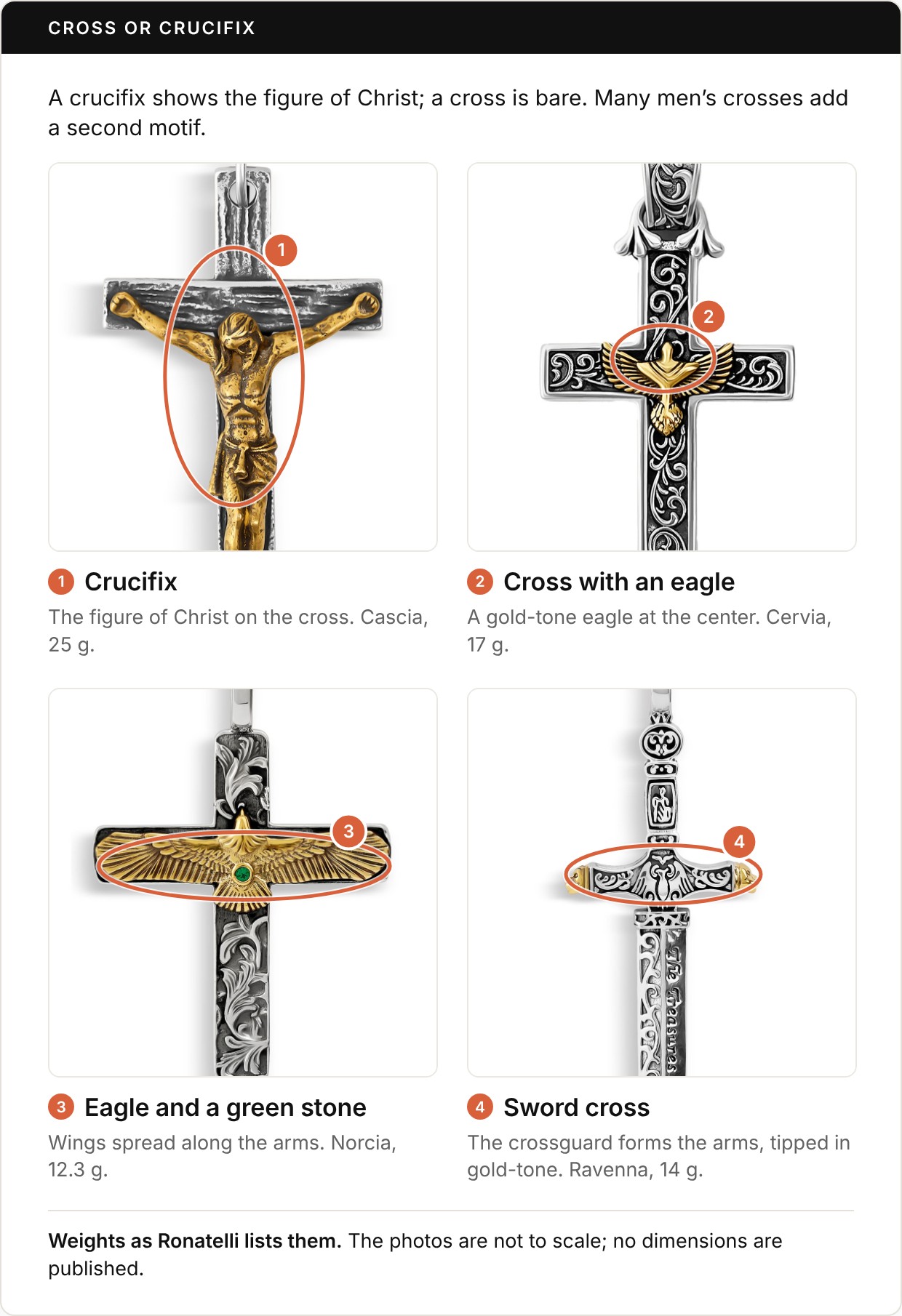
Many men’s crosses add a second motif, and it is worth knowing what it might say. Three of Ronatelli’s four crosses add one; the fourth is a crucifix:
- An eagle. The Cervia sets a gold-tone eagle at the center of a cross covered in scrollwork, and the Norcia an eagle with its wings spread and a green stone at its heart. In Christian art the eagle is the symbol of St. John the Evangelist, “the creature that dwells closest to heaven,” as the Fitzwilliam Museum puts it. Ronatelli doesn’t say what its eagles stand for, and one Cervia reviewer read the bird as the dove of the Holy Spirit.
- A sword. The Ravenna is a medieval-style sword whose crossguard, tipped in gold-tone, forms the arms of the cross, with “The Treasures Heart” engraved into the silver. Most people will still read it as a cross.
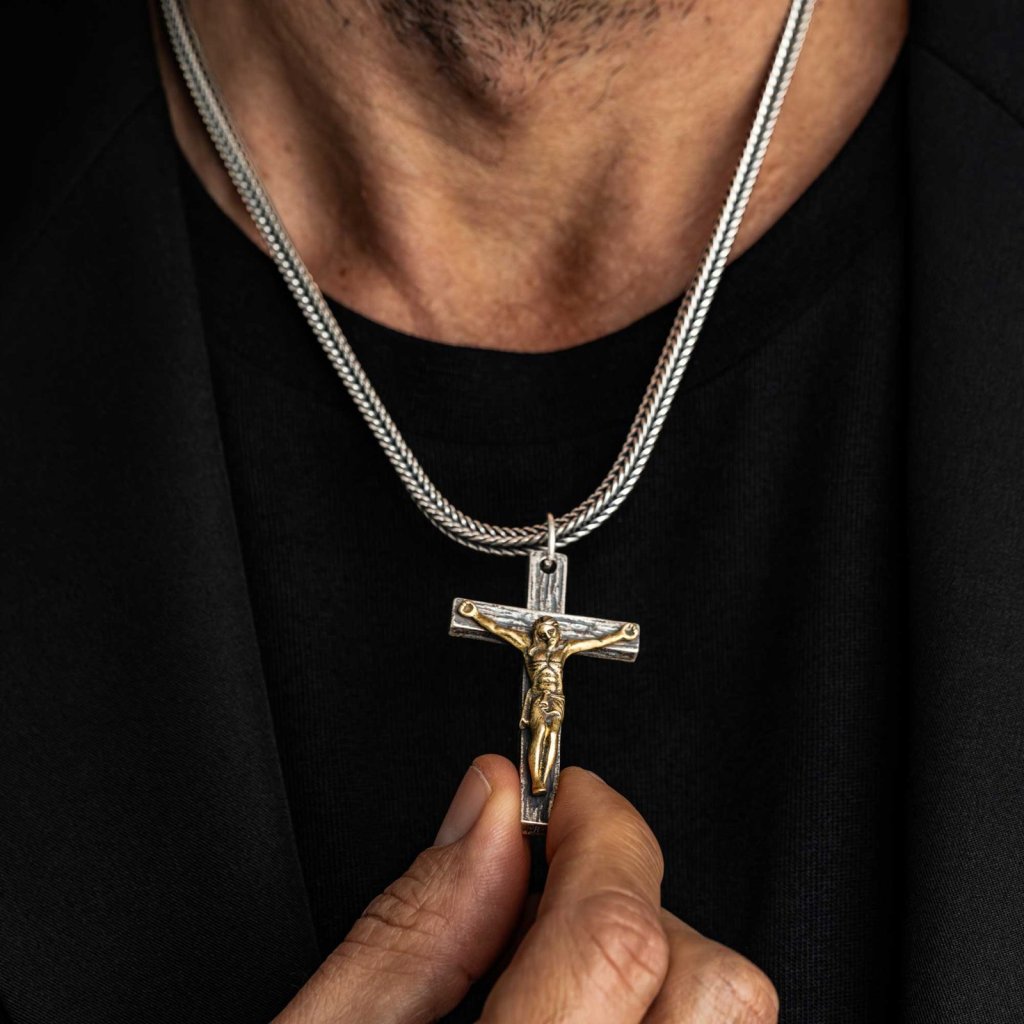
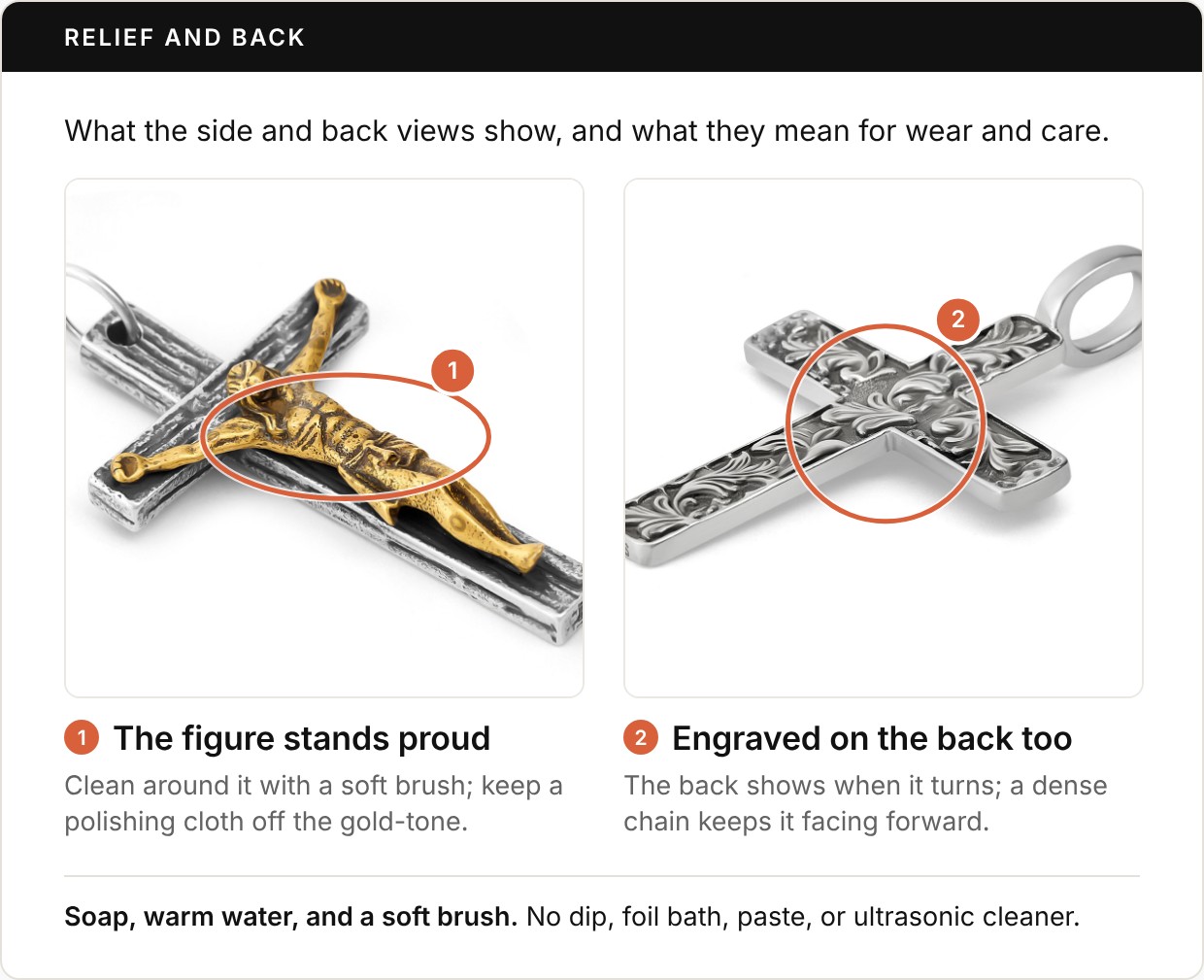
- A crucifix. The Cascia sets a gold-tone figure of Christ against an oxidized cross, so the figure stands out against the dark silver.
Wearing a cross: faith first
Whatever surrounds it, most people read a cross as a statement of faith, as our guide to symbols on men’s bracelets says. Plenty of men wear one as a style piece too; as Wikipedia’s entry puts it, “others, Christian and non-Christian, wear cross necklaces as a fashion accessory.” But the wearer doesn’t control how it is read, so a cross sits best on a man for whom the faith is real.
Reviews of Ronatelli’s crosses show what that looks like. One Cervia buyer calls his “a spot light to my faith”; a Cascia buyer is “blessed everyday with this around my neck,” and another bought it to replace the crucifix on his rosary. Others write only about the detail and the weight.
Under or over the shirt is his call. Orthodox Christians mostly wear the baptismal cross next to the skin, according to an article on Pravmir, an Orthodox site; over a T-shirt, a cross is a more visible statement. With a tie, keep it under the shirt, or leave it at home if it shows as a bump below the knot, as our guide to wearing a chain with a suit explains. And wear one pendant at a time: two pendants close together look cluttered and knock against each other, as our layering guide notes.
Size: go by weight and the worn photos
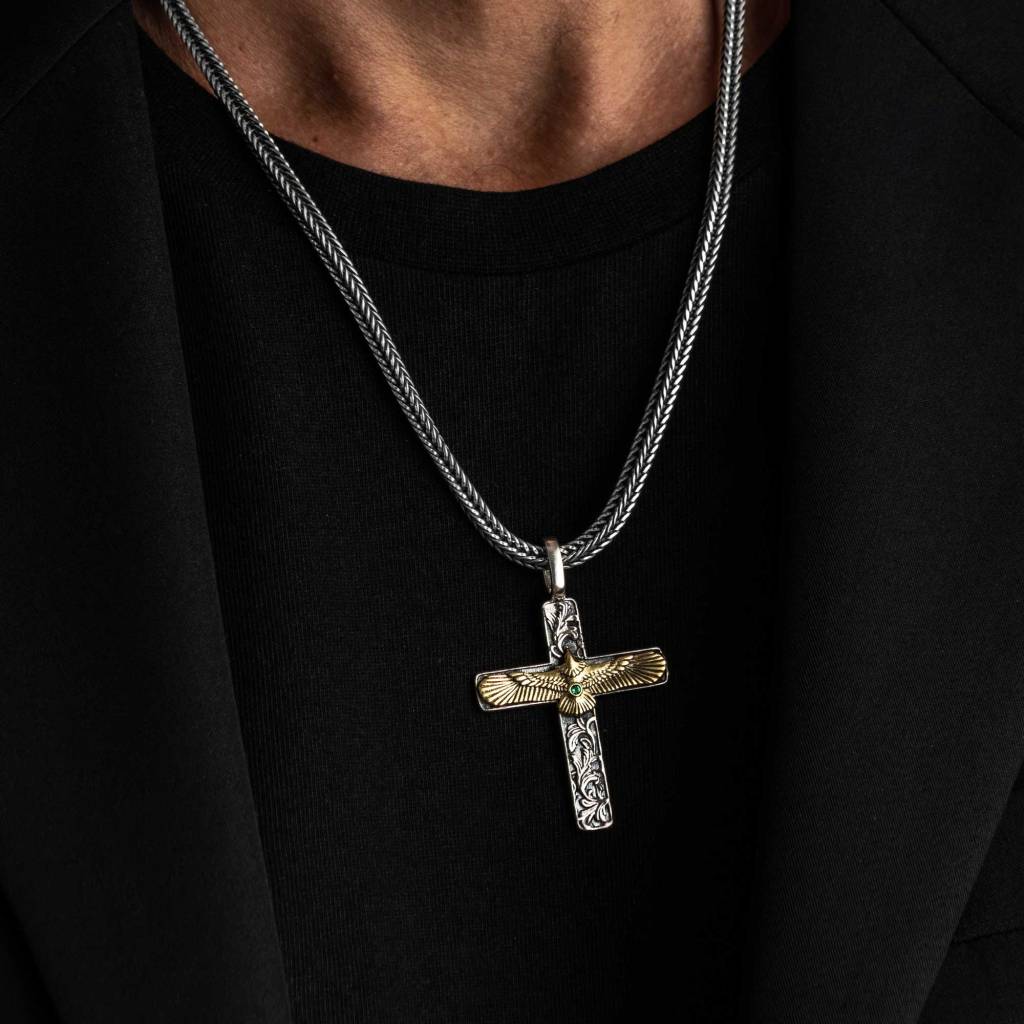
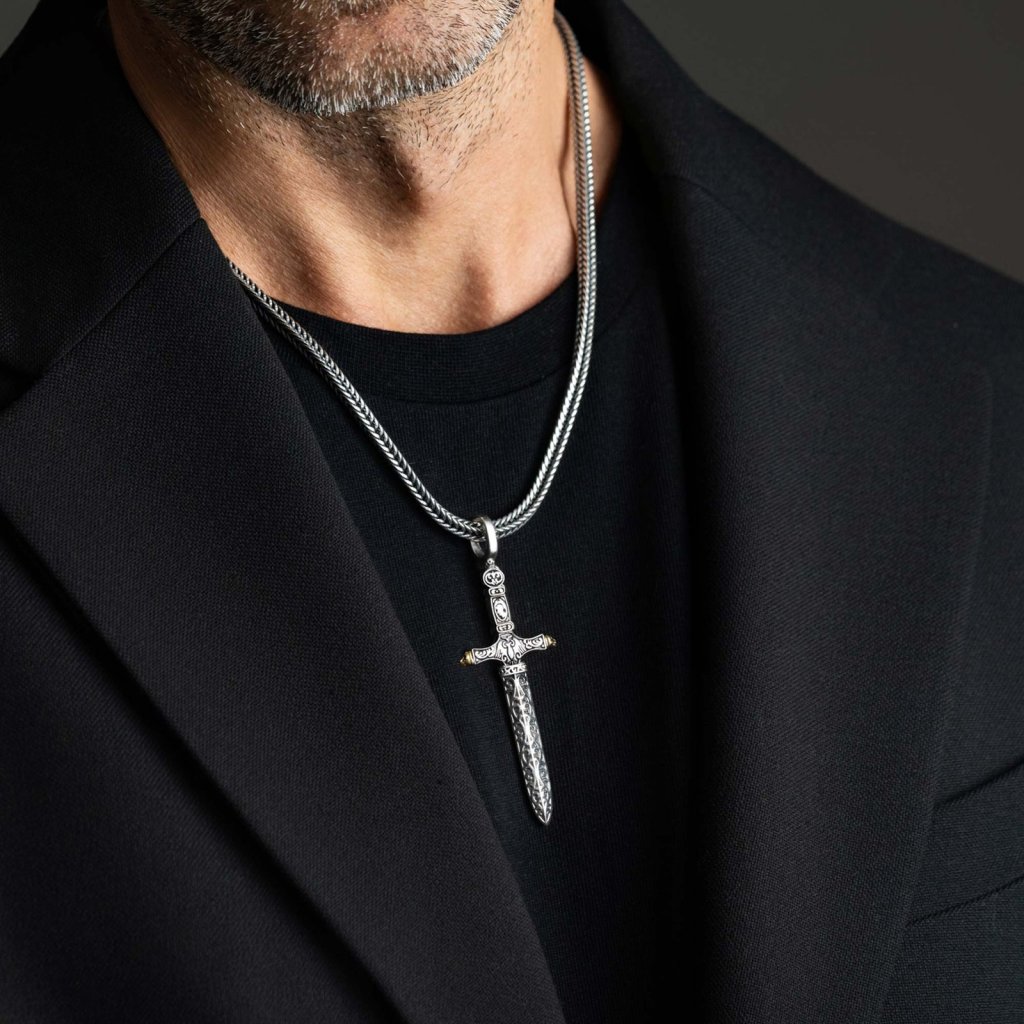
Ronatelli publishes no height or width for its crosses, only a weight in each search listing: 12.3 g for the Norcia, 14 g for the Ravenna, 17 g for the Cervia, and 25 g for the Cascia. Its FAQ says listed weights can vary by about 5 g either way, so the worn photos are the better guide to scale. In the reviews, the Cervia and the Ravenna draw most of the comments that a pendant came out larger than expected, and a 6′5″ buyer found the Norcia larger than he expected and right for his size.
Match the cross to his build and to where he will wear it. The rule in our chain length guide holds: a pendant over about 1½″ (38 mm) tall looks crowded on a chain shorter than 22″. A slim man, or a cross worn under a shirt, suits a smaller one; a broad man can carry the Cascia, which one parent who bought it for a 19-year-old son called “a bit heavy.”
Chain and length
By the weight rule in our guide to the best chain for a pendant, a cross up to 20 g belongs on a dense chain 4 mm wide, and one above 20 g, like the Cascia, on a solid, dense chain 4 to 5 mm wide. Box, wheat, rope, and foxtail chains carry a pendant well; open links let it turn. Ronatelli’s Sergo foxtail and its Monza rope, which comes in 24″ and 26″ only, fit the brief. Every Ronatelli pendant lists a fit of chains up to 6 mm, and the part that has to pass through the bail is usually the clasp end, which is often wider than the chain; our pendant gift guide shows how to check it.
A cross hangs 1″ to 2″ below the chain. For a small one under a shirt, a 20″ chain keeps it high on the chest; over a T-shirt, 22″ or 24″ lets it show, as our chain length guide explains. Ronatelli’s size guide suggests going one size longer than he would wear a plain chain.
Care: dark recesses and gold-tone parts
Ronatelli describes the Cervia, the Norcia, and the Cascia as oxidized, and the Ravenna’s photos show the same darkening: the recesses are dark on purpose so the polished silver stands out, or, in one Cervia reviewer’s words, the dark gives it “contrast that brings out the brightness of the polished parts of the silver.” It varies from piece to piece; two Cascia buyers found theirs brighter than the photos. The gold-tone parts (the eagles, the Cascia’s figure, and the tips of the Ravenna’s crossguard) are a different color, and Ronatelli doesn’t say what they are made of, so treat them gently.
Clean a cross the way our guide to oxidized silver describes: soap, warm water, and a soft brush; a polishing cloth only on the silver high points, never the gold-tone parts; and no foil bath, dip, paste, or ultrasonic cleaner, which strip the dark finish. Don’t soak the Norcia, whose stone Ronatelli doesn’t name; our cleaning guide explains why stones shouldn’t be soaked.
Which cross: four examples
- Detail on every side. The Cervia ($169, 17 g): scrollwork front, back, and bail, with a gold-tone eagle; 5.0 from 86 reviews, the most in the collection.
- The lightest listed weight. The Norcia ($149, 12.3 g): a gold-tone eagle with its wings spread and a green stone; 4.9 from 18 reviews.
- A crucifix. The Cascia ($199, 25 g): a gold-tone figure on an oxidized cross, and the heaviest listed weight; 4.9 from 28 reviews.
- A sword cross. The Ravenna ($149, 14 g): gold-tone tips on the crossguard and an engraved blade; 5.0 from 33 reviews.
Our comparison of all eight Ronatelli pendants has the rest of the collection, and none of these comes with a chain.
FAQ
What is the difference between a cross and a crucifix?
A crucifix shows the figure of Christ on the cross; a cross is bare. Catholic and Orthodox churches have long used the crucifix; Methodist, Baptist, Presbyterian, and many other Protestant churches use a plain cross.
Can a Protestant wear a crucifix?
Yes. Many Lutherans and Anglicans use the crucifix, though some prefer a plain cross; Methodist, Baptist, and Presbyterian churches generally use a plain cross. It comes down to his church and his own preference.
Can you wear a cross if you aren’t religious?
You can, and many people do, but most people will read it as a statement of faith. If that isn’t what he wants to say, a pendant with another motif says less.
What size cross should a man wear?
Go by his build and his chain. A cross over about 1½″ (38 mm) tall looks crowded on a chain shorter than 22″. Ronatelli lists weights, 12.3 to 25 g, but no dimensions, so compare the worn photos.
What chain is best for a cross necklace?
A dense box, wheat, rope, or foxtail chain 4 mm wide for a cross up to 20 g, and a solid one 4 to 5 mm wide above that. Check that the clasp end, not just the chain, fits through the bail.
Should a cross necklace be worn under or over the shirt?
Either. By tradition, Orthodox Christians mostly wear the baptismal cross next to the skin; over a T-shirt, it is a more visible statement. With a tie, keep it under the shirt.
Bottom line
Start with the kind of cross his faith uses: a crucifix in Catholic and Orthodox churches and among many Lutherans and Anglicans, a plain cross in Methodist, Baptist, Presbyterian, and many other Protestant churches. Then size it to his build, hang it on a dense 4 mm chain one size longer than he wears a plain chain, and clean around its dark and gold-tone details with soap, water, and a soft brush.
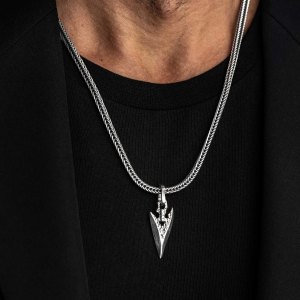
From the collection
Men’s sterling silver pendants by Ronatelli
Eight handmade 925 pendants, $99 to $199. Each fits chains up to 6 mm; the chain is sold separately.
Related guides
Prices, weights, ratings, and product descriptions were read from ronatelli.com on October 30, 2026, and may have changed since; review quotes come from the Reviews.io feed for each pendant. Church practice follows Msgr. Charles Pope in Our Sunday Visitor (March 14, 2022) and Wikipedia’s entry on cross necklaces; Orthodox practice follows Hegumen Philip Ryabykh and Igor Ponkin on Pravmir; the eagle as St. John’s symbol follows the Fitzwilliam Museum. Read our editorial policy.

