For most rings, 14K white gold is the more durable metal and sterling silver is the better value. White gold is at least twice as hard, doesn’t tarnish under its rhodium plating, and suits a wedding band worn for decades; it also costs many times more, needs replating to stay bright white, and often contains nickel. Sterling silver scratches and tarnishes more easily, but both polish out, its color is the same all the way through, and a substantial silver ring costs a fraction of the same design in gold.
Key takeaways
- Harder and heavier: white gold. Compared in the same softened state, 14K white gold is at least twice as hard as sterling, and the same ring weighs about 23 to 39 percent more.
- No tarnish, but plating: white gold. Rhodium keeps it bright and blocks tarnish, then wears to a slightly yellowish tone and needs replating, typically $100 to $500.
- Cheaper upkeep: sterling. Tarnish and fine scratches come off with a cloth or a jeweler’s polish, and there is no plating to replace.
- Far cheaper to buy: sterling. On October 30, 2026, the gold in an ounce of 14K was worth about 49 times the silver in an ounce of sterling.
- Sensitive skin: either, chosen carefully. White gold often contains nickel. Mayo Clinic lists both nickel-free white gold and sterling silver among the metals to look for.
In this guide Side by side What they are Durability Color and upkeep Skin Weight Price Look-alikes Which to choose FAQ
Sterling silver vs. white gold at a glance
| Sterling silver | 14K white gold | |
|---|---|---|
| Color | Sterling silverBright white throughout, often with subtle gray undertones | 14K white goldBright white from rhodium plating; faintly yellow underneath |
| Scratches and dents | Sterling silverSofter: scratches show sooner, and thin bands can dent or bend | 14K white goldAt least twice as hard: resists both better, though not scratch-proof |
| Tarnish | Sterling silverTarnishes with air and moisture; polishes off | 14K white goldRhodium blocks tarnish while it lasts |
| Upkeep | Sterling silverA polishing cloth, and an occasional polish by a jeweler | 14K white goldReplating every 12 to 18 months to about five years |
| Skin | Sterling silverUsually silver and copper; on Mayo Clinic’s list for nickel allergy | 14K white goldOften contains nickel; nickel-free white gold is on Mayo’s list |
| Weight | Sterling silverAbout 10.4 g/cm³ | 14K white gold12.8 to 14.5 g/cm³: about 23 to 39 percent heavier |
| Resizing | Sterling silverA jeweler can resize it, usually by one to two sizes either way | 14K white goldA jeweler can resize it too |
| Price | Sterling silverA fraction of white gold for the same design | 14K white goldThe gold in it is worth about 49 times the silver in sterling, ounce for ounce |
| Best for | Sterling silverStatement, signet, and stone rings; rings you rotate; first rings | 14K white goldWedding bands and rings worn every day for decades |
What each metal actually is
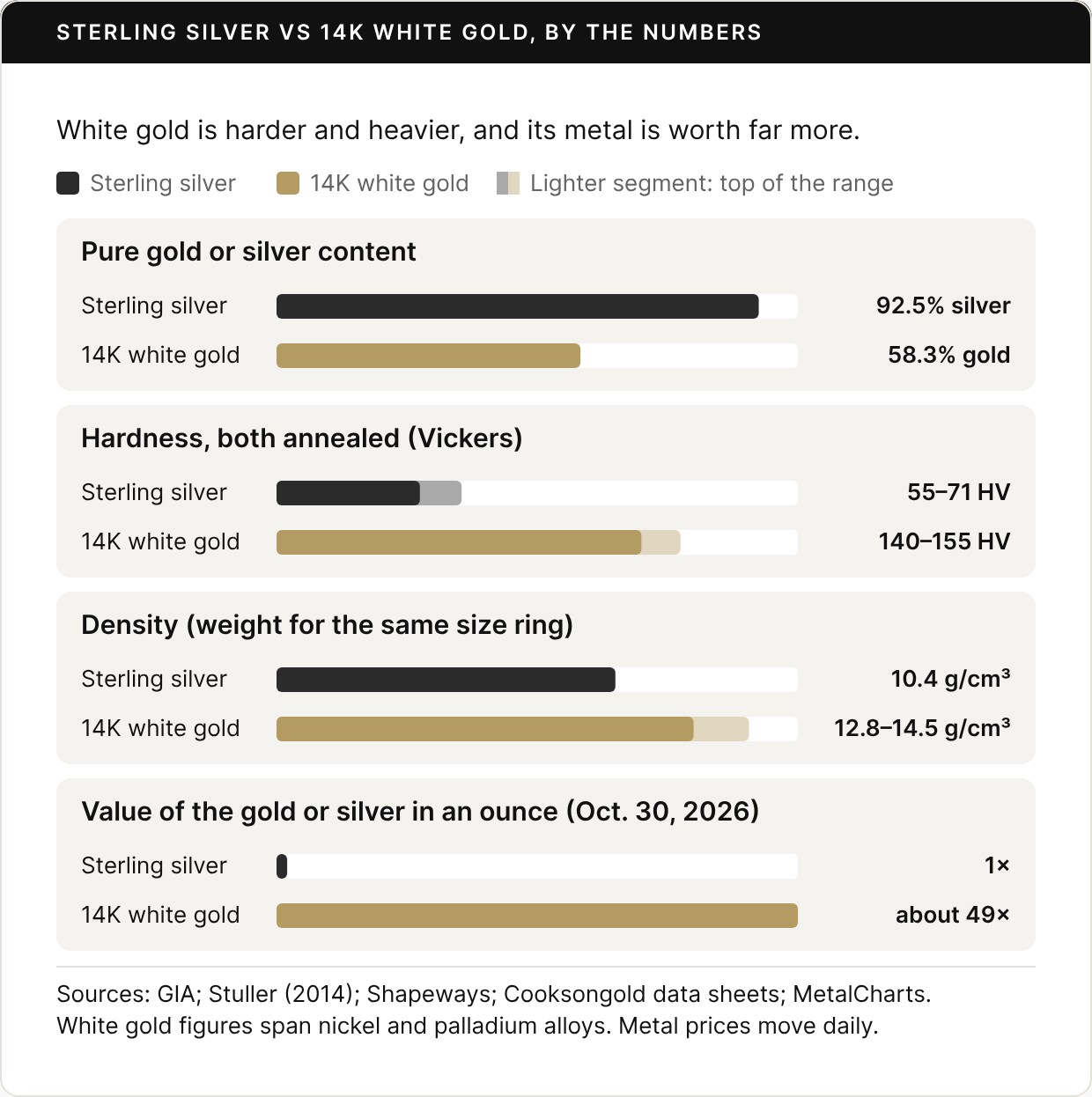
Sterling silver is 92.5% pure silver and 7.5% other metals, almost always copper, and it is stamped 925, as our guide to what 925 means explains. Pure silver is too soft for a ring; the copper makes it hard enough to wear.
White gold is gold alloyed with white metals such as nickel or palladium. At 14 karats it is 58.3% gold and 41.7% other metals, GIA notes; 18K white gold, the other common grade, is 75% gold. Even with all that white metal, gold’s color shows through: unplated white gold looks faintly yellow, according to GIA, so white gold jewelry is often plated with rhodium for a bright white color, extra shine, and scratch resistance. That thin plating is what you see on a new white gold ring, and it explains most of the differences below.
Durability: scratches, dents, and bending
This is white gold’s clearest advantage. “Silver is naturally softer and more susceptible to scratches and dents than white gold,” GIA writes, and the hardness figures agree. Fully softened by heat (annealed), traditional sterling measures 55 to 60 on the Vickers hardness scale in a 2014 study by Stuller’s research team, and a sterling data sheet from Shapeways gives 71. Cooksongold’s data sheets put annealed 14K white gold at about 140 for a nickel alloy and 155 for a nickel-free palladium alloy. Both metals get harder when they are rolled, drawn, or hammered, and the Shapeways sheet and Cooksongold’s palladium-alloy sheet list higher figures for worked metal, but compared in the same condition, 14K white gold is roughly two to nearly three times as hard.
On a ring, which takes more knocks than most jewelry, that difference shows. A sterling band picks up fine scratches sooner and, if it is thin, can be pushed out of round. White gold resists both better, though it isn’t scratch-proof, and its plating wears with time. Two things narrow the gap for silver: a band with 1.5 to 2.5 mm of metal thickness, as our ring buying guide recommends, and a finish that hides wear, such as brushed or oxidized. Fine scratches on sterling are cosmetic, and they polish out.
Color, tarnish, and upkeep
New, both look bright white. GIA describes silver as crisp and cool white, often with subtle gray undertones, while rhodium gives white gold a bright white, mirror-like finish. What changes with time is different for each.
Sterling tarnishes. Silver reacts with sulfur compounds in the air, in sweat, and in everyday materials such as rubber and wool, and forms a darker film. Humidity speeds it up, and silver worn every day tarnishes less than silver left in a drawer, as our guide to why silver tarnishes explains. The rhodium on white gold, by contrast, “provides a barrier against tarnishing,” GIA notes.
White gold’s change is the plating wearing away. As the rhodium thins, the alloy underneath shows through with “a slightly yellowish hue,” as Robinson’s Jewelers puts it, and the fix is replating at a jeweler. How often depends on how hard the ring is worn: Robinson’s recommends replating rings worn daily every 12 to 18 months, while one expert quoted by The Knot suggests about every five years, though some people need it sooner and some later. Another puts the cost at typically $100 to $500, and the first notes that many jewelers’ warranties cover it, so check before you pay.
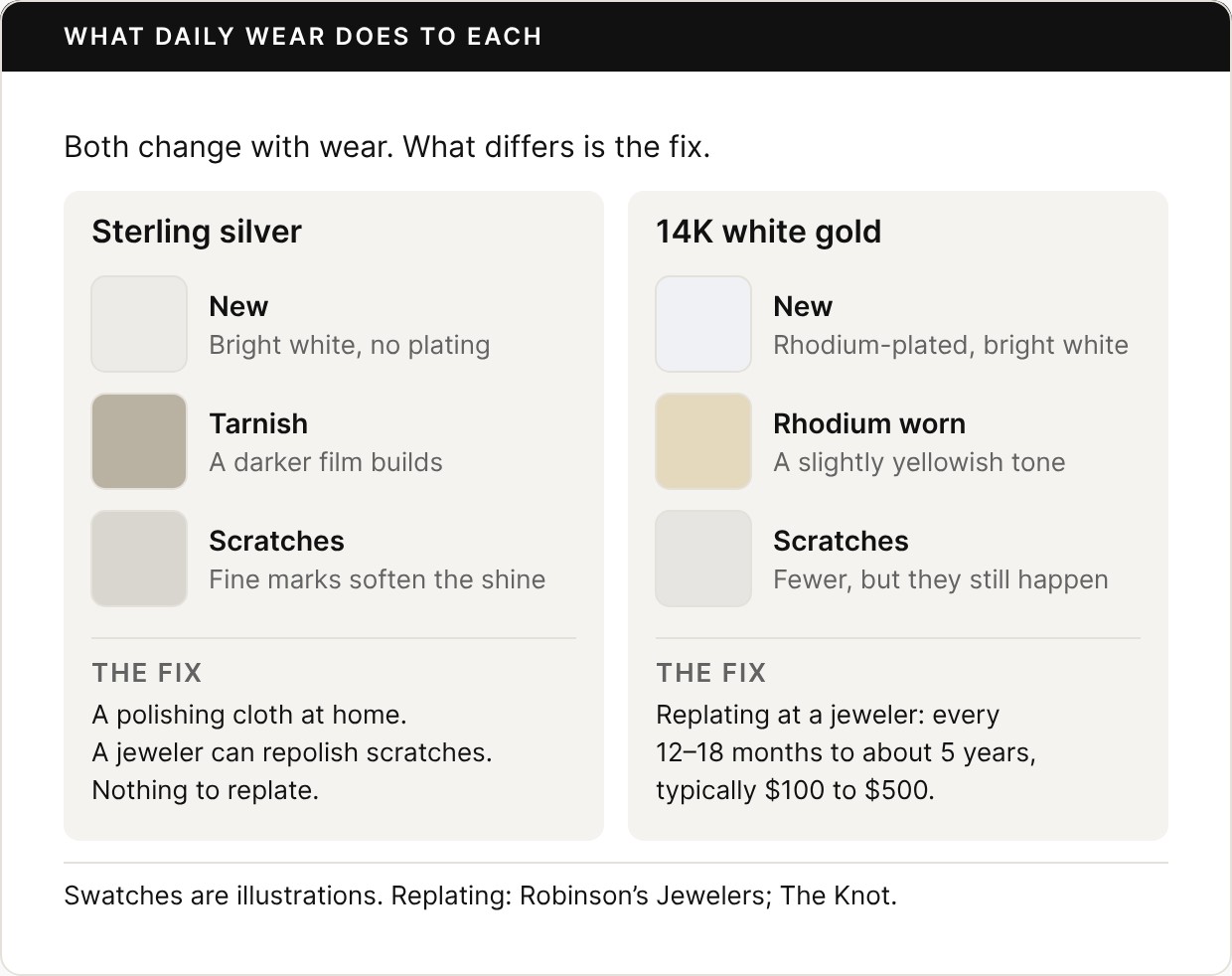
Sterling’s upkeep costs less. A polishing cloth handles tarnish at home, as our guide to cleaning sterling silver shows, and a jeweler can polish out scratches. There is nothing to replate, because the color is the metal itself. Rhodium-plated sterling exists too, and it behaves like white gold’s plating: brighter and slower to tarnish until it wears through, and then it needs replating too.
Sensitive skin and nickel
Nickel is the main skin concern with white gold. “Nickel, often used in white gold alloys, can cause allergic reactions for some people,” GIA notes, and a nickel allergy usually causes an itchy rash where the metal touches the skin, according to Mayo Clinic.
If you know nickel bothers you, Mayo Clinic’s list of jewelry metals to look for includes both “nickel-free white gold” and “sterling silver.” Nickel-free white gold uses palladium or other white metals instead: Cooksongold’s 14K palladium white, for example, contains about 15.5% palladium and no nickel. Ask the jeweler which alloy a white gold ring is made from before you buy.
Sterling isn’t a guarantee either. The metals added to silver “can trigger allergic reactions in some people,” GIA notes, although in sterling that is almost always copper; our guide to 925 covers whether sterling contains nickel. And if a silver ring leaves a green line, that is usually the copper reacting with sweat or soap, and harmless, as our guide to green fingers explains.
Weight: white gold is heavier
Sterling’s density is about 10.4 grams per cubic centimeter (10.37 in Shapeways’ data sheet). Cooksongold lists 12.8 for its 14K nickel white and 14.5 for its 14K palladium white. So the same ring made in 14K white gold weighs about 23 to 39 percent more than it does in sterling. Many people like that heft in a wedding band; on a wide statement ring, sterling’s lighter weight is easier to wear all day.
Price: the biggest difference
On October 30, 2026, MetalCharts listed gold at about $4,000 per troy ounce and silver at about $51.50, a ratio of about 78 to 1. Because 14K is 58.3% gold and sterling is 92.5% silver, the gold in an ounce of 14K white gold was worth about 49 times the silver in an ounce of sterling. Metal prices move every day, so treat these figures as a snapshot rather than a quote.
To put that in a ring: a plain band that weighs 6 grams in sterling contains about $9 of silver at those prices. The same band in 14K nickel white gold would weigh about 7.4 grams and contain about $550 of gold, roughly 60 times as much. Made in 14K nickel white gold, a chunky ring that weighs 15 grams in sterling would contain about $1,400 of gold, against about $23 of silver in the sterling version, before anyone is paid to make it. Finished rings don’t differ by quite that much, since the making costs money in either metal, but white gold “typically has a higher price point than silver,” GIA notes, and silver is more affordable “due to its abundance and less intricate processing requirements.”
The same arithmetic runs the other way when you sell: the gold in a white gold ring keeps real value as metal, while the silver in a sterling ring is worth relatively little. If resale value matters, that is a point for gold. If what matters is how much ring your budget buys, it is a point for silver: bold, heavy designs that would cost well over a thousand dollars in gold are affordable in sterling.
“White gold over sterling” and other look-alikes
Some listings blur the line. “White gold over sterling” means plated sterling silver. “White gold plated” on its own doesn’t say what’s underneath, which can be brass or another base metal. Neither is solid white gold, and a bright white ring stamped 925 is sterling, possibly rhodium-plated. Silver “is sometimes plated with rhodium to give it a bright, mirror-like shine,” GIA notes, which makes it look much like white gold. The plating is real and wears the same way, but the ring underneath is silver, and it should be priced as silver.
The stamp tells you what’s underneath. White gold is typically marked 14K, 18K, or 750, according to GIA (585 also means 14K), and sterling 925 or Sterling. A stamp is a claim rather than a test, as our 925 guide explains, so for an expensive ring, buy from a seller who states the metal in writing, or have a jeweler test it. Weight is a quick clue: the same ring in white gold feels noticeably heavier.
Which should you choose?
| If you want | Choose | Why |
|---|---|---|
| A wedding band worn every day for decades | Choose14K white gold | WhyIt holds its shape and finish better; budget for replating every one to five years. Pick a nickel-free alloy if you’ve ever reacted to nickel. |
| A statement, signet, or stone ring | ChooseSterling silver | WhyA bigger, bolder design for the money, and textured or oxidized surfaces hide wear. See our signet guide and black onyx rings guide. |
| A ring you’ll rotate with others | ChooseSterling silver | WhyPart-time wear means fewer scratches, and a quick polish brings it back. |
| The least maintenance | ChooseDepends on what you mind | WhyWhite gold won’t tarnish but needs replating; sterling needs a polish now and then, and nothing replaced. |
| Hard work with your hands, or the gym | ChooseWhite gold, or take it off | WhyWhite gold dents less, but any ring is safer off; see our guide to wearing a silver ring every day. |
| Sensitive skin | ChooseSterling or nickel-free white gold | WhyBoth are on Mayo Clinic’s list of metals to look for. |
| A first ring, or a tight budget | ChooseSterling silver | WhyThe same design costs a fraction, and it can be resized and repolished for years. |
FAQ
Is white gold better than sterling silver?
For durability and low tarnish, yes: 14K white gold is at least twice as hard as sterling in the same condition, and its rhodium plating blocks tarnish. For value, sterling wins by a wide margin. Which is better depends on whether the ring is a lifelong everyday piece or one of several you wear.
Does white gold tarnish or turn yellow?
It doesn’t tarnish the way silver does, because its rhodium plating is a barrier against tarnish. As that plating wears, the alloy underneath shows a slightly yellowish tone. Replating at a jeweler restores the bright white, usually every 12 to 18 months to about five years.
Is sterling silver good for a wedding band?
It can be, if you are happy to polish it now and then and accept some wear. Choose a band with 1.5 to 2.5 mm of metal thickness, a comfort fit, and a brushed or domed finish that hides scratches. If you want the band to look crisp for decades with the least effort, white gold or another harder metal is the safer choice.
How can you tell white gold from sterling silver?
Check the stamp: 14K, 585, 18K, or 750 for white gold, and 925 or Sterling for silver. White gold also feels heavier for the same size ring. Color isn’t a reliable test, because both can be rhodium-plated; for an expensive piece, have a jeweler test the metal.
What does “14K white gold over sterling silver” mean?
It means plated sterling silver: a thin layer of white plating over a silver ring. It looks like white gold when new, but it is priced, worn, and valued as silver, and the plating wears through with time.
Which is better for sensitive skin?
Sterling silver or nickel-free white gold. Mayo Clinic lists both among the metals to look for if you have a nickel allergy. Standard white gold often contains nickel, so ask which alloy a ring is made from.
Why is white gold so much more expensive than silver?
Mostly the metal. On October 30, 2026, gold cost about 78 times as much as silver per ounce, and 14K white gold is also denser, so the same ring uses more metal by weight. GIA also points to silver’s abundance and simpler processing.
Can white gold and sterling silver rings be resized?
Yes, both can be resized by a jeweler. Sterling usually moves one to two sizes either way; our ring buying guide explains the limits. Tungsten, titanium, and stainless steel rings, by contrast, generally can’t be resized the way gold and silver can, as our metal comparison explains.
Bottom line
Choose 14K white gold for a ring you’ll wear every day for decades and want to keep looking crisp, especially a wedding band, and budget for replating every one to five years. Choose sterling silver for almost everything else: it is softer and it tarnishes, but both are easy to reverse, bare silver never needs replating, and it buys a bolder, heavier ring for a fraction of the price.
From the collection
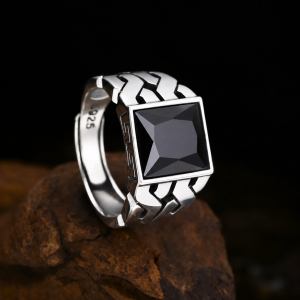
Men’s sterling silver rings by Ronatelli
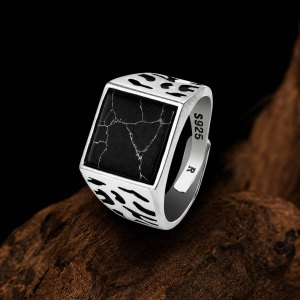
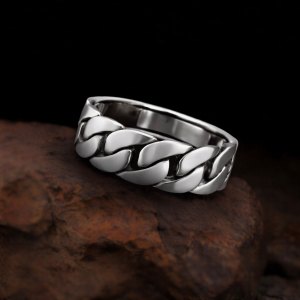
Eleven handmade 925 rings, $129 to $169, from a chain-link band to a black onyx statement ring. Every one is adjustable.
Related guides
Composition, scratch resistance, tarnish, nickel, price, and stamps follow GIA’s “White Gold vs. Silver: What Is the Difference?” (2025). Hardness follows Aithal, Butler, and Welch, “Development of a Harder Sterling Silver Alloy” (Santa Fe Symposium, 2014), Shapeways’ sterling silver data sheet, and Cooksongold’s 14ct NW and 14ct NF data sheets, which also give the white gold densities. Replating follows Robinson’s Jewelers (2025) and The Knot (2025); nickel allergy follows Mayo Clinic. Metal prices are MetalCharts’ figures for October 30, 2026, not live prices. Read our editorial policy.

