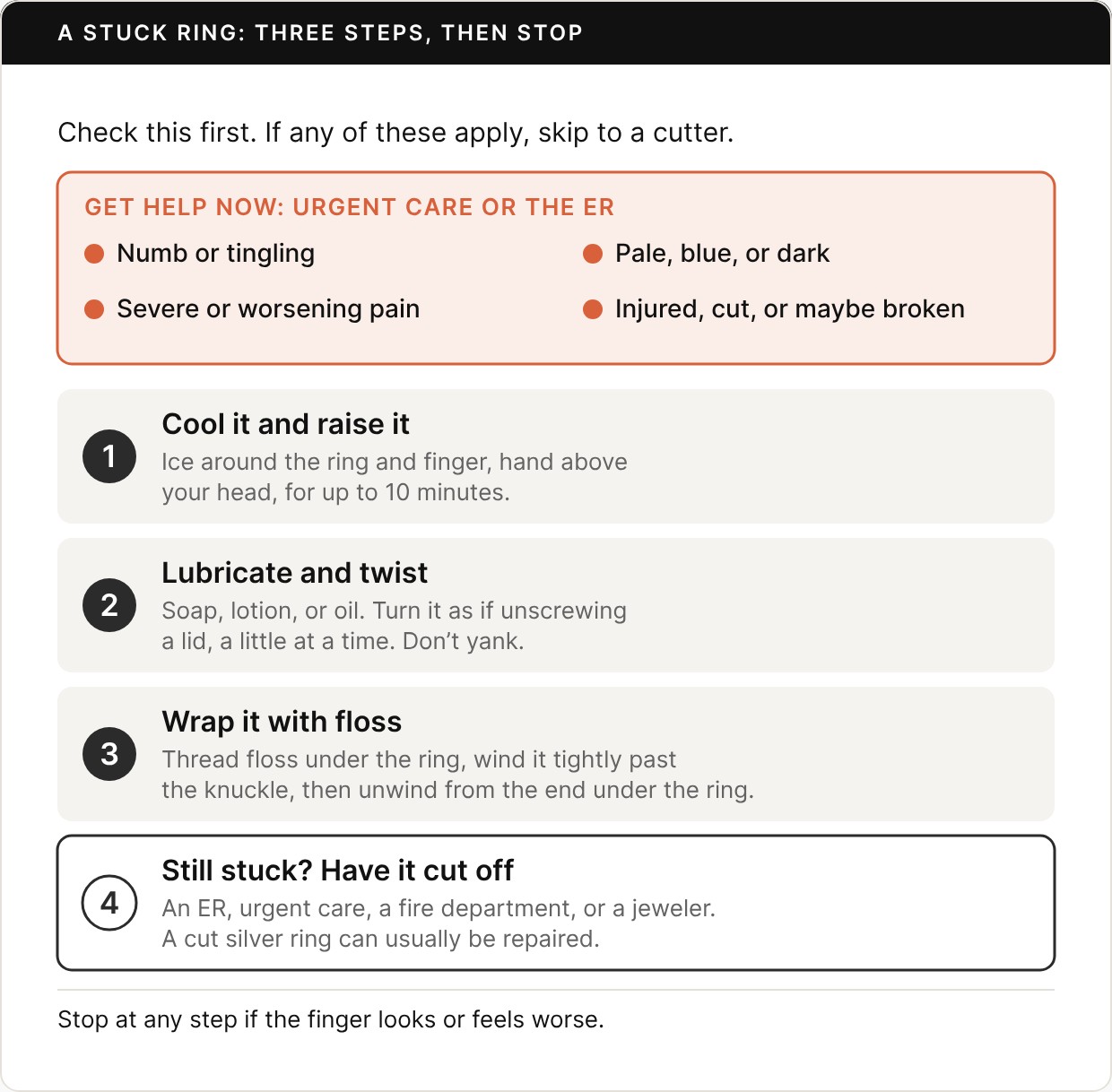
Many stuck rings come off at home: cool the finger and raise your hand, lubricate the ring and twist it, and if it still won’t pass the knuckle, compress the finger with dental floss. Knowing when to stop matters just as much. If the finger is numb, changing color, badly painful, or injured, skip the home methods and go to urgent care or the ER to have the ring cut off. A sterling silver ring cuts easily and can usually be repaired afterward.
Key takeaways
- Check first, then try. Numbness, a pale or blue finger, severe pain, or an injury means urgent care or the ER, not home methods.
- Cool it and raise it. Ice around the ring and finger, with your hand above your head, for up to 10 minutes.
- Lubricate and twist. Soap, lotion, or oil, then turn the ring as if unscrewing a lid. Don’t yank: forcing it swells the finger more.
- Floss does the squeezing. Wound tightly past the knuckle and unwound from under the ring, it carries the ring over the compressed finger.
- Silver is the easy case for a cutter. Soft metals are what a manual cutter is for, and a cut silver ring can usually be soldered and resized; tungsten and ceramic are cracked off and can’t be fixed.
In this guide When to stop Three steps The floss method What not to do Having it cut Why rings stick Prevention FAQ
First: when not to try at home
A ring that won’t come off is usually just uncomfortable. It becomes urgent when it starts acting like a tourniquet: the ring blocks fluid draining from the finger, the finger swells more, and the ring grips tighter. Doctors writing in BMJ Case Reports describe the sequence as lymph flow first, then the veins, and finally the arteries. Serious harm is rare, and it usually comes from delay. Go to urgent care or an emergency room, without trying the methods below, if:
- the finger is numb or tingling, or you’ve lost feeling in it;
- it has turned pale, blue, or dark;
- the pain is severe or getting worse;
- the swelling comes from an injury, or the finger may be cut or broken.
In those cases the answer is a ring cutter, which slides a guard between the ring and the skin before it cuts. Most jewelers, fire departments, and emergency rooms have one, Healthline notes, but with any of these signs go to urgent care or the ER, where the finger can be checked too. Healthline also advises seeing a doctor first whenever the swelling comes from an injury or there’s a wound.
Three steps that work at home
1. Cool it and raise it
Swelling is the problem, so start by bringing it down. The American Society for Surgery of the Hand suggests holding the hand overhead for up to 10 minutes with ice around the ring and finger, as HealthDay reports. Relax the hand while you wait; a patient guide from WebMD Ignite (Healthwise) notes that relaxing alone sometimes frees the ring. Don’t keep tugging in the meantime: forcing the finger out of the ring can make the swelling worse.
2. Lubricate and twist
Coat the finger and the ring generously. Dish soap, hand lotion, cooking oil, and petroleum jelly all work. Then turn the ring as if unscrewing it rather than pulling it straight off, and work it toward the knuckle a little at a time. If it sticks, wait five to ten minutes, cool and raise the hand again, and try once more, as Healthline suggests. The hand surgeons’ list also includes Windex; emergency physicians writing for ALiEM note that no study has tested it, and that its surfactants likely reduce the surface tension between ring and skin.
3. Wrap it with floss
If the ring stops at the knuckle, the finger in front of it needs to be squeezed smaller. That is what the string method does, and it is the technique emergency clinicians use too, as the MSD Manual describes. Use about 2 feet of dental floss or thin string.
How to do the floss method
- Slide one end of the floss under the ring, from the fingertip side toward your hand, and leave a few inches sticking out on the hand side.
- Wind the long end tightly around the finger, starting right next to the ring and working toward the fingertip. Lay each loop against the last, with no gaps, until you are well past the knuckle.
- Take the short end on the hand side and unwind it around the finger, the same way you wrapped it, so the loops come off toward the fingertip. As the floss unwinds, it pushes the ring along over the compressed finger.
- If the ring moves only partway, rewrap from where it stopped and repeat. If it doesn’t move at all, or the finger hurts more, stop, unwind the floss completely, and have the ring cut.
The knuckle is the hardest and most painful part to pass, the MSD Manual notes. Don’t use the floss method on a finger that is cut or might be broken; that’s a job for a clinic.
What not to do
- Don’t yank it. Rough handling adds swelling, Healthline and WebMD Ignite both warn, and more swelling makes the ring tighter.
- Don’t cut it off yourself. Professionals slide a guard under the ring and keep it cool while they cut, and WikEM, a reference for emergency doctors, still lists cuts, burns, and nerve damage among the risks. Doing it at home with pliers, snips, or a rotary tool, and no guard, makes all of those more likely.
- Don’t keep going while the finger gets worse. If it is swelling more, changing color, or losing feeling, stop and get help.
- Don’t wait it out. Swelling behind a tight ring tends to build on itself, which is why doctors advise removing rings from swollen fingers at the earliest opportunity.
When it has to be cut
Having a ring cut off is quick and routine. A clinician slides a guard between the ring and your skin, cuts through the band with a manual or electric cutter, and spreads the ends apart, sometimes with pliers, as WikEM describes. Fire departments carry ring cutters too: Fire Engineering says that even when a power saw is needed, removal should take no more than several minutes, and that proficient rescuers have done it in under 60 seconds. A jeweler can cut a ring off when there’s no injury, no severe swelling, and no sign of lost circulation, as Martin Busch Jewelers notes; anything more urgent belongs at urgent care or the ER.
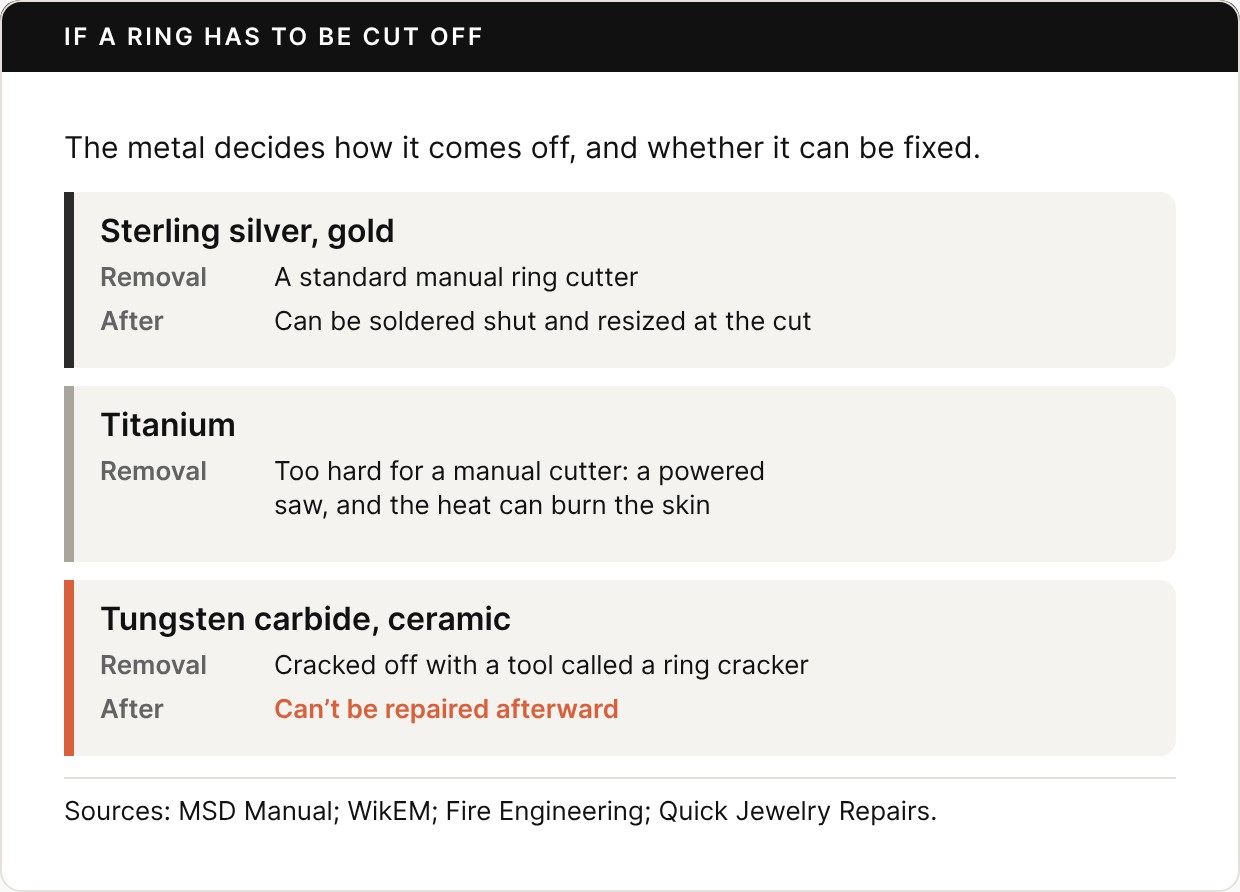
The metal decides what happens next. The MSD Manual lists rings of soft materials such as gold and silver as the ones a manual ring cutter is for, and Martin Busch says a cut ring can be repaired in most cases: according to Quick Jewelry Repairs, small cuts can simply be soldered shut, and if the ring was too small, the jeweler adds metal at the cut to make it larger. Hard metals such as titanium and steel need a powered ring saw or a bolt cutter, the MSD Manual says, and WikEM warns that power tools heat the ring, so the clinician stops often to keep it from burning the skin. Tungsten carbide and ceramic are hard but brittle, so they are cracked off instead, with a tool Fire Engineering calls a ring cracker or with locking pliers, and Quick Jewelry Repairs notes they can’t be repaired afterward.
That is one more reason sterling silver suits a ring you wear every day. Our comparison of silver, steel, and titanium covers the rest of the trade-offs.
Why rings get stuck
A ring gets stuck when the finger is bigger than it was when the ring went on. Usually that is temporary, and sometimes it is permanent.
| Cause | What’s happening | What helps |
|---|---|---|
| Heat and exercise | What’s happeningDuring a workout, blood flow shifts and the vessels in the hands can widen, which can make the hands swell, Mayo Clinic explains | What helpsTake rings off before you exercise, as Mayo Clinic advises |
| A ring that was always a little small | What’s happeningIt passes the knuckle on a cold morning but not on a warm afternoon | What helpsSize rings at the end of the day, when your hands are warm |
| An injury | What’s happeningA knock, sprain, or cut swells the finger behind the ring | What helpsTake rings off right away, before the swelling builds; if one won’t come off, have it removed at a clinic |
| Larger knuckles | What’s happeningArthritis can enlarge the knuckles, Healthline notes, so a ring that fits the base won’t pass the joint | What helpsA hinged shank or an adjustable ring |
| Fingers that change over time | What’s happeningFingers can grow after years of wearing the same ring, and fluid retention from diet or conditions such as kidney or thyroid disease can swell them, according to Healthline | What helpsResize the ring once it’s off; mention frequent, unexplained swelling to a doctor |
How to keep it from happening again
Most stuck rings come down to fit. Size a ring at the end of the day, when your hands are warm, so it passes the knuckle with slight resistance and doesn’t spin at the base; our ring size guide explains how to measure at home. If your knuckle is much larger than the base of your finger, a ring sized for the knuckle will spin, and a hinged shank, sizing beads, or an adjustable ring is the better answer, as our guide to adjustable rings explains.
Take rings off before a workout and at the first sign of swelling after a knock to the hand: doctors writing in BMJ Case Reports advise removing rings from swollen fingers “at the earliest opportunity.” Our guide to wearing a silver ring every day goes through the gym, the pool, and sleep one at a time, and our ring buying guide covers resizing a silver ring that has become too small.
FAQ
How do you get a ring off a swollen finger without cutting it?
Cool the finger with ice and hold your hand above your head for up to 10 minutes, then lubricate the ring with soap or oil and twist it off like a lid. If it stops at the knuckle, compress the finger with dental floss and unwind it from under the ring. Stop and have it cut if the finger is numb, discolored, very painful, or injured.
Does Windex really work to get a ring off?
It can. The American Society for Surgery of the Hand lists it with soap and oil, and emergency physicians have used it, though they note that no study has tested it. Plain dish soap is a good alternative.
Will the ER cut my ring off?
Yes. Emergency rooms and urgent care clinics remove stuck rings routinely, with a cutter that slides a guard under the ring. Fire departments and many jewelers also have ring cutters. Go to a clinic rather than a jeweler if the finger is injured, numb, or changing color.
Can a ring that’s been cut off be fixed?
A gold or sterling silver ring usually can: a jeweler solders the cut closed, and can add metal at the cut if the ring needs to be larger. Tungsten and ceramic rings are cracked off rather than cut, and can’t be repaired.
How do I know if a ring is cutting off circulation?
Numbness, tingling, a pale, blue, or dark finger, and pain that keeps getting worse are the warning signs. Any of them means urgent care or the ER now, not more home attempts.
Can a stuck ring damage your finger?
Rarely, and mostly when removal is delayed. A ring left on a swelling finger can cut off circulation, and in neglected cases it can lead to infection, tendon damage, and worse, as a 2013 case report in BMJ Case Reports describes. That is why doctors advise removing rings from swollen fingers at the earliest opportunity.
Should I resize a ring that got stuck?
If it got stuck because it was always a little small, yes. Once it’s off, have it sized up, and measure at the end of the day, when your hands are warm. If it was stuck because of an injury or a hot day, it may fit fine once the swelling is gone.
Bottom line
Check the finger before you touch the ring: numbness, a change of color, severe pain, or an injury means urgent care, where it can be cut off safely. Otherwise, cool it and raise it, lubricate and twist, and use floss to squeeze the finger past the knuckle. If none of that works, have it cut; a silver ring can be soldered back together, and sized properly this time.
From the collection
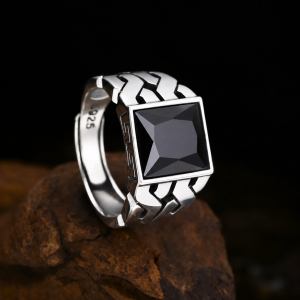
Men’s sterling silver rings by Ronatelli
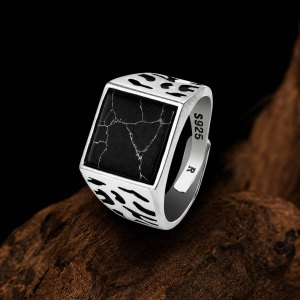
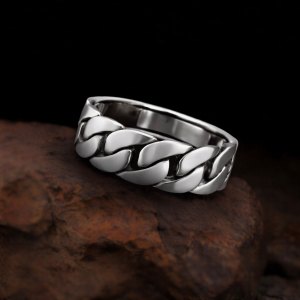
Eleven handmade 925 rings, $129 to $169, from a chain-link band to a black onyx statement ring. Every one is adjustable.
Related guides
This guide is general information, not medical advice; if you are worried about a finger, get it seen. Home methods follow the American Society for Surgery of the Hand (as reported by HealthDay), WebMD Ignite’s (Healthwise) “Removing a Ring From a Finger or Toe,” Healthline, and the MSD Manual’s “How To Remove a Ring Using the String Method”; the Windex note follows ALiEM. Warning signs follow Healthline, WikEM, and Kumar and colleagues in BMJ Case Reports (2013). Cutting follows WikEM, the MSD Manual’s “How To Remove a Ring Using a Manual Ring Cutter,” and Mark D. Gregory in Fire Engineering (2014); repair after cutting follows Quick Jewelry Repairs and Martin Busch Jewelers; exercise swelling follows Mayo Clinic. Read our editorial policy.

