
Disclosure:The example rings in this guide are from Ronatelli. Prices and product details were read from ronatelli.com on October 29, 2026; the advice applies to any brand.
Rarely, and when it does, it is harmless. Sterling silver is 92.5% silver and, almost always, 7.5% copper, and the copper can leave a faint green line on your finger when sweat, salt, or soap sits under the band. A strong green mark that appears quickly, especially from a new ring, more often means brass or copper under a thin layer of plating. This guide explains the three colors a ring can leave on your finger (green, black, and the red of a rash), what causes each, how to tell whether your ring is the sterling it claims to be, and how to stop the marks.
Key takeaways
- Green is copper. Sterling is 7.5% copper, so it can leave a faint green mark now and then; a strong, fast green points to plated brass or copper.
- Black is tarnish, or makeup. Silver sulfide rubs off onto the skin, and sunscreen and makeup can wear tiny particles of metal off the band. Both wash off.
- A red, itchy rash is usually trapped soap. Sometimes it is a nickel allergy, which can mean the alloy isn’t what it claims.
- None of it is dangerous. Green and black marks wash off; a rash that blisters or keeps coming back is one for a dermatologist.
- Clean, dry, and stamped. Keep the ring and your finger clean and dry, and buy from a seller who stamps the ring 925 and stands behind it.
In this guide Short answer Green Black Red rash Is it sterling? Prevent it Examples FAQ
The short answer: rarely, and it’s harmless
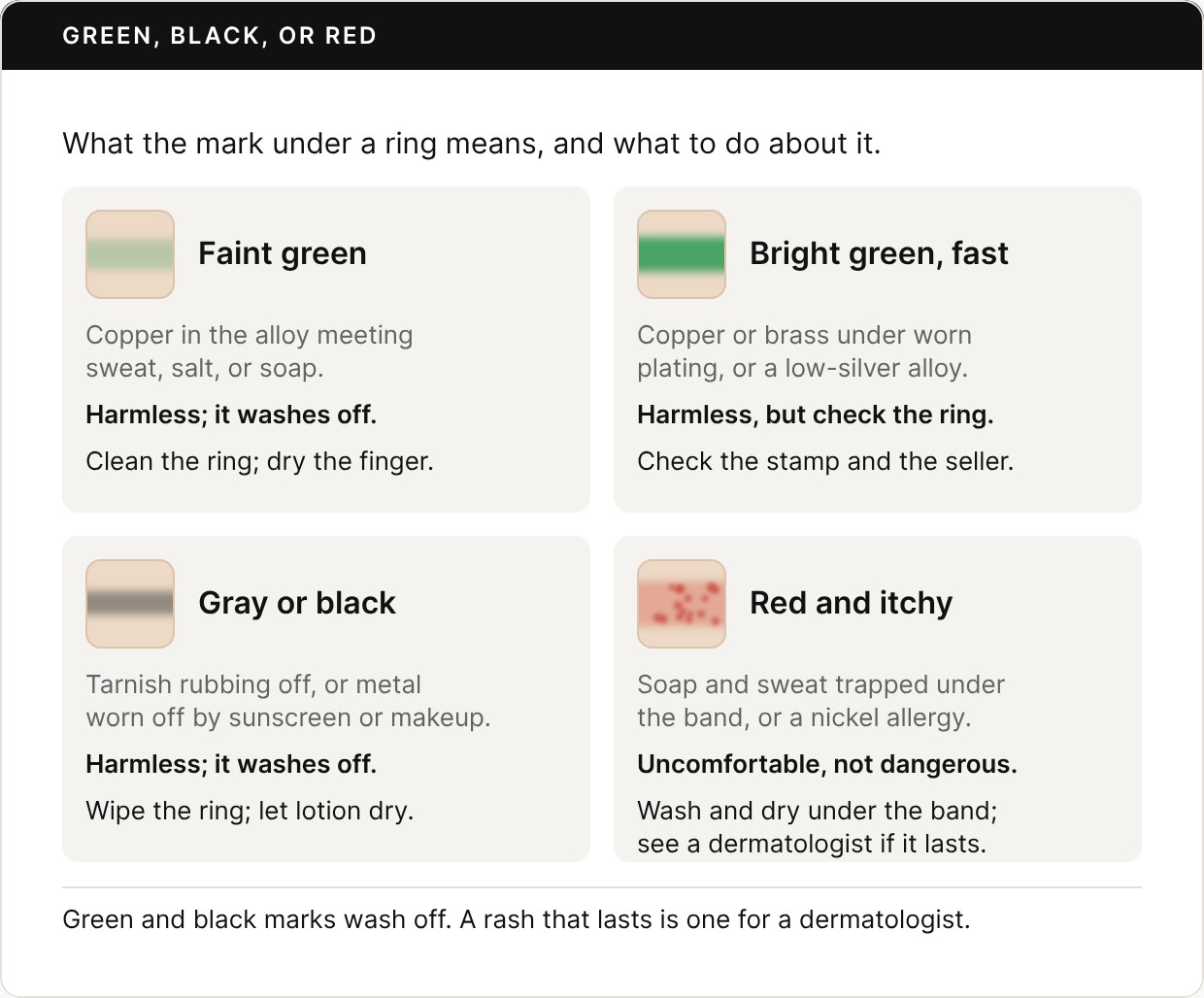
Most people never see a green mark from a sterling silver ring. Some do, now and then, because the copper in sterling reacts with what is on the skin, and some skin, and some days, bring out more of it than others. The color of the mark is the quickest clue to what is going on.
| Mark | What it is | Is it harmful? | What to do |
|---|---|---|---|
| Faint green | What it isCopper compounds from the alloy, formed by sweat, salt, or soap under the band | Is it harmful?No; it washes off | What to doClean the ring and dry your finger |
| Bright green, fast | What it isBrass or copper under worn plating, or an alloy with less silver than sterling | Is it harmful?No, but the ring may not be sterling | What to doCheck the stamp, the seller, and the inside of the band |
| Gray or black | What it isTarnish rubbing off, or metal worn off the ring by sunscreen or makeup | Is it harmful?No; it washes off | What to doWipe the ring; let lotion and sunscreen dry first |
| Red and itchy | What it isSoap and sweat trapped under the band, or a nickel allergy | Is it harmful?Uncomfortable, not dangerous | What to doWash and dry under the ring; see a dermatologist if it lasts |
Why a ring turns your finger green
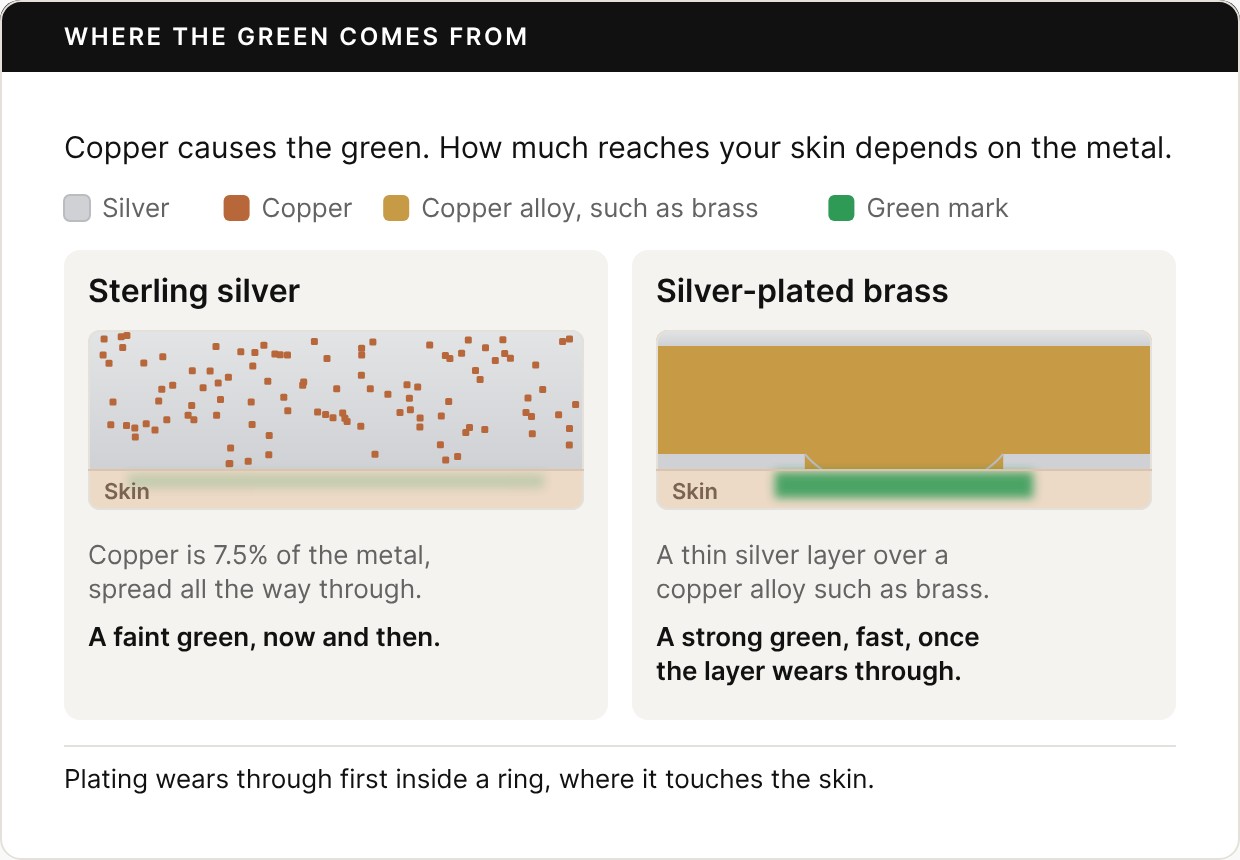
The green is copper, not silver. Copper reacts with sulfur in the air, with salt water, and with sweat, and the compounds it forms range from blue to green, as the Royal Society of Chemistry explains; on a copper surface they build into a thin patina that rubs off as a green mark. The authors of a 2015 case report in the Indian Journal of Dermatology put it simply: acidic sweat leaches the copper out of the metal, and the stain can come from silver, gold, or brass jewelry when it contains copper.
Sterling does contain it. The 925 stamp means 925 parts in every 1,000 are silver; the other 75 are other metals, almost always copper, as our guide to what 925 means explains. That copper is what makes sterling hard enough to wear, and it is spread all the way through the metal. Because it is a small share, the mark from a genuine sterling ring is usually faint and occasional, and many people never see one.
A few things make a mark more likely: sweat, on a hot day or through a workout; salt water; and soap or lotion left under the band, where the skin stays damp. Science Notes describes the green as a reaction between the copper and salts, acids, and other chemicals on the skin. Skin chemistry varies too: the same ring can mark one person’s finger and never another’s, much as some people tarnish silver faster than others, as our tarnish guide explains.
A strong green that appears within days, especially on a new ring, is a different signal. It usually means the metal against your skin is mostly copper: brass or copper under a thin silver-colored plating that has worn through, or an alloy with far less silver than sterling. Plating wears through first inside a ring, where it rubs against the finger, and a yellow or pink tone there is the giveaway, as our guide to telling real silver from fake explains.
Either way, the mark itself is harmless. The copper compounds are not toxic and the stain fades within a few days, according to Science Notes, and the Indian Journal of Dermatology authors note that copper chloride dissolves in water and washes off in the bath. A rash is another matter, covered below.
Black or gray marks
A dark gray or black line under a ring is not copper. On sterling it is usually tarnish rubbing off: silver sulfide, the dark film that forms on silver, transferring onto the skin with help from lotion, soap, or sweat, as our guide to why sterling silver tarnishes explains. It is more common with a new piece that still has polishing compound in its recesses, in humid weather, and on skin with makeup or sunscreen. It washes off and does no harm, and black residue on a polishing cloth is one of the signs a piece is real silver.
Makeup and sunscreen can also leave a dark mark of their own. Dermatologists call it black dermographism: products such as zinc oxide and titanium oxide sunscreens wear tiny particles of metal off jewelry, and the particles stick to the skin. A 2026 case report in Cutis describes it as harmless and not permanent, most often with gold but also with silver, and says it can be prevented by keeping the product and the metal apart. For a ring, that means letting hand cream and sunscreen dry before the ring goes back on.
A red, itchy rash
A red, itchy patch under a ring is the skin reacting, and the usual cause is not the metal at all. Most wedding-ring rashes come from irritation rather than allergy, Mayo Clinic dermatologist Dawn Davis says: soap residue, sweat, and dirt build up under the ring and irritate the skin until it reacts like eczema. Her advice is to wash, rinse, and dry thoroughly under your rings. An adjustable ring needs the same care at the back, where the join collects soap and skin oil, as our adjustable ring guide notes.
The other common cause is nickel. More than 18% of people in North America are allergic to it, according to the American Academy of Dermatology, and it is one of the most common causes of allergic contact dermatitis. A nickel allergy usually causes an itchy rash where the metal touches the skin, starting a day or two after contact, according to Mayo Clinic. Both list sterling silver among the metals people with a nickel allergy can choose.
That doesn’t make every ring stamped 925 nickel-free. Standard sterling is silver and copper, but the 925 standard doesn’t say what the other 7.5% must be, and some low-cost alloys use nickel, as our guide to what 925 means explains; the United States also has no federal limit on how much nickel jewelry may release, unlike the European Union. So a rash from a “925” ring can be a sign that it isn’t what it claims. Ronatelli says its jewelry complies with REACH, the European Union’s chemicals regulation, and that none of its products contain nickel, lead, or cadmium.
If a rash blisters, becomes infected, or comes and goes, the AAD advises seeing a board-certified dermatologist for a proper diagnosis; for a ring rash that persists, Dr. Davis’s advice is to talk to your health care provider.
Is your ring really sterling?
A mark is a reason to look at the ring, not proof of anything. Four quick checks, each covered in more detail in our guide to telling real silver from fake:
- The stamp. Look inside the band for 925, S925, or STERLING, ideally beside a maker’s mark. Under the FTC’s Jewelry Guides, nothing below 925 parts per thousand of silver may be marked or described as sterling, as our guide to 925 explains. A stamp is a claim, not a test, so it matters who stands behind it.
- The inside of the band. Plating wears through there first. A yellow or pink tone showing through means brass or copper underneath; sterling is the same color all the way through, even in a scratch.
- The cloth. Rub the ring firmly with a white cloth or a polishing cloth. Real silver leaves black or dark gray marks; plated and base-metal pieces usually leave nothing, or a greenish or yellowish smear.
- The magnet. Sterling isn’t magnetic. If a strong magnet pulls the ring, it has steel or iron in it. If it doesn’t, keep checking: brass and copper aren’t magnetic either.
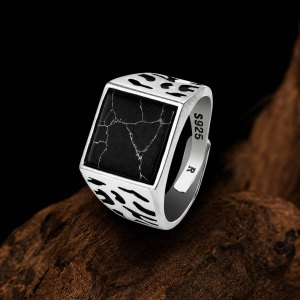
Every Ronatelli ring is described as 925 sterling silver on its product page, and the product photos show an S925 stamp inside the band.
How to stop it happening
- Keep the ring clean. Wash it in warm water with a drop of mild dish soap and a soft brush, then rinse and dry it; that lifts the film of soap and skin oil where the marks start. Every two or three months is enough for most rings, sooner if you see green. Our cleaning guide has the steps.
- Dry under the band. After washing your hands, dry the ring and the skin under it, or slip the ring off and dry both. It is the same advice Dr. Davis gives for ring rash.
- Lotion first, ring second. Let hand cream and sunscreen dry before the ring goes back on. Ronatelli’s FAQ gives the same advice for all its jewelry: put it on last.
- Take it off for the pool and the sea. Salt water and chlorine are hard on sterling anyway; our guide to wearing a silver ring every day goes through the pool, the gym, and sleep.
- A clear coat, if it keeps happening. A thin layer of clear nail polish or a jeweler’s coating inside the band puts a barrier between the metal and your skin, a fix both the Indian Journal of Dermatology authors and Science Notes suggest. It wears off with use, so it needs redoing now and then.
Ronatelli rings: where to aim the brush
Every ring in Ronatelli’s ring collection is 925 sterling silver and adjustable, from $129 to $169. If one ever leaves a mark, the fix is a wash, and these are the places where soap and skin oil collect:
| Ring | Where soap collects | Clean it with | Price |
|---|---|---|---|
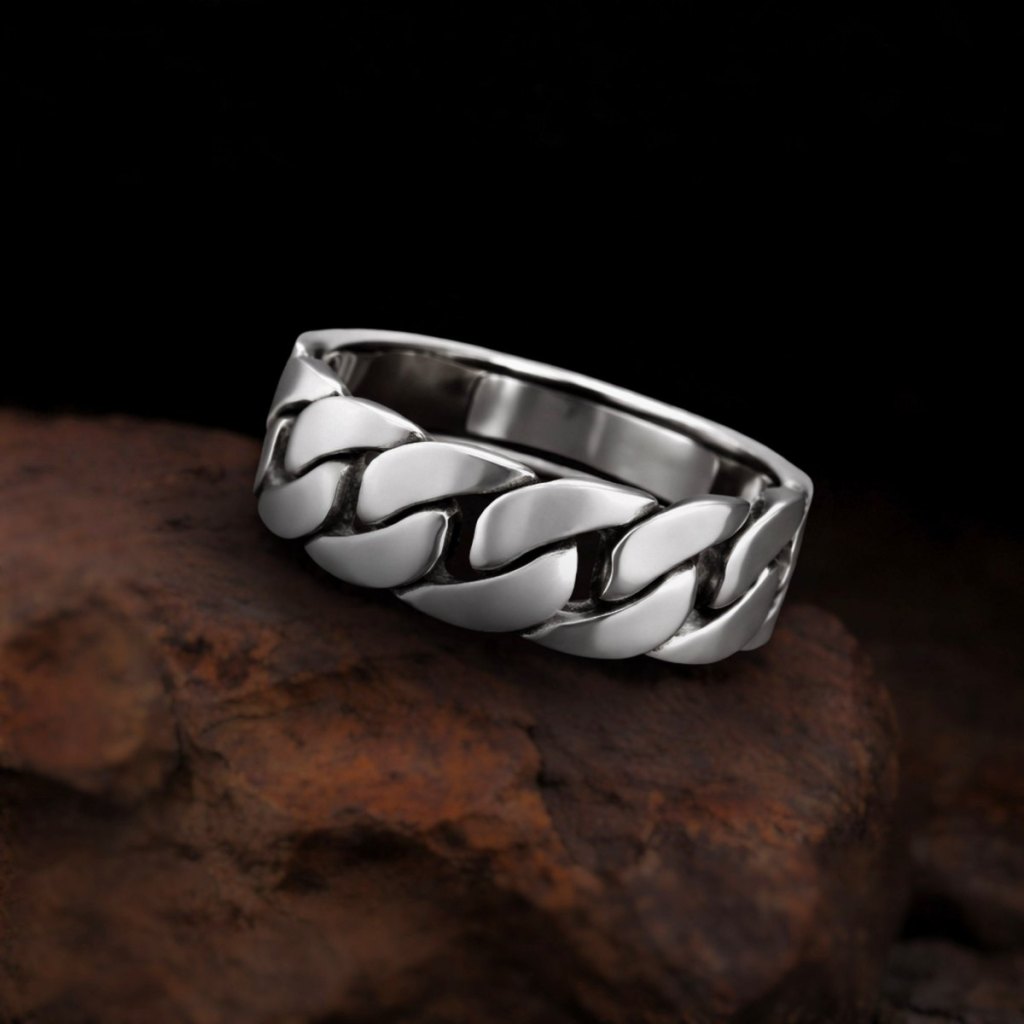
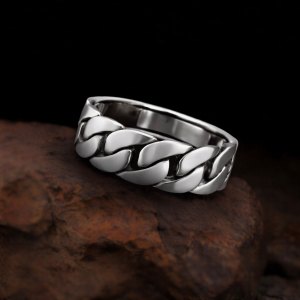
| Torin: Chain Link Ring | Where soap collectsBetween the links and under the sliding back | Clean it withWarm water, mild soap, a soft brush | Price$129 |
| Nexus: Braided Band Ring | Where soap collectsIn the braid | Clean it withWarm water, mild soap, a soft brush | Price$129 |
| Etna: Rock Texture Band Ring | Where soap collectsIn the rock texture and at the open back | Clean it withSoap and water only; the recesses are darkened on purpose | Price$129 |
| Troy: Black Onyx Ring | Where soap collectsAround the prongs and the small stones on the shoulders | Clean it withLukewarm water, mild soap, a soft brush around the stones | Price$149 |
| Ragnar: Square Black Onyx Ring | Where soap collectsAround the frame and at the overlapping back | Clean it withLukewarm water and mild soap; dry it well | Price$149 |
For a darkened ring such as the Etna, skip the foil bath and silver dips, which strip the dark finish, as our guide to oxidized silver explains. For the onyx rings, our guide to black onyx rings covers each setting and how to clean around it, and our comparison of all eleven rings covers the rest of the collection.


FAQ
Does real sterling silver turn your finger green?
Rarely, but it can. Sterling is 7.5% copper, and that copper can react with sweat, salt, or soap under the band and leave a faint green mark. A strong green that appears quickly usually points to brass or copper under plating, or an alloy with less silver than sterling.
Is it bad if a ring turns your finger green?
No. The green is a copper compound that isn’t toxic, washes off with soap and water, and fades within a few days. Clean the ring and dry your finger. A rash, itching, or blisters are different, and worth a dermatologist’s look if they last.
Why does my silver ring leave a black mark?
Usually it is tarnish rubbing off, helped by sweat, soap, or lotion, or tiny particles of metal worn off the ring by sunscreen or makeup. It washes off and is harmless; our tarnish guide explains it.
Can you be allergic to sterling silver?
A rash under a sterling ring is more often irritation from soap and sweat trapped under the band, according to Mayo Clinic dermatologist Dawn Davis, or a reaction to nickel in an alloy that isn’t standard sterling. The American Academy of Dermatology and Mayo Clinic both list sterling silver among the metals people with a nickel allergy can wear. If a rash keeps coming back, a board-certified dermatologist can diagnose the cause.
Does clear nail polish stop a ring turning your finger green?
It helps for a while. A thin coat inside the band keeps the metal off your skin until it wears away, and then it needs redoing. Cleaning the ring and drying your finger deal with the cause.
How do you get a green mark off your finger?
Wash it with soap and water. The copper compounds dissolve in water, and any trace left fades within a few days.
Bottom line
A sterling silver ring can leave a faint green mark now and then, because sterling is 7.5% copper, and the mark is harmless. A strong, fast green is the one to take seriously, not for your skin but for the ring: it usually means plating over brass or copper. Black marks are tarnish or makeup, and a red rash is usually trapped soap, occasionally nickel. Keep the ring clean, dry under the band, put lotion on first, and buy from a seller who stamps the ring 925 and stands behind it.
From the collection
Men’s sterling silver rings by Ronatelli
Eleven handmade 925 rings, $129 to $169, from a chain-link band to a black onyx statement ring. Every one is adjustable.
Related guides
The chemistry of the green mark follows the Royal Society of Chemistry and Balasubramanian and Lakshmi in the Indian Journal of Dermatology (2015); its harmlessness and the clear-coat tip also follow Science Notes. Black dermographism follows Ehlert, Delost, and Delost in Cutis (2026); ring rash follows Mayo Clinic dermatologist Dawn Davis; nickel allergy follows the American Academy of Dermatology and Mayo Clinic. The 925 standard, the stamp, and the home tests follow our guides to 925 and to telling real silver from fake. Ronatelli’s metal and REACH statements come from its FAQ and product pages, and its prices from its product pages, all checked on October 29, 2026. This guide is general information, not medical advice. Read our editorial policy.

