A moissanite tennis chain, a line of lab-grown stones set in sterling silver, is one of the most affordable ways to wear an iced-out look. It can be a good buy. But these chains are often sold in diamond language that doesn’t fit: “moissanite diamond,” “passes diamond tester,” “D color, VVS1, certified.” Here is what moissanite is, what those claims actually tell you, and what to check in the silver, the settings, and the clasp before you pay.
Key takeaways
- Moissanite isn’t diamond. It is silicon carbide grown in a lab, and the FTC tells sellers of simulated diamonds to say so clearly.
- “Passes diamond tester” proves little. A thermal tester can register moissanite as diamond.
- A certificate is only as good as its lab. Look the report number up on the lab’s own website.
- The chain is sterling, often plated. Find the 925 stamp and the plating metal before you buy.
- Check the stones, prongs, and clasp, and keep the chain away from your other silver, which the stones will scratch.
In this guide What moissanite is The claims The silver Settings and clasp Width and length Care FAQ
What moissanite is
Moissanite is silicon carbide. Henri Moissan, a Nobel Prize–winning French chemist, found it in a meteorite crater in Arizona more than 120 years ago, and in nature it is extremely rare, according to the American Gem Society; the stones in jewelry are grown in a lab. It makes a convincing stand-in for diamond because its hardness and its ability to conduct heat approach diamond’s, GIA researchers note. It is still a different stone. Moissanite has much higher dispersion, which shows as more obvious fire, the rainbow flashes in a cut stone, and it is doubly refractive, so under magnification the facets at the back of the stone can look doubled.
What the listing claims mean
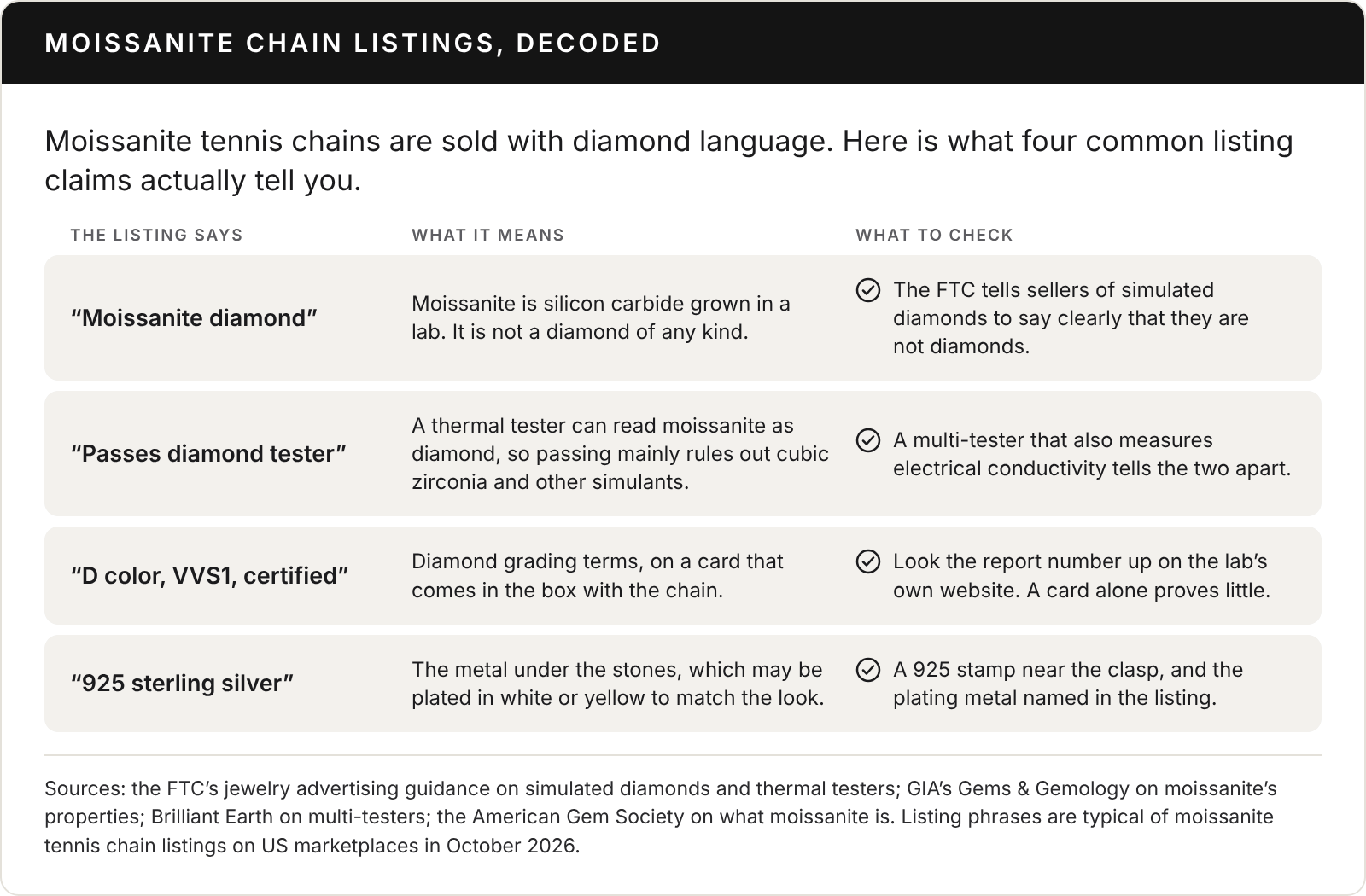
- “Moissanite diamond.” Moissanite isn’t a diamond of any kind. Sellers of simulated or imitation diamonds “should tell consumers that they are not diamonds,” the FTC says, with the disclosure placed immediately before the word “diamond” and just as conspicuous. A listing that leans on “diamond” and buries “moissanite” is a reason for caution.
- “Passes diamond tester.” The FTC warns jewelers that moissanite “may falsely register as a diamond” on a thermal tester, the kind used to tell diamonds from cubic zirconia. Passing mainly rules out cubic zirconia and other common simulants. To tell moissanite from diamond, Brilliant Earth recommends a multi-tester that measures both thermal and electrical conductivity.
- “D color, VVS1, certified.” These are diamond grading terms, and on a moissanite chain they usually arrive on a card in the box. A report is only as good as the lab behind it, so look the number up on the issuing lab’s own website. Even a laser inscription isn’t proof: GIA’s lab once examined a synthetic moissanite inscribed with a real GIA report number that belonged to a natural diamond graded the year before, its researchers reported in Gems & Gemology.
- “925 sterling silver.” This describes the metal under the stones, and it is worth checking as closely as the stones.
The silver underneath
Sterling silver is 92.5 percent silver, and a sterling chain is usually stamped 925 or STERLING, often on the clasp, as our guide to what 925 means explains. Many moissanite chains are also plated: white, to look like white gold or platinum, or yellow, to look like gold. A gold-colored chain stamped 925 is gold-plated sterling, not gold, as our 925 guide notes. Read the material line for both the base metal and the plating, and ask the seller if either is missing.
Plating wears where a piece rubs, the clasp among the first places, as our guide to platinum-plated silver explains, and once the silver shows through, it tarnishes in patches. It also changes the care, which the last section covers.
Settings and clasp: what to check
In a tennis chain, each stone sits in its own small setting, and the settings are linked so the chain bends like a strand. That makes it supple, and it also means many small parts to inspect when it arrives.
- Look along the line. Every stone should sit level and face the same way; a tilted stone usually means a bent setting.
- Check the prongs. Each should sit snugly over the edge of its stone. Run the chain through your fingers: nothing should catch.
- Listen for a loose stone. Shake the chain gently next to your ear; a stone that moves will click.
- Check the clasp. Most tennis chains close with a box clasp. Look for a second catch, a side latch or a figure-eight, as our clasp guide recommends for any box clasp.
- Ask what happens if a stone falls out, and read the warranty before you need it.
Width and length
Tennis chains are sold by the size of their stones; the listings we looked at ran from 2 mm to 6.5 mm. A 3 to 4 mm chain is the easy everyday width and sits quietly at a T-shirt collar; 5 mm and up is a statement, and noticeably heavier. For length, 20″ suits most men worn alone and 22″ suits a larger build, as our chain length guide explains.
If you layer it, keep the chains at least 2″ apart, as our guide to layering chains suggests, and think about what touches what. Moissanite is far harder than silver, so stones rubbing a plain silver chain all day will mark it.
Care
- Clean it with mild soap and water and a soft brush, then dry it flat. Soap film and skin oil are what dull the sparkle.
- Treat a plated chain gently. Skip silver dips, foil baths, and the treated side of a polishing cloth, and take it off for the shower, the pool, and the gym, as our guide to wearing a chain every day advises.
- Take it off for contact sports and bed. Prongs catch on hair and fabric, and a hard pull can bend a setting.
- Store it flat in its own bag, away from your other silver, so the stones can’t scratch it.
FAQ
Is moissanite a real diamond?
No. Moissanite is silicon carbide, a different mineral, and the stones in jewelry are grown in a lab. The FTC tells sellers of simulated diamonds to make clear that they are not diamonds.
Will moissanite pass a diamond tester?
Often, on a thermal tester: the FTC warns that moissanite may falsely register as a diamond. A multi-tester that also measures electrical conductivity tells the two apart.
Is a moissanite certificate worth anything?
Only as much as the lab that issued it. Check that the report number can be looked up on the lab’s own website and that the details match the chain you received.
Does a moissanite chain on sterling silver tarnish?
The stones don’t. The silver can, and on a plated chain it starts once the plating wears through, usually where the chain rubs.
What width tennis chain should a man wear?
A 3 to 4 mm chain is the easy everyday choice; 5 mm and up reads as a statement piece and weighs more.
Can you shower with a moissanite tennis chain?
Better not. Soap film dulls the stones, and daily soap and water wear plating faster, so take a plated chain off for the shower.
Bottom line
A moissanite tennis chain is a fair buy when it is sold as what it is: lab-grown silicon carbide on stamped sterling silver. Ignore “passes diamond tester” and any card you can’t verify, look for the 925 stamp and the plating metal, check the prongs and the clasp, and keep it away from your other silver.
From the collection
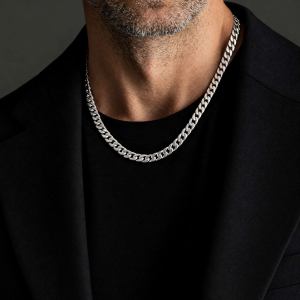
Men’s sterling silver chains by Ronatelli
Ten handmade 925 chains, from a 2 mm snake chain to a 7 mm curb, in 20 to 26 inches. Every length is the same price.
Related guides
Moissanite’s origin follows the American Gem Society; its properties and the inscription case follow GIA’s Gems & Gemology (Fall 2020); disclosure rules and the thermal-tester warning follow the FTC’s guidance on advertising diamonds and gemstones; multi-tester advice follows Brilliant Earth; widths reflect moissanite tennis chain listings on US marketplaces in October 2026; and stamp, plating, clasp, and length advice follows our own guides linked above. All were checked on October 30, 2026. Read our editorial policy.

