Sterling silver can make a good wedding band, as long as you choose it knowing the trade-off. It costs a fraction of gold, a jeweler can resize it easily, it can be cut off and repaired in an emergency, and it is usually nickel-free. But it is softer than 14K and 18K gold, platinum, and the hard alternative metals, so it dents and scratches more readily than most of them, it tarnishes, and a band worn every day for decades wears thin sooner. In 2015, GIA described sterling as “rarely used for engagement rings or wedding bands.” This guide sets out what silver does well and where it falls short, how it compares with gold, platinum, titanium, and tungsten, who it suits, what to look for in a silver band, and how to keep one in shape.
Key takeaways
- It can work, with trade-offs. Sterling is inexpensive, easy to resize, and repairable, but it scratches, dents, and tarnishes more readily than gold or platinum.
- The price gap is mostly metal. A 6 g sterling band holds about $9 of silver; made in 14K white gold, the same band would hold about $550 of gold, at October 30, 2026 prices.
- Buy for durability. Solid 925 with a maker’s mark, 1.5 mm or more thick, sized rather than adjustable, comfort fit, and a finish that hides marks.
- Care is light. Take it off for chlorine, cleaning chemicals, lifting, and tools; clean it monthly; have a jeweler check it once or twice a year.
- For a band that holds its shape for decades, choose gold or platinum. Silver suits a tight budget, a starter or travel band, and men who like a ring that shows its years.
In this guide What silver does well Where it falls short Other metals Who it suits What to look for Care FAQ
What sterling silver does well as a wedding band
Most of silver’s case comes down to cost and flexibility: it is cheap to buy, cheap to fix, and easy to change.
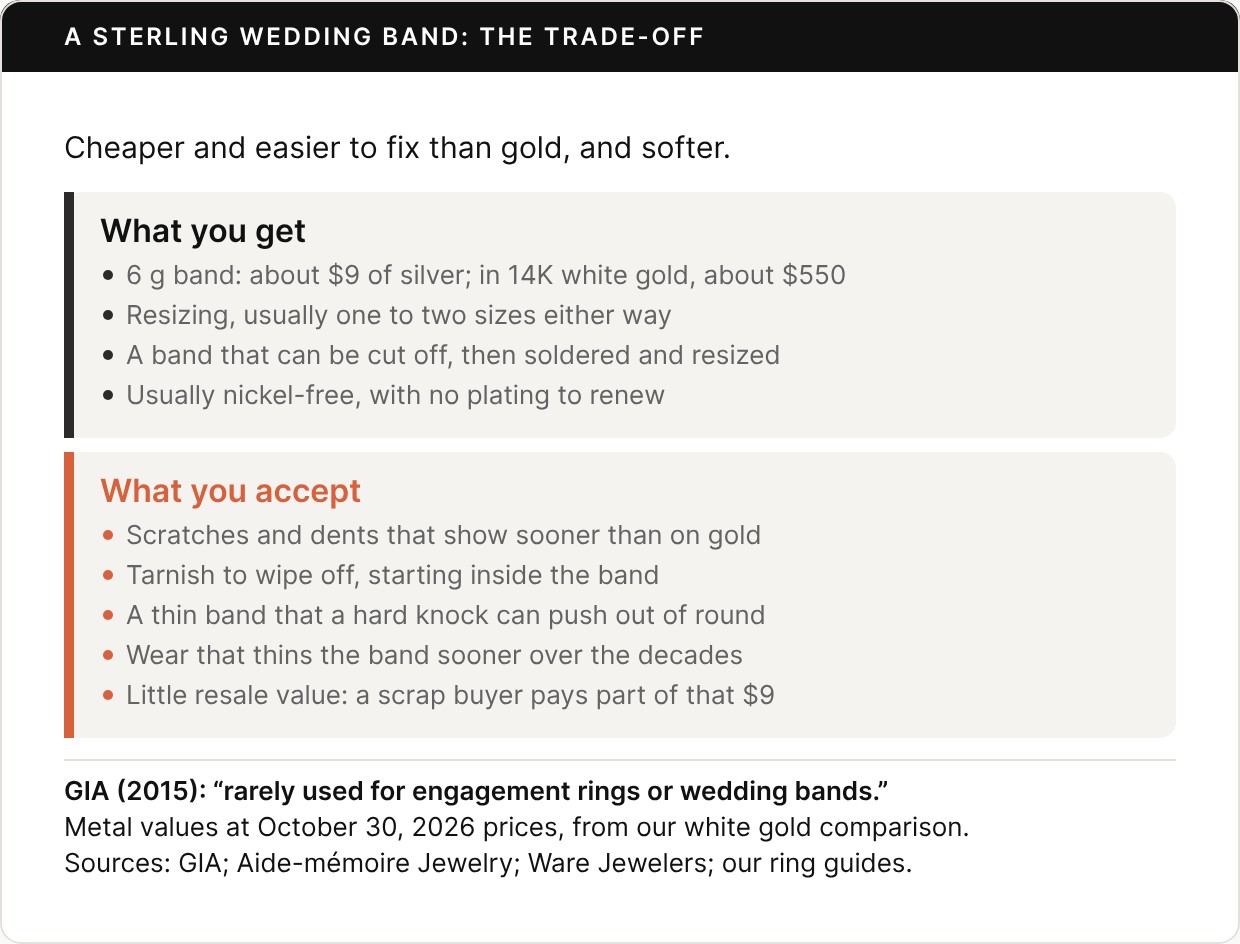
- Price. Little of a silver band’s price is metal. At October 30, 2026 prices, a plain band that weighs 6 grams in sterling holds about $9 of silver, while the same band made in 14K white gold, about 7.4 grams, would hold about $550 of gold, as our comparison of sterling and white gold works out. Most of what you pay for a silver band is the making, as our guide to what silver is worth explains.
- Resizing. Fingers change over the years, and a jeweler can usually take a sterling band one to two sizes either way. Silver is one of the easiest and least expensive metals to resize, as our resizing guide explains, while tungsten, cobalt, and stainless steel generally can’t be resized and titanium usually can’t.
- It can come off, and be fixed. If a finger swells after an injury, go to urgent care or the ER, where a clinician can cut the ring off safely, and don’t try to cut it yourself. Silver is the easy case there: the MSD Manual lists rings of soft materials such as gold and silver as the ones a manual ring cutter is for, and a cut silver ring can usually be soldered and resized afterward, as our guide to stuck rings explains. Tungsten and ceramic bands are cracked off and can’t be repaired.
- Skin. Standard sterling is silver and copper, and the American Academy of Dermatology, the Mayo Clinic, and DermNet all list sterling silver among the metals people with a nickel allergy can wear, as our guide to silver and skin allergies explains. A 925 stamp doesn’t guarantee nickel-free metal, though, so buy from a maker who states the alloy. White gold often contains nickel unless you ask for a nickel-free alloy.
- Nothing to replate. Bare sterling is the same color all the way through, so a polishing cloth handles tarnish and there is no plating to renew. White gold’s rhodium plating needs redoing every 12 to 18 months to about five years, according to the sources our white gold comparison cites.
- A band that shows its years. Some men want a ring that looks lived in. The jeweler Aide-mémoire, which prefers harder metals for wedding bands, names a liking for a patina that builds with wear as one reason to choose silver anyway.
Where a silver wedding band falls short
The downsides all come from one fact: sterling is a soft metal, and a wedding band is worn every day, for years.
- Scratches and dents. “Silver is naturally softer and more susceptible to scratches and dents than white gold,” GIA writes, and 14K white gold is about twice as hard as sterling in the same condition, as our white gold comparison shows. A polished band shows marks quickly; they are cosmetic and polish out, as our ring buying guide notes.
- Shape. A hard knock, or a tight grip on a barbell, can push a thin band out of round, as our guide to wearing a silver ring every day explains. Because wedding rings take a lot of wear and tear, Aide-mémoire warns, a sterling ring “will scratch, ding and lose its shape much faster than other precious metals,” and it suggests a thicker band, 1.5 to 2 mm, or Continuum sterling, a stronger silver alloy.
- Wear over the decades. Every ring loses metal with years of wear. Ware Jewelers describes the bottom of the band thinned by steering wheels, countertops, and tools, faster with hands-on work, and faster in soft gold than in dense platinum. Ware’s page is about gold and platinum, but sterling is softer than 14K or 18K gold, so expect it to thin sooner. Aide-mémoire compares silver and the harder metals to canvas and leather shoes: both wear, but the canvas will likely wear out sooner. Polishing out deep scratches also takes a little silver each time, as our scratch guide explains.
- Tarnish. Silver darkens where it meets sulfur, from sweat to some foods and the air, and the inside of a band, against the skin all day, darkens first. A band worn daily tarnishes less than one in a drawer, because wear rubs the first film away, as our tarnish guide explains. Tarnish is a surface film, not damage, and it cleans off.
- Little resale value. The silver in a typical 6 mm band is worth about $9 to $13 at $50 an ounce, and a scrap buyer typically pays 70 to 85 percent of that, as our guide to what silver is worth explains. As an heirloom, its value is sentimental.
- It is the less usual choice. In 2015, GIA called sterling “not the most durable of metals” and noted that it is rarely used for wedding bands, and Aide-mémoire strongly recommends gold, platinum, or palladium over silver for durability.
Sterling vs. other wedding band metals
Most of these metals resist dents and wear better than sterling, but most of them give up something it keeps: resizing, repair, or a band that can be cut off and fixed.
| Metal | How it wears | Upkeep | Resizing |
|---|---|---|---|
| Sterling silver | How it wearsDents and bends sooner than any of these, and scratches readily | UpkeepA polishing cloth for tarnish; nothing to replate if bare | ResizingYes, usually one to two sizes; one of the easiest |
| 14K gold | How it wearsHarder: 14K white gold is about twice as hard as sterling, though not scratch-proof | UpkeepWhite gold needs its rhodium replated every 12 to 18 months to about five years | ResizingYes; yellow gold is one of the easier metals, and white gold is replated afterward |
| Platinum | How it wearsStrong, but not scratch-resistant; it develops a patina | UpkeepDoesn’t tarnish; re-polishing removes the patina | ResizingYes |
| Titanium | How it wearsStrong and light; resists dents far better than silver, but scratches about as easily | UpkeepDoesn’t tarnish | ResizingDifficult or impossible |
| Tungsten carbide | How it wearsThe most scratch-resistant, but brittle: it can chip or break | UpkeepLittle; in an emergency it is cracked off, not cut, and can’t be repaired | ResizingNo |
| Stainless steel | How it wearsStrong and durable; shows wear in time, and can be polished | UpkeepDoesn’t tarnish | ResizingGenerally no |
If you want a band that holds its shape and resists wear for decades, a harder precious metal is the safer choice; our white gold comparison recommends 14K white gold for a band worn every day for decades. If you want one you can resize, repair, and eventually pass on, silver holds its own, as our comparison of silver, steel, and titanium argues.
Who a silver wedding band suits
A good choice if:
- The budget matters more than the metal.
- You want a starter band. Aide-mémoire suggests silver as a cheaper ring to replace later, or as a way to try a band’s fit and dimensions before paying for a pricier ring.
- You lose things, or travel often. A silver band costs less to replace, and The Knot makes the same case for a stainless steel travel band, one “that can easily be replaced if lost or stolen.”
- You like a ring that shows its years.
- Nickel bothers your skin. Standard sterling is silver and copper; ask the maker for the alloy all the same.
- Everything else you wear is silver or steel. A silver ring goes with a steel watch and silver cufflinks, as our guide to wearing a silver ring with a suit explains.
Think twice if:
- You work with your hands, lift, or use tools every day. Hands-on work thins a band faster, Ware Jewelers notes, and a grip can bend it.
- You want the band to hold its shape and finish for decades. White gold or platinum resists wear better, though white gold needs replating and platinum develops a patina.
- You swim or use hot tubs often and won’t take it off. Chlorine corrodes sterling and, in time, pits it, as our guide to wearing a silver ring every day explains.
- You want the ring itself to hold value. A gold band carries far more metal value.
What to look for in a silver wedding band
- Solid 925, with a maker’s mark. In the US, sterling is stamped 925 or Sterling, and the quality stamp must be accompanied by the registered trademark of the maker or seller, as our guide to 925 explains. “Silver-plated” and “silver-tone” are not sterling.
- At least 1.5 mm thick. Our ring buying guide recommends 1.5 to 2.5 mm of metal on a daily-wear sterling band, and Aide-mémoire suggests 1.5 to 2 mm for a silver wedding band; thinner bands bend out of round and are harder to resize.
- 4 to 7 mm wide. Four to five millimeters is the traditional wedding band width, and six to seven the everyday range for medium and large hands, according to our guide to band widths. From 6 mm up, buy a half size larger.
- Comfort fit. A band rounded on the inside slides over the knuckle more easily and feels better worn all day. It fits slightly looser than a flat band of the same size, which is why some jewelers suggest going down a quarter size, as our ring buying guide notes. On a wide comfort-fit band, the two adjustments partly cancel, as our ring size guide explains.
- A finish that forgives. High polish shows scratches first; brushed and hammered finishes hide wear, according to our ring buying guide. A polishing cloth leaves shiny patches on a brushed band, as our scratch guide explains, and a pattern that runs all the way around makes resizing harder.
- Bare or plated. Rhodium-plated sterling is brighter and resists tarnish, but on a ring the plating wears through in a year or two and has to be redone, as our tarnish guide notes. A band sold as “14K white gold over sterling silver” is plated silver, priced and valued as silver, as our white gold comparison explains.
- Sized, not adjustable. For one ring worn on one finger every day, a sized band is the simpler, sturdier choice, as our adjustable rings guide notes; open rings in a soft metal like silver need extra care.
- Room to engrave. Most rings hold 15 to 20 characters inside, and the band should be at least 2 mm wide, ideally 3 mm, according to the WeddingWire figures in our anniversary gift guide. Settle the size before you engrave, because resizing can damage an engraving.
- A seller who resizes. Measure at the end of the day, when fingers are largest, as our ring size guide explains, and buy where resizing or an exchange is offered.
How to keep a silver wedding band in shape
A silver band needs a little attention often, and a jeweler’s eye now and then.
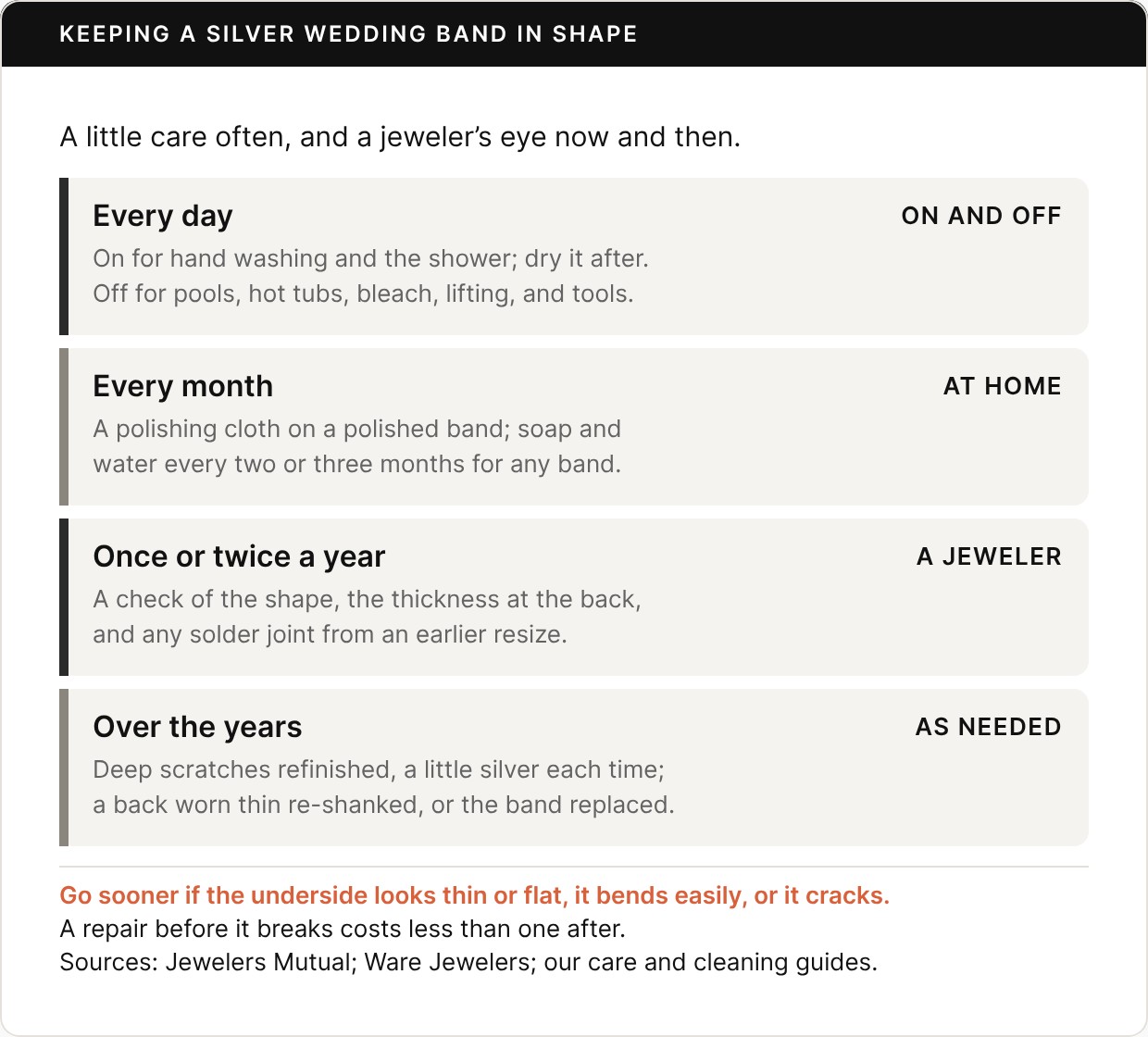
- Every day. Leave it on for hand washing and the shower, then dry it. Take it off for pools and hot tubs, bleach and ammonia, lifting, and work with tools, as our guide to wearing a silver ring every day explains. The Knot quotes Andrew Blackmon, co-founder and CEO of The Black Tux, on owning two bands: “a precious metal one for everyday wear, and a silicone one for exercising, traveling, and working with your hands.”
- Under the band. Most wedding-ring rashes aren’t allergies, a Mayo Clinic report explains: soap, sweat, and dirt trapped under the band irritate the skin, as our guide to silver and skin covers. Keep the ring and the skin under it clean and dry.
- Every month. A polishing cloth around a polished band, and warm water with a drop of dish soap every two or three months, the rhythm our cleaning guide gives for jewelry worn daily. A brushed band gets the soap and water only.
- Once or twice a year. Have a jeweler look it over. Jewelers Mutual suggests a visit twice a year, and Ware Jewelers suggests having rings worn often inspected every six months to a year. Ask about the shape, the thickness at the back, and any solder joint from an earlier resize.
- Over the years. Fine scratches on a polished band come out with a cloth; deep ones need a jeweler, and each refinish takes a little silver. Go back sooner if the underside looks thinner than the sides, the band looks flat rather than round, it bends easily, or you see a small crack, the warning signs Ware Jewelers lists. A band worn too thin can have part of it replaced, which Jewelers Mutual calls a half shank replacement, or it can be replaced outright; fixing a thinning band before it breaks costs less, Ware notes.
FAQ
Is sterling silver good for a men’s wedding band?
It can be, if you accept that it will scratch, tarnish, and need occasional care. It costs far less than gold, resizes easily, and can be repaired. For a band that holds its shape and resists wear for decades, 14K white gold or another harder precious metal is the safer choice.
How long does a sterling silver wedding band last?
There is no set lifespan. A solid band 1.5 mm or thicker that comes off for lifting, tools, and chlorine can be worn for many years, polished, resized, and repaired along the way. A thin band worn through hard work can bend or wear thin much sooner, so have it checked once or twice a year.
Do silver wedding bands tarnish?
Yes, though a band worn every day tarnishes less than one kept in a drawer, because wear rubs off the first film. The inside darkens first. A polishing cloth once a month keeps a polished band bright, soap and water suit a brushed one, and tarnish doesn’t harm the metal.
Can a silver wedding band be resized?
Usually, by one to two sizes either way, and silver is one of the easiest metals to resize. A pattern all the way around, stones, or an engraving inside make it harder; our resizing guide covers the details.
Can you wear a silver wedding band every day?
Yes. Keep it on for hand washing and showers and dry it afterward; take it off for pools, hot tubs, cleaning chemicals, lifting, and tools.
Is silver or white gold better for a wedding band?
White gold if you want the band to hold its shape and finish for decades and don’t mind paying for replating; sterling if price, cheaper and simpler resizing, and a metal that is usually nickel-free matter more. Our sterling vs. white gold comparison covers both in detail.
Can a silver wedding band be cut off in an emergency?
Yes. Silver is soft enough for a manual ring cutter, and a jeweler can usually solder the cut and resize the band afterward. If the finger is injured, numb, or changing color, go to urgent care or the ER, not a jeweler, and don’t try to cut a ring off yourself. Tungsten and ceramic bands are cracked off and can’t be repaired.
What width should a men’s silver wedding band be?
Four to five millimeters is the traditional width, and six to seven the everyday range for medium and large hands. From 6 mm up, buy a half size larger, and keep the band at least 1.5 mm thick.
Bottom line
A sterling silver wedding band is a sound choice if you know what you are buying: a ring that costs little, resizes and repairs easily, and is kind to most skin, in a metal that scratches, dents, and wears sooner than gold or platinum. Buy it solid and at least 1.5 mm thick, sized rather than adjustable, in a finish that hides marks. Take it off for chlorine, cleaning chemicals, lifting, and tools, clean it once a month, and let a jeweler look it over once or twice a year. If you want a band that holds its shape and resists wear for decades, gold or platinum is the better buy.
From the collection
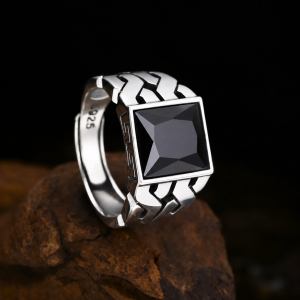
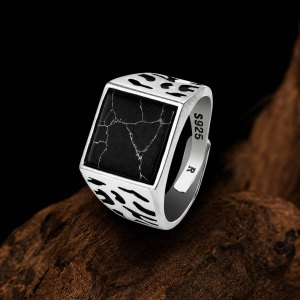
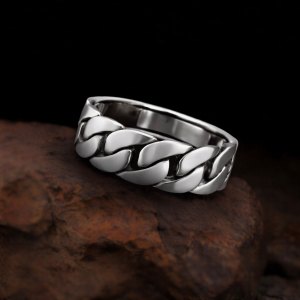
Men’s sterling silver rings by Ronatelli
Eleven handmade 925 rings, $129 to $169, from a chain-link band to a black onyx statement ring. Every one is adjustable.
Related guides
How durable sterling is and how rarely it is used for wedding bands follow GIA’s “Choosing Between White Gold, Platinum, Palladium, and Silver” (2015) and “White Gold vs. Silver: What Is the Difference?” (2025). The jeweler’s view of silver bands, the thickness advice, and when silver makes sense follow Aide-mémoire Jewelry’s FAQ (2023 and 2025). Other metals follow Jewelers Mutual’s “Strongest metals for a wedding band” (2021); thinning bands, warning signs, and inspections follow Ware Jewelers (August 2026) and Jewelers Mutual’s “What to do if you need a ring repair” (Tara Dosh, 2024). The two-band advice and the travel band follow The Knot (2024). Hardness, metal values at October 30, 2026 prices, resizing, emergency removal, skin, tarnish, cleaning, widths, thickness, and engraving follow our own guides and the sources they cite. Read our editorial policy.

