Usually, yes. Sterling silver is soft and easy to work, so a jeweler can typically make a silver ring one to two sizes smaller or larger. Making it smaller is the simpler, cheaper job: the jeweler removes a small piece of the band and solders it closed. Making it larger means adding a small piece of matching silver, or, for a plain band and about half a size, stretching it. Whether it works depends more on the ring than on the metal: a pattern that runs all the way around, stones along the band, an engraving inside, or plating all make it harder, and rings in titanium, tungsten, or stainless steel generally can’t be resized at all. This guide covers how it is done, how far a ring can go, what it costs, and the options when resizing isn’t the answer.
Key takeaways
- One to two sizes, either way. Jewelers treat that range as routine; going further may distort the band or weaken the setting.
- Smaller is simpler. Sizing down takes metal out; sizing up adds a piece of silver, and stretching is limited to plain bands and about half a size.
- The cost depends on the ring. Jewelers Mutual puts resizing at $20 to several hundred dollars; stones, intricate designs, thick bands, and bigger changes cost more.
- Some rings are poor candidates. A pattern all the way around, stones along the band, an eternity band, plated base metal, or titanium, tungsten, cobalt, or steel.
- There are alternatives. Sizing beads, a spring insert, or a sizing bar take up room inside a loose band, and an adjustable ring changes size by hand.
In this guide How it’s done How far Hard to resize Cost Alternatives Before you go Other metals FAQ
How a jeweler resizes a silver ring
Making a ring smaller and making it larger are different jobs, and they are not equally simple.
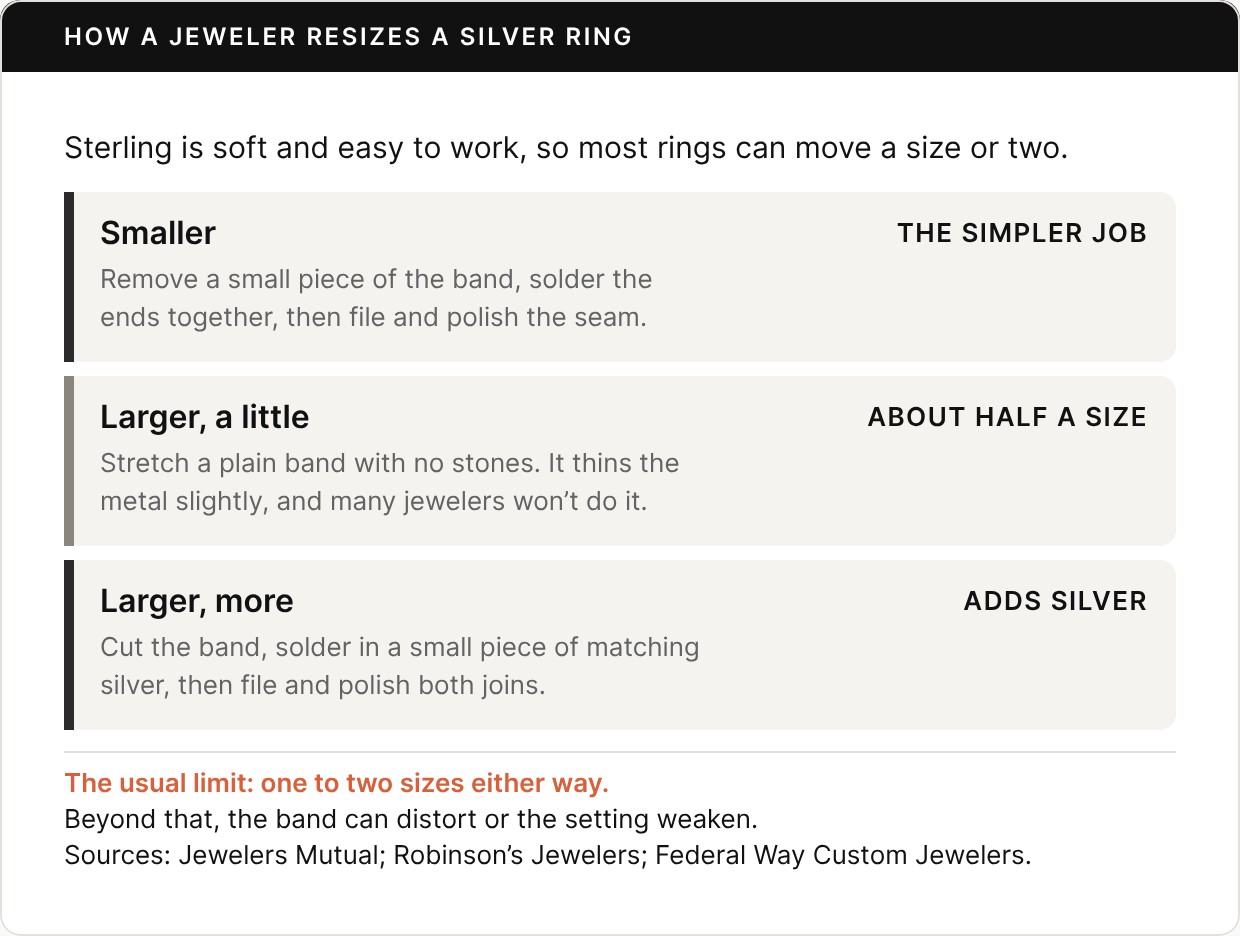
- Smaller. The jeweler removes a portion of the band and solders it back together, as Jewelers Mutual describes, then files and polishes the seam. Because metal comes out rather than going in, it is the simpler and usually the cheaper direction.
- Larger, a little. A plain band without stones “can sometimes be stretched up to about a half size,” Jewelers Mutual says. Stretching thins the band slightly, and many jewelers avoid it: Jewelers Mutual’s cost guide calls it a method “many do not recommend in any situation,” and Federal Way Custom Jewelers in Washington State says it doesn’t stretch rings because it “can cause metal stress and potential damage.”
- Larger, more. The jeweler cuts the band, adds “a small piece of matching metal,” and solders it back together, Jewelers Mutual explains; Federal Way Custom Jewelers calls that piece sizing stock. A band worn too thin may need a new bottom section instead, which jewelers call a re-shank.
How long it takes depends on the shop. Federal Way Custom Jewelers says most of its repairs are completed within five to ten days, and Fitzgerald Jewelry in Brooklyn quotes 10 to 15 business days. If you need the ring by a certain date, say so before you leave it.
How far a silver ring can go
One to two sizes in either direction is the usual limit. Increasing or decreasing a ring by more than two sizes “may distort the shape of the band or weaken the setting,” Jewelers Mutual says. Robinson’s Jewelers notes that most jewelers consider one to two sizes “a standard, low-risk procedure for many rings” and warns that “resizing more than two sizes can compromise the ring’s structural integrity.”
Band thickness matters in both directions. Our ring buying guide recommends 1.5 mm or more of metal on a daily-wear band and notes that thinner bands bend out of round and are harder to resize, and Robinson’s says the physics of resizing can weaken ultra-thin bands. A thick band resizes well but costs more, because there is more metal to work. If you need more than two sizes, ask whether a new ring makes more sense than resizing the old one.
Which silver rings are hard to resize
With sterling, the design decides more than the metal does.
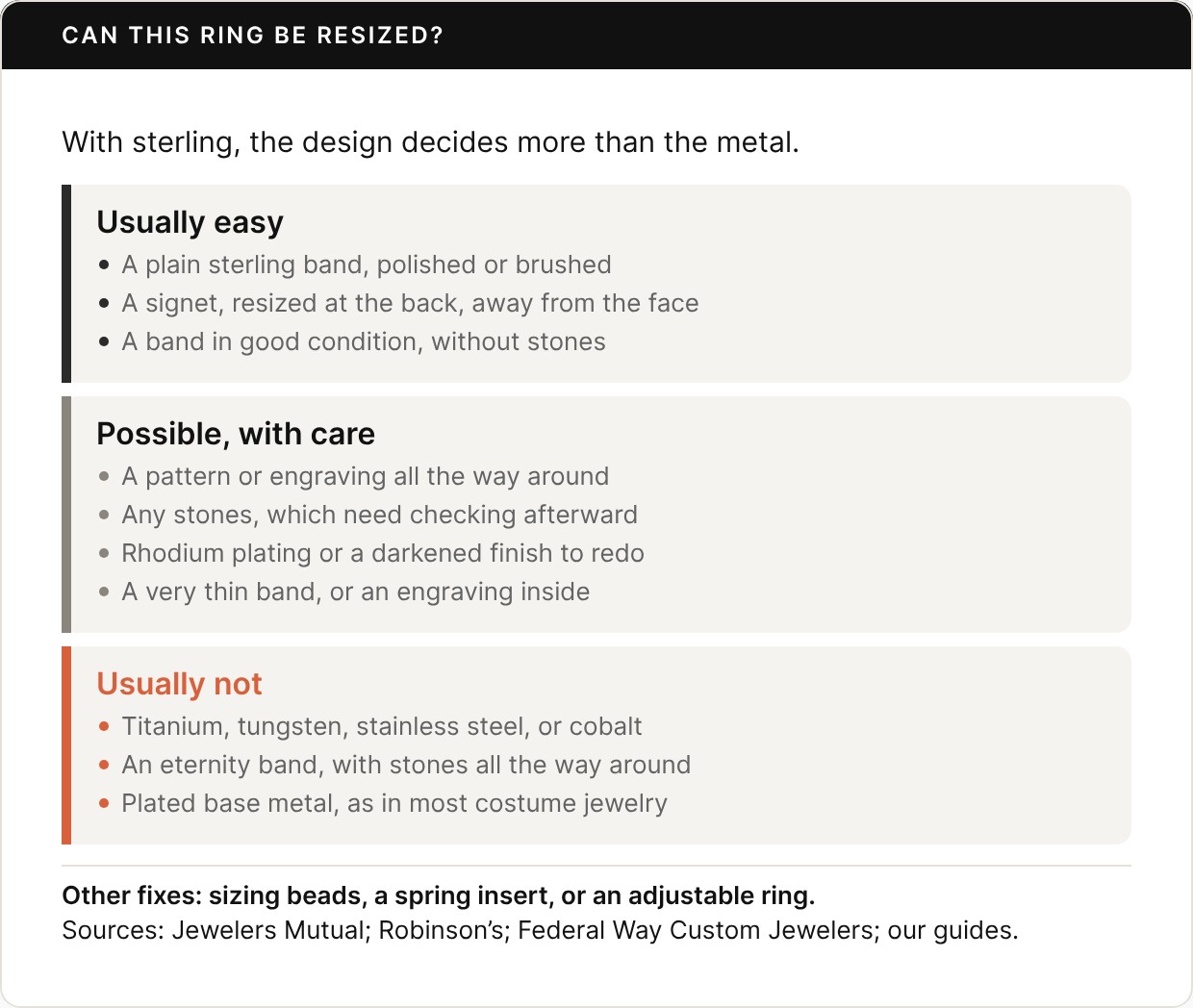
- A pattern all the way around. Engraved and patterned bands “can lose their pattern alignment if stretched or compressed too much,” Robinson’s notes, and rings with a full pattern are the exception to the rule that silver resizes easily, as our ring buying guide says. Chain-link, braided, and Greek key bands belong here, and Jewelers Mutual lists rings with intricate designs that could be damaged among those that can’t be resized.
- Stones. Stones set along the side of a ring being made smaller “will need to be retightened, or even reset,” according to Jewelers Mutual’s cost guide, and temperature-sensitive gems have to come out first; Robinson’s names opals, pearls, and tanzanite. Even stones on the opposite side from the cut usually need tightening afterward, Federal Way Custom Jewelers says, because changing the circle changes how the stones sit. A signet is resized at the back of the band, away from the face, as our signet ring guide notes, but a stone on top should still be checked when the ring comes back.
- An eternity band. With stones all the way around, there is nowhere to cut without removing or adding stones; Jewelers Mutual calls full eternity rings difficult or impossible to resize, and Robinson’s says the stones “would have to be removed and reset, which is costly and risky.”
- An engraving inside. Resizing can damage or remove it, as our 25th anniversary gift guide explains, so resize first and engrave afterward.
- Plating or a darkened finish. White gold needs its rhodium plating redone after sizing, as both Jewelers Mutual and Federal Way Custom Jewelers note. By the same logic, expect a rhodium-plated or darkened silver ring to need its finish restored, often as a separate charge: Fitzgerald lists patina from $45 and plating from $60. Plated rings are on Jewelers Mutual’s can’t-resize list, and Federal Way Custom Jewelers sizes only precious metal, so costume pieces plated over base metal are out. Rhodium-plated sterling is solid silver underneath, so we count it as a job for care, not a refusal.
What resizing a silver ring costs
Resizing “can cost anywhere from $20 to several hundred dollars,” according to Jewelers Mutual’s cost guide, which places sterling second only to yellow gold, its least expensive metal, and calls silver “fairly easy to resize.” Two jewelers that publish prices, as listed on October 30, 2026:
- Fitzgerald Jewelry, Brooklyn: sizing a standard sterling band down, $80. Sizing up is listed as “metal cost above from $50 for every full size,” one line for all metals, which we read as the sizing-down price plus metal. Thicker or heavier bands are quoted in the studio.
- Federal Way Custom Jewelers, Washington State: resizing from $49 to $449 across all metals, depending on the ring. It calls silver “the easiest to size and most affordable.”
Rings with gemstones, intricate settings, or larger size changes typically cost more than plain bands, Jewelers Mutual says, and making a ring smaller costs less than making it bigger because no metal is added. Its cost guide adds a thicker band (“more ring = more material”) and a flat-bottomed euro shank, whose corners carry more metal. Sizing down being cheaper is one reason our guide to finding his ring size without him knowing suggests erring slightly large if you have to guess. Ask for a quote first, and check any warranty or service paperwork that came with the ring, since resizing may be covered, Jewelers Mutual notes.
Alternatives to resizing
For a ring that is too loose, Jewelers Mutual lists three semi-permanent fixes a jeweler can fit inside the band, and two temporary ones you can do yourself.
- Sizing beads. Two small metal balls added inside the band, “a discreet, cost-effective option when a ring only needs to be made about a half size smaller.”
- A spring insert. A flexible, horseshoe-shaped metal strip installed inside the band. Many people find it more comfortable than beads, and it can take up more room.
- A sizing bar. A hinged, U-shaped device attached inside the ring, “typically used when a significant size adjustment is needed.”
- A temporary guard. Plastic ring guards and coil sizers are inexpensive quick fixes. Jewelers Mutual warns against tape, liquid guard, or food-grade silicone, “which can damage your ring,” and Federal Way Custom Jewelers doesn’t recommend metal clip-on guards for long-term use.
- A hinged shank. For a knuckle much larger than the base of the finger, a shank that opens lets the ring pass the knuckle and close snugly, as our adjustable rings guide explains. It is jeweler work, and Federal Way Custom Jewelers calls it “a pricy option and rather delicate.”
- An adjustable ring. An open back you set by hand covers a range of sizes with no jeweler involved. Set it once and leave it, since sterling hardens a little each time it bends, as the same guide explains.
- Another finger or an exchange. A ring that is loose on one finger may fit the next one over; our guide to which finger covers what each choice looks like. If the ring is new, a different size from the seller is often simpler, and a resized ring usually can’t be returned, as our guide to giving him jewelry notes.
Before you take it in
- Measure at the end of the day. Heat, humidity, exercise, salty food, and alcohol can make fingers swell, and cold can shrink them, Jewelers Mutual notes; our ring size guide explains when and how to measure. Your finger “can change as much as a half size from day-to-day,” a jeweler quoted in Jewelers Mutual’s cost guide warns, so don’t resize for one cold morning.
- Start with the seller. The store that sold the ring may resize it, and its warranty may cover the job.
- Check the return window. On a new ring, decide between an exchange and a resize before anyone cuts the band.
- Ask what the price includes. Polishing the seam, restoring plating or a darkened finish, and checking any stones should all be in the quote.
- Mind the stamp. If the 925 mark sits at the back of the band, ask the jeweler to cut beside it if the design allows; it is your proof of the metal.
- Engrave last. Resize first, then add an engraving.
Silver vs. other ring metals
Sterling is one of the easier metals to resize, and that is one reason to choose it over the hard alternatives, as our comparison of silver, steel, and titanium explains.
| Metal | Can it be resized? | Worth knowing |
|---|---|---|
| Sterling silver | Can it be resized?Yes, usually one to two sizes | Worth knowing“Fairly easy to resize”; one shop calls silver “the easiest to size and most affordable.” |
| Yellow gold | Can it be resized?Yes | Worth knowing“One of the easier metals to resize,” and the least expensive of those Jewelers Mutual compares, though the gold price moves. |
| White gold | Can it be resized?Yes | Worth knowingNeeds refinishing and its rhodium plating reapplied afterward, which adds to the cost. |
| Rose gold | Can it be resized?With care | Worth knowing“Very temperamental and can crack during resizing.” |
| Platinum | Can it be resized?Yes | Worth knowingNeeds its own tools, and its higher melting point can add work. |
| Titanium | Can it be resized?Usually not | Worth knowing“Extremely hard to work with”; some jewelers can’t resize it, and Jewelers Mutual’s 2026 guide lists it among rings that can’t be resized. |
| Tungsten carbide | Can it be resized?No | Worth knowing“Too hard to be resized.” |
| Stainless steel, cobalt | Can it be resized?No | Worth knowingOn Jewelers Mutual’s list of rings that can’t be resized. |
FAQ
Can a sterling silver ring be resized?
Usually, yes. Sterling is soft and easy to work, so a jeweler can typically make a silver ring one to two sizes smaller or larger. Patterns all the way around, stones along the band, and plating make it harder.
How much does it cost to resize a silver ring?
Jewelers Mutual puts resizing at $20 to several hundred dollars and calls sterling “fairly easy to resize.” On October 30, 2026, a Brooklyn jeweler listed $80 to size a standard sterling band down, with sizing up priced as that plus metal, from $50 per full size. Stones, thick bands, and bigger changes cost more.
How long does it take to resize a silver ring?
At the two shops we checked, one to two weeks: five to ten days at one, 10 to 15 business days at the other. Ask before you leave the ring if you need it by a certain date.
Can a silver ring be made bigger?
Yes. A plain band without stones can sometimes be stretched about half a size, though many jewelers won’t stretch rings; for more, the jeweler cuts the band and adds a small piece of matching silver. Making a ring bigger costs more than making it smaller.
How many sizes can a silver ring be resized?
One to two sizes either way is routine. Beyond that, the band may distort or the setting weaken, and a new ring may be the better answer.
Can a silver ring with stones be resized?
Often, depending on where the stones are. The cut is made away from a stone on top, but resizing changes the shape of the circle, so stones usually need checking and tightening afterward, and heat-sensitive gems come out first. An eternity band usually can’t be resized.
Can I resize a silver ring at home?
Not a sized ring: cutting, soldering, and adding metal are jeweler’s work. An adjustable ring is the exception, and our adjustable rings guide explains how to set one once without overworking the silver. Temporary guards are fine, but skip tape and liquid guard.
Can a resized ring be returned?
Usually not, which is why it is worth asking about an exchange first on a new ring.
Bottom line
A silver ring that is a size off is a routine job: a jeweler can usually take it one to two sizes either way, and sizing down is the simpler and cheaper direction. Check the design before you hand it over, because patterns all the way around, stones, plating, and engravings are what make resizing hard. If the fit is only slightly off, or your finger changes with the seasons, sizing beads, a spring insert, or an adjustable ring may solve it without changing the size of the band at all.
From the collection
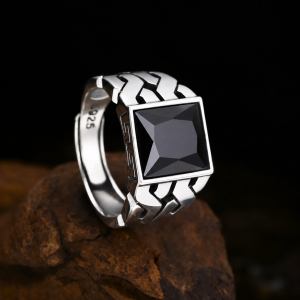
Men’s sterling silver rings by Ronatelli
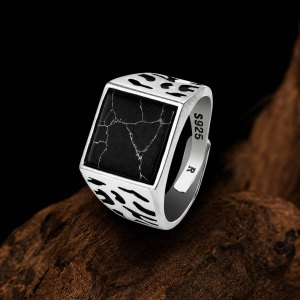
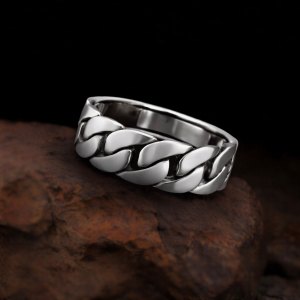
Eleven handmade 925 rings, $129 to $169, from a chain-link band to a black onyx statement ring. Every one is adjustable.
Related guides
How rings are made smaller and larger, stretching up to about half a size, the two-size limit, the rings that can’t be resized, the inserts and guards, finger changes, warranties, and what raises the price follow Jewelers Mutual’s “How to resize a ring: bigger or smaller” (Tara Dosh, July 16, 2026); the cost range, the metal-by-metal comparison, stretching, stones along the band, thickness, euro shanks, and the half-size tip from a jeweler it quotes follow Jewelers Mutual’s “How much does it cost to resize a ring?” (2021). Structural limits, patterned and engraved bands, heat-sensitive stones, thin bands, and eternity bands follow Robinson’s Jewelers (January 2026). Prices, turnaround, stretching, sizing stock, re-shanks, stone tightening, guards, and hinged shanks follow Fitzgerald Jewelry and Federal Way Custom Jewelers as read on October 30, 2026. Thickness, signets, engraving, adjustable rings, returns, and measuring follow our own ring guides. Read our editorial policy.

