Disclosure: The example chains in this guide are from Ronatelli. Widths and prices were read from ronatelli.com on October 30, 2026; the sizing advice applies to any brand.
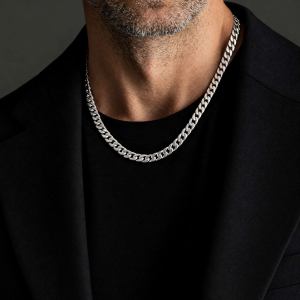
Width decides how a chain looks more than its length or its pattern does. For most men, 3 to 4 mm is the everyday range: visible without being loud, and the right place for a first chain. Go 2 to 3 mm when the chain sits under a shirt or carries a small pendant, 5 to 6 mm when it is the only thing you wear over a T-shirt, and 7 mm and up when you want it to be the first thing people see. Your build, the outfit, and any pendant move that number up or down. Here is how to land on yours.
Key takeaways
- 3 to 4 mm is the safe start. It reads as a chain without reading as a statement, and it suits most builds.
- Your build sets the range. Slim builds look best at 2 to 4 mm, average builds at 3 to 6 mm, and broad builds can carry 5 to 7 mm and up.
- The job adjusts it. Thinner under a shirt and tie, wider worn alone over a T-shirt or a sweater, and strong enough for any pendant.
- Weight climbs faster than width. A 6 mm curb usually weighs three to four times as much as a 3 mm one, so price and feel jump too.
- Test before you buy. Cut paper strips at 3, 5, and 7 mm and hold them at your neck in a mirror.
In this guide Short answer By build Paper test By outfit Weight Pendants Layering Examples FAQ
The short answer: start at 3 to 4 mm
Width is the distance across one link, measured in millimeters, and sellers list it next to the length. Our chain buying guide sorts widths into four bands, and they hold for any style of chain:
| Width | How it reads | Choose it for |
|---|---|---|
| 1.5–2.5 mm | How it readsA fine line; disappears under a pendant | Choose it forUnder a shirt, a small pendant, a slim build |
| 3–4 mm | How it readsVisible but understated | Choose it forA first chain, everyday wear, most builds |
| 5–6 mm | How it readsClearly a piece of jewelry | Choose it forOne chain worn alone over a T-shirt or open collar |
| 7 mm and up | How it readsA statement | Choose it forA chain meant to be the focus; broad builds |
If you have never worn a chain, start at 3 to 4 mm. Going wider later is easy; living with a chain that feels loud every time you catch it in a mirror is not.
Width by build
A chain should be in proportion to the frame that carries it. Two jewelers that publish width guides agree on the direction, if not the exact numbers. JAXXON puts slim builds at 1 to 3 mm, athletic builds at 4 to 6 mm, and broader builds at 7 mm and up. Robinsons Jewelers suggests 1 to 5 mm for slim frames, 4 to 7 mm for average or athletic ones, and 6 to 10 mm or more for broad, muscular builds. Read together with our own width bands, they come out like this:
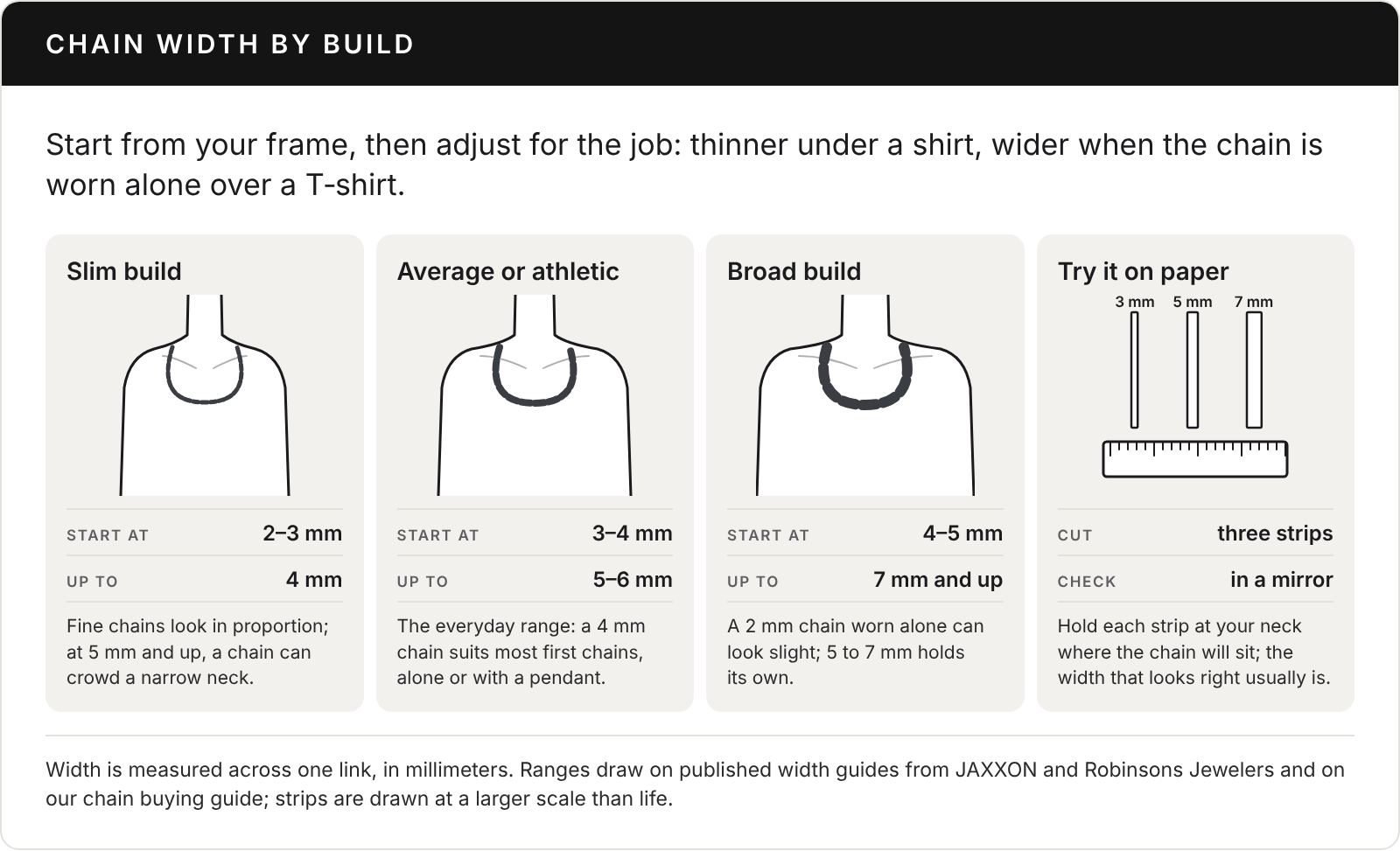
- Slim build. Start at 2 to 3 mm and go up to 4 mm. At 5 mm and up, a chain can crowd a narrow neck.
- Average or athletic build. Start at 3 to 4 mm; 5 to 6 mm works when the chain is worn alone. This is where most first chains belong.
- Broad or heavy build. Start at 4 to 5 mm and go to 7 mm and up. Worn on its own, a 2 mm chain can look slight on a broad build, as our guide to thin silver chains notes, though it still works under a shirt.
Your neck counts as much as your shoulders. A thicker neck makes any chain look a little finer, so if you are between two widths and your neck is on the large side, take the wider one. Neck size also changes where a chain sits, which our chain length guide covers.
Try a width before you buy
Millimeters are hard to picture, and product photos don’t help: close-ups can make a 3 mm chain look like a 5 mm one, as our buying guide warns. Robinsons Jewelers suggests a simpler check, and it costs nothing:
- Cut strips of paper or masking tape to the widths you are considering, say 3, 5, and 7 mm.
- Put on the shirt you will wear the chain with most.
- Hold each strip at your neck where the chain will sit, and look in a mirror from a few feet away, the way other people will see it.
The strip that looks right is usually the width that will. If two look right, the narrower one is the safer buy for a first chain.
Under a shirt, over a T-shirt, or alone
The same man can want two widths. What changes is the job the chain does:
| Where you wear it | Width | Length |
|---|---|---|
| Under a dress shirt and tie | Width2–3 mm | Length20″ |
| Open collar, tie off | Width3–4 mm | Length18″–22″ |
| Alone over a T-shirt | Width4–6 mm | Length20″–22″ |
| Over a crew-neck sweater | Width4 mm and up | Length22″–24″ |
| As the statement piece | Width7 mm and up | Length20″–22″ |
Under a tie, a slim chain lies flat and stays out of sight; our guide to wearing a silver chain with a suit keeps it to 2 to 3 mm under a buttoned shirt and 2 to 4 mm with tailoring in general. A sweater is the opposite problem: a fine chain disappears against the knit, which is why our guide to wearing a chain with a sweater starts at 4 mm. Worn alone over a T-shirt, 4 to 6 mm is the width that looks intentional rather than accidental.
Width, weight, and price
Wider chains are made from thicker wire, so weight climbs much faster than width. Our buying guide puts a 6 mm curb at usually three to four times the weight of a 3 mm curb, not twice. That is why prices in solid sterling rise quickly above 5 mm, and why a heavy chain needs a stronger clasp: Robinsons Jewelers recommends a lobster or a secure box clasp for thick, heavy chains, and our guide to chain clasps explains the difference.
The weave changes the math too. A dense Byzantine or foxtail weave carries more silver than an open cable chain of the same width, and a hollow chain carries less. Width tells you how a chain will look; the gram weight tells you how much silver you are paying for.
Width with a pendant
With a pendant, the chain’s first job is to carry it, so the pendant’s weight sets the minimum. Our guide to the best chain for a pendant matches them like this: 2 to 2.5 mm for a small charm under 6 g, 3 mm up to about 12 g, 4 mm up to 20 g, and a solid, dense 4 to 5 mm chain above that. Then go one step wider if the pendant is large and you want the chain to show.
Check the bail, the loop the pendant hangs from, before you buy. It has to pass over the chain and its clasp with about 1 mm to spare. Ronatelli, for example, lists its pendants as fitting chains up to 6 mm, which rules out its own 7 mm curbs.
Widths for two chains
Layering adds one rule. Our guide to layering chains puts the thinner chain on top and the heavier one below, one to three millimeters wider: a 2 mm chain over a 4 mm one, or a 3 mm over a 5 mm. Two chains of the same width read as one chain worn twice, and a heavy chain above a fine one buries it. Keep 2″ to 4″ between the lengths so they don’t sit on top of each other.
Ronatelli’s chains by width
Ronatelli’s ten chains run from 2 to 7 mm. Every one comes in 20″, 22″, 24″, and 26″ except the Monza, which comes in 24″ and 26″ only, and each costs the same at every length. Sorted by width:
| Chain | Width | Price | Choose it for |
|---|---|---|---|
| Fuli, snake | Width2 mm | Price$149 | Choose it forUnder a shirt; a slim build |
| Alfo, bamboo | Width3 mm | Price$299 | Choose it forA slim chain worn on its own |
| Duomo, cable | Width4 mm | Price$249 | Choose it forA first chain; a light pendant |
| Monza, rope | Width4 mm | Price$249 (was $399) | Choose it forA pendant, at 24″ or 26″ |
| Sergo, foxtail | Width4 mm | Price$279 (was $329) | Choose it forEveryday wear with texture |
| Pudolf, Byzantine | Width4 mm | Price$339 | Choose it forThe densest 4 mm weave |
| Krun, scroll link | Width5 mm | Price$439 | Choose it forWorn alone, with engraved detail |
| Parma, twisted | Width6 mm | Price$329 | Choose it forA wide chain for less |
| Fulda, engraved curb | Width7 mm | Price$439 | Choose it forA statement with detail up close |
| Cana, curb | Width7 mm | Price$429 (was $499) | Choose it forThe boldest, plainest look |
Four of the ten sit at 4 mm, the everyday width, so there the choice comes down to the weave, and the same width spans $249 to $339. A broad build that wants width without the top price has the 6 mm Parma, which at $329 costs less than the 4 mm Pudolf. The Monza, Sergo, and Cana were on sale when we checked. Our comparison of all ten Ronatelli chains covers each weave in more detail.
FAQ
Is a 3 mm chain too thin for a man?
No. 3 mm sits at the bottom of the everyday range: visible on its own on a slim or average build, and slim enough to wear under a shirt. Worn alone on a broad build, 4 mm or wider looks more in proportion.
Is a 5 mm chain too thick?
Not for most men. 5 to 6 mm reads clearly as jewelry, which is what you want from a chain worn alone over a T-shirt. Under a dress shirt and tie it is too much; go 2 to 3 mm there.
What width chain do I need for a pendant?
Match it to the pendant’s weight: 2 to 2.5 mm under 6 g, 3 mm up to about 12 g, and 4 mm or a dense 4 to 5 mm chain above that. Then check that the bail passes over the clasp with about 1 mm to spare.
How is chain width measured?
Across the widest point of one link, in millimeters, usually with calipers. Sellers list it next to the length; if a listing doesn’t give it, ask before you buy, because photos are a poor guide.
Does a wider chain need a different length?
No. Length follows your neck size and where you want the chain to sit, as our chain length guide explains. Width changes how visible the chain is at that length, not where it lands.
Can I layer two chains of the same width?
You can, but they read as one chain worn twice. Put the thinner chain on top, one to three millimeters narrower than the one below, and keep 2″ to 4″ between the lengths.
Bottom line
Start at 3 to 4 mm and adjust from there: down to 2 to 3 mm for a slim build, a shirt and tie, or a small charm; up to 5 to 7 mm for a broad build or a chain worn alone as the statement. If you are torn between two widths, cut the paper strips, and if a pendant is involved, let its weight decide.
From the collection
Men’s sterling silver chains by Ronatelli
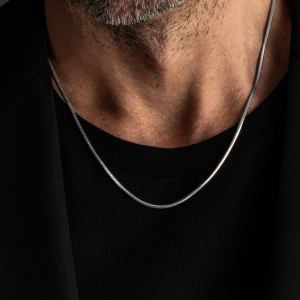
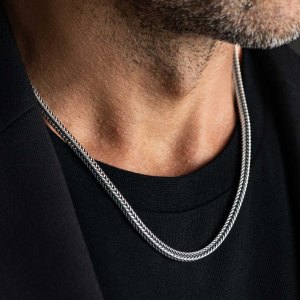
Ten handmade 925 chains, from a 2 mm snake chain to a 7 mm curb, in 20 to 26 inches. Every length is the same price.
Related guides
Width bands and the weight comparison follow our chain buying guide; build ranges combine JAXXON’s and Robinsons Jewelers’ published width guides, and the paper test and clasp advice follow Robinsons Jewelers. Pendant widths follow our pendant chain guide, and outfit widths our suit and sweater guides. Ronatelli widths, lengths, and prices were read from ronatelli.com on October 30, 2026. Read our editorial policy.

