
Wear a lapel pin or brooch on your left lapel: a small pin through the lapel buttonhole, or a larger brooch on the face of the lapel, angled to follow its edge. One is enough. Brooches were all over this year’s awards season. At the Golden Globes in January, “plenty” of the men were wearing “some fun little brooches” on their lapels, Coveteur wrote; at the BAFTAs in February, host Alan Cumming wore a custom brooch at his collar in place of a bow tie, according to MR Magazine; and at the Oscars in March, Channing Tatum wore a Tiffany & Co. bird brooch and Kieran Culkin a yellow gold piece, Bustle reported, adding that “a little pin can go a long way.” They were on the runways too: at the Milan menswear shows in January, Dolce & Gabbana sent out huge flower and watch brooches, and at Armani some models wore a tie pin on the jacket lapel, FashionUnited reported. With holiday parties ahead, here is how to wear one off the red carpet: the difference between a pin and a brooch, where each goes, what size to choose, which pin back to trust, and how to wear one in silver.
Key takeaways
- Left lapel. A small pin goes through the lapel buttonhole, high on the lapel; a brooch sits on the face of the same lapel.
- Size it to the lapel. The Ethos recommends a brooch about one-third to one-half the width of the lapel.
- One at a time, angled to follow the lapel’s edge.
- Trust the back. A locking clutch or a brooch’s pin and catch is the most secure. Keep magnetic backs at least 6 inches from a pacemaker or defibrillator.
- Match the metal. Wear a silver pin with a steel watch and silver cufflinks and buckle.
In this guide Pin or brooch Where it goes Size Pin backs The jacket Silver Occasions FAQ
Lapel pin or brooch: what’s the difference
- A lapel pin is small. Its post goes through the lapel buttonhole or the cloth and is held behind the lapel by a clutch, as Signature Pins, a pin maker, explains.
- A stick pin replaces the post and clutch with a long stem. Signature Pins says you can push it through the lapel and cap it behind, or bring the tip back out to the front and cap it there.
- A brooch is larger and sits on the face of the lapel. Most fasten with a hinged pin that closes into a catch on the back; some use a stick pin or a post and clutch.
Where a lapel pin or brooch goes
The convention is simple: the left lapel. Helzberg Diamonds advises wearing a pin “on the left lapel, near or through the buttonhole if your jacket has one,” and placing it “high on the lapel.”
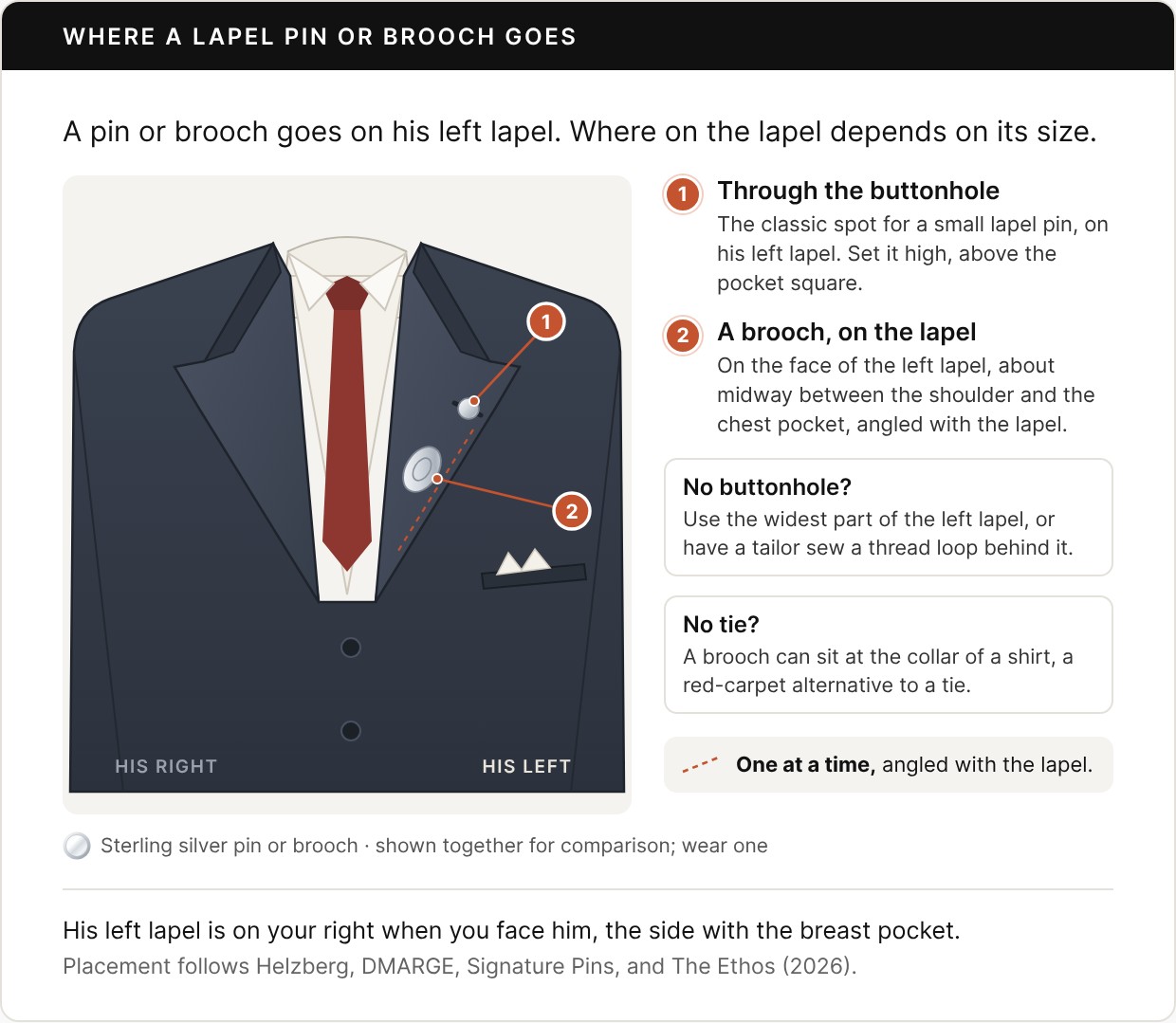
- A pin goes in the buttonhole. Most suit and blazer lapels have one, and it is the intended spot, says Signature Pins. DMARGE puts the pin “north of your pocket square,” at the same angle as the lapel.
- A brooch goes on the lapel’s face. The classic spot is the left lapel, about midway between the shoulder and the chest pocket, according to The Ethos, which made the case for men’s brooches after the 2026 Oscars.
- No buttonhole? Pin it on the widest part of the left lapel, Signature Pins advises, or have a tailor sew a thread loop on the back of the lapel to hold it, as DMARGE suggests.
- One at a time. “Make sure to only wear one lapel pin at a time,” says Signature Pins. DMARGE allows “a lapel pin (or two)” on a neutral cotton jacket for a smart-casual look; with a suit, wear one.
Off the lapel, the stylist Oriona Robb, quoted by The Ethos, suggests a brooch at the collar of a shirt, much as Cumming wore his at the BAFTAs.
What size to choose
Size a brooch to the lapel. The Ethos recommends one about one-third to one-half the width of the lapel; on a lapel 3 inches wide, that’s a brooch about 1 to 1½ inches across. A lapel pin can be much smaller.
- Plain suit, detailed brooch. On a solid suit, a brooch with detail or color can be the focal point; on a patterned suit, choose a simple, solid, or metallic brooch so the two don’t clash, the same article advises.
- Weight matters. A heavy brooch can pull a light lapel out of shape, so save big pieces for heavier cloth. Larger pins “sometimes require an additional post and clutch to keep them steady,” Signature Pins notes.
Which pin back to trust
The back decides whether the pin is still there at the end of the night. Here is how the common ones compare, drawing on All About Pins, a custom-pin maker.
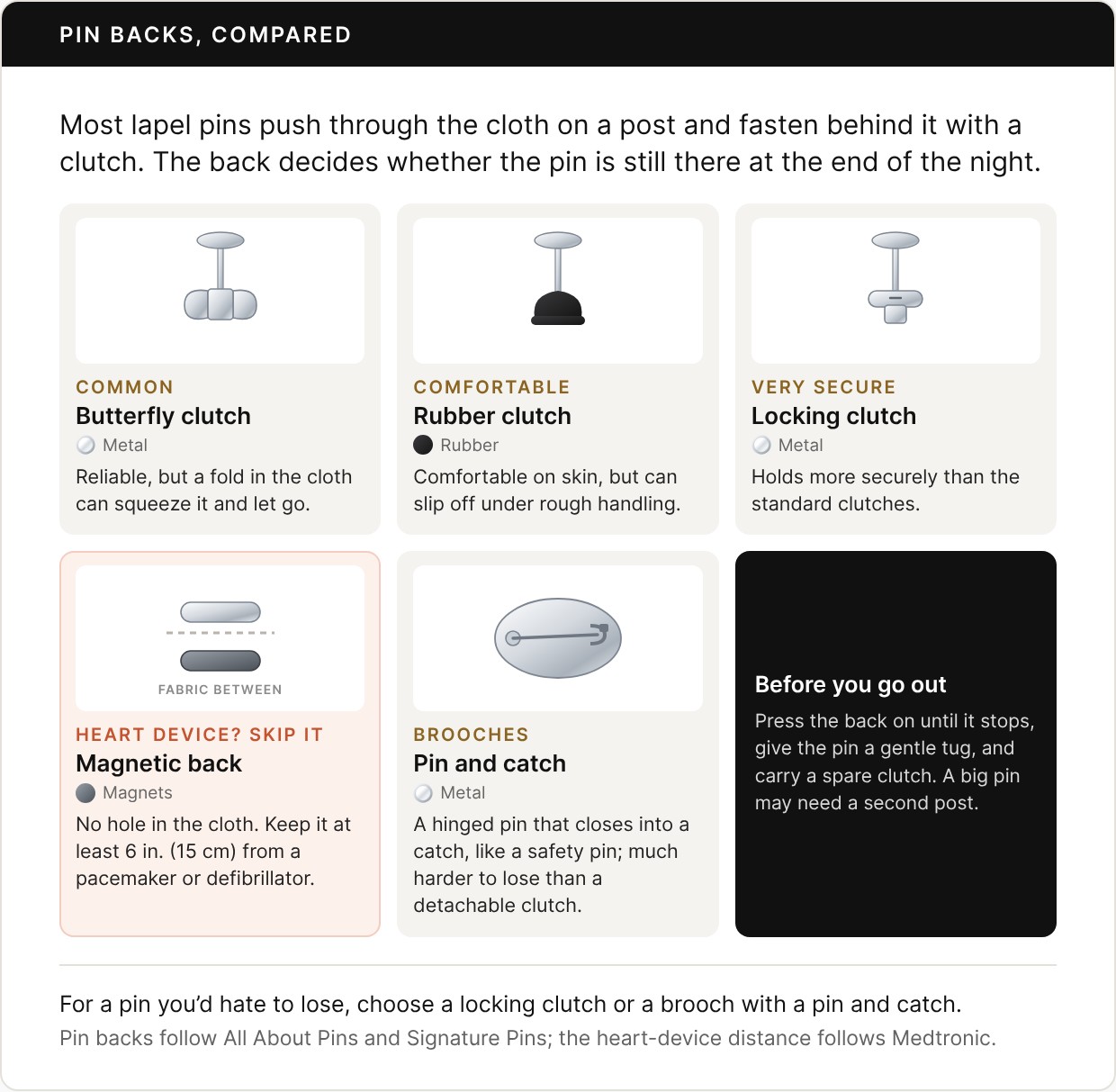
- Butterfly clutch. The standard metal back. It is “quite reliable,” All About Pins says, but a fold in the cloth can press one of its prongs and release it.
- Rubber clutch. More comfortable where a pin touches skin. Like a butterfly clutch, it is fine for daily wear but more likely than a locking clutch to slip under rough conditions, All About Pins says.
- Locking clutch. All About Pins calls it a deluxe, or flathead locking, clutch, and says these hold “more securely than the standard options.” It is the one to want on a pin you’d hate to lose.
- Magnetic back. Two magnets hold the pin with the cloth in between, so there is no hole. Skip it if you have a heart device: magnets can temporarily affect pacemakers and defibrillators, and Medtronic advises keeping magnetic closures at least 6 inches (15 cm) away, as our guide to jewelry for men over 40 notes. A lapel pin sits on the chest, so that distance matters.
- Pin and catch. Most brooches close with a hinged pin and catch, much like the safety-pin back All About Pins describes, which it says is much harder to lose than a detachable clutch.
Protecting the jacket
- Use the buttonhole when you can. It is already a hole, so the pin adds none.
- Otherwise, pin through the cloth. A pin’s post is sharp and small enough to pierce the fabric without damaging it, Signature Pins says.
- Take it off before the jacket goes to the cleaner, and before you hang it in a crowded closet, where it can snag other clothes.
Wearing a silver pin or brooch
Match the metal. The Ethos suggests matching a brooch’s metal to your watch, cufflinks, or belt buckle, and our guide to mixing silver and gold gives the same rule in a suit: watch, cufflinks, tie bar, and buckle in one metal. A silver pin suits a steel watch; with a gold watch in a suit, choose gold.
- Check the stamp. A sterling pin or brooch is usually marked 925 or STERLING on the back. In the US, a quality stamp must come with the maker’s or seller’s trademark, as our guide to what 925 means explains, so look for both.
- Buying vintage. The Ethos calls the vintage market the best place to start: 1stDibs, Etsy, and eBay, or a local vintage or thrift store for more affordable pieces. With a seller you don’t know, run through our online store checks first.
- Silver tarnishes. A polishing cloth brings it back. On darkened (oxidized) details, polish only the high points, and keep dips and the foil bath away from stones and oxidized finishes, as our guide to cleaning sterling silver explains. Store it in its own zip-top bag with the air pressed out, as our tarnish guide suggests.
When to wear one
- At the office. A simple metal pin suits the working week and a smart dinner, DMARGE says. At a job interview, leave it off: our guide to jewelry at work keeps interview jewelry to a watch and one ring.
- At black tie. DMARGE says a tuxedo is “only complete with a boutonniere.” A brooch is the newer option: at this year’s BAFTAs, host Alan Cumming wore one at his collar in place of a bow tie.
- At a wedding. Flowers are the usual choice: DMARGE suggests grooms and guests try colored roses or a sprig of their partner’s favorite flower. If you’re wearing a boutonnière, skip the pin. If you’re giving groomsmen jewelry, our groomsmen gift guide covers sizes and timing.
- Without a suit. Ranson, another stylist quoted by The Ethos, suggests “a relaxed blazer, suit trousers, a white or black T and the brooch.” Robb suggests one pinned asymmetrically on knitwear, near the shoulder or even at the hem.
For the rest of the outfit, our guides to a silver ring, a silver chain, and a silver bracelet with a suit go occasion by occasion.
FAQ
Which side does a lapel pin go on?
The left lapel, through the lapel buttonhole if your jacket has one. When you face someone, his left lapel is on your right, the side with the breast pocket.
What’s the difference between a lapel pin and a brooch?
Size and fastening. A lapel pin is small and goes through the buttonhole or the cloth on a post held by a clutch. A brooch is larger, sits on the face of the lapel, and usually fastens with a hinged pin and a catch.
Can a man wear a brooch without a tie?
Yes. At the BAFTAs, host Alan Cumming wore a custom brooch at his collar in place of a bow tie, and MR Magazine reported other stars swapping ties for brooches. Off the red carpet, a stylist quoted by The Ethos suggests one with a relaxed blazer and a white or black T-shirt.
Do lapel pins damage suits?
Not usually. The buttonhole adds no new hole, and Signature Pins says a pin’s post pierces cloth without damaging it. Take pins off before the jacket goes to the cleaner, and choose a lighter brooch for a light jacket.
How big should a man’s brooch be?
About one-third to one-half the width of your lapel, according to The Ethos. On a 3-inch lapel, that’s about 1 to 1½ inches across.
Can I wear a magnetic lapel pin with a pacemaker?
Medtronic advises keeping jewelry with magnetic closures at least 6 inches (15 cm) from a pacemaker or defibrillator. A lapel pin sits on the chest, so choose a clutch back instead, and ask your cardiologist if you’re unsure.
Bottom line
Put it on the left lapel: a small pin through the buttonhole, or a brooch on the face of the lapel, angled with its edge. Wear one at a time, size a brooch to about a third to half the lapel’s width, and trust it to a locking clutch or a pin and catch. In silver, match it to your watch and cufflinks.
Related guides
Red-carpet examples follow Coveteur (January 12, 2026), MR Magazine (February 27, 2026), Bustle (March 16, 2026), and The Ethos (March 16, 2026); the Milan shows for fall/winter 2026-27 follow FashionUnited (AFP, January 20, 2026). Placement follows Helzberg Diamonds, DMARGE (February 4, 2026), and Signature Pins (August 16, 2019); size and metal advice follow The Ethos, and styling ideas follow the stylists it quotes. Pin backs follow All About Pins (May 22, 2023) and Signature Pins; the heart-device distance follows Medtronic. All were checked on November 1, 2026. Read our editorial policy.

