The Claddagh is a traditional Irish ring: two hands holding a crowned heart, made in Galway since around 1700, the date of the earliest surviving examples. Men wear it as a wedding ring, a sign of Irish roots, or a gift from someone who knows the story, and it pairs naturally with Celtic knotwork or a Celtic cross. Here is where the design comes from, what the hands, heart, and crown stand for, the custom of turning the heart in or out, what Celtic knots and crosses actually mean, and what to check before you buy one in sterling silver.
Key takeaways
- A Claddagh shows two hands holding a crowned heart: friendship, love, and loyalty. The earliest examples date to around 1700 in Galway.
- It draws on the fede ring, a clasped-hands design that goes back to Roman times.
- The four-way custom: right hand, heart out, single; right hand, heart in, taken; left hand, heart out, engaged; left hand, heart in, married. Its origin is uncertain, and nobody will hold you to it.
- Celtic knotwork comes from early medieval art such as the Book of Kells. Readings like “eternity” are modern.
- In Ireland, every silver piece sold must be hallmarked. The Hibernia mark shows a piece was hallmarked in Dublin, not that it was made in Ireland.
In this guide The design History How to wear it For men Celtic knots Celtic cross Buying one FAQ
What a Claddagh ring is
A Claddagh ring has three parts: two hands, a heart, and a crown. “The design shows two hands clasping a crowned heart, which is thought to represent friendship, love and loyalty,” writes Hannah Gallagher, a curator at the National Museum of Ireland (NMI). The usual reading pairs them one to one, as the plaque outside Thomas Dillon’s Claddagh Gold in Galway puts it, according to Tourism Ireland: “The Hands are for Friendship / The Heart is for Love, / And Loyalty is Shown / With the Crown up above.”
The design belongs to an older family. Rings with two clasped hands are known as fede rings, from the Italian mani in fede, “hands clasped in trust,” and the motif is “found all over Europe,” as the V&A notes. The NMI traces the type back to the Roman era. What the Claddagh added was the crown: National Geographic reports that the Galway goldsmith Richard Joyce is credited with introducing it in the 1690s.
Where the Claddagh comes from
The story most often told is Joyce’s. According to James Hardiman’s 1820 history of Galway, as National Geographic recounts it, Joyce’s ship was taken by Algerian corsairs shortly after leaving Galway for the West Indies in 1675, and he was sold in Algiers to a goldsmith who taught him the trade. When William III became king of England in 1689, he negotiated the release of his subjects enslaved in Algeria, Joyce among them. Joyce went home to Galway to work as a goldsmith, and there he is said to have made the first Claddagh. In the NMI’s telling, he made the ring while still in captivity.
The captivity story itself is unproven: official records are scant, and there is “no concrete proof” of it, National Geographic notes. A surviving ring does tie Joyce to the design. The oldest known Claddagh ring, dated to around 1700, still shows Joyce’s mark inside the band; Galway City Museum bought it from a private collector in 2021, National Geographic reports. Later Galway goldsmiths left their marks too. The NMI’s examples include rings by Austin French, Andrew Robinson, and James Sealy, and a gold Claddagh by Robinson in the V&A has initials engraved inside the band.
The name came later. The style became associated with the Claddagh, an Irish-speaking fishing village just outside Galway city, from the middle of the 19th century, according to the NMI, though it was worn well beyond it: W. Dillon wrote in 1905 that the ring was worn from the Aran Islands through Connemara. The village elected its own King of the Claddagh every June 23, and the museum illustrates its page with a folklore account of the king and the ring he wore. The village was declared an “unhealthy area” in 1927, and its thatched cottages were demolished over the following years.
Other origin stories exist, including one, told by Tourism Ireland, in which an eagle drops the first ring into the lap of Margaret Joyce, who was married to the mayor of Galway, according to the NMI. Eoin O’Neill of Galway City Museum told National Geographic that Joyce’s mark on the oldest ring, combined with Hardiman’s account, points to Richard Joyce as the creator of the design.
How to wear a Claddagh ring
The ring comes with a custom: the hand you wear it on, and the way the heart points, say something about your love life. The fullest version has four positions, as Wake Forest University’s Fashioning Faith project describes them. Heart out means the point of the heart faces your fingertips; heart in means it faces your wrist, with the crown toward your fingertips.
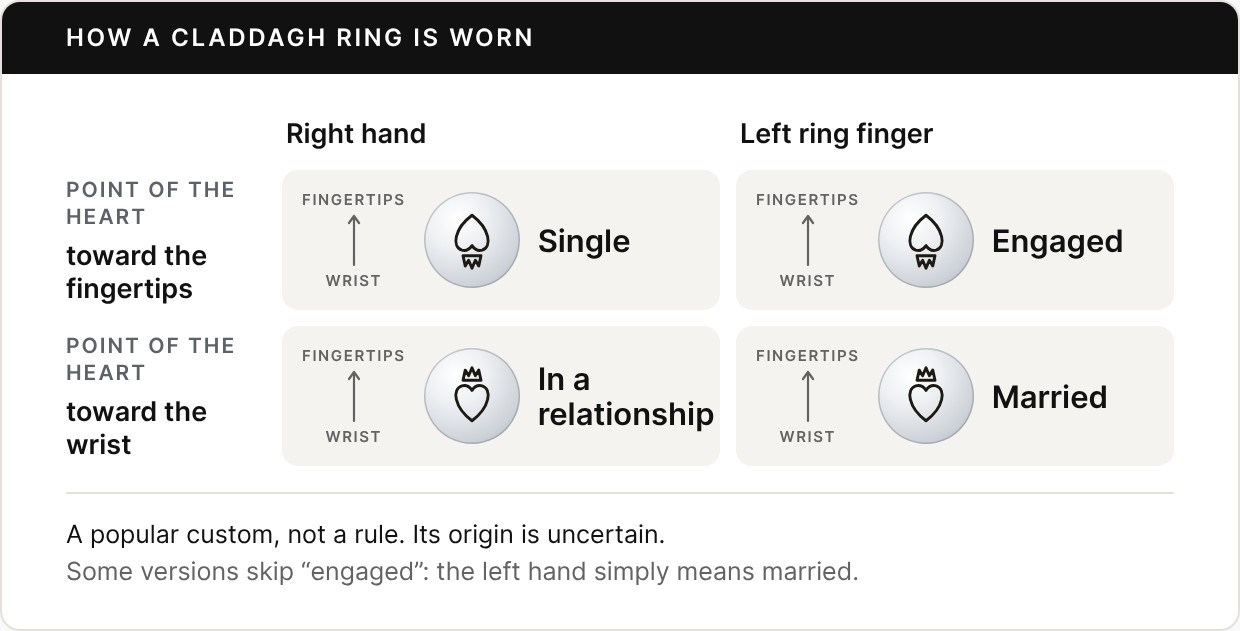
Treat it as custom, not rule. The NMI says “the origin of these traditions is uncertain” and gives a shorter version: on the right hand with the heart facing out if you haven’t yet found love, facing in if you have a romance, and on the left hand if you’re married. Tourism Ireland boils it down to heart out if your heart is open and heart in if it’s joined with another, and adds that the ring is “just a beautiful piece of jewellery that you can wear any way you want.”
You may also hear that buying your own Claddagh is bad luck and that one has to be given to you. The belief is real enough to be recorded in USC’s Digital Folklore Archives, collected from students, but it’s folklore, not history. A ring you buy for yourself is still a Claddagh.
Claddagh rings for men
The Claddagh isn’t only a woman’s ring. “Traditionally, mothers pass it down to their daughters, but men can also wear one,” as Fashioning Faith puts it, and National Geographic describes the family ring as passed from mother to daughter, who would give it to her husband-to-be. The NMI notes that it was used as a marriage and betrothal ring. Four ways a man might wear one:
- As a wedding ring. Left ring finger, point of the heart toward the wrist. In the US the wedding band goes on the left hand, as our guide to how to wear rings explains, and our guide to sterling silver wedding bands covers whether silver suits everyday wear.
- Alongside a wedding band. If you already wear a plain band, a Claddagh on the right hand with the heart pointing in says you’re taken without crowding the band.
- As a promise or engagement ring. The heart-in, heart-out custom makes the Claddagh a natural choice for either; our guides to promise rings for men and men’s engagement rings cover fingers and timing.
- For Irish roots. You can also wear one simply as a sign of heritage, with no message intended. Tourism Ireland’s “wear it any way you want” applies.
Check the fit the same way as any other ring. A Claddagh’s top is wider than its band, so look at both widths in millimeters, and size the finger you’ll wear it on; our ring size guide and our guide to finding his size without asking cover how. If it’s a gift for St. Patrick’s Day on March 17, settle the size well ahead.
Celtic knots and the trinity knot
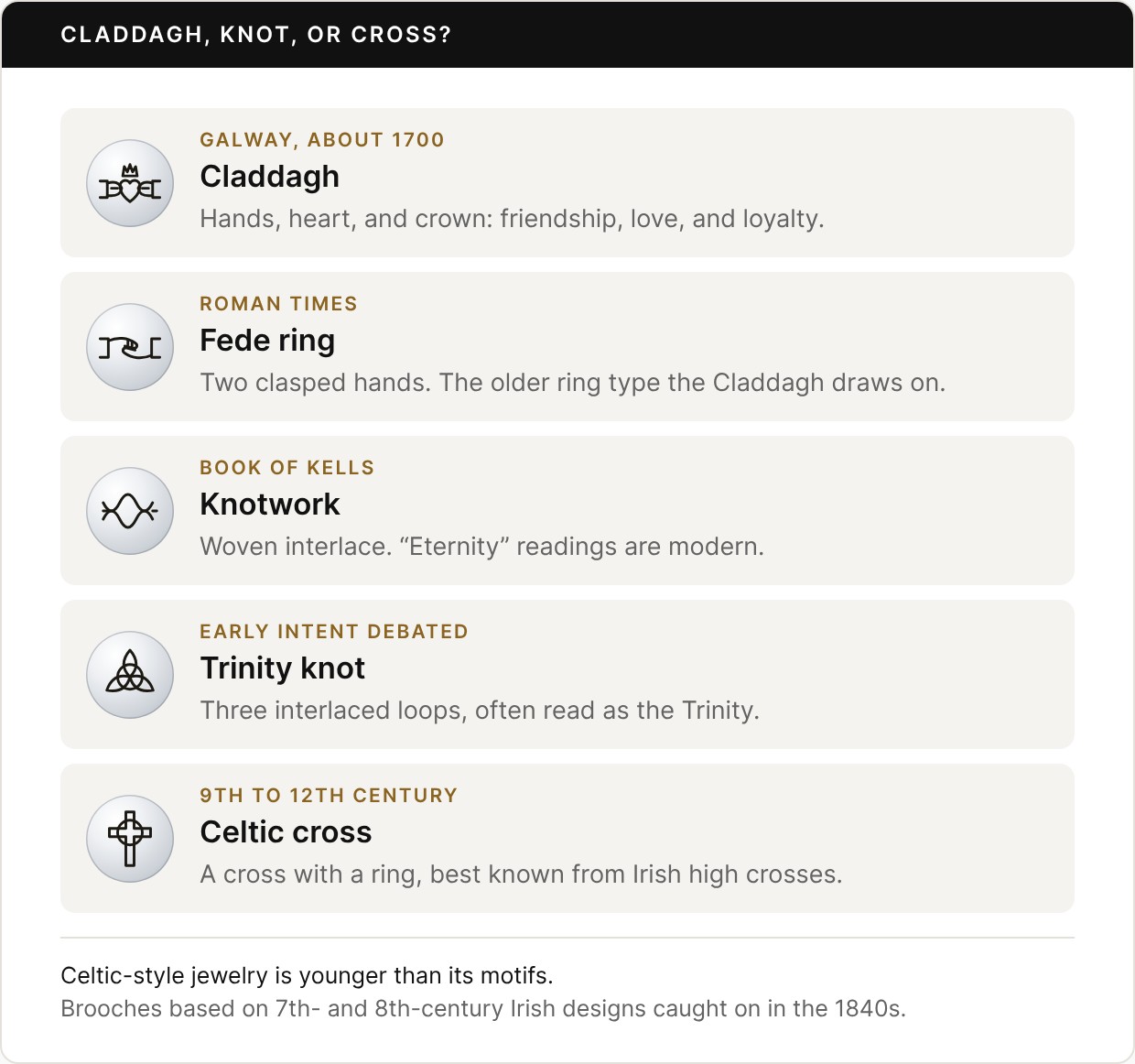
Celtic knotwork is the interlace carved on early medieval crosses in Ireland and Britain and painted in Gospel books such as the Book of Kells. The Insular style it belongs to “first emerged in the 7th century,” decorating Gospels and crosses, as Stephen Walker, a Celtic jewelry maker and historian, writes in his essay “In Search of Meaning”.
What does it mean? Less than many listings say. Of claims that a knot stands for love, health, or strength, Walker writes: “We have absolutely no hard evidence that any such meaning were ever intended by the ancients, but this has not stopped modern designers from attributing such meanings.” Many art historians, he adds, consider interlace purely decorative, and he links the popular idea that a knot’s unbroken line stands for eternity to recent times and to George Bain’s 1951 book on constructing Celtic art, which made much of the single continuous line. Heritage Ireland likewise says that much of the symbolic significance of the high crosses’ interlace “is lost to us.” The triquetra, or trinity knot, is the test case. In a passage Walker quotes, the archaeologist J. Romilly Allen wrote in 1903 that, with two exceptions, it “is used for purely ornamental purposes, and there is not the least foundation for the theory that it is symbolic of the Holy Trinity,” while the art historian Françoise Henry later judged that one early Irish example “most probably” stood for the Trinity. Either way, the knot has been “consciously used as a Christian symbol during the 150 years of the Celtic Revival,” Walker wrote in 2001. On a ring today, it means what its wearer intends.
Celtic-style jewelry is also younger than its motifs. Archaeological-style brooches based on Irish ring brooches of the seventh and eighth centuries were popular from the 1840s, according to the V&A, and after the Tara Brooch was found in 1850, the jewelers G. & S. Waterhouse showed it beside their smaller copies at the Great Exhibition of 1851 in London.
On a man’s ring, knotwork usually runs around the band. Grime collects in the recesses of any cut pattern, so clean it as our guide to textured and braided bands suggests, with warm, soapy water and a soft toothbrush.
The Celtic cross
The Celtic cross is a Christian cross with a ring around the crossing. Its best-known form is the Irish high cross. “These symbols of Christianity first appeared on our landscape from around the ninth century” and were carved into the twelfth, according to Heritage Ireland, which says the ring had a structural purpose and may also have stood for the cosmos, though “opinions still remain divided on this.”
As a pendant or on a ring, it is above all a Christian and Irish symbol. The ADL notes that white supremacists mainly use a different version, “a square cross interlocking with or surrounded by a circle,” and that the traditional Celtic cross, with its long vertical arm and often knotwork, is overwhelmingly non-extremist: “in the absence of other hate symbols,” it “does not denote white supremacy or racism.” Choose the traditional form and you’re wearing what the high crosses show. Our guide to cross necklaces for men covers size and chain.
Buying one: silver, hallmarks, and engraving
Claddagh and knotwork rings come in sterling silver as well as gold. In silver, the recesses of the design darken with time, which shows off the detail. To brighten the raised surfaces without stripping the recesses, use a polishing cloth rather than a dip, as our cleaning guide explains for oxidized pieces.
If a ring is sold in Ireland, it has to be hallmarked. In Ireland, “all articles of silver, palladium, gold and platinum are subject to compulsory assay and hallmarking and there are no exemptions by weight,” according to the Assay Office at Dublin Castle. The piece must carry an Irish hallmark, an International Convention hallmark, or an equivalent hallmark from another EU country. An Irish hallmark has at least three marks: the maker’s or sponsor’s mark, the Hibernia figure of the Dublin Assay Office, and the fineness, 925 in an oval for sterling. Since 2002, Hibernia has gone on every article hallmarked in Dublin whatever its origin, so it tells you the piece was assayed and hallmarked in Dublin, not that it was made in Ireland. If Irish manufacture matters to you, ask the seller. The US has no mandatory hallmarking, as our guide to what 925 means explains, so an American-made ring will usually carry a 925 or sterling stamp instead.
Some old Claddagh rings were personalized: the V&A’s has initials engraved inside, and one of the NMI’s carries the initials IPM. A name, initials, or a date inside the band keeps the habit going; our guide to what to engrave on a gift for him has ideas.
FAQ
Can men wear Claddagh rings?
Yes. “Men can also wear one,” as Wake Forest University’s Fashioning Faith puts it, and National Geographic describes a tradition of a daughter giving the family ring to her husband-to-be. The hand and heart customs apply to anyone.
Which hand does a man wear a Claddagh ring on?
The same as anyone, in the usual version of the custom: the right hand if you’re single or dating, the left ring finger if you’re engaged or married. Worn simply for Irish roots, either hand is fine.
What does it mean when the heart points out?
In the four-way version, the point of the heart toward your fingertips means single on the right hand and engaged on the left; toward your wrist means in a relationship on the right and married on the left. Tourism Ireland’s simpler version: heart out means your heart is open, heart in means it’s joined with another.
Is it bad luck to buy your own Claddagh ring?
Some people believe so, and a university folklore archive has recorded the belief, but nothing in the ring’s history supports it. Buy one if you want one.
Can a Claddagh ring be a wedding ring?
Yes. The NMI notes it was used as a marriage ring. Worn on the left ring finger with the point of the heart toward your wrist, it says married in the usual custom.
What does a Celtic knot mean?
Whatever its wearer intends. There is no hard evidence that the early medieval artists gave knots fixed meanings; love, eternity, and strength are modern readings, as Stephen Walker, a Celtic jewelry maker and historian, notes.
Is the Celtic cross a hate symbol?
The traditional Celtic cross is not. The ADL says its overwhelming use is non-extremist and that, in the absence of other hate symbols, it does not denote white supremacy or racism. White supremacists more commonly use a different version: a square cross interlocking with or surrounded by a circle.
How can I tell if a Claddagh was made in Ireland?
Ask the seller. A Hibernia hallmark shows the piece was hallmarked at the Dublin Assay Office, but since 2002 that applies to imported pieces too, so it isn’t proof of where a new ring was made. Before 2002, Hibernia went only on Irish-made articles, which helps with antique Claddaghs.
Bottom line
A Claddagh is a fine ring for a man: as a wedding ring on the left hand with the heart pointing toward your wrist, alongside a wedding band on the right hand, or simply for Irish roots. The hands, heart, and crown stand for friendship, love, and loyalty, and the design goes back to Galway around 1700. The heart-in, heart-out custom is a popular tradition of uncertain origin, and fixed meanings for Celtic knots are modern readings, so wear either the way that means something to you. In silver, look for a 925 stamp or, on a ring sold in Ireland, a recognized hallmark such as the Irish one with its Hibernia mark.
From the collection
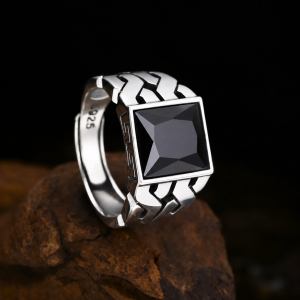
Men’s sterling silver rings by Ronatelli
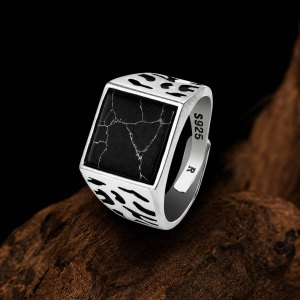
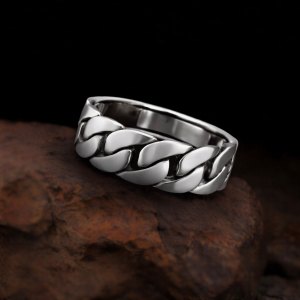
Eleven handmade 925 rings, $129 to $169, from a chain-link band to a black onyx statement ring. Every one is adjustable.
Related guides
The Claddagh’s design, makers, village, and wearing customs follow the National Museum of Ireland’s “Claddagh Rings” by curator Hannah Gallagher. The Joyce story and the Galway City Museum ring follow National Geographic (January 11, 2024), drawing on James Hardiman’s 1820 history of Galway. The four-way custom follows Wake Forest University’s Fashioning Faith; the two-way version, the plaque, and the eagle legend follow Tourism Ireland (updated October 22, 2024); the bad-luck belief follows the USC Digital Folklore Archives. Fede rings, the Robinson Claddagh, and the archaeological-style brooches follow the V&A’s collection records. Knotwork follows Stephen Walker’s “In Search of Meaning” (first published in Dalriada Magazine, 2001; Walker Metalsmiths); high crosses and their interlace follow Heritage Ireland; the hate-symbol note follows the ADL; hallmarking follows the Assay Office, Dublin Castle. Ring prices in the collection box were read from ronatelli.com. All were checked on October 31, 2026. Read our editorial policy.

