A promise ring is a ring given as a sign of commitment that stops short of a proposal, and men wear them too, as one of a matching pair or on their own. There is no rule about the finger: the left ring finger follows wedding tradition, while the right hand keeps it clear of a future engagement ring or wedding band. Sterling silver suits one well. It costs far less than gold, takes an engraving, and comes in textured bands and signets that won’t be mistaken for a wedding band.
Key takeaways
- A promise ring signals commitment without a proposal. What it promises is up to the two of you, so say it out loud.
- Men wear them, as half of a matching pair or on their own. We found no reliable data on how many do.
- There is no rule on the finger. The left ring finger mirrors wedding tradition; the right hand keeps it separate.
- “Promise ring” can also mean a purity ring, worn as a pledge of abstinence and often made of silver. Worth knowing if you choose a plain silver band.
- Sterling is a natural fit: modest in price, easy to engrave, and easy to wear every day with a little care.
In this guide Meaning History Which finger Men Silver Engraving Giving one FAQ
What a promise ring means
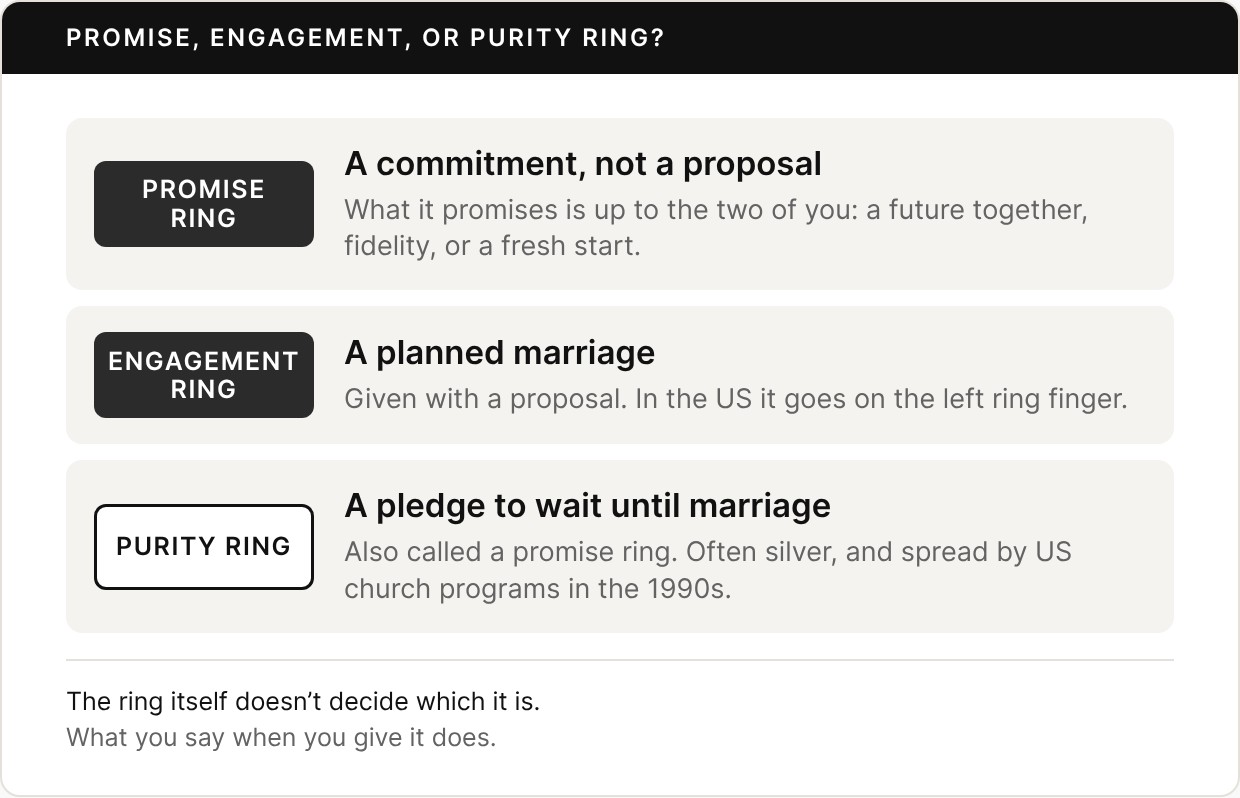
Dictionary.com’s definition covers two kinds of promise: “a finger ring given as the sign of a promise or commitment, such as a promise of faithfulness or marriage to a romantic partner, or a commitment to abstain from sex until married.” This guide is mostly about the first; the second is the purity ring, covered below.
Within a couple, the usual sense is a commitment that comes before an engagement. A promise ring “is typically exchanged between two individuals who eventually—but not immediately—plan on marrying each other,” according to the jewelry insurer Jewelers Mutual, which adds that it can “more generally symbolize love, fidelity, life-long friendship, or committing to a fresh start after a rough patch,” and can pass between friends and family as well as partners.
Sources differ on whether it has to point toward marriage. In a long-term relationship, Jewelers Mutual says, a promise ring is read as a step toward engagement, so “you shouldn’t give someone a promise ring if you don’t eventually want to get married.” Blue Nile says you can also give one “without marriage in mind,” and Gabriel & Co. lists friendship, sobriety, and self-growth among the promises people mark. The practical answer is the same either way: the meaning belongs to the two people involved, and it should be said, not assumed.
Where promise rings come from
The closest historical parallel is the posy ring, a band engraved with a short motto. By 1430, love rings engraved with inscriptions “were known as ‘posies’ (from ‘poesy’ or poetry),” according to the Victoria and Albert Museum (V&A); the mottoes were mostly in French in the 13th and 14th centuries, with English increasingly common from the 15th. Many of these rings, the V&A notes, “seem to have been declarations of love, rather than formal betrothal or marriage rings,” which is close to what a promise ring is today. Others served as betrothal and wedding rings or were given to friends. Medieval posies were usually engraved on the outside of the band; later ones moved inside.
In England around 1830 to 1840, sentimental jewelry spelled out messages in stones. A V&A locket from about 1840 sets a ruby, emerald, garnet, amethyst, ruby, and diamond, whose initials spell “regard,” an arrangement the museum says “was also popular in ‘regard’ rings,” and other pieces spelled “love” the same way. Gabriel & Co. and Jewelers Mutual also trace promise rings to ancient Rome. The V&A confirms that rings have served as love gifts and marriage tokens since Roman times, but we found no museum or academic source that calls those rings promise rings.
The purity ring is a much newer story. Southern Baptist organizations began promoting purity rings in the early 1990s through campaigns such as True Love Waits, the Chicago Tribune reported in 2005, and the pledge behind them was created in 1993 by an evangelical Christian organization, a 2009 study in Pediatrics notes. Citing earlier research, the same study puts the reach at “13% of American adolescents” by 1995. One large ring program was named Silver Ring Thing; it was founded in 1995 in Yuma, Arizona, and became Unaltered in 2019. Because many purity rings were silver bands, a plain silver band may carry that association for some people.
Which finger does a promise ring go on?
Any finger you like. “There are no hard and fast rules on how to wear a promise ring,” Jewelers Mutual says, and Blue Nile and Gabriel & Co. say the same. The choice comes down to what you want the ring to say to people who see it.
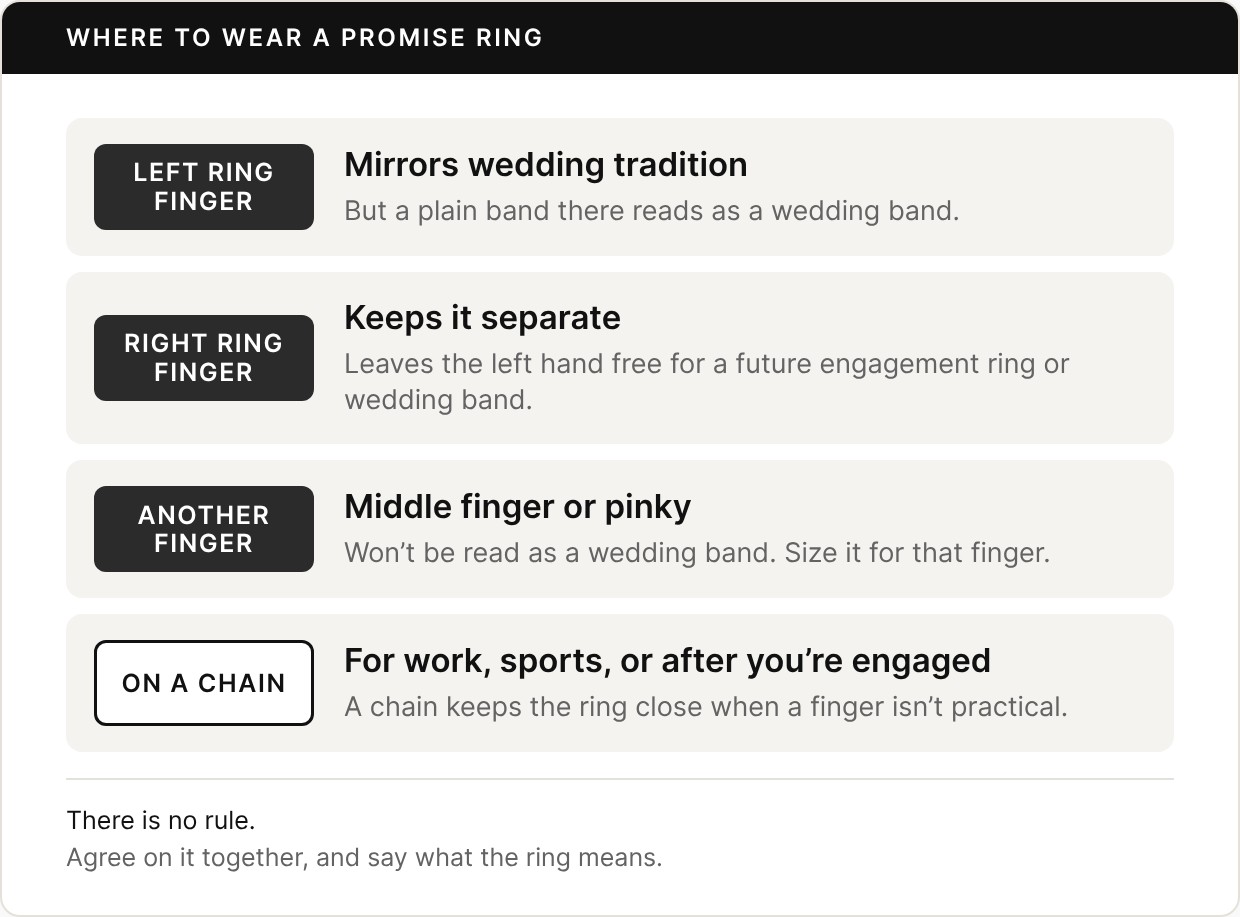
- Left ring finger. It follows wedding tradition, and Gabriel & Co. calls it the most common choice for men, though it gives no data. The catch: a plain band on that finger reads as a wedding band, as our guide to how men wear rings notes, and Jewelers Mutual warns that some people may take it for an engagement ring.
- Right ring finger. It keeps the promise ring “visually separate from a future engagement or wedding band,” as Gabriel puts it, and leaves the left hand free for whatever comes next.
- Middle finger or pinky. Nobody will take it for a wedding band. Fingers differ in size, so measure the one you’ll wear it on; our ring size guide shows how.
- On a chain. A chain suits work where rings aren’t practical, and Jewelers Mutual and Blue Nile both suggest one after you get engaged.
Why does the left ring finger mean “married” at all? In England, the first Book of Common Prayer of 1549 “specifies the third finger of her left hand,” the V&A notes; earlier, the bride’s ring went on the right, and the same record notes that Catholic Europe moved to the left hand in 1614. Customs still differ by country, so a promise ring worn abroad may be read differently.
If you get engaged later, Blue Nile suggests moving the promise ring “to another finger or your other hand,” and Jewelers Mutual suggests wearing it on a chain. The simplest move is to the right hand, leaving the left for the engagement ring or wedding band.
Do men wear promise rings?
Yes, though we found no count of how many. There is no credible survey of men who wear promise rings, and even one retailer’s guides disagree: one Gabriel & Co. guide says it is “not that common” for men, while another says it is “more common than most people realize.” Neither cites data.
What the sources do agree on is how it works. “Some couples exchange a set of promise rings for each to wear and other times, just one person in the relationship is the recipient,” Jewelers Mutual says, and Gabriel adds that “there are no rules about who gives or who receives,” so a woman can give one to a man as easily as the reverse.
Gabriel & Co.’s men’s guide says men’s promise rings “tend to be simpler and more understated,” and lists plain gold and silver bands, diamond-accented bands, hammered or braided textures, and engraved bands; a signet works too. On width, Gabriel suggests 4 to 6 mm for a band that sits discreetly and 6 to 8 mm for more presence. Our guides to silver band rings and signet rings cover those styles.
Why sterling silver suits a promise ring
It keeps the price modest. Jewelers Mutual’s advice is “Just don’t get too spendy with the promise ring,” because it sets a precedent for the engagement ring to come. Sterling costs far less than gold for the same ring, as our guide to sterling silver vs. white gold shows, and Blue Nile counts sterling and 14K gold among the popular choices for thin, low-profile promise rings.
It takes an engraving. A jeweler can engrave sterling inside or out, and a short motto inside the band is the posy-ring tradition in modern form (ideas below).
It wears well with a little care. Solid sterling doesn’t wear off or change color underneath; it tarnishes and polishes back, and it scratches more easily than gold, as our guides to whether sterling silver wears off and wearing a silver ring every day explain. Check that a ring is solid 925, not plated.
It can be sized, or bought adjustable. A promise ring may change fingers later, which favors a ring a jeweler can resize or an adjustable band; our guide to resizing a silver ring covers the limits.
One thing to keep in mind: many purity rings are silver bands, too. If that distinction matters to you, a textured band, a signet, or an engraving makes the meaning your own.
What to engrave: borrow from posy rings
Posy mottoes were short, and some were stock phrases that “could be suggested by the jeweller or found in a book of mottoes or posies,” the V&A notes. A few real ones from its collection, which still work today:
| Inscription | In modern English | Date |
|---|---|---|
| KEPE FAYTH TEIL DETHE | In modern EnglishKeep faith till death | DateEngland, early 1600s |
| LOYALTE NE PEUR | In modern EnglishLoyalty, not fear (French) | DateEngland or France, 1600s |
| I AM YOURS KS | In modern EnglishI am yours (the V&A suggests KS may mean “kiss”) | DateEngland, 1500s |
| TIME DEVM ME AMA | In modern EnglishFear God and love me (Latin) | DateEngland, 1600s |
| LET VIRTV GVD THE | In modern EnglishLet virtue guide thee | DateEngland, early 1600s |
| All is thyn on this side time | In modern EnglishAll is thine on this side of time | DateEngland, 1600s |
Modern choices are simpler: Gabriel & Co. says initials, anniversary dates, coordinates, and short phrases are “especially common.” Jewelers Mutual’s engraving guide says most ring surfaces take 15 to 30 characters and that jewelers prefer a band at least 3 mm wide, so keep it short and choose a band wide enough.
How to give one, and what to say
- Say what it means. If the ring has a diamond, Jewelers Mutual advises, “make sure you clarify that you’re not, in fact, proposing marriage.” Gabriel & Co. puts it more broadly: “A promise ring should never leave room for confusion.”
- Pick a moment that fits. Blue Nile lists anniversaries, birthdays, and Valentine’s Day, as well as couples who are long-distance or not ready to marry.
- Keep it distinct from an engagement ring. A large center stone or a bridal setting “may easily be mistaken for an engagement ring,” Gabriel warns. For a man, a textured band or signet does the same job as a smaller stone.
- Get the size right. Agree on the finger first, then measure that finger; our ring size guide has a size chart.
- Decide together about a matching pair. Some couples both wear one; in others, just one partner does.
FAQ
What does a promise ring mean for a guy?
The same as for anyone: a commitment that stops short of a proposal. Most often it means the two of you plan a future together, but it can also mark fidelity, a fresh start, or a friendship. Agree on what it means when you give it.
Which hand does a man wear a promise ring on?
Either. The left ring finger follows wedding tradition but can be read as a wedding band; the right ring finger keeps it separate from a future engagement ring or wedding band. There is no rule.
Is a promise ring the same as a purity ring?
Not usually, but the names overlap. A purity ring is worn as a pledge of abstinence until marriage, and Dictionary.com’s definition of “promise ring” includes it. Purity rings spread through US church programs in the 1990s, and many are silver.
Can a woman give a man a promise ring?
Yes. Either partner can give one, both can wear one, or just one of you can.
Is a promise ring the same as an engagement ring?
No. An engagement ring comes with a proposal of marriage; a promise ring doesn’t. If a ring could be mistaken for an engagement ring, say clearly which it is.
What do you do with a promise ring when you get engaged?
Move it to another finger or the other hand, or wear it on a chain. The simplest move is to the right hand, leaving the left for the engagement ring or wedding band.
Is sterling silver good for a promise ring?
Yes. It costs far less than gold, takes an engraving, and can be resized. It scratches more easily than gold and needs a polishing cloth now and then, so choose solid 925 rather than plated.
How much should a promise ring cost?
There is no standard. Gabriel & Co. says “anywhere from under $100 to several thousand dollars,” and Blue Nile quotes $200 to $3,000 for a high-quality one. Jewelers Mutual’s advice is not to get “too spendy,” since it sets a precedent for the engagement ring.
Bottom line
A promise ring is a commitment without a proposal, and men wear them too, as half of a pair or on their own. Wear it on whichever finger says what you mean. The left ring finger follows tradition but reads as a wedding band; the right hand keeps it separate. Sterling silver suits one well: it keeps the price modest, takes an engraving, and a textured band or signet helps keep it distinct from a wedding band or purity ring. Whatever you choose, say what it promises when you give it.
From the collection
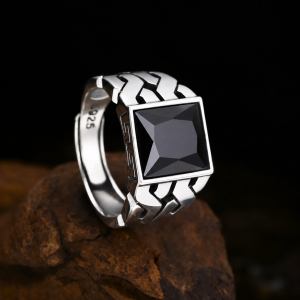
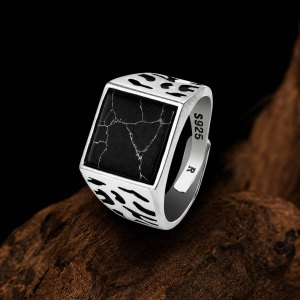
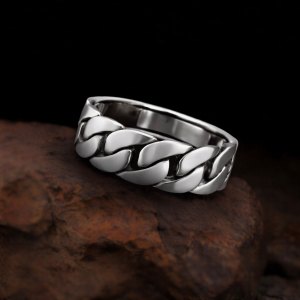
Men’s sterling silver rings by Ronatelli
Eleven handmade 925 rings, $129 to $169, from a chain-link band to a black onyx statement ring. Every one is adjustable.
Related guides
Definitions follow Dictionary.com, Jewelers Mutual (“What is a promise ring?”), Blue Nile, and Gabriel & Co.’s promise-ring guides. Posy, regard, and wedding-ring history and every inscription follow the Victoria and Albert Museum’s collection records. Purity-ring history follows the Chicago Tribune (March 20, 2005), Rosenbaum in Pediatrics (2009), and Unaltered Ministries. Finger, etiquette, and engraving advice follows Jewelers Mutual, Blue Nile, and Gabriel & Co.; price ranges follow Gabriel & Co. and Blue Nile. We found no survey data on men and promise rings. All were checked on October 31, 2026. Read our editorial policy.

