No, not if it’s solid. Sterling silver is the same alloy all the way through, so there is no coating to rub away and nothing different underneath to show. What changes is the surface: it tarnishes, it scratches, and over many years of wear and polishing a ring or chain loses a little metal. What does wear off is anything applied on top: rhodium plating, gold vermeil, a black plated finish, or the thin silver on plated brass.
Key takeaways
- Solid sterling can’t wear off or fade. It is at least 92.5% silver throughout, so a scratch or a worn spot shows the same metal.
- Its color changes only through tarnish, a film that grows from the silver’s own surface and polishes off. A yellowed look is the first stage of it.
- Every polish takes a tiny amount of silver, and decades of wear thin a ring’s underside and a chain’s end links. A jeweler can repair both.
- Plating does wear off: rhodium on a ring worn daily in roughly 6 months to 3 years by jewelers’ estimates, gold vermeil on the high points first.
- A different color showing at a rub point usually means a plating has worn through, not the silver.
In this guide Short answer What changes Polishing Thinning Plating Oxidized Solid or plated? Make it last FAQ
The short answer: solid sterling has nothing to wear off
Sterling is an alloy, not a coating. Under the FTC’s Jewelry Guides, nothing can be called sterling unless it is “at least 925/1,000ths pure silver,” and the rest is usually mostly copper. That mix runs through the whole piece. Wear through the surface of a solid sterling ring and you find more sterling, which is why a worn spot on solid silver still looks like silver.
A plated piece is different. In the same Guides’ words, it is “not composed throughout of silver, but has a surface layer or coating of silver,” and it should be described as coated. Rhodium, gold, and black platings on sterling work the same way: a thin layer over the silver, measured in microns, thousandths of a millimeter. Thin layers wear through.
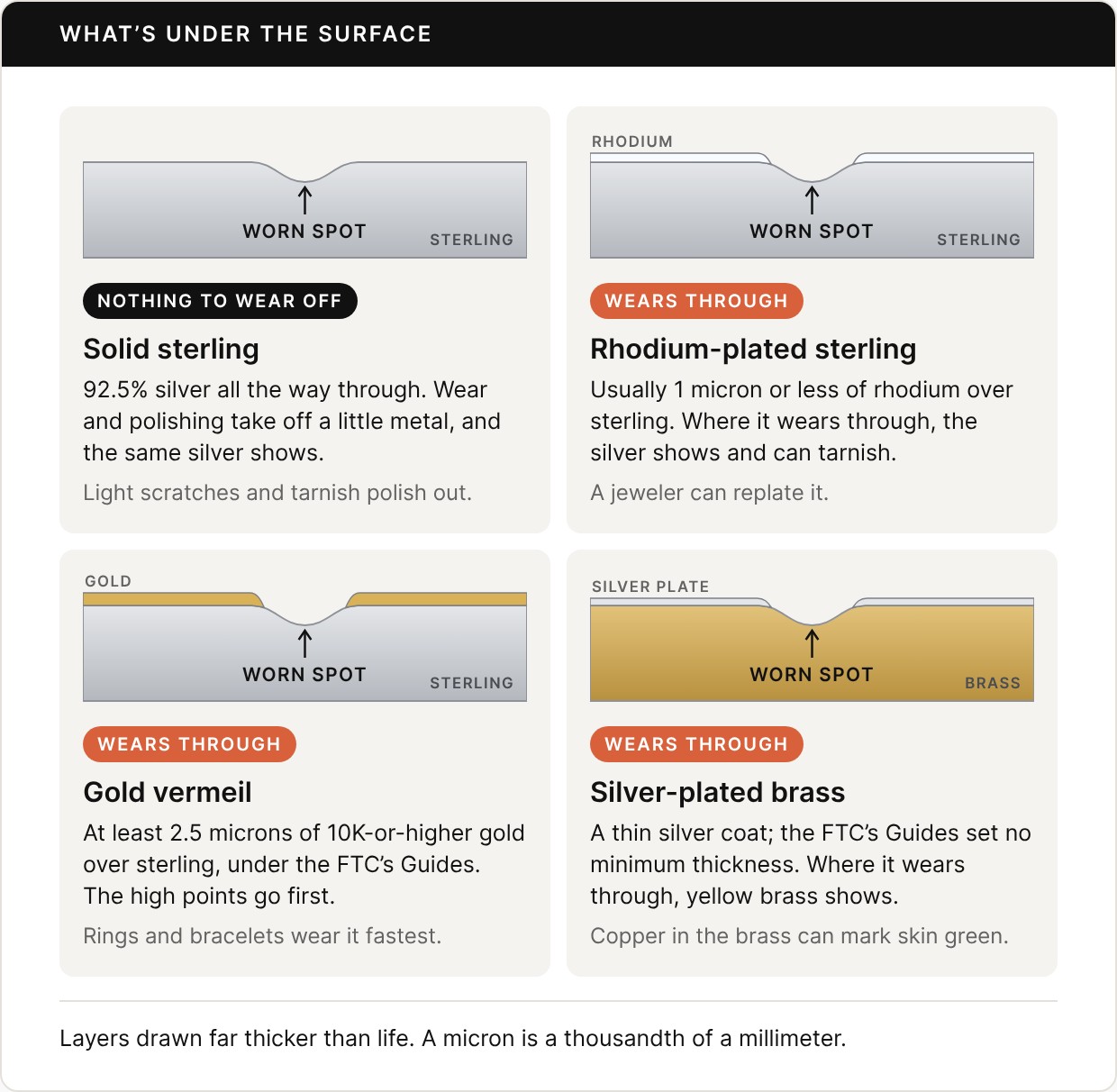
| Finish | What it is | Does it wear off? | What shows underneath |
|---|---|---|---|
| Bare sterling | What it is92.5% silver throughout | Does it wear off?No; tarnish forms and polishes off | What shows underneathThe same silver |
| Rhodium-plated sterling | What it isUsually 1 micron or less of rhodium over sterling | Does it wear off?Yes; jewelers estimate about 6 months to 3 years on a ring worn daily | What shows underneathSterling, which can then tarnish |
| Black rhodium or ruthenium | What it isA thin dark plating over sterling | Does it wear off?Yes, at edges and high points first | What shows underneathBright silver |
| Gold vermeil | What it isAt least 2.5 microns of 10K or higher gold over sterling | Does it wear off?Yes, slowly, on the high points first | What shows underneathSterling |
| Gold-plated sterling | What it is“Gold electroplate” starts at 0.175 micron under the FTC’s Guides | Does it wear off?Yes, sooner than vermeil | What shows underneathSterling |
| Oxidized sterling | What it isThe silver’s own surface darkened, not a coating | Does it wear off?From the high points, by design | What shows underneathBright silver |
| Silver-plated brass | What it isA thin silver coat; the FTC’s Guides set no minimum thickness | Does it wear off?Yes | What shows underneathYellow or pink metal; skin may turn green |
What does change on solid sterling
Three things, and none of them is the silver wearing off.
Tarnish. Silver reacts with sulfur compounds in the air to form silver sulfide, and on sterling the copper forms copper sulfide alongside it. The film grows out of the metal’s own surface, and its color tracks its thickness: between 10 and 100 nanometers it shifts “from yellow through red-brown to blue,” and above about 100 nanometers it is black, according to the Canadian Conservation Institute (CCI). So a sterling piece that looks yellowed or faded is in the first stage of tarnish. The metal itself hasn’t changed color, and a polishing cloth brings it back. Our guide to why sterling silver tarnishes covers the causes.
Scratches. Silver is soft: “naturally softer and more susceptible to scratches and dents than white gold,” as GIA puts it. A piece worn every day collects fine scratches that soften its shine. They are in the silver, not through anything, and our guide to getting scratches out of a silver ring explains which ones polish out.
Lost metal, very slowly. Every polish takes a little silver with it, and friction wears down the places that rub. Both are real, and both are measured in years and decades, as the next two sections explain.
One catch: a piece sold as sterling can still carry a thin coat. Makers often plate production sterling with silver or rhodium to hide firescale, a reddish-purple stain of copper oxide that heating during manufacture can leave in the alloy. On surfaces that rub, “the fire scale will eventually emerge from beneath the plate again,” as goldsmith Charles Lewton-Brain writes on Ganoksin. A reddish-purple cloud showing through at a worn area is likely that stain, not the silver failing.
Does polishing wear silver away?
Yes, a little every time. Tarnish is made from the silver it sits on, so taking it off takes that silver with it. “Each polishing or chemical tarnish removal takes away a certain amount of underlying silver,” CCI’s guide to silver care says, and silver polishing cloths are “impregnated with an abrasive material.” Silversmith Jeffrey Herman, who rates silver polishes by how abrasive they are, goes further: no silver polish on the market is non-abrasive, whatever the label claims.
The amount is tiny. Tarnish turns black once it is about 100 nanometers thick, a ten-thousandth of a millimeter, by CCI’s figure, and the silver locked up in a film that thin is less than that. The abrasive in a cloth or polish takes a little more from the metal beneath. Over decades of hard, frequent polishing it adds up: a conservation article from the Cleveland Museum of Art warns that overpolishing can remove engraved designs and inscriptions over time.
The practical rules:
- Polish when you see tarnish, with a silver cloth or a silver polish. CCI warns that general metal polishes are more abrasive and remove more silver.
- Let wear do some of the work. A piece you wear often tends to rub off early tarnish against skin and clothes, so it usually needs the cloth less than one kept in a drawer.
- For a piece that has gone dark, the baking soda and foil bath in our cleaning guide works by chemistry rather than abrasion: it turns the tarnish back into silver. CCI, describing the same method with aluminum and washing soda, notes that the silver comes back as rough particles that leave a dull, matte surface, which a silver cloth buffs off, and that silver cleaned this way may tarnish again sooner.
- Keep silver dips for recesses nothing else reaches, and keep it brief. Dips dissolve tarnish faster than the silver beneath it, CCI explains, and long exposure can pit the metal.
- Store pieces you aren’t wearing sealed and dry. Less tarnish means less polishing, and less silver lost.
Does a silver ring or chain wear thin?
Yes, over years of daily wear, in the places that rub. A ring meets “steering wheels, countertops, desks, tools, gloves, gym equipment,” and “after many years of normal wear” it starts losing thickness at the bottom of the shank, as Ware Jewelers explains. A band worn down until it is “almost like a wire” is “common with rings worn for decades,” according to Robinson’s Jewelers.
We found no published wear rate for sterling jewelry. The best measurement we found is for gold: a researcher weighed an 18K gold wedding ring every week for a year and found it lost 6.15 milligrams. The biggest loss came on a beach vacation, from the sand, and gardening and skiing also raised it (Gold Bulletin, 2008). Silver is softer than the gold alloys used in rings, so a silver band probably loses thickness at least as fast, but that is an inference, not a measurement.
Chains wear where their links rub against each other, and grit speeds it up. They usually give out at the ends: “Most chains will break at the ends, on or near loops or tabs that latch and where jewelry clasps are secured,” says Jewelry Designs, a repair jeweler in Connecticut, and the jewelry supplier Halstead calls jump rings “the weakest point on sterling silver pendant chains” and “the number one repair item on finished jewelry chains.”
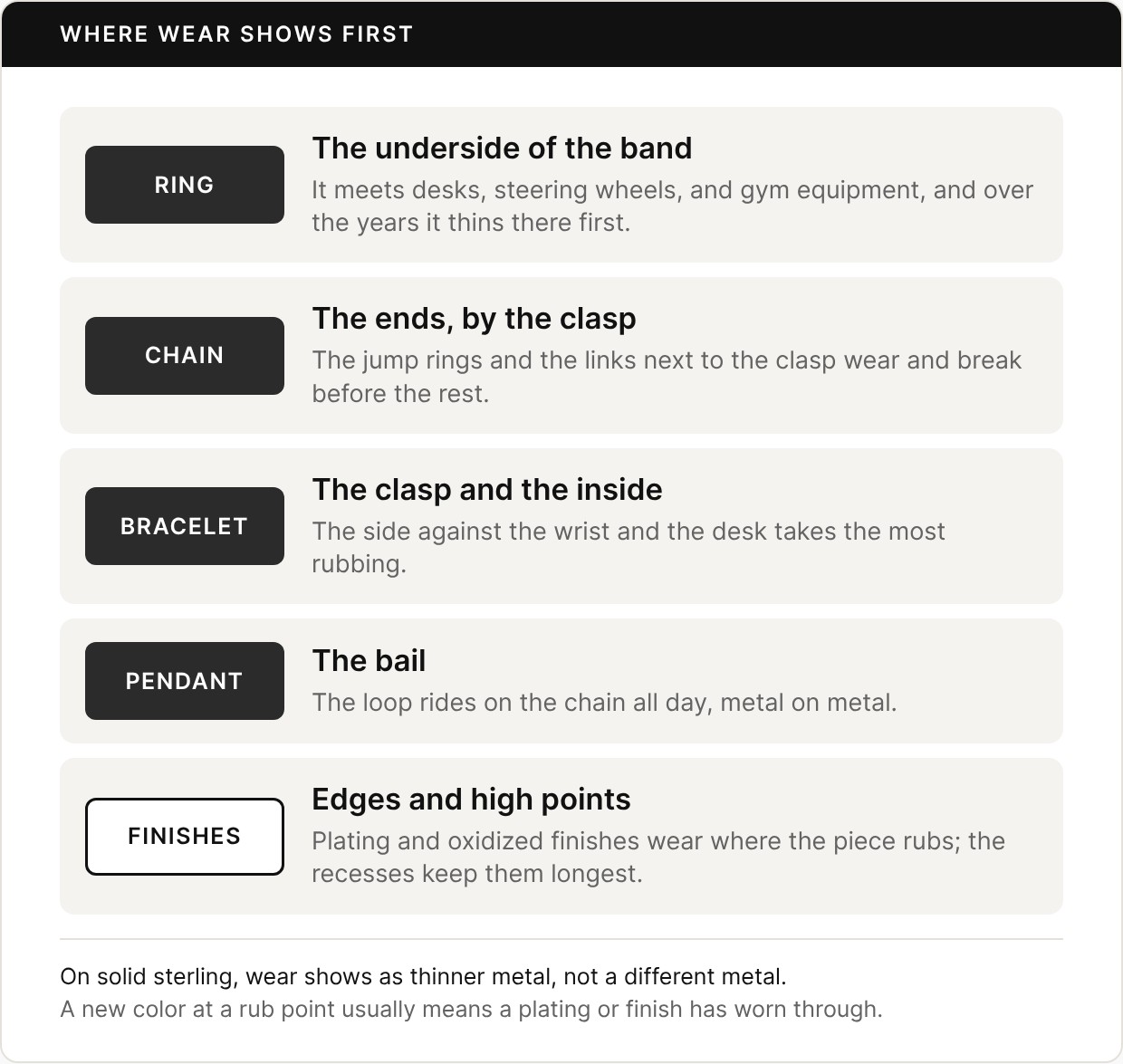
None of this is a reason to keep silver in a drawer. It is a reason to look over your most-worn pieces once a year: a band gone thin at the bottom, a clasp or jump ring worn to a sliver, a bail with a groove in it. It is “better and less expensive to repair a ring with a thinning shank before it breaks,” Ware notes, and a jeweler can rebuild thinning chain links with new metal or replace a worn jump ring. Our guide to fixing a broken silver chain covers those repairs.
What does wear off: plating
Plating is where “wear off” is the right phrase. These are the coatings you will meet on silver jewelry.
Rhodium-plated sterling
Rhodium is a hard, white metal of the platinum group that doesn’t tarnish, and it gives sterling a brighter, whiter finish. The layer is thin, “typically not exceeding 1 micron,” according to Gabriel & Co. Under the FTC’s Guides, it is deceptive not to disclose rhodium on anything marked or described as precious metal, and the FTC has noted that such a surface “may not be permanent and may require replating.”
How long it lasts depends on the piece and how it’s worn. Jewelers’ estimates, mostly given for white gold, run from about 6 months to 3 years for a ring worn every day (Martin Busch Jewelers) and 12 to 18 months for daily-wear pieces (Gabriel & Co.). Robinson’s puts the average at 1 to 3 years and says a band worn around the clock may need it yearly. A piece worn now and then keeps it far longer. Sweat, a loose ring that turns on the finger, stacking against other rings, chlorine, and cleaning products all speed it up. When it wears through, the change is subtle at first; the exposed sterling then tarnishes, so the worn spot slowly turns warmer or darker than the plated area. A jeweler can replate it. Our guide to platinum-plated vs. sterling silver covers how these platings are labeled.
Gold vermeil and gold-plated silver
Vermeil has a floor. Under the FTC’s Guides it means sterling silver plated with gold of 10 karat or higher, at least 2.5 microns thick. The Guides use 0.175 micron as the floor for “gold electroplate,” one-fourteenth as much. Either way, the gold wears through on the high points first, “especially on high-contact pieces like rings and bracelets,” as Quick Jewelry Repairs puts it. Estimates of how long vary widely: Finematter, a UK jewelry marketplace that sells replating, says gold plating 2 microns thick lasts 1 to 2 years on rings and bracelets, and 3 microns about 2 to 3 years, so vermeil’s 2.5-micron minimum falls in between. Robinson’s says well-cared-for vermeil takes “a very, very long time” to wear.
Gold laid straight onto silver can also change color without wearing at all. Silver slowly migrates into the gold layer and tarnishes there, as a plating specialist explains in Products Finishing. In another column he notes that a heavier gold layer slows it, and that palladium makes a good barrier between the two, if a pricey one. If the barrier is nickel or another base metal, the FTC’s Guides call for vermeil made that way to say so. Our guide to two-tone silver pendants covers gold accents in more detail.
Black rhodium and ruthenium
These platings give sterling an even black or gunmetal color. They are thin coats, and Jewelers Mutual notes that black rhodium and ruthenium “aren’t particularly scratch resistant.” They wear at edges and high points to bright silver; one repair service, Quick Jewelry Repairs, puts black rhodium at 6 months to 2 years. A jeweler can replate them.
Oxidized silver: wearing off is the point
An oxidized, or antiqued, finish isn’t a coating. The dark color is the silver’s own surface deliberately turned to sulfide, “a thin conversion layer rather than a coating,” as the Toronto jeweler Skyjems describes it. It wears at the high-friction points, which is what makes engraving and texture stand out more with time, while the recesses stay dark much longer. A well-made finish doesn’t flake the way a plating can, though Halstead warns that a patina built up in one long bath often does.
Silver dips and the baking soda and foil bath remove it fast, taking the dark out of the recesses too, and Skyjems adds abrasive cleaners and many ultrasonic solutions to that list. A silversmith can redo it. Our guide to oxidized silver chains covers the finish in detail.
Solid or plated? How to tell
Before you worry about a finish wearing off, check what you have.
- Read the stamp. Solid sterling is usually stamped 925, Ster, or Sterling, though a stamp is a claim, not proof, and US law doesn’t require one. Under the National Stamping Act, a company that stamps a quality mark such as 925 must put its trademark or name next to it, and silver- or gold-plated base-metal pieces may not be stamped “sterling.”
- Read the listing. “Rhodium-plated sterling,” “vermeil,” and “gold over sterling” mean solid silver under a coat, so when the coat wears, you find silver. “Silver-plated,” “silver-tone,” and “silver color” mean any silver is only on the surface, and “silver-tone” has no definition in the FTC’s Guides.
- Look at the rub points. Yellow or pink metal at a clasp or the edge of a link means brass or copper under a plating. A strong green mark on the skin within days points the same way, as our guide to green fingers explains.
Our guides to what 925 means, telling if silver is real, and silver-filled vs. sterling go further.
How to make a finish last
- Take plated pieces off for the gym, the pool, and cleaning. Sweat, chlorine, and household chemicals all speed plating wear. Our guide to silver and water covers pools and the sea.
- Don’t stack plated rings. Metal rubbing on metal wears rhodium faster.
- Get the size right. A loose ring turns all day, and that friction wears the plating sooner.
- Clean plated pieces with mild soap and water only. Skip the treated side of a polishing cloth, the foil bath, and dips.
- Store pieces apart, so they don’t scratch each other, and sealed, so bare sterling tarnishes less.
FAQ
Will sterling silver fade over time?
No. Solid sterling has no color layer to fade. What looks like fading or yellowing is the first stage of tarnish, a thin film on the surface that polishes off. If a piece fades to a different metal underneath, it was plated.
Does 925 silver wear off?
Solid 925 doesn’t: it is 92.5% silver all the way through. Many 925 pieces are rhodium- or gold-plated on top, though, and that layer wears off in time, showing the sterling beneath.
Does polishing silver make it thinner?
Very slightly, each time. Polishing cloths and polishes are abrasive, and removing tarnish removes the silver it formed from. On jewelry the loss is tiny; it adds up only on pieces polished hard and often over many years.
How long does sterling silver last?
For generations, with ordinary care. It doesn’t rust, wear off, or fade, and the parts that do wear, such as a ring’s underside or a chain’s end links, can be repaired by a jeweler.
How long does rhodium plating last on sterling silver?
On a ring worn every day, jewelers estimate anywhere from about 6 months to 3 years, depending on fit, friction, and skin chemistry. On a piece worn now and then, much longer. A jeweler can replate it.
Does gold vermeil wear off?
Yes, eventually, on the high points first. Vermeil’s 2.5-micron minimum under the FTC’s Guides makes it more durable than ordinary gold plating, but rings and bracelets still wear through soonest. Underneath is sterling silver.
Why is my silver ring a different color underneath?
Dark on the inside or the underside is usually tarnish, which builds where the band traps soap and moisture; our guide to wearing a silver ring every day covers it. A yellow or pink color usually means a plating has worn through to brass or copper. A warmer or darker patch on a bright white ring is usually rhodium that has worn through, with the sterling beneath starting to tarnish.
Can you replate sterling silver?
Yes. A jeweler can replate rhodium or gold, and a silversmith can redo an oxidized finish. Bare sterling needs no replating; a polish restores it.
Bottom line
Solid sterling silver doesn’t wear off or fade. It tarnishes, it scratches, and over decades a ring’s underside and a chain’s end links wear thin, all of which a cloth or a jeweler can deal with. What wears off is plating: rhodium in months to a few years on a ring worn daily, gold on the high points, black finishes at the edges. Know what you’re buying, take plated pieces off for the gym and the pool, polish only when tarnish appears, and look over your most-worn pieces once a year.
From the collection
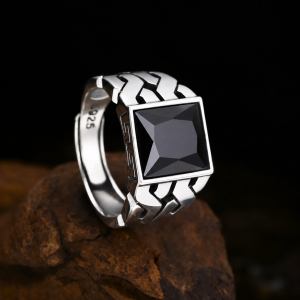
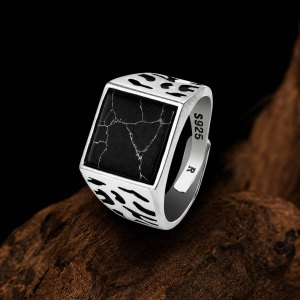
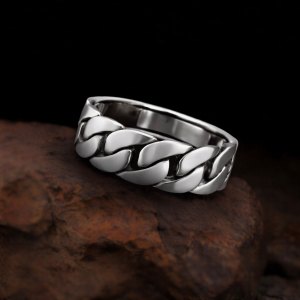
Men’s sterling silver rings by Ronatelli
Eleven handmade 925 rings, $129 to $169, from a chain-link band to a black onyx statement ring. Every one is adjustable.
Related guides
Definitions of sterling, silver plate, vermeil, and gold electroplate, and the rhodium disclosure, follow the FTC’s Jewelry Guides (16 CFR §§ 23.3–23.7) and the FTC’s 2018 Statement of Basis and Purpose; stamping rules follow the National Stamping Act (15 U.S.C. § 297). Tarnish chemistry, color, and thickness, and the effects of polishing, dips, and the foil bath, follow the Canadian Conservation Institute (“Understanding how silver objects tarnish” and CCI Notes 9/7). Polish abrasiveness follows Jeffrey Herman; overpolishing follows the Cleveland Museum of Art; firescale follows Charles Lewton-Brain on Ganoksin. Ring wear follows Ware Jewelers, Robinson’s Jewelers, and Steinhauser in Gold Bulletin (2008); chain wear follows Jewelry Designs and Halstead. Rhodium thickness and lifespan follow Gabriel & Co., Martin Busch Jewelers, and Robinson’s (figures mostly given for white gold); black rhodium and ruthenium follow Jewelers Mutual and Quick Jewelry Repairs; vermeil wear follows Quick Jewelry Repairs, Finematter, and Robinson’s; silver migration into gold follows Products Finishing; oxidized finishes follow Skyjems and Halstead. Read our editorial policy.

