Disclosure:The example pieces in this guide are from Ronatelli. The advice applies to any brand. Prices, product details, and policies were checked on ronatelli.com on October 30, 2026.
A two-tone silver pendant often puts three surfaces on one small piece: polished silver on the raised parts, silver darkened on purpose in the recesses, and a gold-colored detail such as an eagle, a figure, or a crown. Each needs different care, and listings don’t always say what the gold color is. This guide covers what it can be, how each surface wears, how to clean a two-tone pendant without stripping either finish, what to wear with it, and what to ask before you buy, with one brand’s six two-tone pendants as examples.
Key takeaways
- Gold-tone describes a color: the FTC’s Jewelry Guides give minimum karats and thicknesses for calling a gold layer vermeil or gold plate, but in 2018 the FTC declined to set any minimum for “gold tone,” so the word says nothing about what the detail is made of.
- Wash it gently: warm water, a drop of mild dish soap, and a soft brush, then dry it completely. The treated side of a polishing cloth goes on the raised silver only, never on the gold-tone or into the dark recesses.
- Never a dip, a foil bath, paste, or an ultrasonic cleaner: each can strip the dark finish, wear a thin gold layer, or both.
- Treat the gold-tone like plating until you know otherwise: off for the shower, the pool, and the gym, on after cologne, and stored on its own.
- Ask before you buy: what the gold-colored detail is made of, its karat and thickness, and whether the warranty covers it.
In this guide Two-tone The gold color How it wears Cleaning What to wear What to ask Six examples FAQ
What makes a pendant two-tone
On a two-tone silver pendant, most of the piece is sterling silver and a smaller detail is gold-colored. Many add a third surface: the silver in the recesses of an engraving is darkened on purpose, the oxidized finish that makes a pattern stand out, as our guide to oxidized silver explains. So one pendant can carry polished silver, dark silver, and gold-tone side by side.
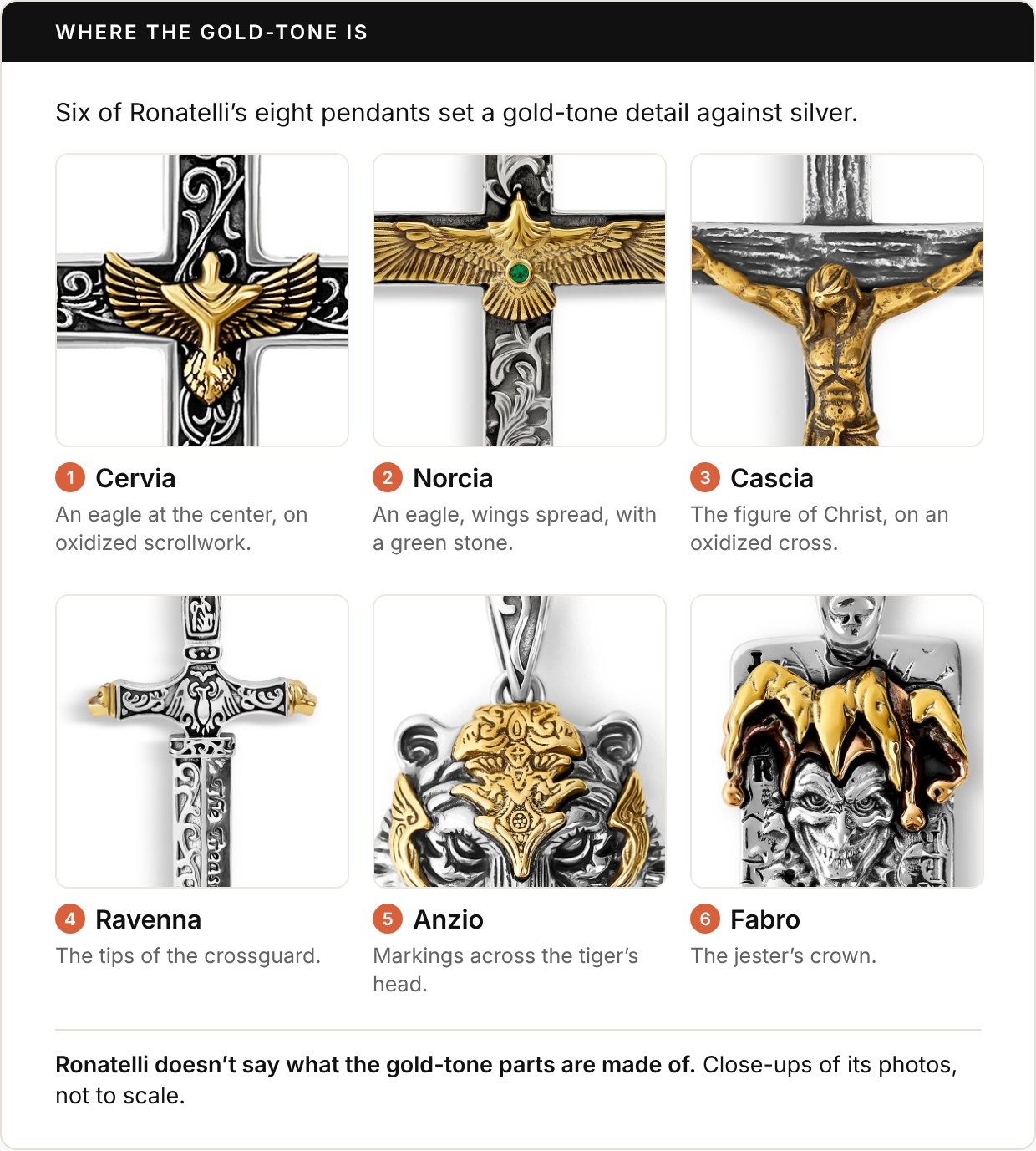
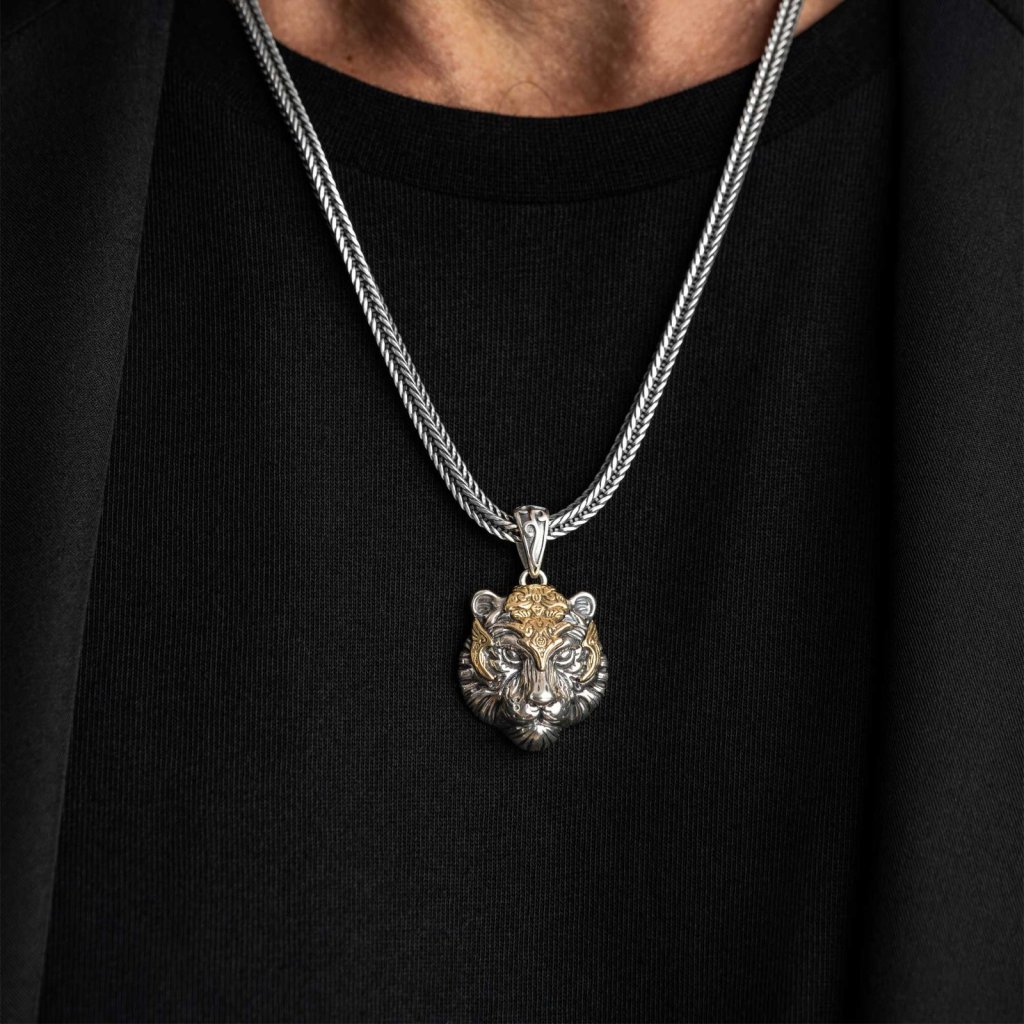
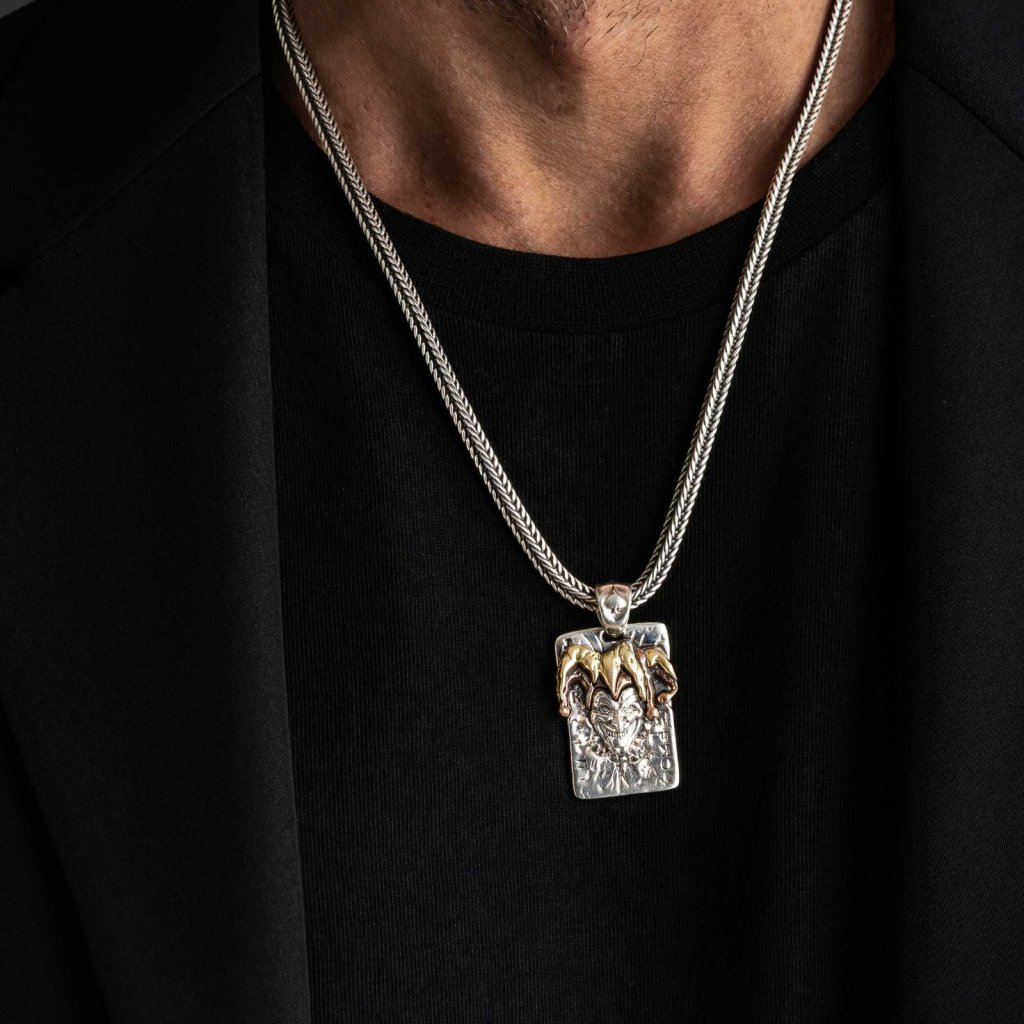
Six of Ronatelli’s eight pendants are made this way: the eagles on the Cervia and the Norcia, the figure of Christ on the Cascia, the tips of the Ravenna’s crossguard, the markings across the Anzio tiger’s head, and the Fabro joker’s crown. Ronatelli’s search listings call these details gold-tone and its product pages call them gold-accented or gold, and none of the pages says what the gold-colored parts are made of. Ronatelli describes the Cervia, the Norcia, and the Cascia as oxidized, and the photos show the other three darkened in their recesses as well.
What the gold color can be
A gold color on sterling silver can be several things: a part made of karat gold, a gold coating over the silver, or a finish described only by its color. For coatings, the Federal Trade Commission’s Jewelry Guides, its guidance on how sellers may describe precious metals, give minimums for each term:
| Term | Gold | Minimum thickness |
|---|---|---|
| Vermeil | GoldAt least 10 karat, over a sterling silver base | Minimum thickness2.5 microns (about 100 millionths of an inch) |
| Gold plate, gold electroplate | GoldAt least 10 karat, with the karat named, as in “12 Karat Gold Electroplate” | Minimum thickness0.175 micron (about 7 millionths of an inch) for electroplate, one-fourteenth of vermeil’s |
| Heavy gold electroplate | GoldAt least 10 karat, with the karat named | Minimum thickness2.5 microns, the same as vermeil |
| Gold-tone | GoldNo FTC standard: in 2018 the FTC declined to set one | Minimum thicknessNone set |
Thickness matters because it affects how long a coating takes to wear through: industry test reports, as the FTC’s 2018 statement on the revision summarizes them, indicated that “coating thickness affects a product’s abrasion resistance.” The same statement lists “gold tone” among the coating terms for which it declined to set a minimum thickness, and reminds sellers that their claims remain subject to the FTC Act. Ronatelli doesn’t say which of these, if any, describes its gold-tone details, and this guide doesn’t guess, so the care below is gentle enough for a thin coating.
How the gold-tone and the dark silver wear
A surface layer wears with friction, and it goes first where something rubs. The jewelry retailer Ross-Simons says plating shows the metal beneath first “on high-contact areas like the edges of a ring,” and that pendants “often maintain their radiance for longer” than rings and bracelets because they meet far less friction. On a pendant, that means the raised edges of a gold-colored detail, the parts a shirt brushes. Chemicals speed it up: the jewelry insurer Jewelers Mutual warns that chlorine, bleach, and cleaning products “can break down the gold plating,” and that sweat and skin oils can affect it too, while Ross-Simons says beauty products “can compromise gold plating faster than almost anything else.” Where the layer wears through, the metal beneath is exposed and can tarnish, and a jeweler can re-plate it, as Jewelers Mutual notes.
Gold laid straight onto silver can also darken without being rubbed at all: silver migrates into the gold layer and tarnishes there, as a plating specialist explains in Products Finishing. The fix is a barrier layer on the silver before the gold goes on, and Ross-Simons says many high-end makers use palladium for it.
The dark silver ages differently. It isn’t a coating but the silver’s own surface, darkened, so it can’t chip or peel. It lightens slowly on the high points, where skin and cloth rub, while the recesses stay dark, so the pattern gets sharper with time, as our guide to oxidized silver explains; a dip, a foil bath, abrasive paste, or chlorine can strip it all at once. How dark it starts varies from piece to piece: two Cascia buyers found theirs brighter than the photos.
Of the 223 reviews of Ronatelli’s six two-tone pendants, 187 with a comment, none mentions the gold-tone wearing, fading, or changing color. That says little about how it will look after years of wear, only that no reviewer has raised it. Four habits slow both kinds of wear:
- Put it on last. Ronatelli’s FAQ says to “avoid splashing chemicals such as perfume, aftershave, or lotion directly on your jewellery,” to let cosmetics dry first, and to put jewelry on last.
- Take it off for water and sweat. Ronatelli’s FAQ says its necklaces can get wet and be worn to exercise, and recommends drying them with a towel as soon as possible, but it doesn’t address the gold-tone details. Until you know what the gold-tone is, treat it like plating: our guide to wearing a chain every day takes a plated chain off for the shower, the pool, and the gym, and Ross-Simons advises removing plated pieces “before showering, swimming or sweating.” Chlorine strips an oxidized finish too.
- Dry it whenever it gets wet. “If your jewellery gets wet, dry it with soft materials,” as Ronatelli’s FAQ puts it; moisture left in the recesses is a common cause of fresh tarnish, as our cleaning guide notes.
- Store it on its own. A soft pouch or a compartment of its own keeps harder pieces from scratching it, and an anti-tarnish strip and a dry place slow tarnish, as Jewelers Mutual recommends; our guide to why sterling tarnishes covers storage.
How to clean a two-tone pendant
Clean it as you would an oxidized piece, with one more rule for the gold-tone:
- Wash. Lay it in warm water with a drop of mild dish soap for a few minutes, no longer; Jewelers Mutual, which recommends this wash for gold-plated jewelry, warns that “prolonged soaking can damage the jewelry.” If it is set with a stone the seller doesn’t name, as the Norcia is, treat it as a soft stone: don’t soak it, wipe the metal with a damp cloth, and keep the stone dry, as our cleaning guide advises for porous and soft stones. If the seller gives care instructions for the gold-tone, follow those first; some vermeil makers, Mejuri among them, advise no water at all.
- Brush. Work a soft toothbrush gently over the whole piece, recesses included. It lifts grime without lifting the dark.
- Rinse and dry. Rinse in clean warm water and dry it completely with a soft, lint-free cloth. Give an openwork piece, such as the Anzio, time to dry inside before you put it away.
- Polish the silver only. If the raised silver has dulled or yellowed, run the treated side of a polishing cloth lightly over it, and keep it off the gold-tone and out of the recesses. For fingerprints on the gold-tone, use a soft, untreated cloth.
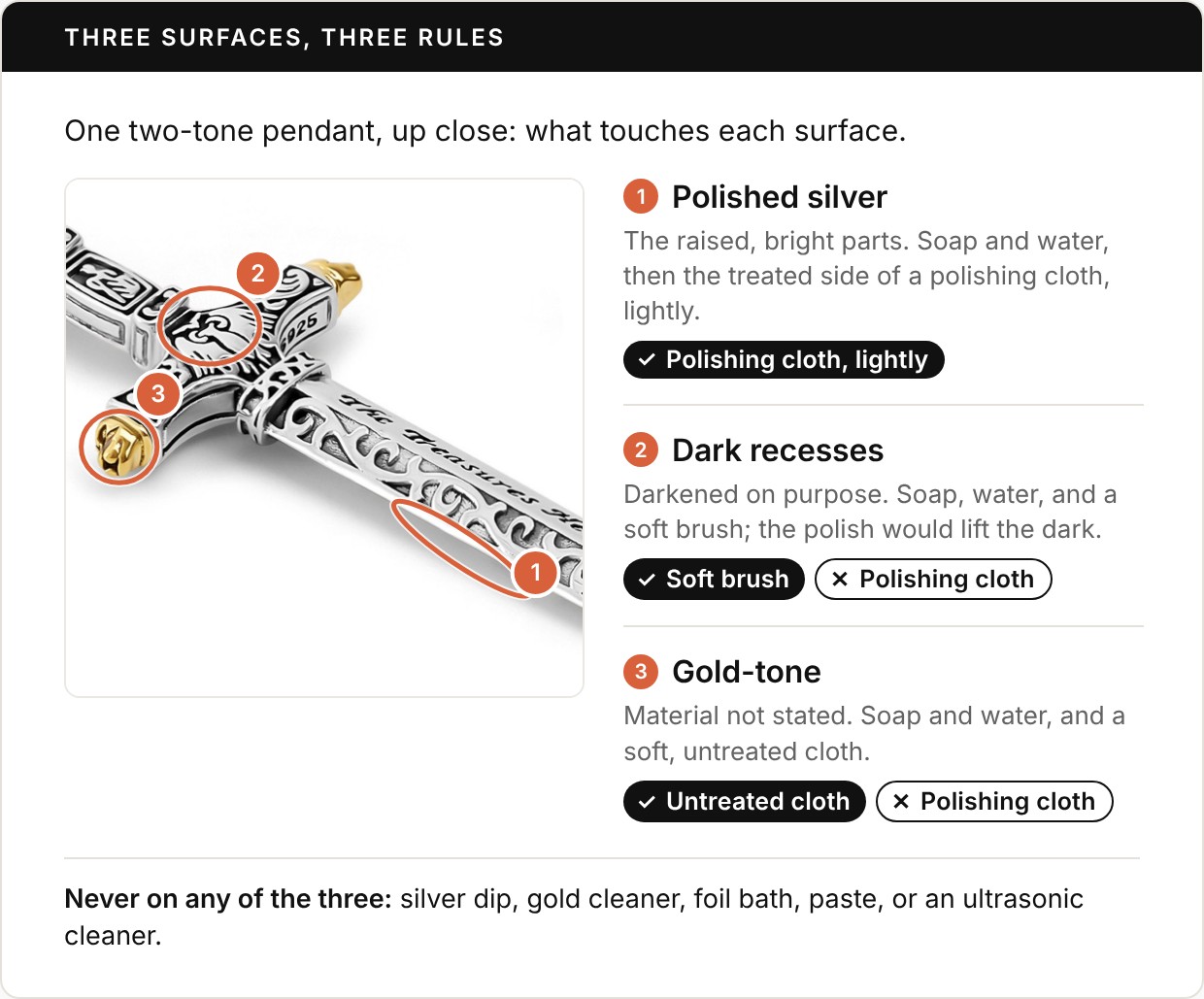
A polishing cloth’s treated side carries a fine polish, which is why it is kept off both finishes: silver polishing cloths “are impregnated with an abrasive material,” and polishes “will damage gilding,” as the Canadian Conservation Institute notes, while Tiffany & Co. warns that silver polish “will strip the oxidized finish.” Pandora makes the same split with its own two-sided cloth: the treated side for sterling silver and 14k gold, the untreated side for its plated pieces. Makers differ on how much a treated cloth takes off a dark finish (Connoisseurs says its cloth leaves antiquing in place), so keeping it on the raised silver is the course they all allow. Here is what is safe on a two-tone pendant:
| Method | On a two-tone pendant | Why |
|---|---|---|
| Warm water, mild soap, soft brush | On a two-tone pendantYes, for a few minutes | WhyCleans all three surfaces without abrasion |
| Soft, untreated cloth | On a two-tone pendantYes | WhyLifts fingerprints and moisture from every surface |
| Treated polishing cloth | On a two-tone pendantOn the raised silver only | WhyIts polish is abrasive: it can wear a thin layer and lift the dark |
| Silver dip | On a two-tone pendantNo | WhyThe Connoisseurs label: “Not for use on … painted/antiqued or plated pieces” |
| Gold jewelry cleaner | On a two-tone pendantNo | WhyWeiman says its cleaner for gold, platinum, and gems “is not formulated for silver” |
| Baking soda and foil bath | On a two-tone pendantNo | WhyIt strips an oxidized finish, as our cleaning guide explains, and Jewelers Mutual says baking soda and hot water “can damage gold plating” |
| Ultrasonic cleaner | On a two-tone pendantNo | WhyIt can “speed up the wearing away of any plating,” says Blue Nile, and Pandora excludes oxidized silver and plated pieces |
| Toothpaste or polishing paste | On a two-tone pendantNo | WhyAbrasive: it scratches the silver and wears a thin layer |
As for how often: for a pendant worn daily, our cleaning guide suggests the polishing cloth about once a month and a wash every two or three months. On a two-tone piece, that monthly polish is for the raised silver only.
What to wear with a two-tone pendant
A two-tone pendant is mostly silver, so it reads as a silver piece with a gold accent. Real Men Real Style’s rule for mixing gold and silver is that “one should clearly lead,” and here the silver leads, so the rest of what you wear can follow it:
- The chain: silver. A silver chain keeps the silver in the lead and leaves the gold-tone as the accent. A foxtail or rope darkened in its recesses repeats the pendant’s dark silver: our guide to the best chain for a pendant pairs Ronatelli’s pendants with its Sergo foxtail and Monza rope, and our guide to oxidized silver shows both darkened that way. Leave a heavily patterned chain to be worn on its own, as that guide advises.
- The watch: steel, or two-tone. Sterling belongs with a steel, titanium, white gold, or platinum case, as our guide to a silver chain with a suit puts it. A two-tone watch picks up both colors, and Real Men Real Style names one as a piece that can anchor a mix of metals; our guide to wearing a bracelet with a watch covers case metals.
- A gold watch or gold cufflinks. Real Men Real Style now calls the one-metal rule outdated, so worn casually it is a matter of taste. In a suit, the pendant goes under the shirt anyway, as our suit guide advises, so it never sits beside a gold watch or gold cufflinks.
- Rings and bracelets: silver. A gold wedding band is the usual exception, as Gentleman’s Gazette notes.
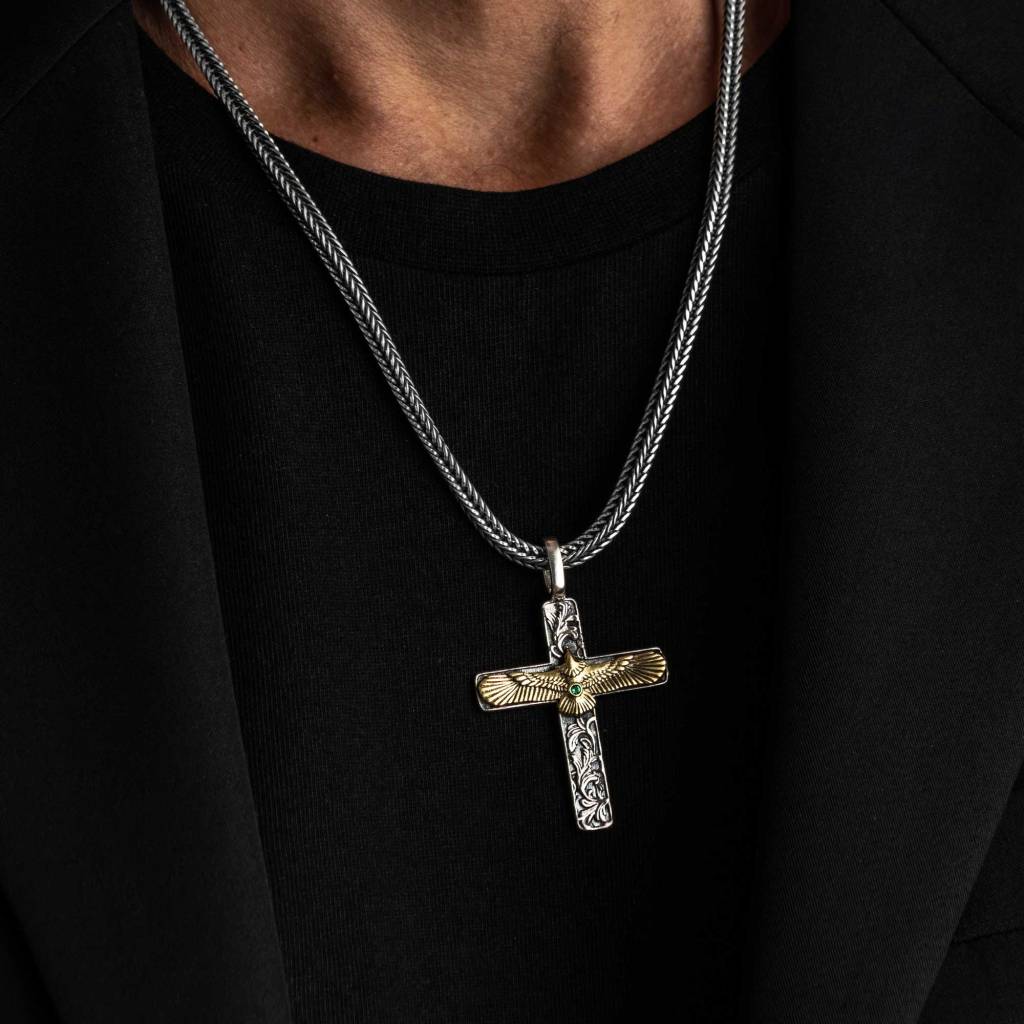
Matching metals is a convention, not a rule. Even Gentleman’s Gazette, which advises it, adds that if you don’t have a matching metal for everything, “just wear it.” Ronatelli photographs these pendants worn on a silver foxtail chain:
What to ask the seller
Jewelers Mutual’s advice on gold-plated jewelry is to “ask your jeweler about the specific gold content before purchasing to ensure the price matches the quality.” For a two-tone pendant, that comes down to four questions:
- What is the gold-colored part made of? Solid karat gold, vermeil, gold plate, or another finish, and, if it is a coating, whether there is a barrier layer under it.
- What karat, and how thick? The two numbers the FTC’s terms turn on: 0.175 micron is the minimum for gold electroplate, 2.5 microns for vermeil.
- Does the warranty cover the finishes? Ask whether worn gold-tone or lightened dark silver counts as a defect or as wear.
- Can it be refinished, and by whom? A jeweler can re-plate a worn layer and re-darken silver, but some makers do it themselves, and work by someone else can void a warranty.
Get the answers in writing. In its advice to jewelry shoppers, the FTC urges consumers to “ask salespeople to write down any information they might rely on to make their purchase.”
Ronatelli’s policies answer part of this. Its lifetime warranty covers manufacturing defects and guarantees that a piece remains 925 sterling silver. It excludes general wear and damage from harsh chemicals such as chlorine, bleach, and perfume, and it doesn’t cover damage from repairs or changes made by anyone other than Ronatelli-certified technicians. It doesn’t mention the gold-tone details or the deliberate oxidized finish; its only mention of oxidizing is ordinary tarnish, which it says is not a defect. For damage outside the warranty, Ronatelli says it can offer paid repair “when physically possible,” subject to an assessment fee. So ask Ronatelli before you take a worn pendant to a local jeweler.
Six two-tone pendants at Ronatelli
These are the six in Ronatelli’s pendant collection with gold-tone details, at their listed prices:
| Pendant | Gold-tone detail | Dark silver | Price | Rating (reviews) |
|---|---|---|---|---|
| Cervia eagle cross | Gold-tone detailThe eagle at the center | Dark silverOxidized scrollwork, front, back, and bail | Price$169 | Rating (reviews)5.0 (86) |
| Norcia eagle cross | Gold-tone detailThe eagle, wings spread, with a green stone at its heart | Dark silverOxidized scrollwork, both sides | Price$149 | Rating (reviews)4.9 (18) |
| Cascia crucifix | Gold-tone detailThe figure of Christ | Dark silverAn oxidized cross | Price$199 | Rating (reviews)4.9 (28) |
| Ravenna sword cross | Gold-tone detailThe tips of the crossguard | Dark silverDarkened engraving, in the photos | Price$149 | Rating (reviews)5.0 (33) |
| Anzio tiger | Gold-tone detailMarkings across the head | Dark silverDarkened detail, in the photos | Price$169 | Rating (reviews)4.7 (24) |
| Fabro joker | Gold-tone detailThe jester’s crown | Dark silverDarkened detail, in the photos | Price$99 small, $149 medium | Rating (reviews)5.0 (34) |
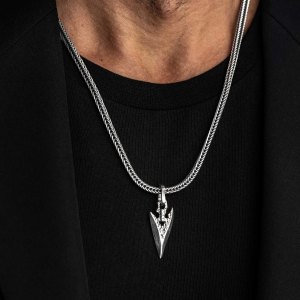
Two need a little extra care. The Norcia’s green stone isn’t named, so wipe it rather than soak it, and the Anzio’s back is an openwork grid that one buyer says is hollow inside, so let it dry fully. The other two in the collection, the Poseidon trident and the Lyon arrowhead, are all silver, for a man who would rather have no gold-tone to look after. Our comparison of all eight has their listed weights and details, and our guide to cross necklaces for men covers the four crosses.
FAQ
Is the gold on a two-tone silver pendant real gold?
It depends on the piece, and the color alone won’t tell you. The detail can be solid karat gold, a gold coating, or a finish described only by its color. Under the FTC’s guidance, “vermeil” and “gold plate” mean gold of at least 10 karat in a layer of a set minimum thickness; “gold-tone” has no FTC standard. Ask the seller what the detail is made of, its karat, and, for a coating, its thickness.
Can I use a polishing cloth on a two-tone pendant?
On the raised silver, lightly. Keep the treated side off the gold-tone, where its polish can wear a thin layer, and out of the dark recesses, where it can lift the oxidized finish. A soft, untreated cloth is fine everywhere.
Will the gold-tone wear off?
Any surface layer wears with friction, at the raised edges first, and how soon depends on its thickness and how the piece is worn. Pendants meet less friction than rings and bracelets, so they often keep a finish longer. A jeweler can re-plate a worn layer, though work by someone other than the maker can void its warranty.
Can I shower with a two-tone pendant on?
Better not. Until you know what the gold-tone is, treat it like plating: off for the shower, the pool, and the gym, as our guide to wearing a chain every day advises for plated chains. Chlorine also strips an oxidized finish.
Can I put a two-tone pendant in silver dip?
No. Connoisseurs labels its silver dip not for plated or antiqued pieces, and Weiman says its gold cleaner is not formulated for silver, so neither suits a pendant with a dark finish and a gold-tone detail. Use warm water, mild soap, and a soft brush.
Does a two-tone pendant go with a silver chain and a steel watch?
Yes. It is mostly silver, so the silver leads and the gold-tone stays an accent. A two-tone watch works too. In a suit, wear the pendant under the shirt, whatever the watch.
Bottom line
A two-tone pendant is often three surfaces in one: polished silver, dark silver, and a gold-colored detail whose material a seller may not state. Wash all three with warm soapy water and a soft brush, keep the polishing cloth on the raised silver, never dip it, and take it off for water and sweat. Before you buy, ask what the gold-tone is and whether the warranty covers it.
From the collection
Men’s sterling silver pendants by Ronatelli
Eight handmade 925 pendants, $99 to $199. Each fits chains up to 6 mm; the chain is sold separately.
Related guides
The terms for gold over silver come from the FTC’s Guides for the Jewelry, Precious Metals, and Pewter Industries (16 CFR Part 23) and its 2018 statement on their revision, and the advice to get answers in writing from an FTC release for jewelry shoppers; the care advice from Jewelers Mutual, Ross-Simons, Pandora, Blue Nile, Tiffany & Co., the Canadian Conservation Institute, Mejuri, and the Connoisseurs and Weiman product pages; the note on darkening from Products Finishing; and the style advice from Real Men Real Style and Gentleman’s Gazette. Ronatelli descriptions, prices, ratings, its FAQ, and its warranty were read from ronatelli.com on October 30, 2026, and may have changed since; the gold-tone details and darkened finishes are from the product photos, and the review counts and what buyers wrote from the Reviews.io feed for each pendant. Read our editorial policy.

