
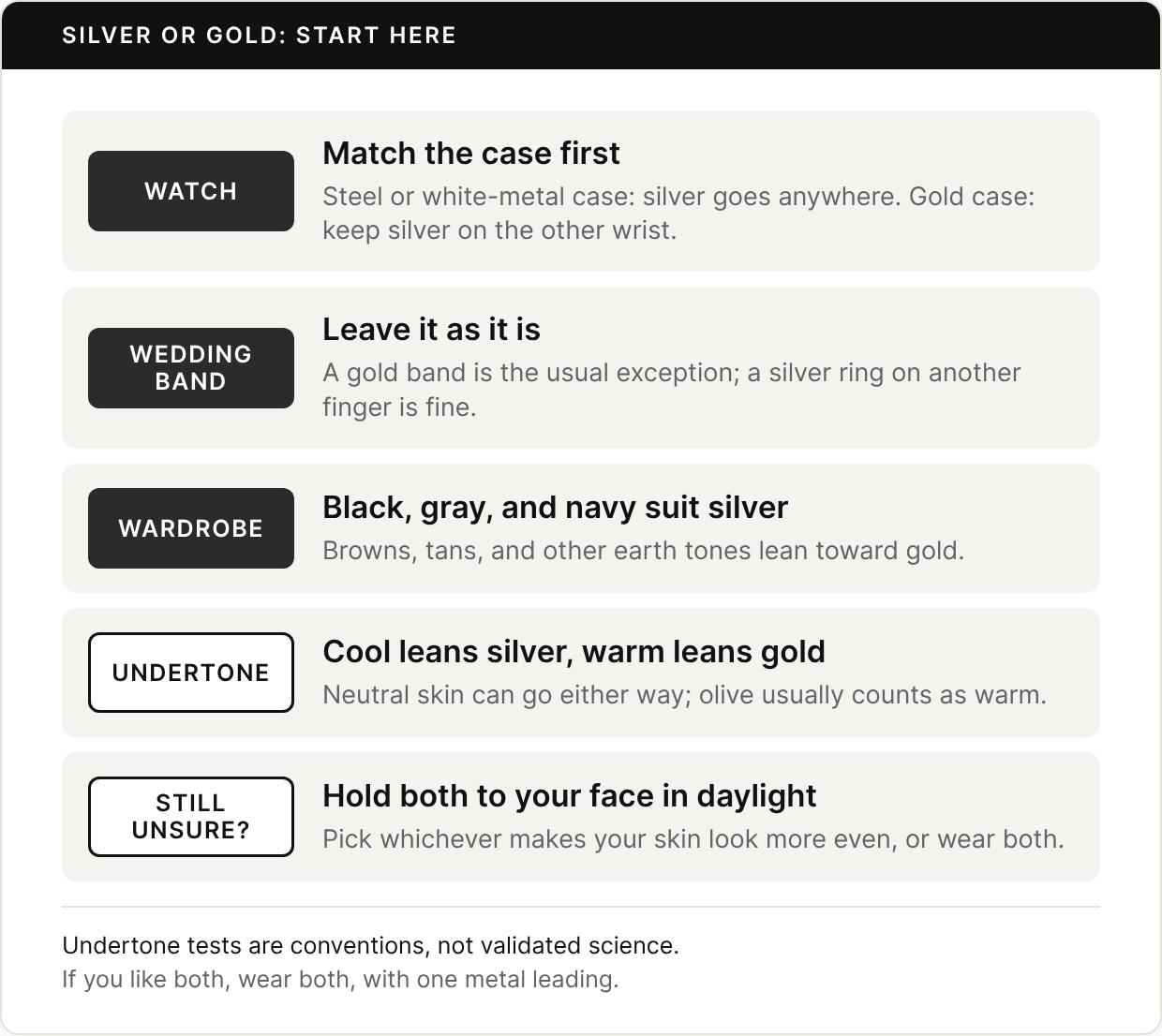
Many men can wear either, and the metal you already wear every day can matter as much as your skin. Start with your watch and your wedding band. If the choice is still open, the usual rule of thumb is that cool undertones lean silver, warm undertones lean gold, and neutral skin can go either way. The home tests for undertone are conventions rather than science, so treat them as hints and trust the mirror.
Key takeaways
- Your watch case and wedding band set the lead. Build around them first.
- The rule of thumb: cool undertones lean silver and warm lean gold; neutral skin can go either way, and olive usually counts as warm.
- Dermatology-practice guides describe undertone as separate from how light or dark you are, and say it doesn’t change with a tan.
- The vein, white-paper, and sun tests are rough guides; even Gentleman’s Gazette, which recommends two of them, says working out your undertone “is not hard science.”
- Your clothes count too: silver sits naturally with black, gray, and navy; gold with browns and earth tones.
In this guide Short answer Undertone Home tests Your coloring Beyond skin Wear both FAQ
The short answer: start with what you already wear
Undertone is the standard advice, and it is a reasonable place to start. “Generally, silver looks better on people with cool skin tones, and gold looks better on people with warm skin tones,” as The Modest Man puts it. But many of the writers who spell out the rule also hedge it. Working out your undertone “is not hard science,” writes Sven Raphael Schneider of Gentleman’s Gazette, and Blue Nile, a jewelry retailer, calls the undertone signs it lists, such as vein color and how easily you tan, “general indicators rather than strict rules.”
In practice, three things often decide before skin does: the case of the watch you wear every day, your wedding band, and the colors in your closet. Even Blue Nile says personal style, wardrobe, and design “can influence your metal choice just as much as skin undertone.” Silver also makes an easy default. Art of Manliness counts silver among the neutrals, alongside polished stainless steel and chrome, so it sits comfortably with most of what a man already owns.
What undertone means
Skin tone and undertone are different things. Tone is the surface color, “ranging from fair to deep,” as The DERM Center, a dermatology practice in Chattanooga, Tennessee, defines it. Undertone is the cast beneath it: cool (pink, red, or bluish) or warm (yellow, golden, or peachy), as makeup artist Jaleesa Jaikaran describes them to Makeup.com, or neutral, a mix of the two. Jaikaran adds that olive, a warm or neutral cast with a slight green shade, can be considered a fourth. Dermatology-practice guides treat undertone as separate from depth: it “has nothing to do with how pale or dark your skin tone is,” notes Western Dermatology Consultants, an Albuquerque practice, and it doesn’t change when you tan.
Skin science doesn’t use the word “undertone,” but it does show that skin color varies in more than lightness. Color comes from three pigments, melanin, hemoglobin, and carotene, as an open anatomy textbook explains. In a 2016 study that measured skin color in four groups (Caucasian, Chinese, Kurdish, and Thai), differences in lightness and yellowness came mostly from ethnicity, while redness varied mostly by body site, with the forehead the reddest and the inner arm the least red. The study didn’t look at undertone tests, but it is a reminder that the skin on your arm can read differently from your face.
Four home tests, and how far to trust them
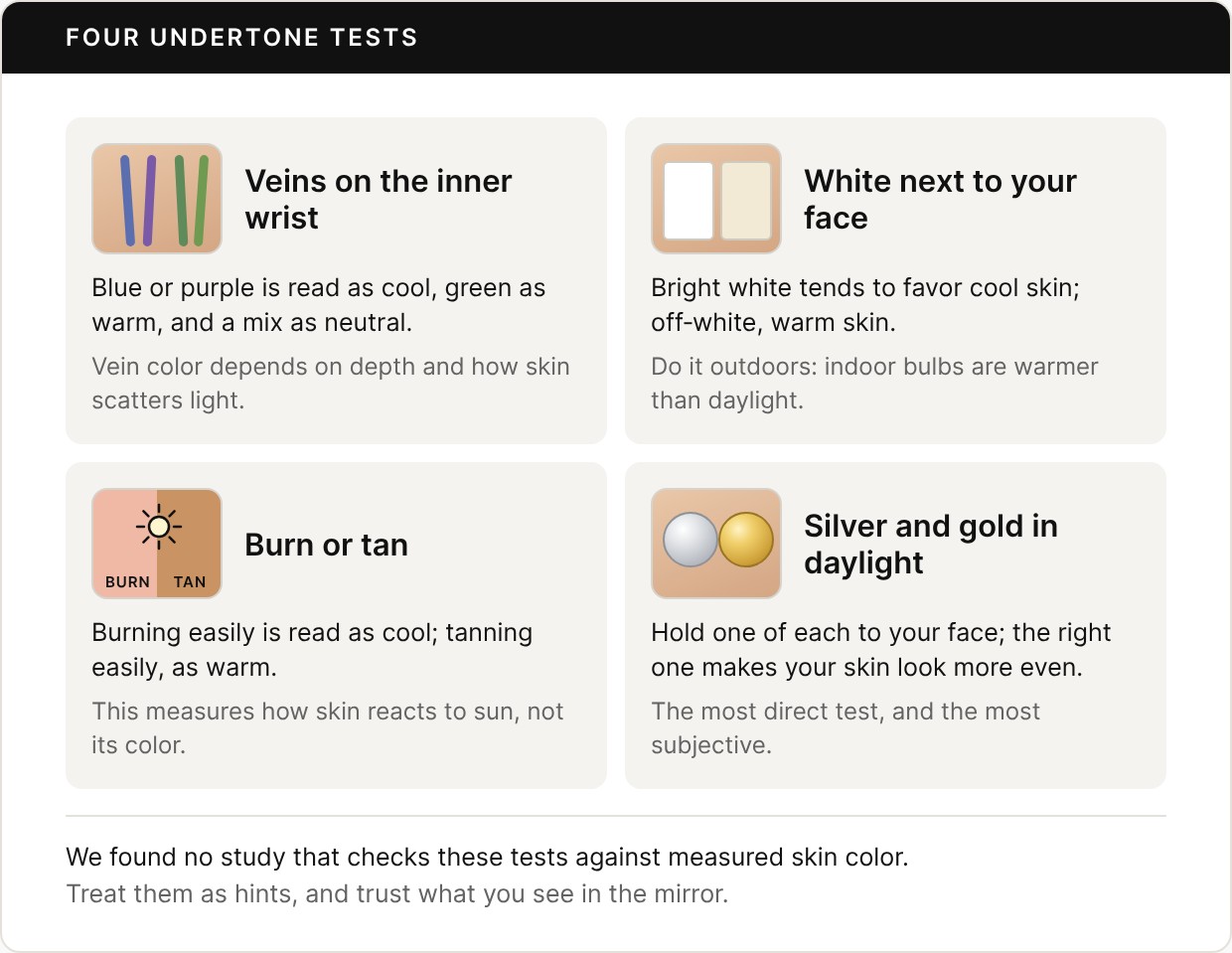
The vein test. Look at the veins on the inside of your wrist in natural light: blue or purple is read as cool, green as warm, and a mix as neutral. Real Men Real Style presents it without caveats, and so does Western Dermatology Consultants, but The DERM Center adds that it’s “not always foolproof.” There is a reason. Blood is dark red; veins look blue because of how skin scatters and absorbs light, the blood’s oxygen level, the vessel’s depth and size, and how the eye perceives color, as a 1996 paper in Applied Optics, “Why do veins appear blue?”, explains. The paper says nothing about undertone, so a vein’s color tells you about optics at least as much as about your skin.
The white test. Hold a sheet of white paper or a white T-shirt next to your face and look in a mirror. “True white tends to favor cooler undertones, while warm undertones may look better in off-white,” according to Healthline. Gentleman’s Gazette’s advice is to do it outside in daylight, because “most interior lamps are warmer.”
The sun test. If you burn and rarely tan, the convention says cool; if you tan easily, warm. Gentleman’s Gazette and Blue Nile both use it. But burning and tanning are how dermatologists sort skin into Fitzpatrick types, which estimate “UV reactivity rather than constitutive skin color,” as the American Academy of Ophthalmology’s EyeWiki puts it, and that sorting goes most wrong in darker skin. And since darker skin tends to tan rather than burn, the test labels most deep skin “warm,” whatever its undertone. It tells you how your skin handles sun, which is not the same as its color.
The metal test. Hold a silver piece and a gold piece to your face in daylight and compare them. Blue Nile’s version: “The right metal will make your complexion look more even and balanced.” It is the most subjective of the four and also the most direct, because it shows you the thing you are actually choosing. Real Men Real Style’s advice comes to the same: “try on pieces.”
We found no study that checks any of these tests against measured skin color, so take them as hints. If two of them disagree, believe the mirror.
What the rule of thumb says for your coloring
| Your coloring | The usual advice | Where sources differ |
|---|---|---|
| Cool undertone | The usual adviceSilver, white gold, or platinum | Where sources differLittle disagreement; silver is the safe pick |
| Warm undertone | The usual adviceGold | Where sources differA jewelry founder tells Man of Many that warmer skin can “pull off gold or silver” |
| Neutral undertone | The usual adviceEither, or both | Where sources differLittle disagreement |
| Olive skin | The usual adviceUsually gold, treated as warm | Where sources differSome class olive as neutral; one designer says it can wear almost any metal |
| Deep or dark skin | The usual adviceEither; mixed metals work well | Where sources differOne designer finds silver “can get a bit lost” in fine pieces and gold the strongest |
| Very fair skin | The usual adviceSilver, in one designer’s view | Where sources differThe same designer suggests 9K or 14K gold, or white gold, rather than 18K |
| Gray hair | The usual adviceSilver or white gold, in one jeweler’s advice | Where sources differWe found no men’s style source that sets a rule |
Deep skin is where one-line rules are least useful. Black men’s skin “spans an enormous range — from deep ebony to light brown, with cool, neutral, and warm undertones underneath,” as Real Men Real Style points out in a guide to clothing color, and the same logic applies to metal. Its guide to mixing metals adds that darker complexions “can usually pull off both.” Jewelry designer Charlotte Blakeney told Grazia that on darker skin “any metal will look striking,” though silver “can get a bit lost,” especially in fine jewelry, and gold “really comes into its own.” Her caveat was about fine, delicate pieces, so a bolder silver chain or ring is worth trying before you rule silver out.
For gray hair, the advice we found comes from one jeweler: Robinson’s Jewelers says silver and white gold “blend seamlessly” with it, and suggests rose gold for contrast. That is a retailer’s view, not a style rule; go by your undertone and your watch first.
What matters besides your skin
Your watch. It is the largest piece of metal on your wrist, and the rest usually follows its case. “The watch case should agree with your buckles, cufflinks, and rings,” says Real Men Real Style. Art of Manliness agrees, wanting your accessories “either gold or silver,” though shades within a metal “don’t have to match exactly.” Not everyone gives the watch the final word: Man of Many argues it “doesn’t need to dictate every other piece of metal on your body.” Our guide to wearing a bracelet with a watch covers the wrist itself.
Your wedding band. “The exception to issues of color matching are wedding bands and heirloom pieces,” as Art of Manliness puts it. A gold band can stay as it is; a silver ring on another finger sits fine with it, and wearing it on the other hand avoids scuffs, as our guide to mixing silver and gold explains.
Hardware. In a suit, keep the watch, cufflinks, tie bar, and belt buckle in one metal; with jeans and a T-shirt it matters far less. Our guides to a silver chain with a suit and a silver ring with a suit go further.
Your clothes. Silver goes with black, gray, and blue, and gold with browns, beiges, tans, and other earth tones, according to Art of Manliness. Man of Many draws the same line: if you prefer black, gray, navy, crisp white, and cooler colors, “silver is a pretty natural fit.”
Finish. “All golds aren’t the same, and all silvers aren’t the same,” stylist Christina Robert White tells Man of Many; for very soft coloring, she suggests a soft gold rather than a very yellow one. Silver varies the same way: bright polished silver, brushed silver, and oxidized silver with darkened recesses each look different on the same man, so if one silver washes you out, try another before you give up on the metal.
What you like. Healthline’s medically reviewed guide to undertones puts it plainly: “personal preference should always be the most important factor.”
Can’t decide? Wear both
Mixing is the usual answer for neutral and darker skin, and it works for anyone. Real Men Real Style’s rule is that “one should clearly lead,” and its tip when in doubt is “two pieces in one metal, one in the other.” Our guide to mixing silver and gold covers where each piece goes, and two-tone pieces, silver with gold accents, bridge the two, as our guide to two-tone silver pendants explains. As Man of Many puts it: “And if you like both? Wear both.”
Silver is also the cheaper way to experiment: a solid sterling ring or chain costs far less than the same piece in gold, as our guide to sterling silver vs. white gold shows.
FAQ
Does silver or gold look better on men?
Neither, as a rule. Silver tends to suit cool undertones and gold warm ones, but your watch, wedding band, and wardrobe often matter as much. Silver is the easier default, because it works as a neutral with most clothes.
How do I know if my skin is warm or cool?
Check the veins on your inner wrist in daylight (blue or purple suggests cool, green warm), hold white paper next to your face outdoors, and compare a silver and a gold piece against your skin. None is precise; if they disagree, believe the mirror.
Does silver look good on dark skin?
Yes. Deep skin comes in every undertone, so the same rule applies: cool undertones lean silver. One designer, speaking to Grazia, says any metal looks striking on darker skin but finds gold stands out most, and Real Men Real Style says darker complexions can usually wear both.
Is silver or gold better for olive skin?
Sources split. Most treat olive as warm and suggest gold; some call it neutral, and one designer says it can wear almost any metal. Compare both in daylight.
Can I wear silver with a gold watch?
Yes. Put the silver on the other wrist, or let it be the smaller share of what you wear; our mixed-metals guide has the details.
Should my jewelry match my wedding ring?
It doesn’t have to. Style guides treat the wedding band as the usual exception to matching metals.
What jewelry goes with gray hair?
One jeweler, Robinson’s, says silver and white gold “blend seamlessly” with gray hair, but we found no men’s style authority that sets a rule. Go by your undertone and your watch.
Is the vein test accurate?
Only roughly. Vein color depends on how light passes through skin, the blood’s oxygen level, and how deep the vein lies, which says little about undertone, and a dermatology practice calls the test “not always foolproof.” Use it alongside the other checks.
Bottom line
Start with what you already wear: your watch case and wedding band set the lead, and your wardrobe usually confirms it. If the choice is still open, cool undertones lean silver and warm undertones lean gold, neutral skin can go either way, and olive usually counts as warm. The home tests are rough guides, not science, so hold both metals to your face in daylight and trust what you see. And if you like both, wear both, with one leading.
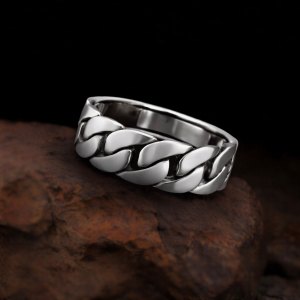
From the collection
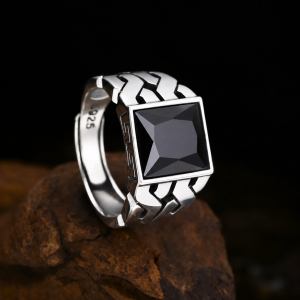
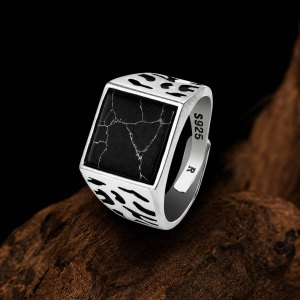
Men’s sterling silver rings by Ronatelli
Eleven handmade 925 rings, $129 to $169, from a chain-link band to a black onyx statement ring. Every one is adjustable.
Related guides
The undertone rule and its hedges follow The Modest Man, Gentleman’s Gazette, Blue Nile, and Real Men Real Style; definitions of tone and undertone follow The DERM Center, Western Dermatology Consultants, Healthline, and makeup artist Jaleesa Jaikaran in Makeup.com. Skin pigments follow Integrated Human Anatomy and Physiology (UEN Pressbooks); body-site color follows Xiao and colleagues in Skin Research and Technology (2016); vein color follows Kienle and colleagues in Applied Optics (1996); Fitzpatrick typing follows the American Academy of Ophthalmology’s EyeWiki. Coloring advice follows Real Men Real Style, Man of Many, Grazia, and Robinson’s Jewelers; watch, wedding band, and clothing advice follows Real Men Real Style, Art of Manliness, Man of Many, and Blue Nile. All were checked on October 31, 2026. Read our editorial policy.

