Sterling silver can get wet. Water won’t hurt it, and it can’t rust: rust is iron oxide, and sterling is silver and copper with no iron in it. But “waterproof” promises too much. Water left on silver speeds up tarnish, soap and hard water leave a dull film and spots, and chlorine and salt water speed tarnish far more than plain water does. The short version: wash your hands and shower in plain sterling if you dry it afterward, take it off for the pool, the hot tub, and the ocean, and keep plated pieces and porous stones as dry as you can.
Key takeaways
- Sterling can’t rust. Rust is iron oxide, and sterling contains no iron. What silver does instead is tarnish: a dark film of silver sulfide that polishes off.
- Water is harmless; water left on it isn’t. Moisture speeds tarnish, so dry silver whenever it gets wet, clasp and links included.
- The shower is fine for plain sterling. Soap film and hard-water spots dull it, but they wash and wipe off. Plated pieces should come off.
- Take it off for the pool and the hot tub. Chlorine speeds tarnish and can mark the surface, and a hot tub adds heat and a higher chemical minimum.
- Take it off for the ocean. Salt speeds tarnish, sand scratches, and cold water and waves make rings easy to lose and clasps easy to open.
In this guide Short answer Rust or tarnish Shower Pool and hot tub Ocean Keep these dry “Waterproof” After a swim FAQ
Can sterling silver get wet?
Yes. Water on its own doesn’t tarnish silver or eat into it. The trouble is what water carries and what it leaves behind. Silver tarnishes faster as the air gets more humid, according to the Canadian Conservation Institute, so a chain that stays damp inside its links darkens sooner than one that’s dried. Tap water carries minerals, the shower adds soap, and pools, hot tubs, and the sea add chlorine and salt, which, unlike plain water, react with silver.
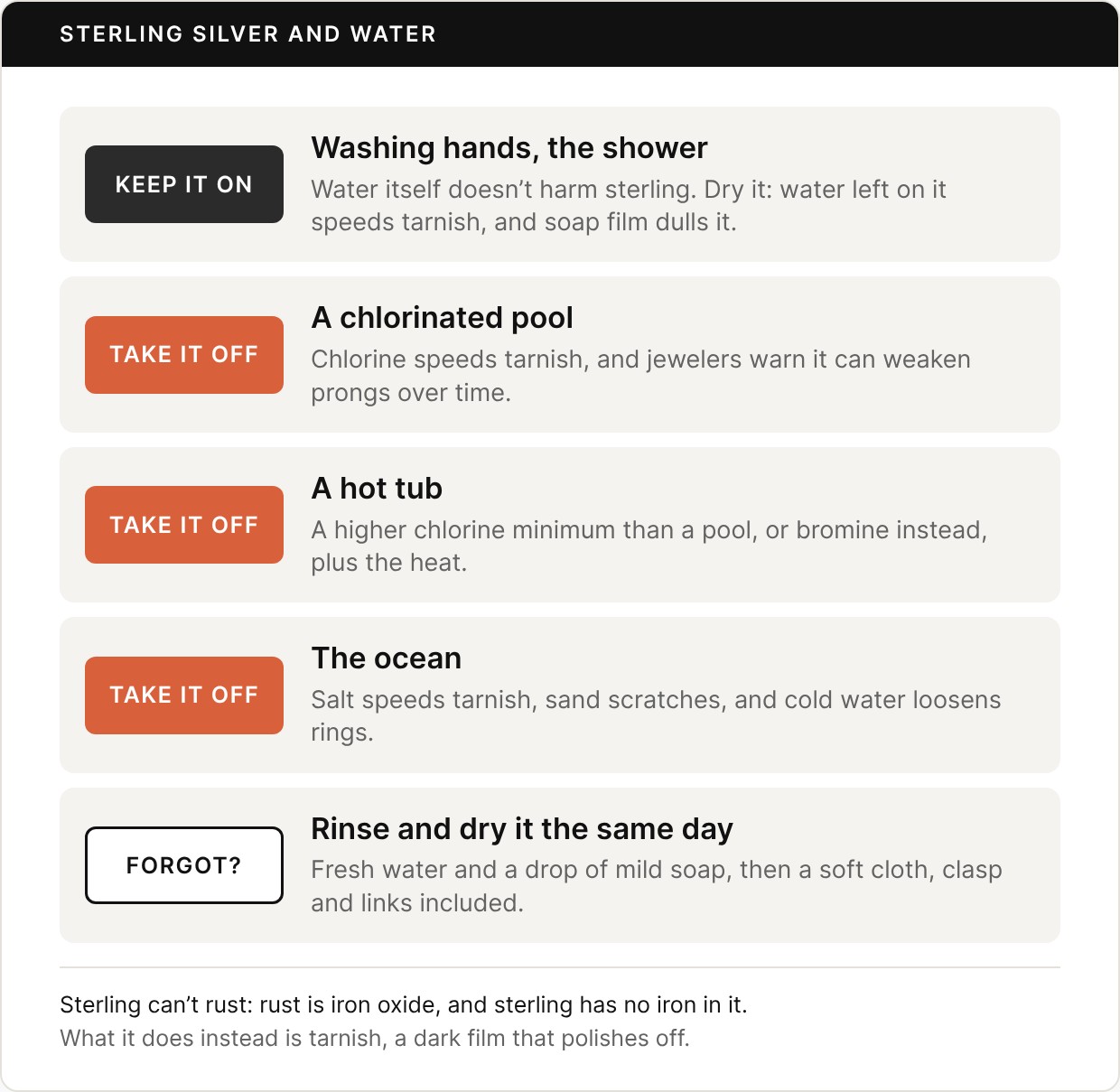
| Water | Keep it on? | What it does to sterling | Afterward |
|---|---|---|---|
| Washing your hands | Keep it on?Yes | What it does to sterlingSoap can leave a film, mostly inside links and the back of a ring. | AfterwardDry it, clasp and the back of the ring included. |
| Shower | Keep it on?Yes, if you dry it | What it does to sterlingShampoo and body wash leave residue; hard water leaves chalky spots. | AfterwardRinse the soap off and towel it dry, or take it off, which is less work. |
| Pool | Keep it on?No | What it does to sterlingChlorine speeds tarnish; jewelers warn it can weaken prongs over time. | AfterwardRinse in fresh water and dry; buff it if it has dulled. |
| Hot tub | Keep it on?No | What it does to sterlingA higher chlorine minimum than a pool (or bromine instead), in water up to 104°F (40°C). | AfterwardAs for the pool. |
| Ocean | Keep it on?No | What it does to sterlingSalt speeds tarnish, sand scratches the polish, cold water loosens rings. | AfterwardRinse in fresh water and dry it the same day. |
| Sulfur springs, “rotten egg” well water | Keep it on?No | What it does to sterlingHydrogen sulfide is the main gas that tarnishes silver. | AfterwardExpect it to darken; clean it as our cleaning guide shows. |
Our guides to wearing a silver chain, a silver bracelet, and a silver ring every day cover the rest of a normal day, from the gym to sleep. This guide is about water.
Does sterling silver rust?
No. Rust is a specific compound, the red-brown hydrated oxide that forms when iron meets oxygen and water, as the Chemistry LibreTexts textbook explains. Sterling silver is 92.5% silver, and the rest is almost always copper; neither is iron, so there is nothing in it that can rust. Orange rust on a “silver” piece usually means it isn’t sterling, has a steel part such as a clasp spring, or picked up rust from something else.
What silver does instead is tarnish. It reacts slowly with sulfur compounds in the air to form black silver sulfide, as the Royal Society of Chemistry puts it. Sterling tarnishes faster than pure silver because its copper is more reactive than silver, and its tarnish also contains copper sulfide, according to the Canadian Conservation Institute. The film starts yellow, turns red-brown and bluish as it thickens, and goes black once it passes about 100 nanometers, the institute says. It sits on the surface and polishes off; our guide to why sterling silver tarnishes covers it in full.
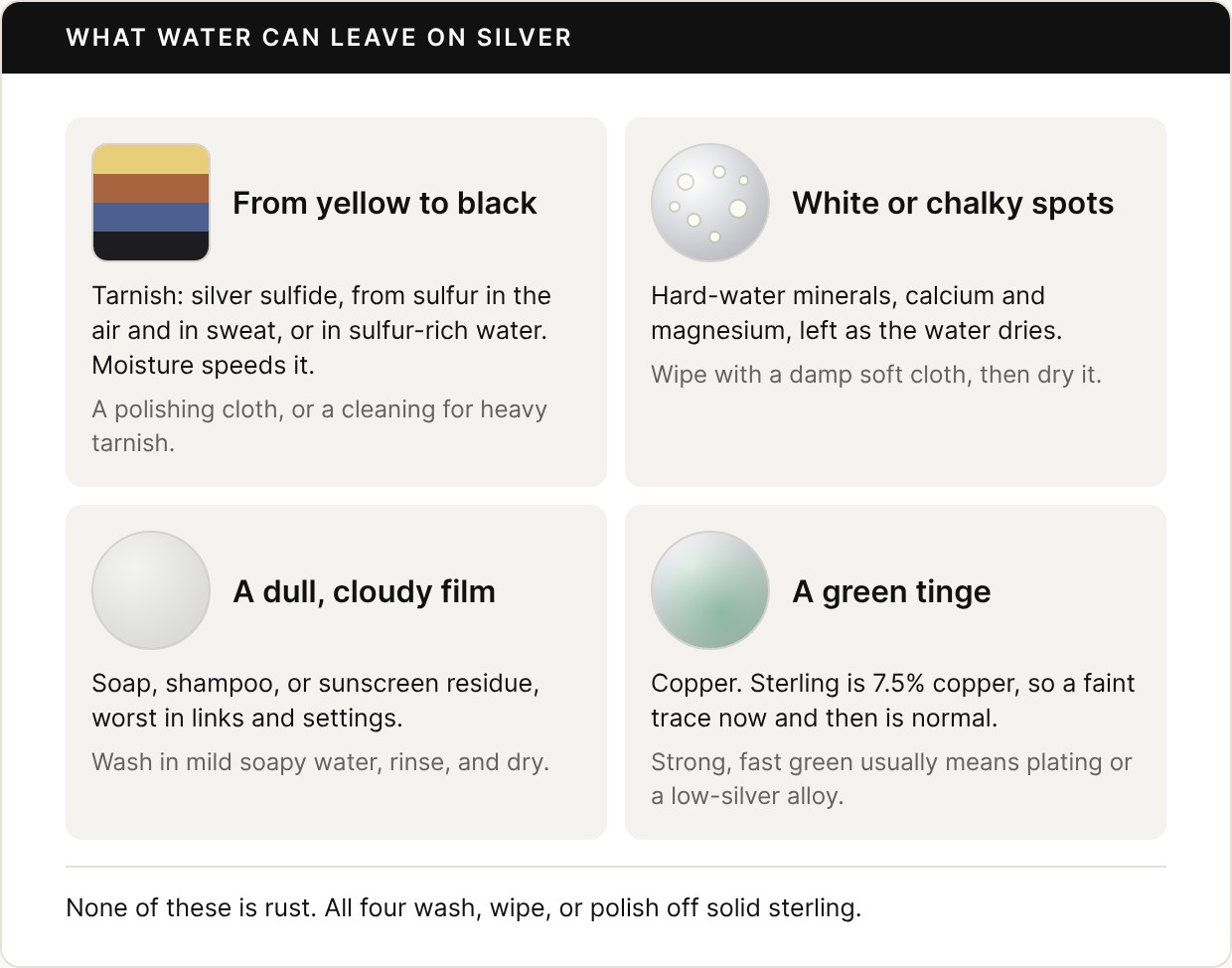
Green is the one color worth a second look. Sterling’s own copper can leave a faint green trace now and then, but a strong green that appears quickly usually points to plating worn through to brass or copper, or to a low-silver alloy, as our guide to green marks from silver explains.
Can you wear sterling silver in the shower?
Plain, solid sterling can stay on. The water itself doesn’t harm it; what dulls it is what comes with the water, and any left on it afterward. Shampoo, body wash, and soap can leave a residue on the metal, Blue Nile notes. Hard water is high in dissolved calcium and magnesium, which react with soap to form soap scum and leave spots and film on glassware, as the U.S. Geological Survey describes; on silver they dry to pale spots. Neither is damage: a wipe with a damp cloth or a wash in mild soapy water takes both off.
Some jewelers go further. Blue Nile advises taking silver off before you shower to keep its shine, and Jewelers Mutual lists bathing, and even hand washing, among the times to take silver off. That is the stricter, no-maintenance choice. If you keep it on, rinse the soap out of the links and dry the piece, the clasp and the back of a ring included, so it doesn’t stay damp.
Two exceptions. If your water smells of rotten eggs, it contains hydrogen sulfide, which can tarnish silverware, according to UMass Amherst, so take silver off in that shower. And take plated pieces off every time, for the reasons below.
Can you wear sterling silver in a pool or hot tub?
Take it off. The CDC recommends keeping at least 1 part per million of chlorine in a home pool and at least 3 in a hot tub, and those are minimums. For public hot tubs it gives at least 4 ppm of bromine as the alternative and caps the water at 104°F (40°C) (CDC).
Chlorine reacts with silver and speeds tarnish. Discussing chlorine-based hand sanitizers, a metallurgist at Stuller, the jewelry manufacturer, told JCK that free chlorine is very reactive and can tarnish jewelry, especially sterling; pool water is kept disinfected with free chlorine too. GIA advises taking fine jewelry off before a chlorinated pool, and Jewelers Mutual warns that pool and hot tub chlorine can be hard on some metals, adding to tarnish and, over time, weakening prongs. Retailers such as Blue Nile go further and warn that repeated exposure can leave permanent pitting. Be aware that the lab research we found on chlorine and prongs was done on gold alloys (Gold Bulletin, 2005), not on silver; for a stone-set silver ring, the practical advice is the same.
A hot tub is the harder case of the two. It runs a higher chemical minimum than a pool, and it’s hot: many chemical reactions roughly double in speed with every 10°C (18°F) rise, a general rule of thumb in chemistry (LibreTexts). We found no measurement of how much faster silver tarnishes in a hot tub, but every jeweler we read puts it on the take-it-off list.
Can you wear sterling silver in the ocean?
A swim won’t ruin solid sterling, but the sea is no place to wear it. Salt reacts with silver and speeds tarnish, and Blue Nile rates salt water as harshly as a pool. Sand is the second problem: pure silver is soft, about 2.5 to 3 on the Mohs scale, and sterling only somewhat harder (LibreTexts), while quartz, common in sand and in household dust, is 7 (Lang Antiques), so wet sand leaves fine scratches on a polished surface, as our guide to scratches explains.
The other risk is losing it. Cold makes fingers shrink and a ring loosen, Jewelers Mutual warns, and in the water you may not notice until it’s gone; our guide to a ring that’s loose in winter covers why. A chain whose clasp opens in the surf is just as gone. If a piece does go in, rinse it in fresh water and dry it the same day.
Pieces to keep dry
Everything above is about plain, solid sterling. These are stricter:
- Plated pieces. Plating is a thin surface layer. On gold-plated jewelry, friction and sweat wear it away over time and pool chlorine can react with the base metal underneath, according to Jewelers Mutual; rhodium and silver plating are thin layers too. Vermeil is thicker, at least 2.5 microns (about a ten-thousandth of an inch) of 10K-or-better gold over sterling under the FTC’s Jewelry Guides, but it is still a layer. Our guides to silver-filled and platinum-plated pieces cover the labels.
- Porous stones. Turquoise and lapis are porous and soak up oils and chemicals, and opal and malachite are soft, with water and chemicals able to crack or discolor them, according to Jewelers Mutual, which says never to soak porous gemstones; GIA allows cleaning turquoise with warm, soapy water. Wiping is fine; soaking and swimming are not.
- Glued stones and pearls. Opal doublets and triplets are layers held by glue that soaking can loosen, and a pearl strand should never be immersed, according to the International Gem Society. GIA says pearls can be damaged by many chemicals; our pearl necklace guide covers their care.
- Leather, cord, and stretch bracelets. The silver can take water; the leather, the cord, and the elastic don’t last as long if they keep getting wet. Our beaded bracelet guide covers stretch cord.
- Darkened finishes are fine in plain water. Silver dips, the foil bath, and pool chlorine are what strip an oxidized finish, as our guide to oxidized silver chains explains.
What “waterproof jewelry” means on a label
Nothing official. The FTC’s Jewelry Guides (16 CFR Part 23), the federal guidance on how jewelry may be described, never use the word “waterproof.” The nearest section covers rust and corrosion claims: it calls “rust proof” or “corrosion proof” deceptive unless every part of the product stays free of rust and corrosion for its whole expected life, and “rust resistant” or “corrosion resistant” deceptive unless no part suffers material corrosion damage for most of that life in normal use. Its examples of corrosion-resistant metals are pure nickel, gold of 10 karat or more, and austenitic stainless steel. Silver isn’t on that list. The FTC has also said it lacked the information to define “waterproof” even for watches (Federal Register, 1999).
In practice, jewelry sold as waterproof is usually stainless steel, or sometimes brass, with a PVD coating, according to Miltons Diamonds, a UK jeweler, which adds that the coating itself can wear through with time. If you want a chain or a ring you can swim in without thinking about it, our comparison of sterling, stainless steel, and titanium explains why steel or titanium is the better tool for that job. Silver is the better material for almost everything else.
What to do after a swim
- Rinse it in fresh water as soon as you can, to wash off chlorine or salt and any sand.
- Wash it if it was in a pool or met sunscreen. A drop of mild dish soap in warm water, a soft brush on the links, then rinse.
- Dry it completely with a soft cloth: the clasp, between the links, and inside the back of an open ring, where water hides.
- Buff off light tarnish with a polishing cloth. These cloths carry a mild abrasive and remove a little silver with the tarnish, the Canadian Conservation Institute notes, so use them when the piece needs it, not after every swim.
- Clean heavier tarnish properly. Our cleaning guide covers the soap-and-water and foil methods, and when to skip a dip. Keep stone-set pieces out of an ultrasonic cleaner.
- Check the prongs and the clasp on anything that spent a summer in pools. Jewelers Mutual suggests having a jeweler inspect the setting and clasp when in doubt.
Packing for a beach trip? Our guide to traveling with silver jewelry covers airport security and how to pack each piece in its own sealed bag.
FAQ
Can I shower with a sterling silver chain on every day?
Yes, if it’s solid sterling and you dry it, links and clasp included. Daily showers will dull it sooner with soap film and hard-water spots, so it will need a wipe or a wash now and then. Take plated chains off every time.
Is 925 sterling silver waterproof?
Water can’t damage it and it can’t rust, but it isn’t waterproof in the sense of unaffected: moisture speeds tarnish, and chlorine and salt water tarnish it faster. There is also no FTC definition of “waterproof” for jewelry.
Does sterling silver rust in water?
No. Rust is iron oxide, and sterling silver is silver and copper. It tarnishes instead, and the dark film polishes off. Orange rust on a “silver” piece usually means it isn’t sterling or has a steel part.
Can sterling silver go in the ocean?
One swim won’t ruin solid sterling, but salt speeds tarnish, sand scratches the polish, and cold water and waves make rings easy to lose and clasps easy to open. Leave it on the towel; if it does go in, rinse it in fresh water and dry it the same day.
What does chlorine do to sterling silver?
It speeds tarnish, and retailers such as Blue Nile warn that repeated exposure can pit the surface. Jewelers also warn that chlorine weakens prongs over time, though the research we found was done on gold. Take silver off for the pool and the hot tub; if you forget, rinse, dry, and buff it.
Can I wear a silver ring in a hot tub?
Better not. Hot tubs run a higher chlorine minimum than pools (or bromine instead), and the heat speeds chemical reactions. Take it off before you get in.
Why did my silver turn black after swimming?
Mostly tarnish from chlorine, salt, or sulfur, and it polishes off. Retailers such as Blue Nile also warn that repeated chlorine exposure can leave permanent pitting, which is one more reason to take silver off for the pool. A polishing cloth takes off light tarnish; our cleaning guide covers heavier tarnish. A green color instead points to copper, as described above.
Is stainless steel better than silver for swimming?
Yes. Austenitic stainless steel resists corrosion, and titanium doesn’t tarnish, so either is the better choice for a piece you want to swim in. Our metal comparison covers the trade-offs.
Bottom line
Sterling silver can get wet and can’t rust. Water itself does no harm; what it carries, and what it leaves behind, is the problem. Shower in plain sterling if you dry it afterward, take it off for pools, hot tubs, and the ocean, keep plated pieces and porous stones dry, and if a piece does go in, rinse it in fresh water and dry it the same day. A polishing cloth handles the rest.
From the collection
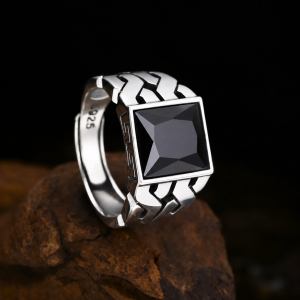
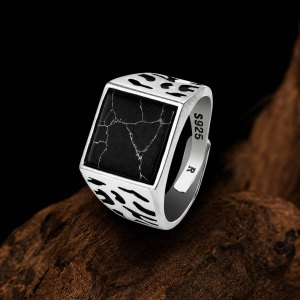
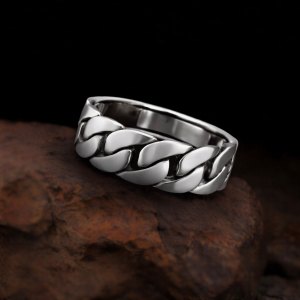
Men’s sterling silver rings by Ronatelli
Eleven handmade 925 rings, $129 to $169, from a chain-link band to a black onyx statement ring. Every one is adjustable.
Related guides
Rust, corrosion, and reaction rates follow Chemistry LibreTexts, and Mohs hardness follows LibreTexts Geosciences and Lang Antiques; tarnish chemistry follows the Royal Society of Chemistry and the Canadian Conservation Institute (“Understanding how silver objects tarnish” and CCI Notes 9/7). Hard water follows the USGS, and hydrogen sulfide in well water follows UMass Amherst. Pool and hot tub minimums follow the CDC’s home and public pool guidance. Chlorine and jewelry follow GIA’s care tips, JCK’s interview with Stuller metallurgist Shan Aithal (March 13, 2020), Jewelers Mutual, and Merriman, Bahr, and Norton in Gold Bulletin (2005); showers, salt water, and sand follow Blue Nile’s “Can Sterling Silver Get Wet?” and Jewelers Mutual. Plated pieces and stones follow Jewelers Mutual, GIA, and the International Gem Society. The FTC Jewelry Guides are 16 CFR Part 23; the FTC’s 1999 statement on “waterproof” watches is in the Federal Register, and waterproof-jewelry labels follow Miltons Diamonds. Read our editorial policy.

