Silver-filled is real silver on the outside and brass or copper underneath. A thick layer of silver, usually sterling, is bonded to a base-metal core by heat and pressure, and it makes up about a tenth or a twentieth of the piece’s weight. That puts it between sterling silver, which is 92.5% silver all the way through, and silver plate, a thin electroplated film. It is a fair material for beads, findings, and inexpensive pieces, as long as it is sold under its own name. What it isn’t is sterling, and a listing that calls it 925 without saying “filled” is misleading you.
Key takeaways
- A silver skin over brass. The layer is bonded on by heat and pressure and makes up roughly 5 to 10% of the weight.
- Not sterling. Sterling is 92.5% silver throughout; the same piece in silver-filled holds a tenth to a twentieth as much silver.
- Tougher than plating. The layer is far thicker than an electroplated coat, so it lasts longer, but it can still wear through.
- No federal grade. The FTC defines gold-filled but not silver-filled, and it expects a silver coating to be described as one.
- Read the listing. “Silver-filled,” “925/10,” or “1/20” means a layer; a bare “925” should mean solid sterling.
In this guide What it is Labels and rules Compared How it wears Skin Value How to spot it FAQ
What silver-filled is
Silver-filled starts as a core of brass or copper with a layer of silver bonded around it mechanically, by heat and pressure, rather than by electroplating. Artbeads, a US beading supplier, explains the usual notation: 925/10 means the layer is sterling silver and makes up one-tenth of the total weight, while 1/20 means one-twentieth, which Artbeads gives as the minimum for silver-filled material.
Not every maker uses sterling for the layer. Perles & Co, a European bead supplier, describes its silver-filled as fine silver bonded to a brass or copper base, again at one-tenth of the total weight. Either way, the silver is on the outside and the core is not silver.
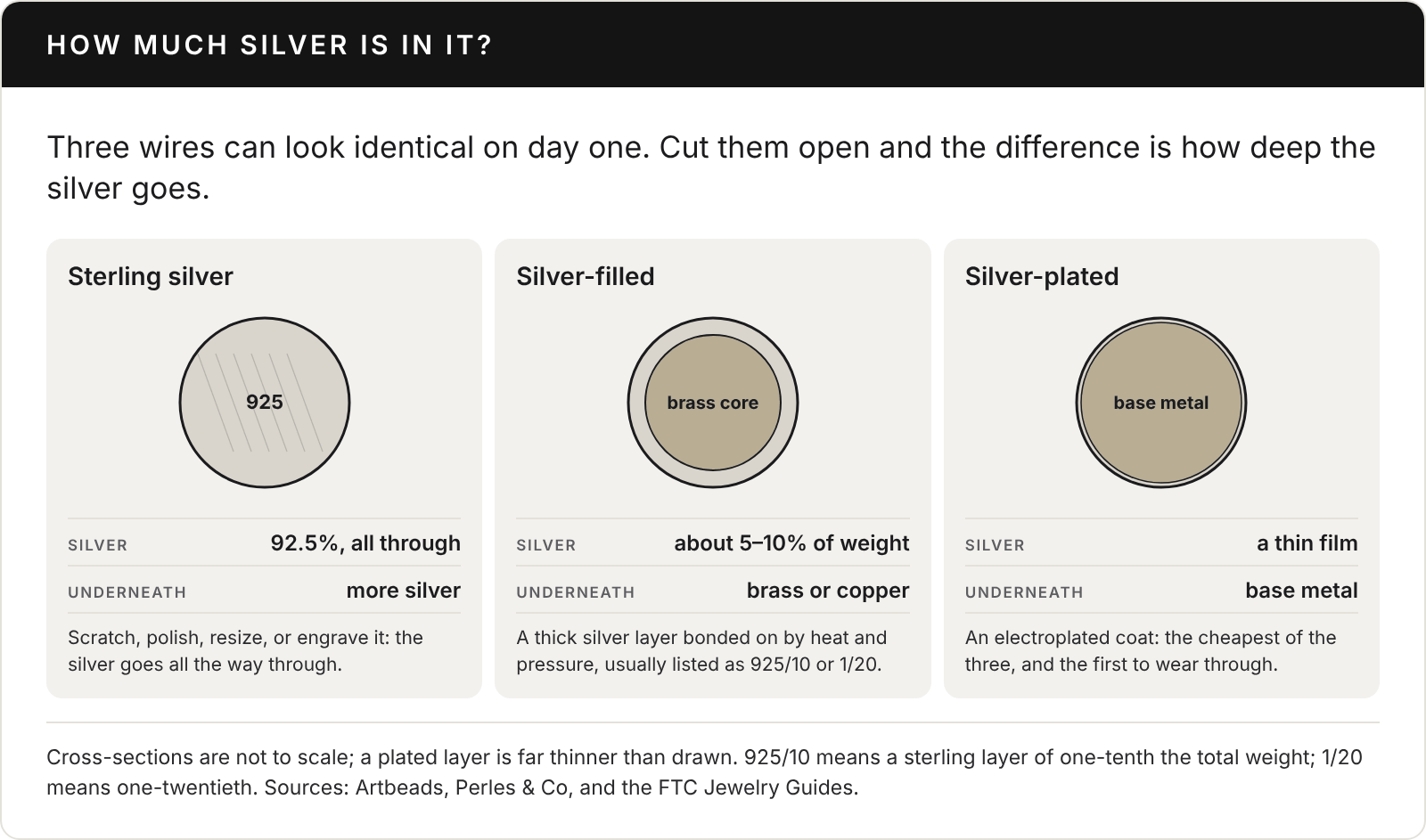
The math is simple. A 925/10 piece is about 9% silver by weight (one-tenth times 92.5%), and a 1/20 piece about 5%. Sterling is 92.5% silver throughout, as our guide to what 925 means explains, so the same chain in sterling holds roughly ten to twenty times as much silver.
What the labels mean, and what the rules say
In the US, the Federal Trade Commission’s Jewelry Guides set the terms. A product that “is not composed throughout of silver, but has a surface layer or coating of silver” shouldn’t be described as silver “unless the term is adequately qualified to indicate that the product or part is only coated.” “Sterling” is reserved for metal that is at least 925 parts per thousand silver, and “coin silver” for at least 900.
The Guides do define gold-filled: when the gold layer “constitutes at least 1/20th of the weight of the metal in the entire article, the term ‘Gold Filled’ may be used.” There is no matching definition for silver-filled, so 925/10 and 1/20 are trade conventions borrowed from gold-filled, not a federal grade. What the Guides do expect is the qualifier: a silver-filled chain should say it is filled or layered, not just “silver” or “925.”
| Label | What it means |
|---|---|
| 925 or Sterling | What it meansSterling silver: 92.5% silver all the way through |
| 925/10 silver-filled | What it meansA sterling layer that is one-tenth of the total weight, over brass or copper |
| 1/20 silver-filled | What it meansA silver layer that is one-twentieth of the total weight |
| Silver-plated | What it meansA thin electroplated coat over base metal |
| Silver-tone | What it meansSilver color only; it may contain no silver at all |
| Coin silver | What it meansSolid silver at least 90% pure |
Perles & Co lists silver-filled as carrying no hallmark. If you see a plain 925 stamp on a piece the listing calls silver-filled, treat the stamp as a red flag and ask the seller what is under the surface.
Silver-filled vs. sterling vs. plated
| Sterling silver | Silver-filled | Silver-plated | |
|---|---|---|---|
| Silver content | Sterling silver92.5% throughout | Silver-filledAbout 5–10% of the weight, on the surface | Silver-platedA thin surface film |
| How it’s made | Sterling silverSolid alloy | Silver-filledLayer bonded by heat and pressure | Silver-platedElectroplated |
| Underneath | Sterling silverMore silver | Silver-filledBrass or copper | Silver-platedBase metal |
| Wear | Sterling silverScratches show more silver | Silver-filledWears slowly; the core can show at rub points | Silver-platedWears through first |
| Repair and resizing | Sterling silverYes | Silver-filledLimited; filing or heavy work can expose the core | Silver-platedNot practical |
| Melt value | Sterling silverYes | Silver-filledSmall | Silver-platedNext to none |
| Stamp | Sterling silver925 or Sterling | Silver-filledUsually none; listed as 925/10 or 1/20 | Silver-platedUsually none |
The same three-way split runs through other labels. Our guides to platinum-plated sterling and German silver cover two more cases where the word on the label and the metal underneath don’t match.
How it wears
Silver-filled tarnishes like sterling, because the surface is silver; Artbeads notes that its silver-filled wire “will tarnish just like any other sterling silver” component. Clean it the way you clean sterling, gently: soap and water and a soft polishing cloth. Go easy on abrasive polishes. Every polish takes off a little metal, which costs a solid piece nothing that matters but slowly thins a layer.
The layer is much thicker than plating, which is why Perles & Co calls silver-filled more durable than silver plate, but it isn’t endless. Where a piece rubs, at a clasp, between chain links, or along the edge of a bead, the core can eventually show through, and Artbeads warns that hard hammering can reveal it. Resizing, filing, or heavy reshaping carries the same risk.
Skin and green marks
Day to day, your skin touches only silver, so an intact silver-filled piece behaves like sterling against the skin. Once the layer wears through at a rub point, the skin meets brass or copper instead, and copper is what leaves green marks, as our guide to silver and green fingers explains. If you have sensitive skin, our guide to whether sterling silver is hypoallergenic covers the metals involved.
Price and value
Silver-filled costs less because it uses a fraction of the silver. That is a fair trade for beads, findings, and pieces you won’t wear hard, and a poor one for a chain you wear every day or a ring you may need resized. It also holds little resale value: melt value follows silver content, which is small, as our guide to whether sterling silver is worth anything explains.
- Choose sterling for a daily chain or bracelet, a ring, a gift meant to last, and anything you may repair or resize.
- Silver-filled makes sense for beads, findings, and inexpensive fashion pieces, where cost matters more than resale.
- Plated is for occasional wear, on pieces you won’t mind replacing when the coat wears through.
How to spot silver-filled in a listing
- Read the whole description. “Silver-filled,” “SF,” “925/10,” “1/20,” “bonded,” and “layered” all describe a silver skin over a base-metal core.
- Watch for contradictions. “925 sterling silver-filled” is still filled, not sterling. If the title says sterling and the details say filled, the details win.
- Check the price against the weight. A heavy chain priced far below what that much sterling would cost is unlikely to be solid. Our guide to telling if silver is real covers the other checks.
- Ask before you buy. A good seller will tell you what the core is and how much of the weight the layer makes up.
At home, a magnet won’t tell them apart, since neither silver nor brass is magnetic. A jeweler can test the surface and, with a small file mark in a hidden spot, show whether the silver goes all the way through. That test removes metal, so leave it to them.
FAQ
Is silver-filled real silver?
The outer layer is real silver, usually sterling; the core is brass or copper. Silver makes up about 5 to 10% of the weight, so the piece as a whole is not sterling.
Does silver-filled tarnish?
Yes, the same way sterling does, because the surface is silver. Clean it with soap and water and a soft polishing cloth, and avoid abrasive polishes that thin the layer.
Will silver-filled turn my skin green?
Not while the silver layer is intact. Once it wears through at a rub point, the copper in the brass core can leave a green mark, as it does with any copper alloy.
Can silver-filled be stamped 925?
A bare 925 stamp tells a buyer the piece is sterling throughout, and under the FTC’s Jewelry Guides a coated product should be described as coated. Treat a plain 925 on a silver-filled piece as a red flag.
Is silver-filled better than silver-plated?
For durability, yes: the bonded layer is far thicker than an electroplated coat, so it takes much longer to wear through. It is still not as durable, repairable, or valuable as solid sterling.
How long does silver-filled last?
There is no fixed lifespan; it depends on the thickness of the layer and how hard the piece is worn. It outlasts plating, and pieces rubbed every day wear first at their contact points.
Bottom line
Silver-filled is honest material when it is sold under its own name: a thick silver layer over brass, about 5 to 10% silver by weight, more durable than plating and far cheaper than sterling. It is not sterling, though, and it won’t behave like sterling when you polish, resize, or sell it. For a chain or ring you’ll wear every day, buy solid 925; for beads, findings, and fashion pieces, silver-filled is a sensible way to spend less.


From the collection
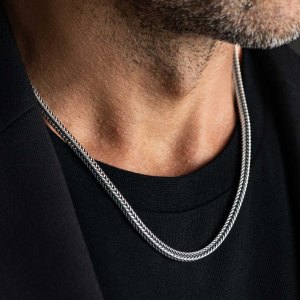
Men’s sterling silver chains by Ronatelli
Ten handmade 925 chains, from a 2 mm snake chain to a 7 mm curb, in 20 to 26 inches. Every length is the same price.
Related guides
Silver-filled construction and notation follow Artbeads and Perles & Co. The rules on coated silver, sterling, coin silver, and gold-filled follow the FTC’s Guides for the Jewelry, Precious Metals, and Pewter Industries as revised in 2018. Silver percentages are our arithmetic from the stated layer weights. Sources were checked on October 30, 2026. Read our editorial policy.

