No. German silver, also called nickel silver, contains no silver at all: it is an alloy of copper, nickel, and zinc that happens to look silvery. Sterling silver is 92.5% real silver. The difference shows up in four places: what a piece is worth, whether it carries nickel, a common skin allergen, how it wears, and how much it weighs. German silver is a respectable metal when it is sold under its own name, in costume jewelry, instrument parts, and as the base for silver-plated flatware. But a piece sold as “silver” should be sterling, and the stamp, a density check, and the fine print of a listing tell you which one you are looking at.
Key takeaways
- German silver has no silver in it. It is nickel silver, a copper, nickel, and zinc alloy, and the name describes the color, not the metal.
- Sterling is 92.5% silver. In the US, “sterling” and “solid silver” are reserved for metal that is at least 925 parts per thousand silver.
- It contains nickel. Anyone with a nickel allergy should avoid German silver against the skin; quality sterling is usually nickel-free.
- It weighs less. At about 8.75 g/cm³ against sterling’s 10.4, the same piece is roughly 16% lighter, a difference a simple density check at home can show.
- Other names, same story. Alpaca, “Tibetan silver,” silver-tone, and silver-plated all mean little or no silver; look for 925 or sterling.
In this guide What it is Side by side Other names Nickel and skin How to tell Is it worth anything? FAQ
What German silver is
German silver is the old name for nickel silver, “a range of alloys of copper, nickel, and zinc which are silvery in appearance but contain no silver,” as Britannica defines it. The recipe varies: copper makes up 52 to 80 percent, zinc 10 to 35, and nickel 5 to 35, according to CAMEO, the Museum of Fine Arts, Boston’s conservation materials database. Britannica names 18 percent nickel silver as the most widely used. One standard version, alloy C75200, often called 65-18 for its nominal copper and nickel content, is 63 to 66.5% copper and 16.5 to 19.5% nickel, with zinc making up the rest, according to the Copper Development Association. The nickel is what turns the copper white; Britannica notes that the color runs from nearly white in high-nickel alloys to a pale brassy yellow when the nickel is low.
Why “German”? The alloy came from China: paktong, smelted there from copper-nickel ores, was later improved with zinc and imported into Europe by the East India Company, Britannica explains. CAMEO dates the first German manufacture to 1770, with the process refined in 1823, and Britannica notes that the alloy “was known as German silver until 1914.” CAMEO lists a string of other names for the same family: Neusilber and argentan in German, Alpacca, and white copper.
It is a useful metal in its own right. The Copper Development Association lists costume jewelry, musical instrument parts, zippers, flatware, and hollowware among the uses of the 65-18 grade, and a base for silver plate. That last use is where the mark EPNS comes from: electroplated nickel silver, a nickel silver piece with a thin coat of real silver on the surface, as CAMEO notes.
German silver vs. sterling silver, side by side
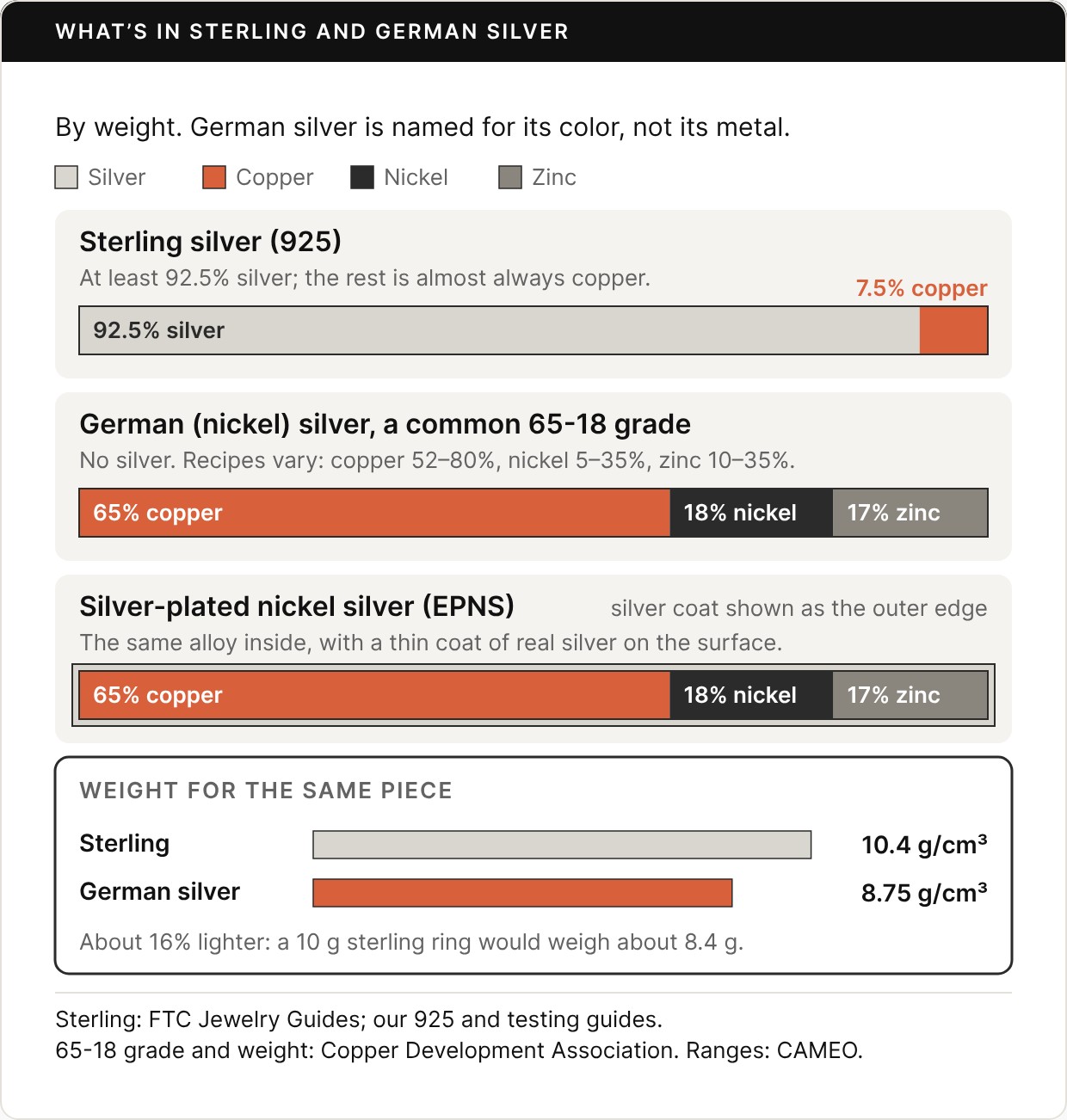
Sterling is silver first: 92.5% pure silver, with the remaining 7.5% made up of other metals, almost always copper, as our guide to what 925 means explains. German silver is copper first. Everything else follows from that.
| Compare | Sterling silver | German (nickel) silver |
|---|---|---|
| What it is | Sterling silverSilver alloyed with a little copper | German (nickel) silverCopper alloyed with nickel and zinc |
| Silver content | Sterling silver92.5% | German (nickel) silverNone |
| Nickel | Sterling silverUsually none in quality sterling | German (nickel) silver5 to 35 percent; about 18 in the common 65-18 grade |
| Weight | Sterling silverAbout 10.4 g/cm³ | German (nickel) silverAbout 8.75 g/cm³, so roughly 16% lighter for the same piece |
| Color | Sterling silverSilvery white | German (nickel) silverSilvery white (more nickel) to pale brassy yellow (less nickel) |
| Tarnish | Sterling silverDarkens to gray and black; polishes back | German (nickel) silverTarnishes too, though slowly |
| Marks | Sterling silver925, .925, Sterling, Ster. | German (nickel) silverNo 925 or sterling mark; EPNS when it is silver-plated |
| Metal value | Sterling silverFollows the silver price | German (nickel) silverNo precious-metal value |
Two rows matter most for jewelry. The first is value: the silver in sterling is worth something on any given day, which is why its metal value is a floor under the price of a sterling piece, as our guide to what sterling silver is worth explains, and German silver has no such floor. The second is nickel, covered below.
Tarnish is not the giveaway many people expect. Nickel silver resists corrosion better than brass but still tarnishes “slowly through the action of sulfur in the air,” Britannica notes, and sterling tarnishes too, for reasons our tarnish guide explains. A piece that darkens is not proof of either metal.
Alpaca, Tibetan silver, and other “silver” that isn’t
German silver is not the only name that borrows the word. Listings use a handful of terms that sound like silver and contain little or none of it.
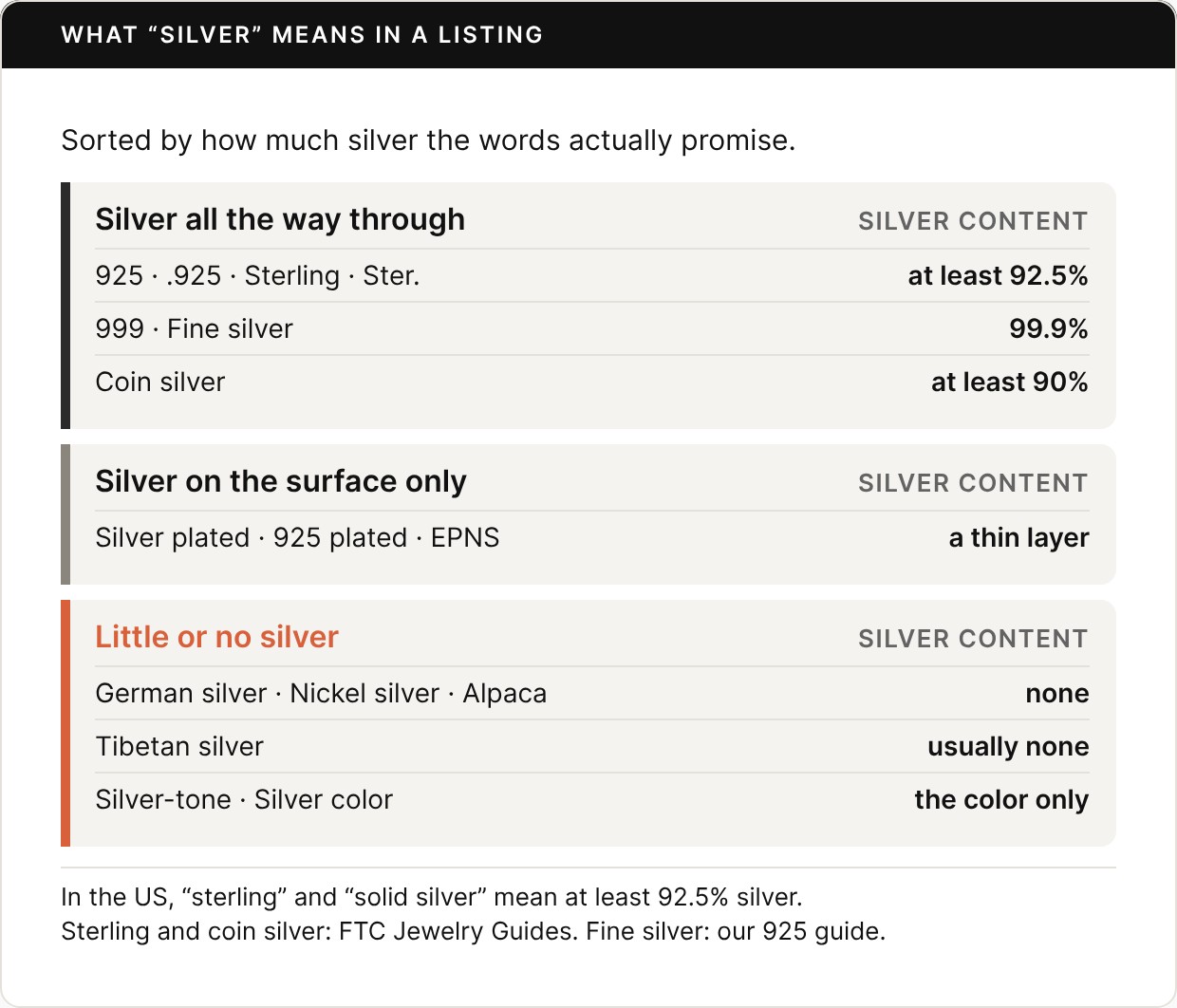
- Nickel silver, alpaca, or alpacca. The same copper, nickel, and zinc family as German silver; CAMEO lists Alpacca among its names.
- “Tibetan silver.” A loose label, not a standard. Historically it did contain silver, and some old pieces may be mostly silver, but in modern usage it covers a variety of white non-precious alloys, such as copper-tin, copper-nickel, and zinc alloys, used mainly for jewelry components, according to Wikipedia, which cites an X-ray fluorescence analysis in which six of seven items bought online as Tibetan silver were mainly copper, nickel, and zinc.
- Silver-plated, 925 plated, or EPNS. A base metal under a thin layer of silver; the 925 in “925 plated” refers to the coating, not the piece, as our silver testing guide explains.
- Silver-tone or silver color. A description of the color, not the metal.
US rules back the plain reading. Under the FTC’s Jewelry Guides, it is deceptive “to misrepresent that an industry product contains silver,” and the words “solid silver,” “Sterling Silver,” “Sterling,” and “Ster.” may be used only for metal that is “at least 925/1,000ths pure silver.” A plated piece may be called silver only if the term is adequately qualified to show that it is only coated. Our guide to 925 marks covers the stamping rules in more detail.
Nickel, skin, and green fingers
For many men, nickel is the deciding difference. A nickel allergy is “usually related to earrings and other jewelry,” according to the Mayo Clinic, and a reaction “usually begins within a couple of days after contact.” More than 18% of people in North America are allergic to nickel, according to the American Academy of Dermatology, as our guide to green fingers and skin reactions notes. German silver can be a third nickel by weight, so it is a poor choice for anyone who reacts. The Mayo Clinic lists sterling silver among the metals to look for instead.
Copper is the other half of the story. Sterling’s 7.5% is usually copper, so it can leave a faint green mark now and then; a strong, fast green points to a copper-based metal, as the same guide explains. German silver is mostly copper.
Sterling is not automatically nickel-free, though. Nothing in the 925 standard specifies what the other 7.5% must be, and some low-cost alloys use nickel or zinc in the mix, as our 925 guide notes. If you react to a ring stamped 925, that guide and our skin reaction guide explain what to check.
How to tell German silver from sterling
Polished and new, the two can look alike. These checks, most of them from our guide to telling if silver is real, separate them, and all but a jeweler’s acid test leave the piece unmarked.
- Read the stamp. Sterling is usually stamped 925, .925, Sterling, or Ster., and US law requires a maker’s trademark next to that stamp. EPNS means plated nickel silver. No mark at all on a piece sold as silver is a warning.
- Read the listing’s specifications. “Silver” in the title with “nickel silver,” “German silver,” “alpaca,” or “silver-tone” in the details means the piece is not sterling, and “alloy” or “metal” alone in the specifications is a warning sign.
- Check its density. The same ring is roughly 16% lighter in German silver, but typical sterling weights vary by more than that, so a scale alone won’t always catch a solid piece. The water test in our testing guide will: weigh the piece dry, then hanging in a glass of water, and divide. Sterling comes out near 10.4, the 65-18 grade near 8.75.
- Check the price. A heavy “silver” chain priced below the value of the silver it would contain is not sterling; our melt value guide shows the math.
- Ask a jeweler to test it. An acid test or an XRF scan settles it, often for a small fee or free, as our testing guide explains.
Skip the home tests that circulate online. Bleach darkens other metals too and can pit the surface, and biting proves nothing, as our testing guide’s list of tests to skip explains.
Is German silver worth anything?
Not as precious metal. With no silver in it, German silver has no precious-metal melt value, and silver-plated nickel silver carries only a thin layer of silver, so neither is bought by the gram the way sterling is. Our guide to sterling’s melt value puts German silver and plate on its list of pieces that aren’t worth melt value.
That doesn’t make it worthless as an object. A well-made German silver buckle, a vintage instrument, or a set of plated flatware is priced on its design, condition, and maker, not its metal. The problem is only a piece sold as silver, at a silver price, that isn’t. For a ring or chain you will wear every day and want to keep, sterling is the metal to pay for; our ring buying guide covers what else to check.
FAQ
Is German silver real silver?
No. German silver is another name for nickel silver, an alloy of copper, nickel, and zinc that contains no silver. The name refers to its silvery color.
Is nickel silver the same as sterling silver?
No. Sterling is 92.5% silver, usually with copper. Nickel silver is mostly copper, with nickel and zinc, and no silver. It is lighter, contains nickel, and has no precious-metal value.
Is German silver worth anything?
Not as precious metal: it contains no silver, so it has no precious-metal melt value. A piece can still have value for its design, age, or maker, but not for its silver.
Does German silver tarnish?
Yes, slowly. Nickel silver resists corrosion better than brass but still tarnishes from sulfur in the air, according to Britannica. Sterling tarnishes too, so tarnish alone doesn’t tell the two apart.
Can I wear German silver if I’m allergic to nickel?
It isn’t a good idea. German silver contains nickel, often around 18 percent and up to about a third, and jewelry is the usual source of nickel reactions, according to the Mayo Clinic. Quality sterling is usually nickel-free.
What is alpaca silver?
Another name for nickel silver, the same copper, nickel, and zinc alloy as German silver; CAMEO lists Alpacca among its names. It contains no silver.
Is Tibetan silver real silver?
Usually not. It is a loose label, not a standard. Older pieces may contain real silver, but modern “Tibetan silver” is generally a white base-metal alloy used for jewelry components.
What does EPNS mean?
Electroplated nickel silver: a piece made of nickel silver with a thin layer of real silver on the surface. You will see it most often on flatware and tableware.
Bottom line
German silver is nickel silver: copper, nickel, and zinc, with no silver in it. It is a fine metal for costume jewelry and instrument parts when it is sold under its own name and priced like one. For a ring or chain sold as silver, look for 925 or sterling, check the density, and steer clear of “German,” “nickel,” “alpaca,” “Tibetan,” and “silver-tone” if what you want is the real thing, or if your skin reacts to nickel.
From the collection
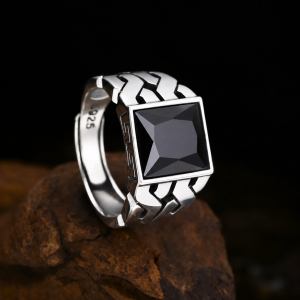
Men’s sterling silver rings by Ronatelli
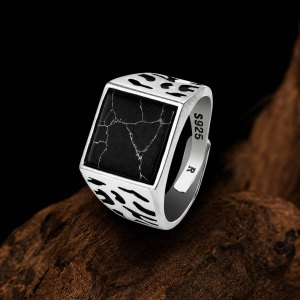
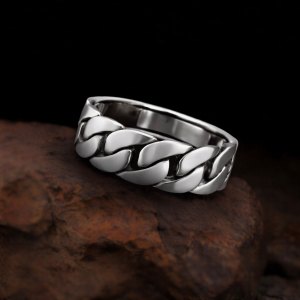
Eleven handmade 925 rings, $129 to $169, from a chain-link band to a black onyx statement ring. Every one is adjustable.
Related guides
Nickel silver’s definition, history, color, and tarnish follow Britannica’s entry on nickel silver; composition ranges, other names, and the date of German manufacture follow CAMEO, the Museum of Fine Arts, Boston’s materials database; alloy C75200, its specific gravity, and its uses follow the Copper Development Association. US marking rules are the FTC’s Guides for the Jewelry, Precious Metals, and Pewter Industries, 16 CFR 23.5. Nickel allergy follows the Mayo Clinic and, via our skin reaction guide, the American Academy of Dermatology. “Tibetan silver” follows Wikipedia’s article and the tests it summarizes. Sterling’s composition, density, marks, and tests follow our own 925, testing, tarnish, skin reaction, and melt value guides. Read our editorial policy.

