A turquoise ring or cuff in sterling silver is easy to wear and easy to get wrong when you buy it. Only about 15% of the world’s turquoise supply is natural, by the estimate of the US Indian Arts and Crafts Board. Most of the rest is treated so it can be cut and worn, some of it is chips bonded with epoxy, and some “turquoise” is a different mineral dyed blue. None of that is a problem if the label is honest and the price matches. Here is what each term means, what you can and can’t check yourself, what sets the value, and how to wear and clean a stone that is soft and porous.
Key takeaways
- Ask whether turquoise is natural, not whether it is real. Stabilized and other treated turquoise is still turquoise; dyed howlite and dyed magnesite are not.
- “Block” turquoise is chips bonded with epoxy, and the word is sometimes used loosely for dyed imitations. Ask what the chips are.
- You can’t reliably tell at home, and home tests can damage treated stones. Get the answer in writing.
- The trade prizes an even medium blue, GIA says; the Indian Arts and Crafts Board says natural blue and green are equally valuable. Quality matters more than the mine, according to GIA.
- Turquoise rates 5 to 6 on the Mohs scale and is porous. Put it on after lotion and cologne, and take it off for hard work.
- Clean it with a damp cloth and warm, soapy water. No dip, foil bath, steam, or ultrasonic cleaner.
In this guide The labels How to tell Value Styles Everyday wear Care Native American work FAQ
Natural, stabilized, block, or imitation: what the label means
The Indian Arts and Crafts Board (IACB), part of the US Department of the Interior, puts the buyer’s question this way in its turquoise brochure: “Most consumers will ask if the turquoise is ‘real,’ but the question to ask is if it is ‘natural’ turquoise.” Natural turquoise, it says, is “the stone that comes directly from the earth without any treatments or enhancements.” The brochure estimates that about 15% of the world’s turquoise supply is natural, and that about 85% of turquoise is too soft to cut or polish when it comes out of the ground. That softer material can still be used once it has been treated.
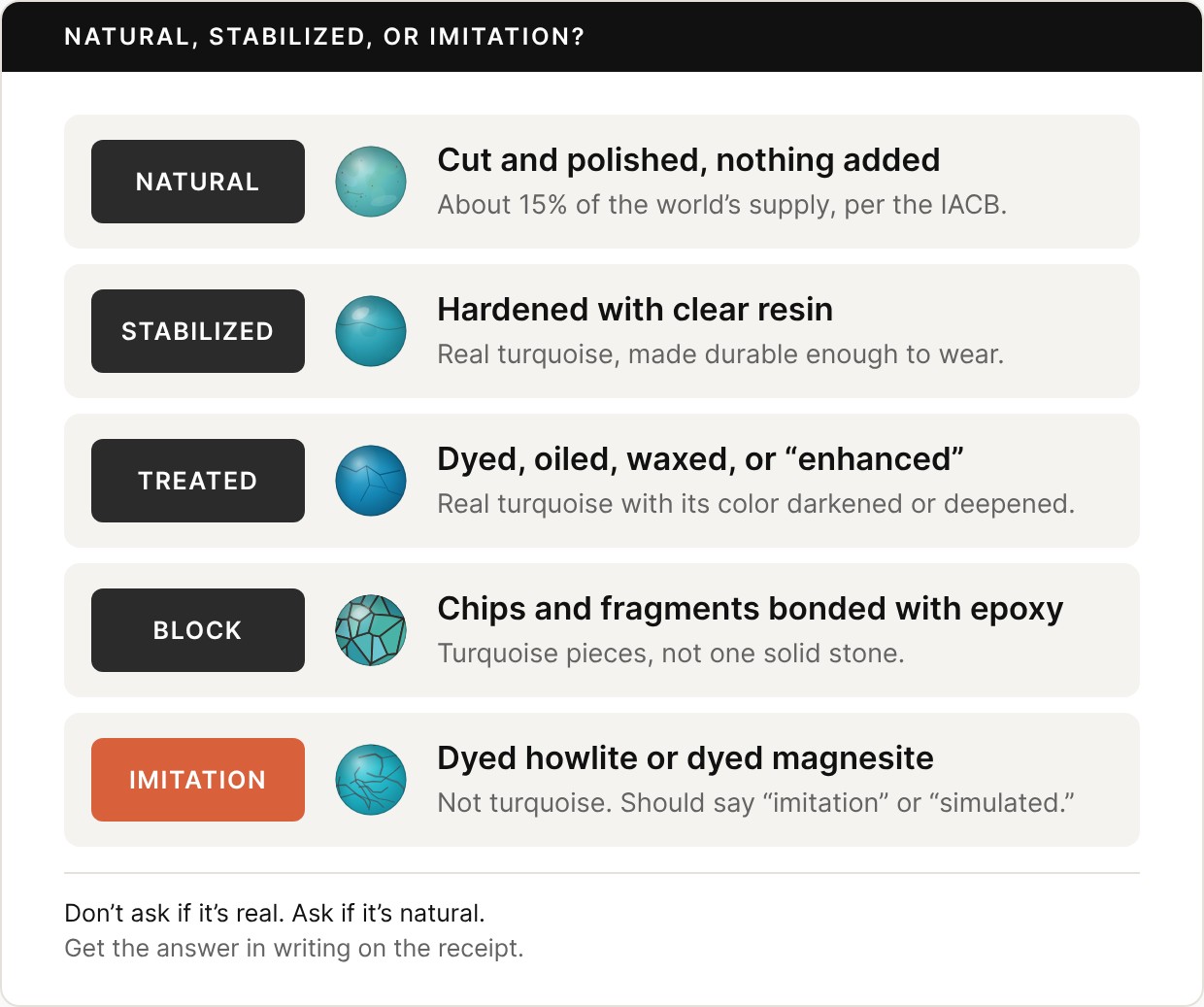
The IACB counts stabilized, blocked, dyed, oiled or waxed, and enhanced turquoise as treated. Here is what each label means:
| Label | What it is | What it means for you |
|---|---|---|
| Natural | What it isMined, cut, and polished, with nothing added | What it means for youThe rarest kind. Porous, so it can absorb oils and change color as it’s worn |
| Stabilized | What it isCombined with colorless resin (plastic) under vacuum or pressure, which hardens the stone and darkens its color | What it means for youReal turquoise, made durable enough to wear. Fine natural stone is worth more |
| Oiled or waxed | What it isSoaked or cooked in oil or wax to darken the color | What it means for youReal turquoise. Heat and solvents can damage treated surfaces, GIA warns |
| Enhanced | What it isA patented process that darkens low- or medium-grade turquoise to imitate a higher grade | What it means for youReal turquoise, made to look like a better grade |
| Dyed | What it isPigment added to deepen the color or to create a “matrix” pattern | What it means for youReal turquoise if the stone underneath is turquoise |
| Block | What it isChips and fragments mixed with epoxy to form blocks for cutting | What it means for youMade from turquoise pieces, not one stone. It may be sold under another name |
| Imitation | What it isA different material made to look like turquoise, such as dyed howlite or dyed magnesite | What it means for youNot turquoise. It should be labeled “imitation” or “simulated” |
One treatment is harder to pin down. In 1999, GIA’s journal Gems & Gemology described the Zachery treatment, a proprietary process that had already been applied to “millions of carats” of turquoise. It doesn’t impregnate the stone with a polymer, it helps the stone take a better polish, and it “decreases the material’s porosity, limiting its tendency to absorb discoloring agents such as skin oils.” Its gemological properties are similar to those of untreated natural turquoise, so standard gem tests don’t reveal it: “Most Zachery-treated turquoise can be identified only through chemical analysis.”
Block material isn’t always sold under that name. In 2010, a study in Gems & Gemology by Gagan Choudhary of the Gem Testing Laboratory in Jaipur, India, examined purple to purple-pink, yellow-green, and blue stones that had been marketed as dyed and/or stabilized turquoise. Testing showed that every one was a composite “of turquoise pieces bonded together” with polymer, and the author noted that these composites were “typically marketed as ‘stabilized’ turquoise.” The confusion runs the other way too: Skyjems, a gem dealer, notes that “block turquoise” is used in the trade for dyed howlite and magnesite as well as bonded turquoise powder, so ask what the chips are. The FTC’s Jewelry Guides say that products made with gemstone material and “any amount of filler or binder” shouldn’t be described by the stone’s name alone or as “treated” turquoise, and that a term such as “composite” needs a clear note that the product doesn’t have the same characteristics as the stone and requires special care.
Imitations are a different material altogether. Howlite, a white mineral, “is frequently dyed blue to resemble turquoise, and it makes a most convincing simulant,” according to the International Gem Society, which rates it 3 to 3.5 on the Mohs scale, softer than turquoise. GIA’s lab has also reported dyed magnesite as a turquoise simulant. Under the same FTC guides, using a stone’s name without qualification for something that “is not in fact a mined stone of the type described” is unfair or deceptive, and an imitation should carry the word “imitation” or “simulated” in front of the stone’s name. The guides add that “faux” isn’t an adequate disclosure.
Can you tell if turquoise is natural at home?
Not reliably. Telling natural from treated or imitation turquoise is lab work. A 1983 Gems & Gemology study proposed infrared spectroscopy and X-ray powder diffraction to separate natural, treated, synthetic, and imitation turquoise, and Zachery-treated stones usually need chemical analysis.
Home tests can do more harm than good. GIA’s turquoise care guide warns that “heat or solvents can damage the treated surfaces,” which is reason enough to skip the hot-needle test. An acetone swab can also miss the dye it’s meant to find: in the 2010 study, a swab rubbed on a dyed composite took off no color, while a 48-hour soak in acetone left a piece of the same stone patchy, dull, and cracked.
What you can do is look for warning signs, then ask:
- Colors turquoise doesn’t come in. Purple or pink is a giveaway: in the 2010 study, the purple to purple-pink range was “not associated with turquoise” and indicated artificial coloring. Green and yellow-green occur naturally, so they aren’t a warning sign on their own.
- Gold veins that look too bright. Natural matrix is “a remnant of its surrounding rock,” as GIA puts it, and it can contain grains of pyrite. The veins in the 2010 composites were different: gold-colored polymer that looked “much brighter than that seen in natural turquoise.”
- A price that seems too good. The IACB’s advice: “if a price seems too good to be true, be sure to ask more questions about the item and its maker.”
- A listing that doesn’t say. Under the FTC’s guide on treatments, a seller should disclose a treatment that isn’t permanent, creates special care requirements, or has a significant effect on the stone’s value. When you can buy without seeing the piece, as online, that disclosure belongs in the product description.
Then get it in writing. The IACB recommends a written receipt that states whether the turquoise is natural, stabilized, or treated; the mine it came from; the artist’s name and tribal affiliation; where you bought it; the price; the date; and the seller’s business address. For an expensive piece, an identification report from a gemological laboratory can usually settle the question.
Check the metal too. Look for a 925 or “sterling” stamp. “Nickel silver” and “German silver” contain no silver at all, as our guide to German silver explains, and our guide to telling if silver is real covers the other checks.
Blue, green, or spiderweb: what sets the value
According to GIA, turquoise is typically judged on three quality factors: color, texture, and whether matrix, the veins of host rock, is present. GIA and the IACB don’t fully agree on what’s best, which is worth knowing before anyone tells you one look is the valuable one.
| Factor | GIA | IACB |
|---|---|---|
| Color | GIAThe most-prized color is an even, intense medium blue, called robin’s egg or sky blue in the trade. Green to greenish blue is generally less desirable, but it depends on personal preference | IACBNatural blue and green are the most sought after, and “neither of these two colors is more valuable than the other” |
| Matrix | GIAThe most valuable turquoise has no matrix, but some collectors prefer spiderweb patterns, and black matrix is usually preferred for contrast | IACBAn evenly distributed matrix is desired. Spiderweb is the rarest matrix |
| Origin | GIAIran or a famous mine like Sleeping Beauty can bring “a small premium,” but pricing is “primarily based on quality, not geographic origin” | IACBMine reputation and rarity add value. Lone Mountain, #8, Lander Blue, and Bisbee are highly regarded |
| Grade | GIAThe best quality turquoise is harder and more durable, and fine stones take a good polish | IACBHigher grades have greater clarity and deeper color. White “chalk” turquoise is too soft to use untreated |
“Persian blue” is a color name, not proof of origin. The traditional source of the top color is the Nishapur district of Iran, but the trade uses the term “whether or not it was actually mined in Iran,” GIA notes. The most commonly marketed American turquoise comes from Arizona’s Sleeping Beauty and Kingman mines, according to the IACB’s 2018 brochure. Sleeping Beauty shifted from turquoise to copper in 2012, GIA reports, so its turquoise on the market today comes from earlier production. For a piece you’ll wear, two answers matter more than a mine name: whether the stone is natural or treated, and whether the price fits that answer.
How men wear turquoise and silver
Turquoise is most often cut as a cabochon, a smooth dome, and it is also cut into beads and into small, flat pieces for inlay, according to GIA. You’ll see all three in men’s pieces:
- Cabochon rings. A single domed stone. Look for a band of metal around the stone’s edge, called a bezel: as our guide to black onyx rings notes, GIA says a band of metal around a stone’s edge protects it, and turquoise, at 5 to 6 on the Mohs scale, needs that more than onyx at about 7. For a larger, flat-topped stone, see our guide to stone signet rings.
- Inlay. Flat pieces of turquoise fitted into silver, a look you’ll see on cuffs, rings, and buckles. Our comparison of cuffs and chain bracelets covers fit.
- Beads. Turquoise beads on a stretch cord, sometimes with silver spacers. Our guide to beaded bracelets covers sizing, checking the silver, and which stones hold up best.
- Native American silverwork. Many US buyers know turquoise from the stylized silver jewelry of Native American peoples such as the Pueblo, Hopi, Zuni, and Navajo, GIA notes. Buying that work comes with its own rules, covered below.
If you wear turquoise with other rings, plain silver bands let the color lead. Our guide to how to wear rings covers fingers and how many to wear, and our men’s silver ring guide covers band widths.
Can you wear turquoise every day?
Yes, with care. Turquoise rates 5 to 6 on the Mohs hardness scale, and its toughness is “generally Fair to Good,” according to GIA. Black onyx and tiger’s eye rate 7, as our guide to beaded bracelets notes, so a turquoise ring will show scratches and knocks sooner than an onyx one.
Hardness is only half of it. Turquoise “can be discolored by chemicals, cosmetics, and even skin oils or perspiration,” GIA warns, and high heat can cause discoloration and surface damage. Because most turquoise is porous, “beads and rings that touch the skin can gradually darken as they absorb natural skin oils,” GIA’s buyer’s guide adds. A few habits help:
- Put it on after lotion, sunscreen, and cologne. GIA’s advice is to put turquoise on after cosmetics and lotion, and to take it off when you clean.
- Take it off for the gym, yard work, and anything with household chemicals.
- Keep it out of pools, hot tubs, and the ocean. Our guide to silver and water explains why soaking is the problem for porous stones.
- Store it in its own pouch. Harder stones can scratch it, and the stone can mark plain silver.
Our guide to wearing a silver ring every day covers the metal side: showers, sleep, and the gym.
How to clean turquoise set in silver
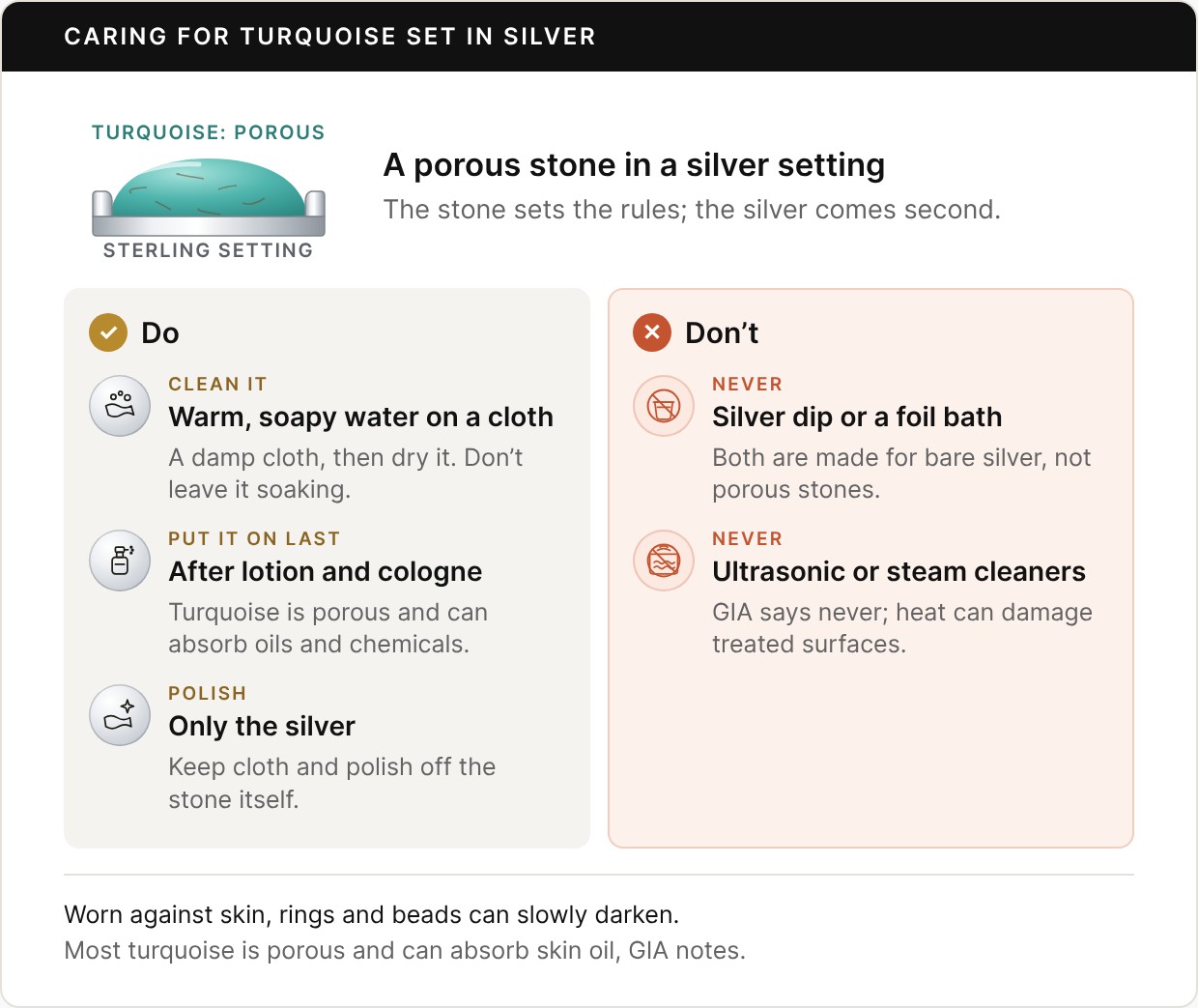
Clean for the stone, not the metal. GIA says “it’s safe to clean turquoise jewelry with warm, soapy water, but it should never be cleaned with steam or ultrasonic cleaners.”
- Wipe, don’t soak. Dip a soft cloth in warm water with a drop of mild dish soap, wring it out, and wipe the stone and the silver. Wipe again with a cloth dampened in plain water, then dry the piece right away.
- Polish only the metal. A silver polishing cloth is fine on the band or cuff, but keep it off the stone: natural turquoise can absorb “cleaning products, perfume, or metal polish, which may affect its color,” GIA notes.
- Leave heavy tarnish to a jeweler. Silver dips and baking-soda foil baths are for plain silver. Our cleaning guide keeps every stone-set piece out of both.
- Skip the machines. No ultrasonic or steam cleaner, as our guide to ultrasonic cleaners also explains.
Darkening on the silver around the stone is usually ordinary tarnish, a reaction with sulfur, or a deliberate oxidized finish. Either way, it isn’t a problem with the turquoise, so ask before you polish it out. Our guide to why silver tarnishes covers prevention.
Native American turquoise jewelry and the law
The Indian Arts and Crafts Act of 1990 is “a truth-in-advertising law that prohibits misrepresentation in the marketing of Indian art and craft products within the United States.” It is illegal to sell any art or craft product “in a manner that falsely suggests it is Indian produced, an Indian product, or the product of a particular Indian or Indian tribe,” among other things. For a first violation, an individual can face civil or criminal penalties of up to a $250,000 fine or a five-year prison term, or both, and a business can be fined up to $1,000,000, according to the IACB.
The Act covers who made a piece, not the stone in it: the IACB’s brochure says the use of materials such as turquoise is “not within the scope of the Act.” New Mexico’s Indian Arts and Crafts Sales Act goes further. It requires the seller to disclose in writing the type of materials used, and a seller who doesn’t give that disclosure violates state law, which may entitle the buyer to a refund on returning the item, according to the brochure.
- “Native American,” “Navajo,” or “Zuni” in a listing is a claim about who made the piece. Ask for the artist’s name and tribal affiliation, and get them on the receipt, as the IACB recommends.
- A style word such as “Southwestern” describes a look. If you want work by a Native American artist, ask directly.
- To report a suspected fake, the IACB’s number is 1-888-ART-FAKE.
FAQ
Is stabilized turquoise real turquoise?
Yes. It is turquoise combined with colorless resin under vacuum or pressure to harden it and darken its color, according to the IACB. It isn’t natural turquoise, and fine natural stone is worth more.
Is howlite turquoise real?
No. Howlite is a different mineral that is often dyed blue to look like turquoise, according to the International Gem Society. If it’s sold using the word turquoise at all, the FTC’s Jewelry Guides say it should be called imitation or simulated turquoise. “Faux” isn’t enough.
What is block turquoise?
Chips and fragments of turquoise mixed with epoxy and cut from the resulting block, as the IACB defines it. It is made from turquoise pieces, not a single stone, and composites like it aren’t always sold under that name: the one a 2010 Gems & Gemology study examined was typically marketed as “stabilized.” Some sellers also use “block” loosely for dyed howlite or magnesite, so ask what the chips are.
Why is my turquoise changing color?
Most turquoise is porous, so it can absorb skin oils and gradually darken as it’s worn, GIA says. Cosmetics, perfume, cleaning products, and metal polish can also affect its color. Put it on last, and keep polish off the stone.
Can turquoise get wet?
Briefly. GIA says warm, soapy water is safe for cleaning it. Don’t soak it, swim in it, or wear it in a hot tub, and dry it after it gets wet.
Is turquoise a December birthstone?
Yes. GIA calls turquoise the traditional birthstone for December and the gem of the 11th anniversary.
Is turquoise a good stone for a man’s everyday ring?
It can be, if you accept that it will show wear sooner than a harder stone. At 5 to 6 on the Mohs scale, it is softer than black onyx, which rates about 7. Choose a bezel setting, and take it off for hard work. Our guide to black onyx rings covers the tougher option.
Does Native American turquoise jewelry have to use natural turquoise?
Not under federal law. The Indian Arts and Crafts Act is about who made the piece, not its materials. New Mexico requires sellers to disclose the materials in writing, and wherever you buy, the IACB recommends getting the stone’s type on your receipt.
Bottom line
Treat turquoise as a question of disclosure. Stabilized and other treated turquoise is real turquoise and fine to wear, as long as the label says so and the price reflects it. Block turquoise is bonded chips, and dyed howlite and dyed magnesite are imitations. A home test won’t settle it, so get the answer in writing. Once you own it, put it on after lotion and cologne, keep it out of water and chemicals, and clean it with a damp, soapy cloth, never a dip, a foil bath, or an ultrasonic cleaner.
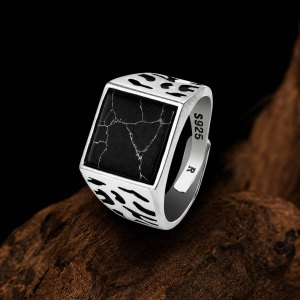
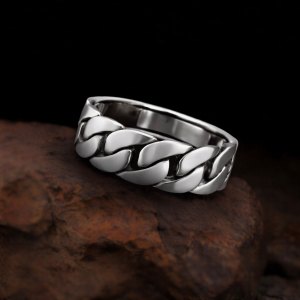
From the collection
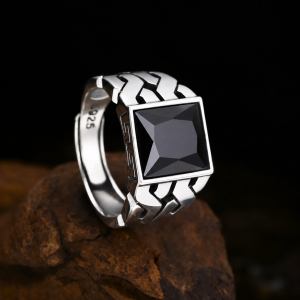
Men’s sterling silver rings by Ronatelli
Eleven handmade 925 rings, $129 to $169, from a chain-link band to a black onyx statement ring. Every one is adjustable.
Related guides
Treatment terms, the natural-supply estimate, mines, and buying tips follow the US Department of the Interior’s Indian Arts and Crafts Board turquoise brochure (2018) and its page on the Indian Arts and Crafts Act. Color, quality, cuts, hardness, and care follow GIA’s turquoise description, quality factors, buyer’s guide, and care and cleaning pages. Treatments and imitations follow Gems & Gemology (Lind, Schmetzer, and Bank, Fall 1983; Fritsch et al., Spring 1999; Choudhary, Summer 2010), GIA’s Spring 1985 Lab Notes, the International Gem Society’s howlite profile by Joel E. Arem (updated July 1, 2018), and Skyjems’ entry on block turquoise. The Sleeping Beauty mine’s 2012 switch to copper follows GIA’s “Arizona Road Trips.” Disclosure and labeling follow the FTC’s Guides for the Jewelry, Precious Metals, and Pewter Industries (16 CFR 23.24 and 23.25). Ring prices in the collection box were read from ronatelli.com. All were checked on October 31, 2026. Read our editorial policy.

