
Beside black onyx and turquoise, you’ll also find tiger’s eye, lapis lazuli, malachite, and jade in men’s silver rings. They wear very differently. Tiger’s eye and jade hold up to daily use, lapis is softer and may be dyed, and malachite needs real care. Here is what each stone is, how it lasts in a ring, what is commonly done to it, how to clean it without harming the stone or the silver, and, for tiger’s eye and jade, which of the meanings attached to them have any history behind them.
Key takeaways
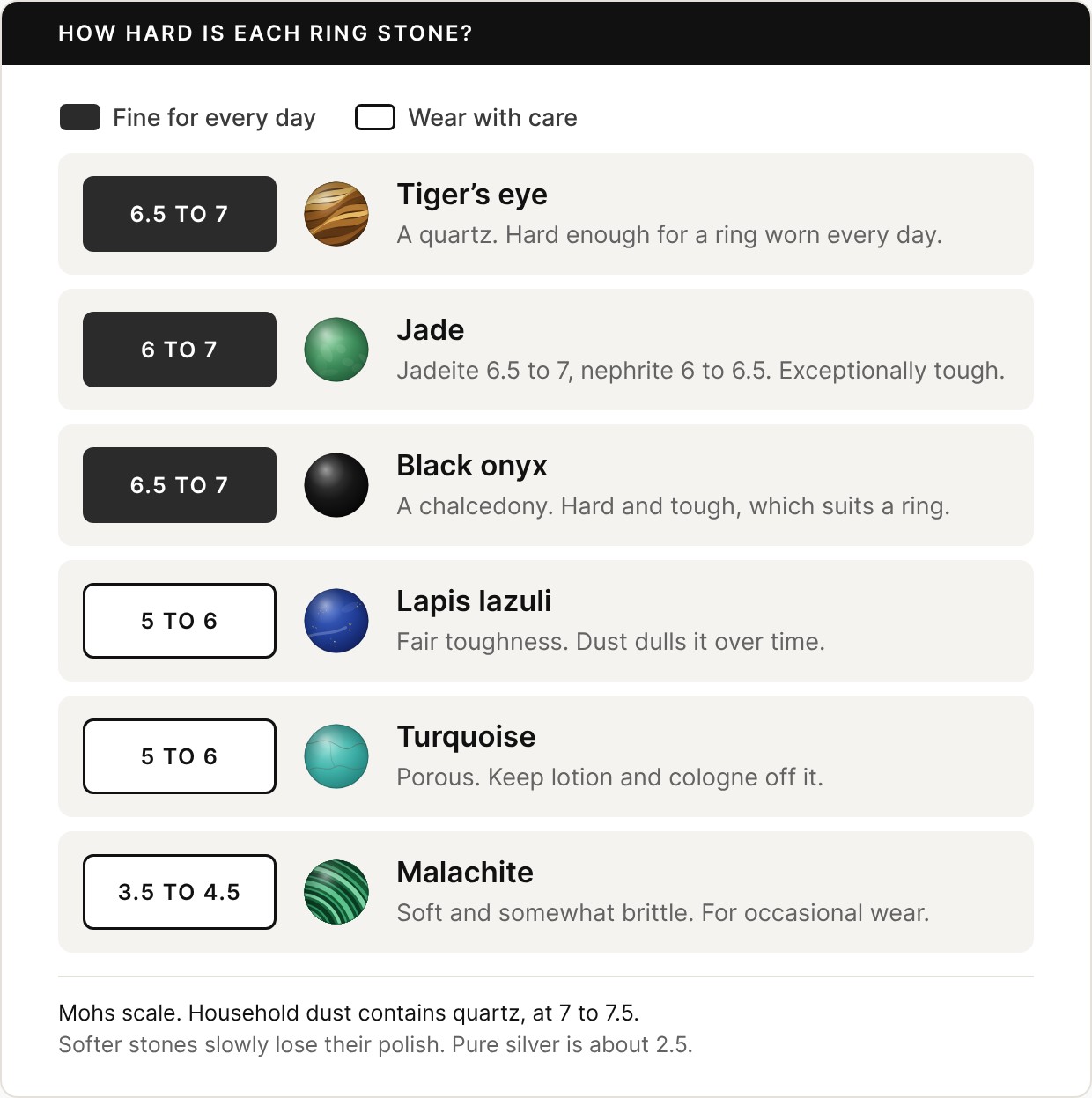
- Tiger’s eye (6.5 to 7 on the Mohs scale) and jade (6 to 7, and exceptionally tough) are the best of the four for a ring you wear every day.
- Lapis rates 5 to 6 and may be dyed or waxed; GIA says the dye in some lapis can come off when rubbed with acetone or denatured alcohol.
- Malachite rates only 3.5 to 4.5 and is sensitive to heat and acids. Keep it for occasional wear, in a protective setting.
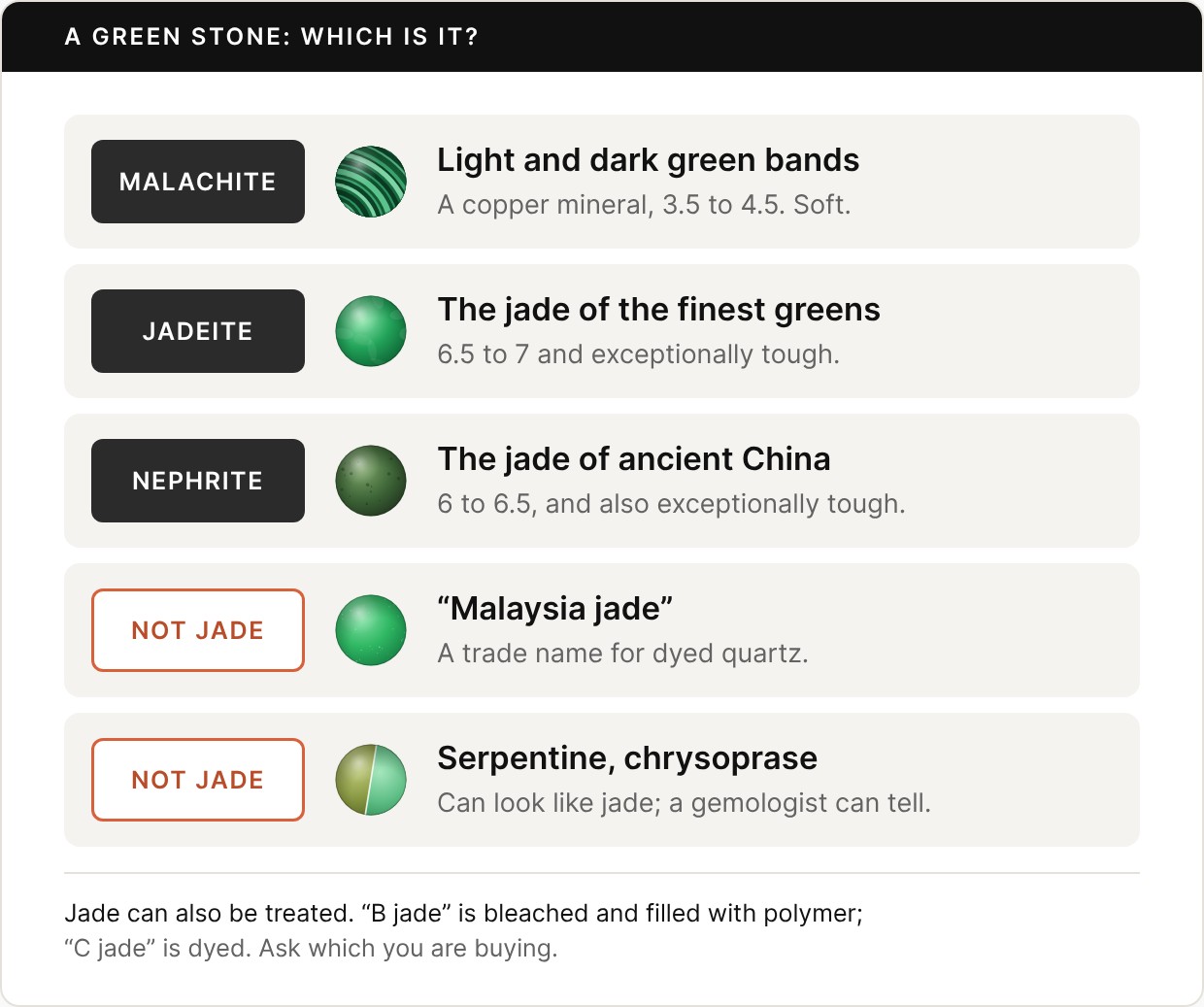
- Jade is two stones, jadeite and nephrite. Bleached, polymer-filled “B jade” and dyed “C jade” are both sold, so ask which you are buying.
- Under the FTC’s Jewelry Guides, a seller should disclose a treatment that isn’t permanent, needs special care, or significantly affects value, and online that belongs in the listing.
- Clean all four with warm, soapy water. Keep silver dip, foil baths, and acids away from the stones.
In this guide Hardness Tiger’s eye Lapis Malachite Jade Green stones Treatments Care FAQ
Hardness: what each stone can take
On the Mohs scale, hardness measures resistance to scratching, not to breaking or chipping, as the International Gem Society explains. It matters in a ring because of dust: the particles floating in the air and settling on furniture “contain quartz, a mineral with a Mohs scale hardness of 7 to 7.5,” and “gems softer than quartz will scratch easily from dust or daily contact,” slowly losing their polish, the IGS says. Pure silver is about 2.5 and sterling only a little harder, so every stone here is harder than the silver around it.
Toughness, the resistance to breaking, is the other half. Jade is the standout: jadeite and nephrite “have exceptional toughness and are very resistant to breaking or chipping,” according to GIA, and a 1987 article on gem durability in GIA’s journal Gems & Gemology named jadeite and chalcedony, the family black onyx belongs to, among the stones “more resistant to abrasion and chipping” and so better suited to bracelets and cufflinks. Lapis has only fair toughness, GIA says, and malachite is “somewhat brittle,” according to the IGS.
Tiger’s eye: the everyday stone
Tiger’s eye is quartz with fibers inside it. In GIA’s description of a specimen from the Pilbara region of Western Australia, cracks in the rock filled with the fibrous mineral crocidolite, the fibers “were encapsulated by quartz” as they crystallized, and trapped iron oxides gave the golden color. Light reflecting off the fibers produces the moving, silky band known as chatoyancy. Since 1873, geologists had explained the stone as quartz that replaced the fibers; in 2003, Peter Heaney and Donald Fisher of Penn State reported that crocidolite, not quartz, causes the shimmer. Pieces that keep the fibers’ original blue are sold as hawk’s eye, according to the IGS.
It rates 6.5 to 7 on the Mohs scale, about as hard as the quartz in dust, which makes it, with jade, the most practical of the four for a ring worn every day. Most tiger’s eye is untreated, according to the gem dealer GemSelect, though reddish stones “might be dyed or heated for better color,” and the IGS lists bleaching, dyeing, and heating among the stone’s typical treatments, so ask about a red or unusually bright stone. GemSelect’s care advice is simple: warm water and mild soap, and no bleach or ammonia.
The meanings are lore rather than history. “It is said” that tiger’s eye protects travelers and strengthens conviction and confidence, and that Roman soldiers wore it in battle, Jeweller magazine writes. Wear it for the color and the sheen, and take the rest as belief.
Lapis lazuli: blue rock with gold flecks
Lapis lazuli isn’t a single mineral but a rock, GIA explains, made of lazurite, calcite, and pyrite in varying amounts. Lazurite supplies the blue, according to the IGS. The most prized lapis has no visible calcite, though it may have gold-colored pyrite flecks, while the lowest quality “looks dull and green, the result of an excess of pyrite,” GIA says. Afghanistan has been the traditional source of the finest lapis for thousands of years, and the 1987 Gems & Gemology article noted that lapis and turquoise appear in one of the oldest known pieces of wrought jewelry, more than 5,000 years old.
It rates 5 to 6 on the Mohs scale, with only fair toughness, according to GIA, so dust will dull it over time and a setting that protects its edges is worth having. Lapis “might be dyed to improve its color and conceal any calcite inclusions,” and lapis that hasn’t been dyed “might be impregnated with wax or oil,” GIA notes; “these treatments have only fair stability.” The dye in some lapis can come off when rubbed with acetone, the main ingredient in many nail polish removers, or with denatured alcohol, so keep both away from it.
Not everything blue is lapis. “Swiss lapis” is jasper dyed blue to imitate it, according to Minerals.net.
Malachite: striking, but soft
Malachite is the banded green copper mineral, and most malachite gem rough comes from the Democratic Republic of the Congo, according to the IGS. It rates just 3.5 to 4.5 on the Mohs scale, has “a somewhat brittle tenacity,” and is sensitive to heat and acids; it even “effervesces in warm acids,” the IGS says.
That makes it the most delicate of the four. Being much softer, it will show scratches sooner than tiger’s eye or jade, so it suits a ring worn now and then, a pendant, or a tie pin better than a daily band. If you want a malachite ring anyway, choose a setting that wraps the stone’s edges and take it off for the gym, yard work, and washing up.
Most malachite is untreated, but “lower quality, less compact pieces may be stabilized with plastic resins” or given a surface polish with wax, the IGS says. Ultrasonic and steam cleaners and acidic cleaners are all out. Its dust is toxic to breathe, which matters to the people who cut it; wearing finished jewelry “should be safe,” the IGS notes.
Jade: two stones, one name
“Jade is an umbrella term for two gem materials: jadeite and nephrite,” GIA explains. In China, jade carving “has flourished for more than 3,000 years,” and the first jadeite reached China from Burma, now Myanmar, only “in the late 1700s,” according to GIA, so the jade of ancient China was nephrite. Confucius ascribed 11 virtues to jade, among them benevolence, intelligence, and righteousness, the Royal Collection Trust notes, and GIA writes that the Chinese associate it “with clarity of mind and purity of spirit.”
Jadeite rates 6.5 to 7 and nephrite 6 to 6.5 on the Mohs scale, and both are exceptionally tough, GIA says, which puts jade alongside tiger’s eye as the best choice here for daily wear. GIA calls ultrasonic and steam cleaners safe for untreated jade, but you can’t tell untreated jade by eye, so our guide to ultrasonic cleaners keeps stone rings out; warm, soapy water is “always a safe choice,” GIA says.
The catch is treatment. Jade “can be dyed, bleached, heated, waxed and impregnated,” GIA says, and a classification system used in China sorts jadeite into grades: “A” jade is natural or polished with wax only, “B” jade has been “bleached with acid and then impregnated with polymer resin,” and “C” jade is dyed. The bleaching causes structural damage that makes the jadeite brittle, and the color of dyed jade is unstable and fades with heat and time, gemologist Branko Deljanin wrote in Jewellery Business, warning that much of the treated jadeite on the market “may not be properly disclosed.” For a jadeite ring of real value, ask for a lab report.
A green stone: malachite, jade, or a look-alike?
If a listing just says “green stone,” malachite and jade are two candidates to ask about. Malachite is the easiest to spot by its light and dark bands. Jade is harder to judge by eye, and some “jade” isn’t jade at all: “Malaysia jade” is a trade name for dyed quartz, usually chalcedony, according to Fire Mountain Gems, and serpentine and chrysoprase can look like jade to the naked eye, though a gemologist can tell them apart, Deljanin notes. Under the FTC’s Jewelry Guides, calling dyed quartz simply “jade” would be unfair or deceptive, since it is “not in fact a mined stone of the type described.” Whatever the label says, ask what the stone is.
Treated, dyed, or filled: what to ask
Treatment isn’t a flaw in itself, but it can change what a stone is worth and how it needs to be cared for. Under the FTC’s guide on treatments, a seller should disclose a treatment that isn’t permanent, that creates special care requirements, or that has a significant effect on the stone’s value, and when you can buy without seeing the piece, as online, the disclosure belongs in the product description. Products made with gemstone material and “any amount of filler or binder” can’t simply carry the stone’s name either: a term such as “composite” has to make clear the product lacks the stone’s characteristics and needs special care.
| Stone | What is often done | Ask the seller |
|---|---|---|
| Tiger’s eye | What is often doneOften untreated; may be dyed, heated, or bleached | Ask the sellerIs the color natural? |
| Lapis lazuli | What is often doneDyed, or impregnated with wax or oil | Ask the sellerIs it dyed or waxed? |
| Malachite | What is often doneLower grades stabilized with resin or polished with wax | Ask the sellerIs it stabilized? |
| Jade | What is often doneDyed, bleached, polymer-filled, heated, or waxed | Ask the sellerJadeite or nephrite? A, B, or C jade? Is there a lab report? |
| Black onyx | What is often doneDyed black, a permanent treatment | Ask the sellerSee our black onyx ring guide |
| Turquoise | What is often doneStabilized, dyed, or made into composites | Ask the sellerSee our turquoise guide |
Get the answer in writing, and keep the product page. A seller who can’t say what a stone is or how it was treated is telling you something too.
Wearing and cleaning a stone ring
- Setting. A frame that wraps the stone’s edges protects it best; prongs and raised settings show more stone and take more knocks, as our black onyx ring guide explains. That matters most for lapis and malachite.
- Hand. The dominant hand takes more knocks, so if you work with your hands, wear a stone ring on the other one, as our guide to wearing rings suggests.
- Last on, first off. Put the ring on after cologne, lotion, and hand sanitizer, and take it off for the gym, yard work, and cleaning products.
- Cleaning. Warm, soapy water and a soft brush, then dry it. GIA calls warm, soapy water the safest way to clean lapis and always safe for jade. Porous stones such as malachite and lapis “may absorb some of the cleaning solution, which could cause discoloration,” the 1987 article warns, so rinse and dry promptly and never soak them.
- The silver. Polish the band with a polishing cloth and keep the cloth off the stone. Many jewelry-cleaning dips contain ammonia, the 1987 article notes, so no dip and no foil bath for a stone ring; our guides to cleaning silver and ultrasonic cleaners explain why.
FAQ
What is the best gemstone for a men’s everyday ring?
Tiger’s eye or jade. Tiger’s eye is a quartz at 6.5 to 7 on the Mohs scale, and jade, at 6 to 7, is exceptionally tough. Black onyx, at 6.5 to 7, is the other everyday choice.
What is the green stone in men’s silver rings?
Often malachite, which shows light and dark bands and is soft, or jade, either jadeite or nephrite. Ask the seller to name it: stones sold as “Malaysia jade” are dyed quartz, not jade.
How can you tell if lapis lazuli is dyed?
Ask the seller; GIA says a gemologist can detect dye and wax. The dye in some lapis comes off when rubbed with acetone or denatured alcohol, which is also why both should be kept away from it. Don’t test it yourself: the solvent can strip the dye and leave a patch.
Can you wear a malachite ring every day?
You can, but it is better kept for occasional wear. At 3.5 to 4.5 on the Mohs scale it scratches easily, and it is sensitive to heat and acids. Choose a setting that wraps the stone’s edges and take it off for work with your hands.
What is the difference between jadeite and nephrite?
They are two different minerals, both sold as jade. Jadeite is a little harder, 6.5 to 7 against 6 to 6.5, and natural-color jadeite is the most valuable; nephrite is the jade of ancient China. Both are exceptionally tough.
Which hand should a tiger’s eye ring go on?
Either. Beyond keeping the left ring finger for a wedding band, there’s no rule. If you work with your hands, the non-dominant hand spares the stone and the setting, as our guide to wearing rings explains.
Bottom line
For a ring you’ll wear every day, choose tiger’s eye or jade, and ask whether the jade is untreated. Lapis works in a protective setting kept away from solvents; malachite is for occasional wear. Whatever the stone, ask what has been done to it, clean it with warm, soapy water, and treat the meanings as part of the story rather than a property of the stone.

From the collection
Men’s sterling silver rings by Ronatelli
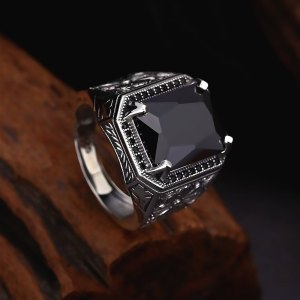
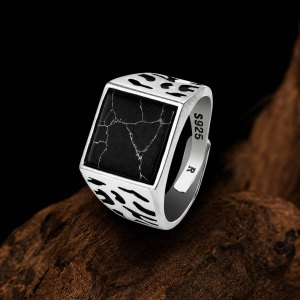
Eleven handmade 925 rings, $129 to $169, from a chain-link band to a black onyx statement ring. Every one is adjustable.
Related guides
Hardness, toughness, treatments, and care follow GIA’s gem encyclopedia pages on lapis lazuli and jade, Deborah Dupont Martin’s “Gemstone Durability: Design to Display” (Gems & Gemology, Summer 1987), and the International Gem Society on hardness (updated April 4, 2025) and malachite (updated July 10, 2025). Tiger’s eye formation follows GIA and Penn State (April 8, 2003); its hardness, treatments, and care follow GemSelect and the IGS, and its lore follows Jeweller magazine; lapis composition follows GIA and the IGS. Jade history follows GIA and the Royal Collection Trust; jade grades follow GIA and Branko Deljanin in Jewellery Business (August 1, 2012); “Malaysia jade” follows Fire Mountain Gems, and “Swiss lapis” Minerals.net. Disclosure rules follow the FTC’s Jewelry Guides (16 CFR 23.24 and 23.25). Ring prices in the collection box were read from ronatelli.com. All were checked on October 31, 2026. Read our editorial policy.

