Cremation jewelry lets you keep a small part of someone’s ashes close: a pendant, a bead, or a ring with a tiny sealed chamber. For a man, it is often a simple urn pendant on a chain, such as a cylinder, a bar, a dog tag, or a cross, worn under a shirt or over it. This guide covers how they work and how much they hold, how to fill and seal one or have it done for you, when to take it off, which metal and chain to choose, and two things to know before you buy: flying with it, and what the Catholic Church asks.
Key takeaways
- An urn pendant has a small screw-sealed chamber. Many hold a quarter teaspoon or less.
- You can fill it yourself in a few minutes, or ask the funeral home whether it can do it.
- Fillable jewelry isn’t fully waterproof. Take it off to shower, bathe, swim, or work out.
- Sterling silver tarnishes and needs a polish now and then; stainless steel is lower-maintenance.
- Match the chain to the pendant’s weight, and choose a secure clasp: this is one piece you can’t replace.
- For Catholic families, the Church’s 2016 instruction says ashes may not be kept in jewelry. Ask your priest.
In this guide How it works Filling it Daily wear The metal The chain Engraving Before you buy FAQ
How an urn pendant works
Cremation is now the most common choice in the United States: the National Funeral Directors Association projects a cremation rate of 63.4% for 2025, against 31.6% for burial, in its 2025 Cremation & Burial Report. When a family keeps the ashes, a pendant is one way to carry a small part of them.
Inside the pendant is a small hollow chamber, closed by a threaded cap at the neck, which usually carries the bail, or on some designs by a small screw in the bottom, as the memorial retailer Mainely Urns describes. It holds very little. The amount is usually “a pinch,” and for many designs “less than 1/4 teaspoon,” according to the memorial retailer Funeral.com; bar and cylinder pendants “may hold closer to 1/4 to 1 teaspoon.”
Filling and sealing it
Filling an urn pendant takes a few quiet minutes. The steps below follow the instructions published by Legend Urn and Mainely Urns:
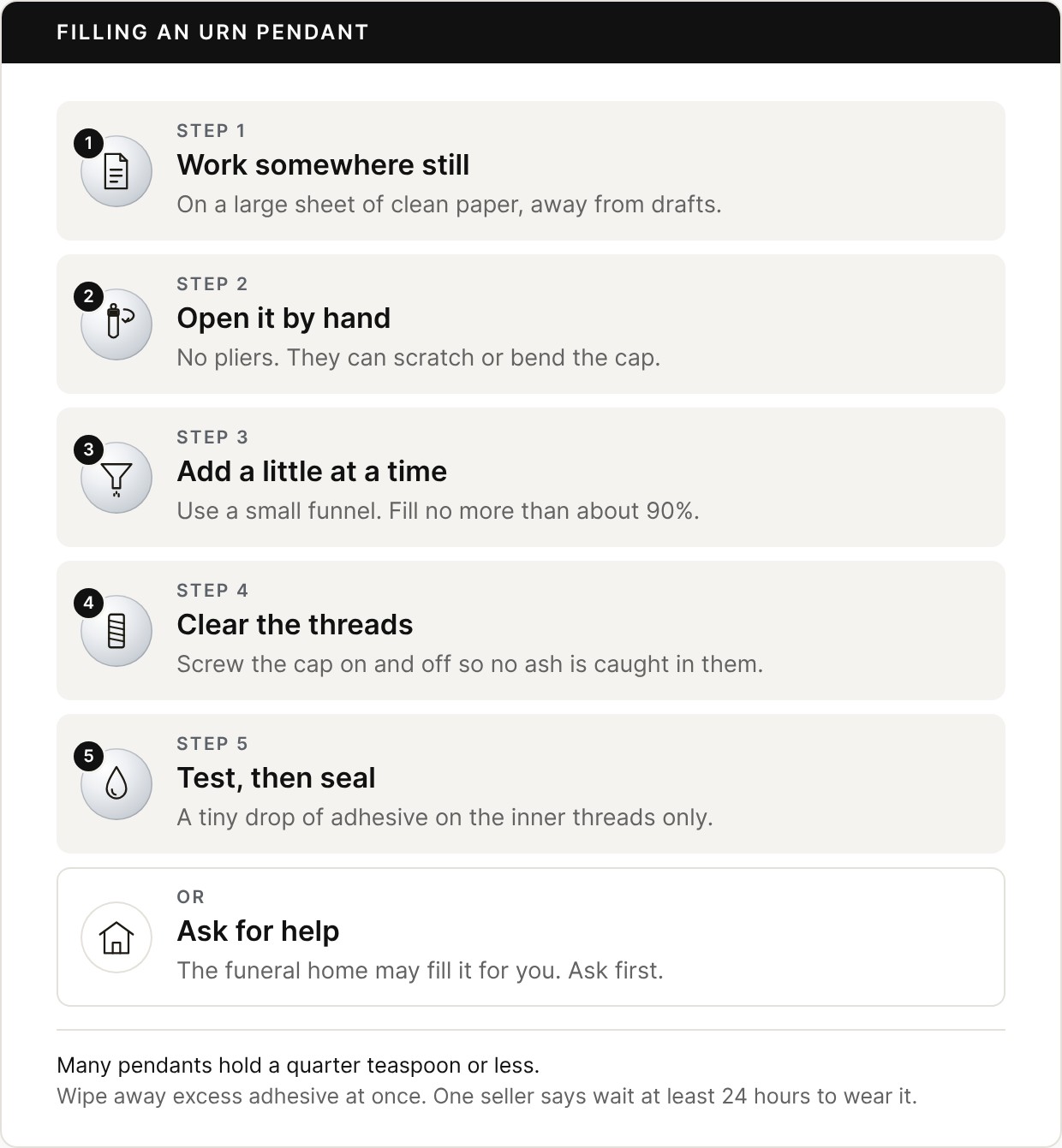
- Set up. Choose a flat, still spot, and work over what Legend Urn calls “a large clean sheet of paper.”
- Open it by hand. “Do not use pliers or other tools, as they may scratch or deform the jewelry,” Legend Urn advises.
- Add a little at a time. Use a small funnel, if one came with the pendant, or a folded piece of paper. If the ashes need settling, press them gently with a wooden toothpick, not metal. Don’t overfill: too much and “the cap may not close properly,” Legend Urn warns, and Mainely Urns says to fill “no more than 90% full.”
- Clear the threads. Make sure no ash is left between them; Mainely Urns suggests screwing the cap on and off several times.
- Close it once without adhesive to check that it seats neatly and that the bail lines up so the chain runs from side to side. Threaded front to back, Mainely Urns notes, the chain will twist and the pendant won’t hang correctly.
- Seal it. For a permanent closure, Legend Urn advises “a very small drop of adhesive to the inner screw thread only,” then tightening the cap in one movement and wiping away any excess at once. Mainely Urns uses epoxy or super glue and recommends waiting “at least 24 hours before wearing.” If you may want to open it again, Funeral.com suggests “a removable, medium-strength threadlocker used sparingly on the threads (not in the chamber),” left to cure fully before you wear it, and cautions that a permanent adhesive can make the piece impossible to open without damage.
If you would rather not do it yourself, the funeral home may be able to fill the pendant for you. Legend Urn suggests asking in advance whether it offers this and whether there is a charge.
Water, sweat, and daily wear
“Cremation jewelry is never completely waterproof,” Legend Urn says, so it is better not to wear it while showering, swimming, bathing, or in a sauna. Mainely Urns goes further: to protect the seal, it says, pendants shouldn’t be immersed in liquids at all. Legend Urn’s care advice also suggests taking it off for runs and workouts that bring on heavy sweat, and notes that perfume “may contain chemicals that can tarnish” jewelry over time, so put it on after cologne.
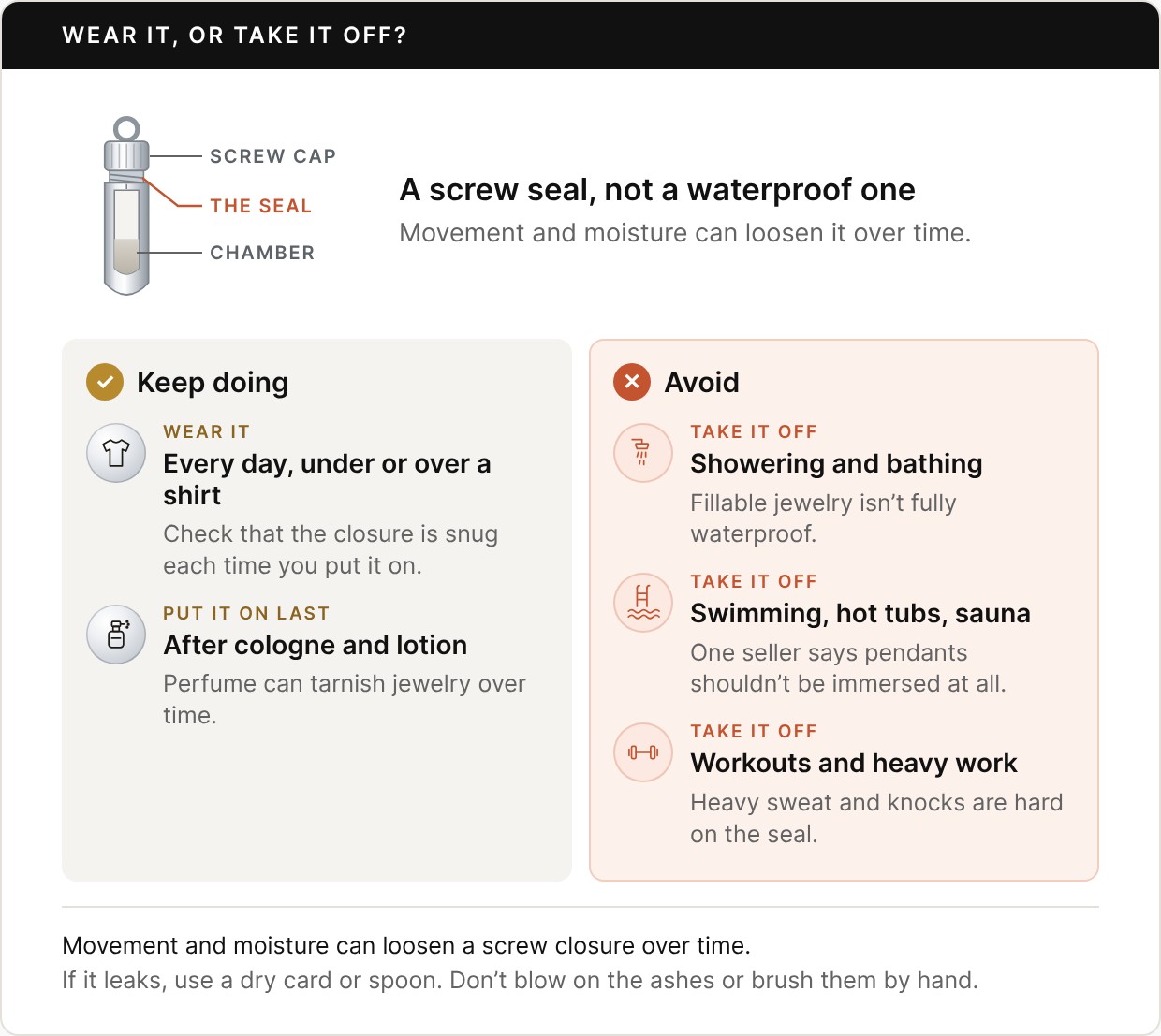
Even a sealed pendant can work loose. Funeral.com lists the usual causes: “daily vibration,” “frequent opening and closing,” cross-threading, “residue in the threads,” and moisture from showers, swimming, or heavy sweat. Its advice is to pick a regular moment, such as when you put the necklace on or take it off, to “confirm the closure is snug,” without overtightening, which can strip the threads.
If it does leak, stop wearing it and work over a tray, towel, or sheet of paper. Funeral.com suggests gathering any loose ashes with a dry spoon, folded paper, or a small card rather than blowing or brushing them, then deciding whether to reseal the pendant yourself or have a jeweler do it.
Sterling silver, stainless steel, or titanium
Urn pendants come in all three, and they differ in the same ways as any men’s jewelry, as our comparison of the three metals explains:
| Metal | Look and weight | Care | Worth knowing |
|---|---|---|---|
| Sterling silver (925) | Look and weightBright, warm white; the heaviest of the three | CareTarnishes; polishes back with a cloth | Worth knowingHas metal value and is easy for a jeweler to repair |
| Stainless steel (316L) | Look and weightCooler, grayer white; medium weight | CareDoesn’t tarnish | Worth knowingHard and low-maintenance; most grades contain nickel |
| Titanium | Look and weightDark gray; very light | CareDoesn’t tarnish or corrode | Worth knowingHypoallergenic; scratches more easily than steel |
Stainless steel “is often the most forgiving choice for daily wear,” Funeral.com notes, while sterling tarnishes faster with “sweat, humidity, lotions, and saltwater.” The closure itself isn’t the difference: “Sterling silver closures are not inherently less secure than stainless steel; the key factor is habit.” For sterling, a polishing cloth handles light tarnish. Don’t put an urn pendant in water at all: no soaking, no baking soda and foil bath, no silver dip, and no ultrasonic cleaner. If it needs more than a dry cloth, Legend Urn suggests a cloth with “a bit of warm, soapy water,” then drying it at once. Our guide to why silver tarnishes covers prevention. If a listing says sterling, look for a 925 stamp, as our guide to telling if silver is real explains.
Choosing a chain
An urn pendant is a pendant like any other, so the same rules apply, with one more reason to follow them: this is a piece you can’t replace.
- Width. Match the chain to the pendant’s weight, as our guide to the best chain for a pendant explains: 2 to 2.5 mm under 6 g, 3 mm up to 12 g, and 4 mm up to 20 g. Box, franco, and wheat chains carry a pendant best.
- Bail. The opening needs about 1 mm to spare over the widest part that passes through it, usually the clasp.
- Clasp. A lobster clasp that snaps shut firmly is the secure everyday choice, 12 mm or longer on a chain of 4 mm or more, as our clasp guide explains. Avoid magnetic and toggle clasps, which can open or slip under a pendant’s weight.
- Length. A pendant hangs 1″ to 2″ below the chain, so 22″ suits most men and 24″ a large pendant or a broad build. Our chain length guide has the details, and our guide to pendant size covers proportions.
Engraving
Many urn pendants are sold as engravable. The space is small, so short works best: initials and dates, a name, or one word. Count the characters, spaces included, and ask for a proof before anything is cut, as our guide to what to engrave explains. Plain block letters are easier to read at that size.
Before you buy: flying and faith
Flying. TSA has said jewelry generally doesn’t need to come off at the checkpoint, as our guide to traveling with silver notes. Its rules for cremated remains are stricter: remains in a carry-on “must pass through the X-ray machine,” and officers “will not open containers with cremated remains, even if the passenger requests this be done,” according to TSA; a container they can’t clear won’t be permitted. Keep the pendant with you rather than in a checked bag.
Faith. The Catholic Church has specific guidance on how ashes are kept. Its 2016 instruction Ad resurgendum cum Christo says ashes must be laid to rest in a sacred place, may not be divided among family members, and may not be “preserved in mementos, pieces of jewellery or other objects.” In December 2023 the Vatican’s doctrine office added that church authorities may consider a family’s request to keep “a minimal part of the ashes” in a place significant to the person who died, provided the rest are kept in a sacred place. It said the 2016 rules still hold, and it doesn’t mention jewelry. If this matters to your family, ask your priest before you buy. For a cross or a saint’s medal without ashes, our guides to cross necklaces and saint medals may help.
FAQ
How much ash goes in a cremation necklace?
Very little. Many pendants hold a pinch, less than a quarter teaspoon; bar and cylinder pendants may hold a quarter to one teaspoon. Don’t overfill, or the cap may not close properly.
Can you shower with cremation jewelry?
It’s better not to. Fillable jewelry isn’t fully waterproof, and moisture is one of the things that loosens a screw closure. Take it off for showers, baths, swimming, and the sauna.
Is sterling silver or stainless steel better for an urn pendant?
Stainless steel is lower-maintenance and doesn’t tarnish. Sterling silver is warmer in color and easier for a jeweler to repair, but it needs a polish now and then. Neither closure is more secure than the other; what matters is how you wear it and how often you check it.
Can a funeral home fill cremation jewelry?
Some will, and crematory staff may help too. Ask in advance whether it’s possible and whether there’s a charge.
Can you wear a cremation necklace through airport security?
Usually. TSA has said jewelry generally doesn’t need to come off, but its guidance on cremated remains doesn’t mention jewelry, and the officer has the final say. If you’re asked to remove the pendant, it goes through the X-ray. Officers won’t open a container of cremated remains, even if you ask, and one they can’t clear won’t be allowed through. Keep it on you or in your carry-on rather than a checked bag.
Can Catholics wear cremation jewelry?
The Church’s 2016 instruction says ashes may not be preserved in jewelry. A 2023 clarification allows a family to ask about keeping a minimal part of the ashes in a significant place, but it doesn’t mention jewelry. Ask your priest.
Bottom line
Choose a pendant you will be glad to wear every day, in sterling silver for its warmth or stainless steel for ease, and fill it slowly or let a funeral home do it. Seal the threads, take it off for water and workouts, and check the closure whenever you put it on. Then give it a chain and clasp strong enough for something you can’t replace.
From the collection
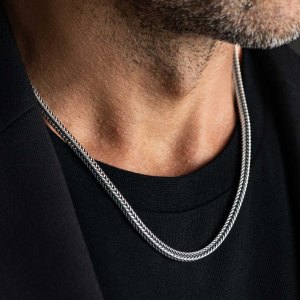
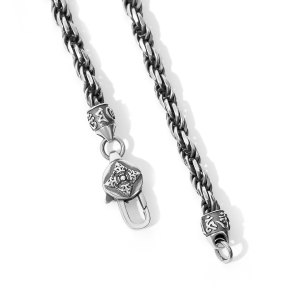
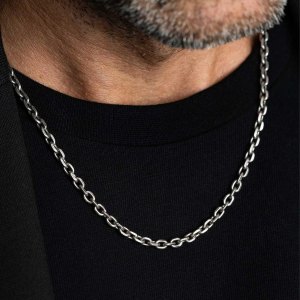
Men’s sterling silver chains by Ronatelli
Ten handmade 925 chains, from a 2 mm snake chain to a 7 mm curb, in 20 to 26 inches. Every length is the same price.
Related guides
The cremation rate follows the National Funeral Directors Association’s 2025 Cremation & Burial Report. Capacity, closures, filling, leaks, and water follow the memorial retailers Funeral.com (January 21, 2026, and December 19, 2025), Legend Urn, and Mainely Urns. Air travel follows TSA. Catholic guidance follows the Congregation for the Doctrine of the Faith’s Ad resurgendum cum Christo (2016) and the Dicastery for the Doctrine of the Faith’s response of December 9, 2023. Metal, chain, clasp, and engraving advice follows our own guides. Chain prices and lengths in the collection box were read from ronatelli.com. All were checked on October 31, 2026. Read our editorial policy.

