Gold vermeil and gold-plated silver look the same the day you buy them: gold on the outside, sterling silver inside, and often a 925 stamp. What separates them is how much gold there is, and whether the label promises a minimum. This guide covers what each term means under US guidance, how long each lasts on a chain, a ring, or a bracelet, why gold over silver can darken without being worn, how to make the gold last, and when to re-plate.
Key takeaways
- Vermeil has a floor: under the FTC’s Jewelry Guides, sterling silver plated with gold of at least 10 karat, equal to at least 2.5 microns of fine gold.
- “Gold-plated” promises less. The Guides’ example for gold electroplate is 0.175 micron, terms such as “gold over” have no minimum at all, and “gold-tone” describes only a color.
- Thickness is the biggest factor in how long the gold lasts. Vermeil’s minimum is about 14 times the FTC’s example for gold electroplate.
- Rings and bracelets wear through first; pendants usually keep their gold longer.
- Gold-filled usually lasts longer than either. Solid gold or solid sterling has nothing to wear through.
- To make it last, put it on after cologne, take it off for water and the gym, wash it with mild soap, and never dip it.
In this guide The labels Thickness How long Where it wears Darkening Care Re-plating Which to buy FAQ
Vermeil, gold plate, and gold-filled: what the labels mean
Both are usually sterling silver with gold laid on in a plating bath, so the difference isn’t how they’re made but what the label promises. The FTC’s Jewelry Guides, its guidance on how sellers may describe precious metals, say a piece may be called vermeil if it is sterling silver plated on all significant surfaces with gold of at least 10 karat, “of reasonable durability,” equal to at least 2.5 microns of fine gold. “Gold-plated silver” is a description, not a grade. The same Guides expect “gold plate” and “gold electroplate” to come with the karat named, 10 or higher, and give 0.175 micron as their example of a non-deceptive electroplate, about one-fourteenth of vermeil’s minimum. It is an example, not a floor: the FTC’s statement on its 2018 revision says a thinner coating may still be called gold plate if it is reasonably durable, for instance under a protective coating.
Other words come with no benchmark at all. In the same revision, the FTC declined to set minimum thicknesses for terms such as “flashed,” “washed,” “bonded,” “over,” “gold tone,” and “gold layered,” while reminding sellers that their claims must still not deceive. So “18K gold over sterling” tells you the karat of the gold, and nothing about how much of it there is.
| Term | Base metal | Gold | How much | Marks you may see |
|---|---|---|---|---|
| Vermeil | Base metalSterling silver | Gold10K or higher | How muchAt least 2.5 microns | Marks you may see925, for the silver |
| Heavy gold electroplate | Base metalAny | Gold10K or higher, karat named | How muchAt least 2.5 microns | Marks you may seeHGE |
| Gold electroplate, gold plate | Base metalAny | Gold10K or higher, karat named | How much0.175 micron, the FTC’s example | Marks you may see12K GEP, 18K GP |
| Gold-filled | Base metalUsually brass or copper | Gold10K or higher, karat named | How muchAt least 1/20 of the metal’s weight | Marks you may see14K GF, often 1/20 14K GF |
| Rolled gold plate, gold overlay | Base metalUsually brass or copper | Gold10K or higher, karat named | How muchAt least 1/40 of the metal’s weight | Marks you may see1/40 12K RGP |
| Gold over, bonded, flashed | Base metalAny | GoldNo minimum, but the karat should be named | How muchNone set | Marks you may seeNo standard mark |
| Gold-tone | Base metalAny | GoldDescribes a color; may contain no gold | How muchNone set | Marks you may seeNo standard mark |
On a gold-colored piece, a 925 stamp describes the silver underneath, not the gold, as our guide to what 925 means explains. A vermeil piece usually carries a 925 stamp for its silver base, as Quick Jewelry Repairs notes, and that stamp says nothing about the gold, so look for the vermeil claim and the karat in the listing or on the receipt. A mark like “18K GP” doesn’t mean 18K gold but a piece plated with 18K gold, the jewelry insurer Jewelers Mutual explains; look for it on the clasp of a chain or bracelet, or inside a ring.
Thickness is what you’re paying for
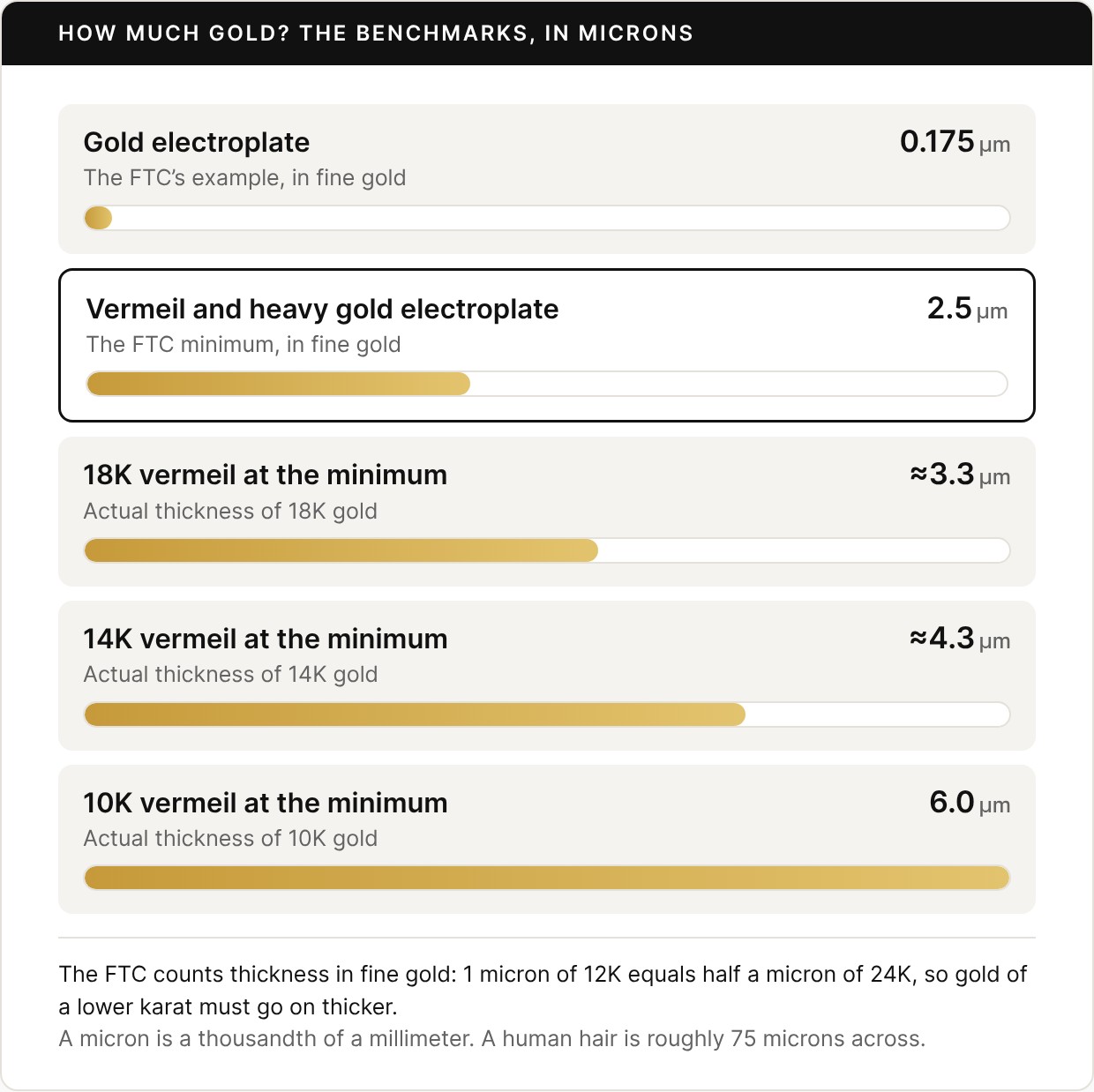
How long a gold layer lasts comes down mostly to how much gold there is to wear away. Industry tests the FTC reviewed for its 2018 revision “indicated that coating thickness affects a product’s abrasion resistance,” in the words of its statement, and Finematter, a jewelry marketplace that sells re-plating, puts it simply: the thicker the plating, “the longer it lasts.”
The minimums are counted in fine gold. The Guides note that a product with 1 micron of 12 karat gold “is equivalent to one-half micron of 24-karat gold,” so plating in a lower karat has to go on thicker to qualify. By that arithmetic, 18K vermeil at the minimum is about 3.3 microns of 18K gold, 14K about 4.3 microns, and 10K 6 microns. The same goes for gold electroplate: 0.175 micron of fine gold is about 0.3 micron of 14K.
For scale, a micron is a thousandth of a millimeter, and a human hair is roughly 75 microns across, as Finematter notes. The karat matters less than the thickness: for plating, Finematter suggests choosing the karat for its color more than its value.
How long does each last?
No rule sets a lifespan. The FTC’s statement says that “the record does not specify how long consumers expect coated products to last,” and the estimates jewelers publish vary with the thickness, the piece, and how it’s worn:
- 2-micron plating: about 1 to 2 years on rings and bracelets, and 1 to 3 years on necklaces, with “regular and considerate wear,” according to Finematter.
- 3-micron plating: about 2 to 3 years on rings and bracelets, the thickness Finematter recommends for them.
- Vermeil, at least 2.5 microns of fine gold: no source gives it a figure, but by thickness it starts in the same range as these, or above it in 14K or 10K, which must go on thicker. Robinson’s Jewelers, a family-owned jeweler, says high-quality vermeil “can absolutely last for years and years” with proper care, and that wearing through on the high points takes “a very, very long time.”
- Gold-plated jewelry in general: it “generally lasts for several years before tarnishing occurs” with proper care, according to Jewelers Mutual, which adds that it depends on the plating’s thickness, the base metal, and the care it gets.
- Gold-filled: its heat-bonded layer is “highly resistant to wear and can last for decades,” says the jewelry retailer Ross-Simons.
So which lasts longer? Measured by their benchmarks, vermeil, since it starts with about 14 times the gold. But the name isn’t the whole story. A gold-plated piece can be made with a heavy layer, and Jewelers Mutual notes that a thickly plated piece can be worth more than a thin one of vermeil, while heavy gold electroplate has the same 2.5-micron floor over any metal. The thickness in microns tells you more than the word on the tag. Gold-filled usually outlasts all of them.
Where it wears first: rings, bracelets, chains, pendants
A gold layer wears where something rubs it. Rings and bracelets “tend to show wear first” from constant motion and contact with everyday surfaces, Ross-Simons says, while pendants and earrings “often maintain their radiance for longer.” On a man’s pieces, look here:
- Rings: the underside of the band and its edges. Robinson’s points to “the underside of a ring that rubs against your desk,” and Ross-Simons to “the edges of a ring.”
- Bracelets: the links and the edges that meet a desk or a watch. Wear it on the other wrist from a metal watch: when hard metal rubs a thin gold layer, the layer loses, as our guide to wearing a bracelet with a watch explains for plated watch cases.
- Chains: the clasp, which your fingers work every time you put it on, and the links, which rub against each other as the chain moves, as our guide to whether sterling wears off explains.
- Pendants: the back, which rests against your chest, and the bail the chain runs through. Robinson’s names “the back of a pendant” as the part that gets the most friction.
When the gold wears through vermeil, the sterling underneath shows and then tarnishes darker, as Quick Jewelry Repairs notes; Robinson’s calls this wear, “not a ‘defect.’” On gold-plated brass or copper, the base metal shows instead, and copper can tarnish green or brown, according to Jewelers Mutual. Our guide to whether sterling turns your finger green explains where the green comes from.
Why gold over silver can darken without wearing
Gold laid straight onto silver can change color even where nothing rubs it. Silver slowly migrates into the gold and tarnishes there, the plating specialist Arthur S. Kushner explained in two columns for the trade magazine Products Finishing (2013 and 2014). In one, a reader’s gold plating, about 0.4 micron thick, began to tarnish after about six months. “The gold does not really tarnish,” Kushner wrote; what darkens is a silver-gold compound that forms as silver works into the gold. A heavier layer of gold slows it, and the cure is a barrier layer on the silver before the gold goes on. Nickel was once the routine choice, he noted, but many people are allergic to it; palladium works well too, though it is expensive.
Makers differ on the barrier. Ross-Simons says many high-end manufacturers use palladium, which sits between the base metal and the gold “to prevent metal migration.” Jewelers Mutual says jewelers often apply a thin layer of nickel before the gold, to help it adhere and to slow wear and tarnish. The FTC’s Guides treat nickel under vermeil as something to disclose: calling a piece vermeil when the silver has been covered with a base metal “(such as nickel)” and then gold is deceptive unless that is disclosed. If nickel bothers your skin, ask, as our guide to whether sterling is hypoallergenic explains.
Where the gold has worn through, the silver tarnishes like any sterling: “Since the core is sterling silver, it can tarnish if exposed to sulfur in the air,” Robinson’s notes, and a gentle wash usually takes care of light tarnish. Darkening that a wash won’t lift usually means the gold is thin or worn, and re-plating is the fix. Our guide to why sterling tarnishes covers storage.
How to make the gold last
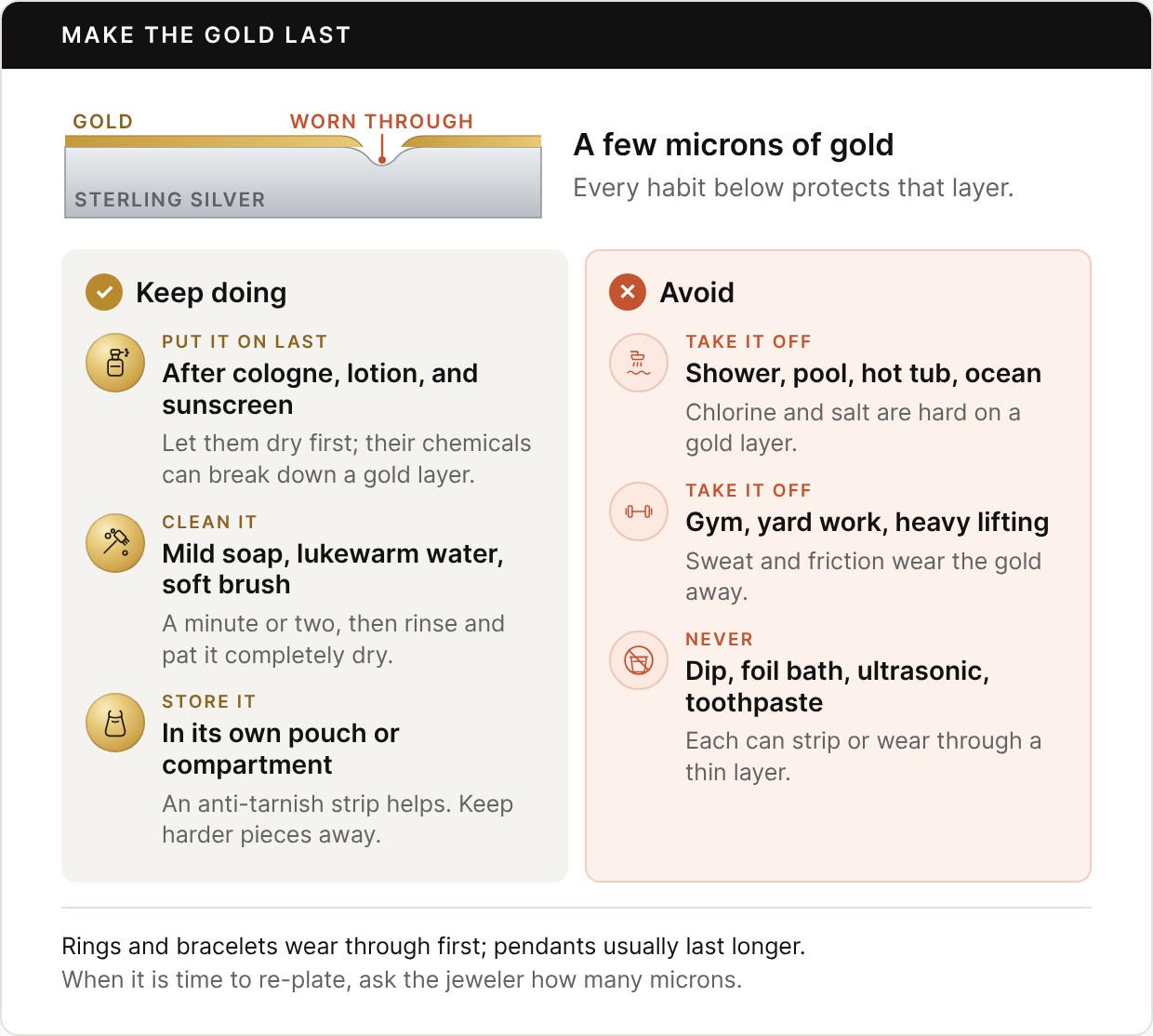
- Put it on last. Perfume, lotion, and sunscreen can “break down the gold layer over time,” Robinson’s warns. Ross-Simons calls its rule “Last On, First Off”: on once everything has dried, and off first at night.
- Keep it out of water. Showers, pools, and hot tubs are “vermeil no-gos,” in Robinson’s words, and “Chlorine and salt are particularly aggressive.” If it does get wet, dry it straight away, as Jewelers Mutual advises. Our guide to whether sterling is waterproof covers plated pieces too.
- Take it off to work out or work outside. The sweat and oils from mowing the lawn or gardening “can be enough to impact gold plating,” Jewelers Mutual says, let alone the gym.
- Wash it gently. A few drops of mild dish soap in lukewarm water, a minute or two, a very soft brush, a rinse, and then pat it “completely, totally, unmistakably DRY,” as Robinson’s puts it. Don’t leave it to soak for long: Jewelers Mutual warns that “prolonged soaking can damage the jewelry.” If the maker gives care instructions, follow those first.
- Skip silver cleaners and home remedies. Jewelers Mutual lists baking soda, hot water, vinegar, and hydrogen peroxide among the home remedies that “can damage gold plating,” and Robinson’s rules out toothpaste and abrasive polishes. A silver dip or a baking soda and foil bath is made for bare silver, as our cleaning guide explains, and an ultrasonic cleaner can “speed up the wearing away of any plating,” says Blue Nile.
- Polish lightly, if at all. Jewelers Mutual suggests a gold polishing cloth, itself mildly abrasive, used with light pressure, and Finematter says a gentle polishing cloth is fine on vermeil. Keep the treated side of a silver cloth off the gold, as our two-tone pendant guide advises.
- Store it on its own. A soft pouch or a compartment of its own keeps harder pieces from scratching it, and Robinson’s says to keep the anti-tarnish strips that come in some boxes.
Re-plating: when, and what to ask
When silver starts to show through, a jeweler can re-plate the piece: it is cleaned, then given a new coat of gold in a plating bath, as Finematter describes. Jewelers Mutual recommends it, Robinson’s offers it, and Quick Jewelry Repairs re-plates vermeil itself. Three things decide whether it is worth doing:
- The thickness you ask for. The thicker the gold, the higher the price, Jewelers Mutual notes, and a layer that is too thin means re-plating again sooner. Ask for the number in microns; Finematter recommends 3 for rings and bracelets.
- What the piece is worth. Ross-Simons suggests weighing the cost against the piece’s value: a premium design on sterling is often worth a fresh layer, while a simple fashion piece may be more practical to replace. Under the gold, vermeil is solid sterling, with the metal value our guide to what sterling is worth shows how to estimate.
- The warranty. Ask the maker whether it re-plates its own pieces before you go elsewhere: some makers’ warranties exclude damage from work done elsewhere, so check the terms first.
Two limits. Gold-filled can’t be refilled: once its layer wears through, re-plating makes it a gold-plated piece, as Finematter notes. And if you would rather go back to silver, Quick Jewelry Repairs doesn’t recommend rhodium plating straight over vermeil, which can peel or flake; some jewelers can polish off what is left of the gold first.
Which to buy: vermeil, gold-plated, gold-filled, or solid
If you want gold on a chain, a ring, or a bracelet, here is how the choices compare:
| Choice | Best for | Keep in mind |
|---|---|---|
| Vermeil | Best forA gold chain or pendant worn often, kept out of water and the gym | Keep in mindIt will need re-plating in time, rings and bracelets first |
| Gold-plated silver, no thickness given | Best forTrying the look, or a piece worn now and then | Keep in mindOften thin: the FTC’s example for electroplate is 0.175 micron, and “gold over” promises no thickness at all |
| Gold-filled | Best forA gold chain or bracelet worn most days, on a smaller budget than solid gold | Keep in mindThe core is usually brass, and it can’t be refilled once worn through |
| Solid karat gold | Best forA ring or bracelet worn every day for decades | Keep in mindThe price |
| Solid sterling silver | Best forThe silver look, with nothing to wear through | Keep in mindIt tarnishes, and a polishing cloth brings it back |
For a heavy chain worn every day, such as a Cuban or a rope chain, gold-filled or solid gold is the durable route, and vermeil the gold-on-silver choice with a floor. Our guides to Cuban link chains and rope chains cover width and weight, and our guide to mixing silver and gold covers wearing the two together.
What to ask before you buy
- Is it vermeil, and in what karat? “Gold plated” and “gold over” promise less.
- How thick is the gold, in microns? Vermeil means at least 2.5 microns of fine gold.
- Is there a barrier layer, and of what? Palladium, or nickel, which matters if your skin reacts to it.
- Does the warranty cover the gold, and does the maker re-plate?
Jewelers Mutual’s advice is to “ask your jeweler about the specific gold content before purchasing to ensure the price matches the quality.” Get the answers in writing, on the listing or the receipt.
FAQ
Is gold vermeil real gold?
The surface is. Under the FTC’s Guides, vermeil is sterling silver plated with real gold of at least 10 karat, equal to at least 2.5 microns of fine gold. Underneath it is silver, so it isn’t solid gold, and its 925 stamp refers to the silver.
Does gold vermeil tarnish?
Gold itself resists tarnish, though lower karats less so. The silver under it can tarnish: where the gold has worn through, and, without a barrier layer, as silver migrates into the gold. A gentle wash with mild soap and dry storage help keep it bright. Darkening that a wash won’t lift usually means the gold is thin or worn, and re-plating is the fix.
Can you shower with gold vermeil?
Better not. Showers, pools, hot tubs, and salt water are hard on a gold layer, so take it off, and dry it at once if it gets wet.
How long does gold vermeil last?
It depends on the thickness and the piece. One re-plating service estimates 1 to 2 years on rings and bracelets for 2-micron plating and 2 to 3 years for 3 microns, and vermeil starts at 2.5. Necklaces and pendants usually last longer, and with care, one jeweler says, vermeil can last “for years and years.”
Is vermeil or gold-filled better?
Gold-filled usually lasts longer: its gold is bonded with heat and pressure and makes up at least a twentieth of the metal’s weight. Vermeil has a sterling silver core, so it keeps its silver value, and when the gold wears, silver shows rather than brass.
Can gold vermeil be re-plated?
Yes. A jeweler cleans it and plates it again. Ask how many microns you are getting: thicker costs more but lasts longer, and Finematter recommends 3 microns for rings and bracelets.
What does “18K gold over sterling” mean?
Sterling silver with an 18K gold surface. “Over” is one of the terms for which the FTC set no minimum thickness, so ask how thick the gold is. On sterling, “vermeil” or “heavy gold electroplate” is the term that means at least 2.5 microns of fine gold.
Bottom line
Vermeil and gold-plated silver are the same idea, gold over sterling, and the label decides how much gold you can count on: at least 2.5 microns of fine gold for vermeil, a benchmark of 0.175 micron for gold electroplate, and no minimum at all for “gold over.” Ask for the microns, put it on after cologne, keep it out of water and the gym, and expect rings and bracelets to need re-plating first. For gold that lasts decades, look at gold-filled or solid gold; for nothing to wear off at all, solid sterling.


From the collection
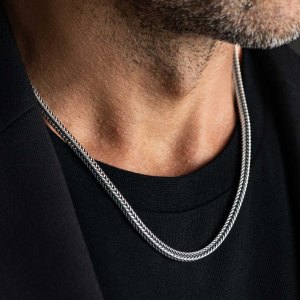
Men’s sterling silver chains by Ronatelli
Ten handmade 925 chains, from a 2 mm snake chain to a 7 mm curb, nine of them in 20, 22, 24, and 26 inches. Every length is the same price.
Related guides
Label definitions and minimums follow the FTC’s Guides for the Jewelry, Precious Metals, and Pewter Industries (16 CFR 23.3 and 23.4) and its 2018 statement on their revision. Lifespans, wear, care, and re-plating follow Jewelers Mutual (October 18 and December 2, 2024; February 24, 2025; July 27, 2026), Robinson’s Jewelers, Ross-Simons, Finematter, Quick Jewelry Repairs, and Blue Nile; darkening and barrier layers follow Arthur S. Kushner’s columns in Products Finishing (October 2013 and February 2014). The fine-gold arithmetic is ours, from the FTC’s own footnote. Chain prices and lengths in the collection box were read from ronatelli.com. All were checked on October 31, 2026. Read our editorial policy.

