Rhodium is the bright white coat on most white gold and on plenty of sterling silver, and black rhodium is one way to give a ring or chain an even dark gray to black finish. Both are thin platings over the silver, and both wear. This guide covers why silver gets plated, how to tell whether yours is, how long white and black rhodium last, what wears them faster, how to clean them, and when re-plating is worth it.
Key takeaways
- Rhodium is a hard, white metal of the platinum group, plated over sterling in a layer usually about 1 micron thick or less.
- While it lasts, it keeps sterling bright white and slows tarnish. Under the FTC’s Jewelry Guides, sellers should disclose it, on sterling as on white gold.
- On a ring worn every day, jewelers’ estimates run from about 6 months to 3 years. Pieces worn now and then keep it for years.
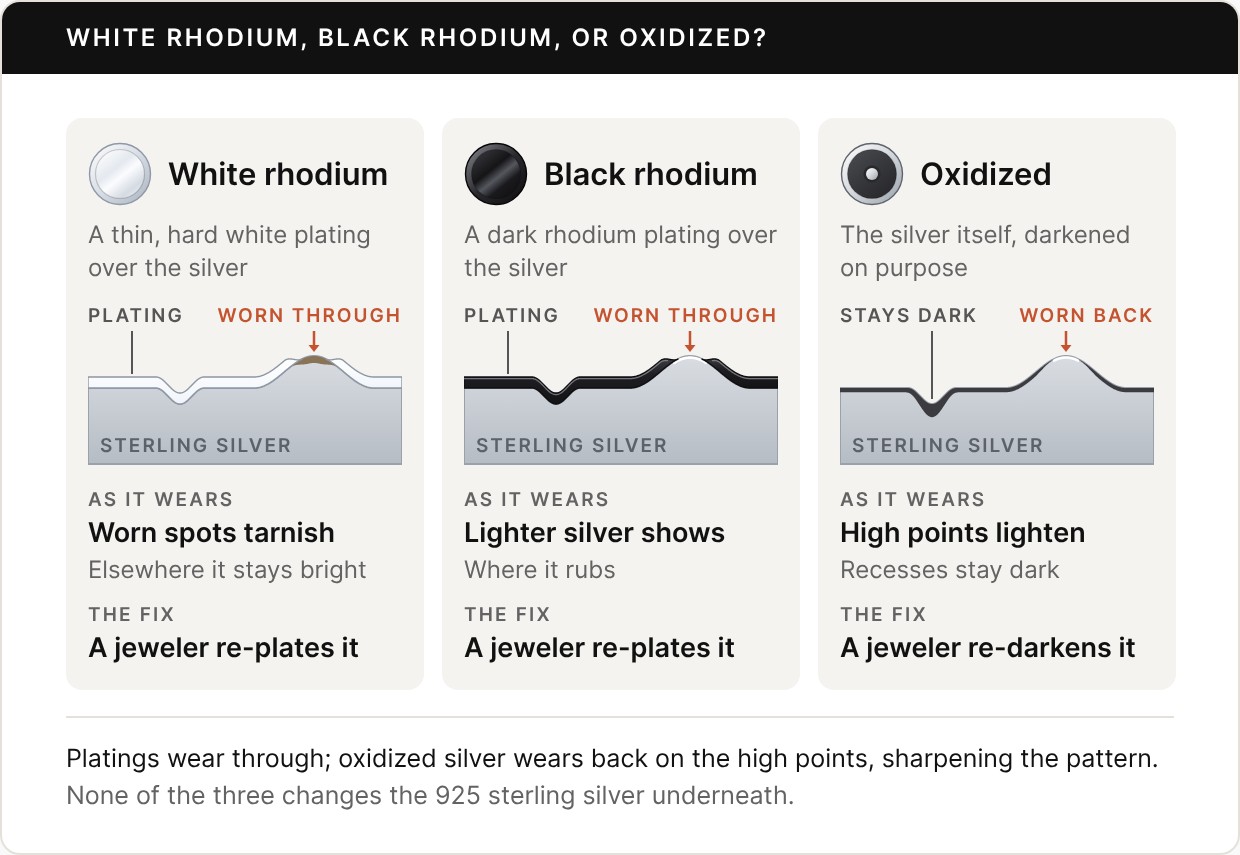
- Black rhodium wears the same way, showing the lighter silver underneath at the edges and contact points; one repair service puts it at 6 months to 2 years. Oxidized silver isn’t a plating: its dark sits in the recesses, so wear brightens the high points and sharpens a pattern instead of exposing another layer.
- Clean it with mild soap and water. Keep the treated side of a polishing cloth, silver dips, and the foil bath away from it.
- Re-plating is routine: a jeweler cleans the piece, polishes out light scratches, and plates it again.
In this guide What it is The label How to tell How long What wears it Black finishes Cleaning Re-plating Is it worth it? FAQ
What rhodium plating is, and why silver gets it
Rhodium is “a rare, bright white, hard, brittle and expensive metal,” as the jewelry insurer Jewelers Mutual describes it, and a member of the platinum family. It is too brittle to make jewelry from, so it is electroplated over another metal in a very thin layer: “typically not exceeding 1 micron,” according to Gabriel & Co., and 0.75 to 1.0 micron, according to Robinson’s Jewelers. For comparison, vermeil must carry the equivalent of at least 2.5 microns of fine gold, as our guide to gold vermeil vs. gold-plated silver explains.
On sterling silver, the plating does three things:
- It brightens the color. “Like white gold, silver is sometimes plated with rhodium to give it a bright, mirror-like shine,” GIA notes, and because rhodium doesn’t tarnish, the piece keeps that look. Our sterling vs. white gold guide compares the two.
- It slows tarnish. The plate isolates the silver from the sulfur compounds in the air that cause tarnish, the Toronto jeweler Skyjems explains, though “sulphur compounds can migrate through scratches and through any thin spots in the plate.” Our guide to why sterling tarnishes covers the chemistry.
- It can cover firescale. Makers of production silver often plate it with silver or rhodium to hide firescale, a stain that heating can leave in the alloy, as the goldsmith Charles Lewton-Brain writes on Ganoksin. Our guide to whether sterling wears off explains what shows through when that plating wears.
DermNet, the dermatology reference, names rhodium as a non-allergic metal a jeweler can plate over a ring that causes a reaction, though it shields the skin only while it lasts, as our guide to whether sterling is hypoallergenic explains.
What the label should tell you
Under the FTC’s Jewelry Guides, “It is unfair or deceptive to fail to disclose a surface-layer application of rhodium on products marked or described as precious metal.” That includes sterling. When the FTC added this guidance in 2018, one commenter argued that disclosure on sterling adds nothing, since rhodium looks like untarnished silver and its wearing off causes no immediate change in color. The FTC declined to make an exception: without disclosure, its statement on the revision says, consumers “may not know that the product’s initial color (in this case, an apparently non-tarnished silver) is not permanent and will require re-plating to restore its appearance.”
The Guides set no minimum thickness for rhodium, as they do for vermeil, though the same statement says sellers “must assure the reasonable durability of rhodium coatings.” So any thickness figure has to come from the seller; ask for it in microns, as our guide to platinum-plated vs. sterling silver advises for platings generally. “Rhodium-plated” also doesn’t say what is underneath, Skyjems notes: it can be white gold, silver, or base metal, so check for a 925 stamp as well, as our guide to what 925 means explains.
How to tell if your silver is rhodium-plated
- Read the listing or receipt. Under the Guides, rhodium on a piece sold as silver should be disclosed.
- Look at the color. Rhodium reads as a cooler, whiter white than bare sterling, which GIA describes as a crisp, cool white, often with subtle gray undertones. Because rhodium doesn’t tarnish, a plated piece keeps that look. The difference is subtle, so check the listing too.
- Watch for tarnish. Rhodium doesn’t tarnish, so a plated piece stays bright, and a clean white cloth rubbed on it comes away clean, where bare sterling usually leaves a gray mark, as our guide to telling if silver is real explains. Don’t use the treated side of a polishing cloth for this.
- Check where it rubs. On a piece that is bright white everywhere else, a darker or warmer patch at a rub point, such as the bottom of a ring’s shank or the contact faces of bracelet links, usually means the plating has worn through and the silver beneath has started to tarnish. Skyjems calls it a “visible tonal step between worn and unworn areas.” On bare sterling, darkening inside a band or in the recesses is ordinary tarnish.
How long rhodium plating lasts
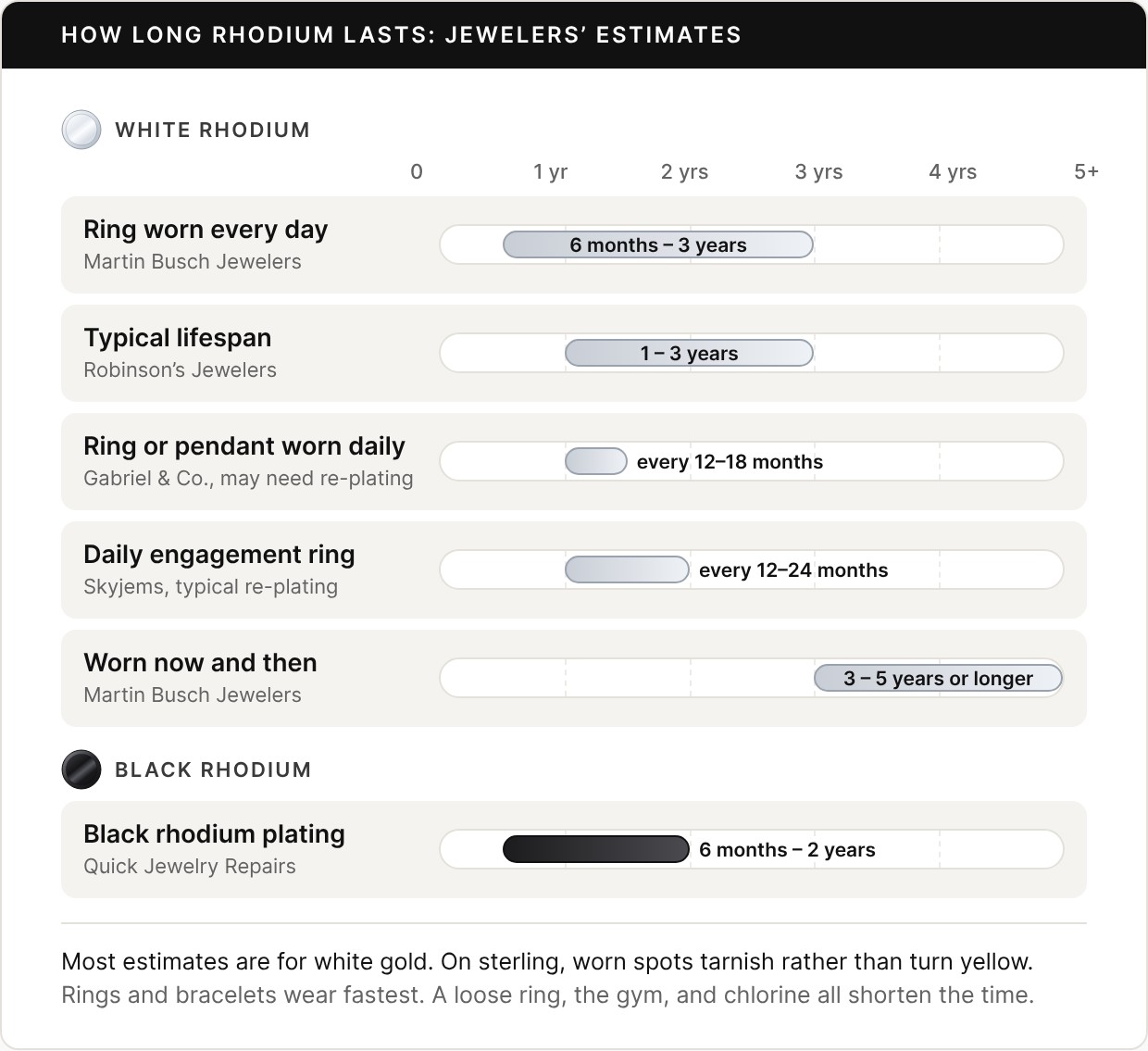
There is no fixed lifespan, and the estimates jewelers publish are mostly written for white gold rings. Rhodium on sterling is the same kind of thin layer and wears at the same points; how long it lasts depends on its thickness, which sellers don’t always state:
| Source | Piece | Estimate |
|---|---|---|
| Martin Busch Jewelers | PieceRings worn every day | Estimate6 months to 3 years |
| Martin Busch Jewelers | PieceJewelry worn occasionally | Estimate3 to 5 years or longer |
| Robinson’s Jewelers | PieceAverage lifespan; a band worn around the clock | Estimate1 to 3 years; “sometimes even annually” for the band |
| Gabriel & Co. | PieceDaily-wear rings or pendants | EstimateMay need re-plating every 12 to 18 months |
| Gabriel & Co. | PieceOccasional wear, with proper care | Estimate“Several years, even up to a decade” |
| Skyjems | PieceEngagement rings worn daily | EstimateRe-plate every 12 to 24 months |
| Quick Jewelry Repairs | PieceBlack rhodium | Estimate6 months to 2 years |
For a man’s pieces, that suggests a ring worn every day will want re-plating every year or two, as our ring buying guide says. A pendant meets far less friction, and plated pendants “often maintain their radiance for longer” than rings and bracelets, as the jewelry retailer Ross-Simons notes of plated jewelry in general, though Gabriel & Co. groups daily-wear pendants with rings. On sterling there’s no yellow to give it away: the usual first sign is a duller or darker patch where the plating has worn, as the exposed silver starts to tarnish.
What wears rhodium faster
Two people can wear identical rings and see “completely different plating lifespans,” Martin Busch Jewelers says, because of body chemistry alone. The main factors, from Martin Busch and Robinson’s:
- Friction. Typing, weightlifting, gardening, cooking, driving, tools, and sports all wear it; “Even repeatedly gripping a steering wheel can contribute,” Martin Busch notes. Jobs that are hard on the hands, from mechanic to chef, wear it faster.
- Skin chemistry. “Higher skin acidity,” oilier skin, and heavier sweating can speed it up.
- Chemicals. Hand sanitizer, lotion, sunscreen, cleaning products, chlorinated pools, and cologne. Robinson’s calls chlorine, cleaning products, and salty air rhodium’s kryptonite.
- A loose ring. “A loose ring tends to rotate constantly around the finger,” adding friction, Martin Busch says.
- Stacking. “Metal-on-metal friction will wear down rhodium faster,” Robinson’s warns of stacked rings. The same goes for a plated bracelet worn against a watch, as our guide to wearing a bracelet with a watch explains.
- Never taking it off. Wearing it to sleep, shower, exercise, and clean the house all adds up, Martin Busch notes.
Black rhodium, ruthenium, and oxidized silver
Three finishes give silver a dark look, and they behave differently. Black rhodium is a rhodium plating made with additives that produce a darker deposit, and ruthenium is a plating of a dark gray platinum-group metal, usually 0.1 to 0.3 micron thick, according to Skyjems. Oxidized silver isn’t a plating at all: it is the silver’s own surface darkened on purpose, as our guide to oxidized silver chains explains.
| Finish | What it is | How it wears | How long | The fix |
|---|---|---|---|---|
| White rhodium | What it isA thin white plating | How it wearsThrough, at the points that rub; the silver beneath then tarnishes | How longAbout 6 months to 3 years on a daily ring | The fixRe-plating |
| Black rhodium | What it isA dark rhodium plating | How it wearsThrough, at the edges and contact points, showing lighter silver | How long6 months to 2 years, per Quick Jewelry Repairs | The fixRe-plating |
| Ruthenium | What it isA dark gray platinum-group plating | How it wearsThrough, at the contact areas first | How longNo estimate in our sources | The fixStripping, polishing, and re-plating |
| Oxidized | What it isThe silver’s own surface, darkened | How it wearsBack, on the high points; the recesses stay dark | How longVaries with wear | The fixA jeweler or silversmith re-darkens it |
Skyjems ranks ruthenium as harder and more wear-resistant than black rhodium. Jewelers Mutual cautions that neither is “particularly scratch resistant” and advises planning on regular maintenance. Either way, a plating wears through at the edges and contact points, while an oxidized finish, which Skyjems rates softer than either plating, wears back on the high points as the recesses stay dark. That is why our guide to whether sterling wears off calls wearing off the point of an oxidized finish. One label to read carefully: pieces sold as “black gold” are “almost invariably ruthenium- or black-rhodium-plated,” Skyjems notes.
How to clean rhodium-plated silver
Rhodium doesn’t tarnish, so a plated piece needs cleaning, not polishing, as our cleaning guide explains:
- Wash it. A few drops of mild dish soap in warm water, a few minutes’ soak, then your fingers or a very soft toothbrush, as Robinson’s describes. Rinse well and pat it dry with a soft, lint-free cloth.
- Use only the soft side of a polishing cloth. The treated side carries a polish meant for bare silver; our guide to scratches on a silver ring says to leave fine scratches in plating alone and let a jeweler refinish deep ones.
- Skip dips and the foil bath. Our cleaning guide warns that both can dull or wear the plating. Gabriel & Co. adds household cleaners and chlorine to the list.
- Keep it out of the ultrasonic. An ultrasonic cleaner can “speed up the wearing away of any plating,” says Blue Nile; our ultrasonic guide covers which silver can go in. Skyjems gives the same care advice for ruthenium: mild soap, a soft cloth, and no abrasive compounds or chemical jewelry cleaners.
Day to day, Robinson’s rule is to put jewelry on last, after cologne and lotion, and take it off first for chores, swimming, and working out. Store each piece on its own, in a soft-lined box or a pouch, so harder pieces can’t scratch it.
Re-plating: what it involves and when to do it
When the plating has worn, a jeweler can renew it. To re-plate a piece, Martin Busch Jewelers says, a jeweler will typically clean it thoroughly, polish away minor scratches, inspect the setting if there is one, apply fresh rhodium by electroplating, and buff the surface. For ruthenium, Skyjems describes the job as stripping what is left, polishing, and re-plating.
- When. On sterling, when tarnish shows in the worn spots or the piece has lost its shine. Robinson’s lists loss of luster, fine scratches, and a patchy look among the signs.
- Not on a schedule. Re-plating usually starts with light polishing, and “excessive polishing over many decades can gradually remove tiny amounts of metal,” Martin Busch notes, so “it’s best to have replating performed only when needed.”
- Cost. Robinson’s Jewelers, in a December 2025 post, puts the typical cost at $50 to $150, “depending on the size and complexity of the piece.” Quotes vary widely, so ask your jeweler, and ask whether a warranty or protection plan covers it; coverage varies, Martin Busch notes.
- After a repair or resizing. Rhodium tends to burn “to a hard and nasty black color” when heated during a repair, Lewton-Brain writes, so a plated ring that is resized or soldered needs refinishing and re-plating afterward, as our guide to resizing a silver ring notes.
Is rhodium-plated sterling worth it?
It depends on how you wear the piece, and on whether you would rather polish or re-plate:
| Choice | Best for | The trade-off |
|---|---|---|
| Rhodium-plated sterling | Best forA pendant or chain you want bright with no polishing | The trade-offRe-plating in time: about every year or two on a ring or bracelet worn daily, usually longer on a pendant or chain |
| Bare sterling | Best forA ring worn every day, or anyone happy to use a polishing cloth | The trade-offIt tarnishes, but the color is the metal itself, so there is nothing to wear through |
| Black rhodium or ruthenium | Best forAn even, dark finish | The trade-offLighter silver shows at the edges as it wears; plan on re-plating |
| Oxidized sterling | Best forA dark look that ages with you | The trade-offThe high points lighten over time, which sharpens the pattern |
For a wedding band or another ring you never take off, bare sterling is usually the easier keep, as our guides to sterling wedding bands and wearing a silver ring every day explain. If tarnish is what bothers you, rhodium is worth it on pieces that don’t rub much.
FAQ
Does rhodium-plated silver tarnish?
Rhodium itself doesn’t tarnish, so a well-plated piece stays bright, though tarnish can creep in through scratches and thin spots. Where the plating wears through, the sterling underneath tarnishes as usual, which is often the first sign that the piece needs re-plating.
How long does rhodium plating last on sterling silver?
It depends on the piece and how it’s worn. Jewelers’ estimates for a ring worn every day run from about 6 months to 3 years. A pendant meets less friction and often keeps it longer, though Gabriel & Co. still puts a daily-wear pendant at 12 to 18 months. Pieces worn now and then keep it for years.
Is rhodium-plated sterling silver real silver?
Yes, if it is sterling underneath: under the plating it is still 925 silver, so look for the stamp. Under the FTC’s Guides, the rhodium layer should be disclosed.
Can I use a polishing cloth on rhodium-plated silver?
Only the soft, untreated side. The treated side carries a polish meant for bare silver and can wear a thin plating. Mild soap and water is all a plated piece needs.
Can I shower with rhodium-plated jewelry?
Better not. Wearing it to shower, exercise, and clean adds to the wear, Martin Busch Jewelers notes, and chlorine and cleaning products are among the worst things for it.
Is black rhodium the same as oxidized silver?
No. Black rhodium is a plating over the silver, and it wears through at the edges and contact points. Oxidized silver is the silver’s own surface, darkened, and it wears back on the high points while the recesses stay dark.
How much does rhodium re-plating cost?
Robinson’s Jewelers, in a December 2025 post, puts the typical cost at $50 to $150, depending on the size and complexity of the piece. Quotes vary widely, so ask a local jeweler.
Bottom line
Rhodium keeps sterling bright and largely tarnish-free for as long as it lasts, which is roughly a year or two on a ring worn every day, and often longer on a pendant. Clean it with soap and water, keep dips and the treated side of the cloth away from it, and re-plate it when tarnish starts showing in the worn spots. If you’d rather never re-plate anything, wear bare sterling and keep a polishing cloth handy.
From the collection
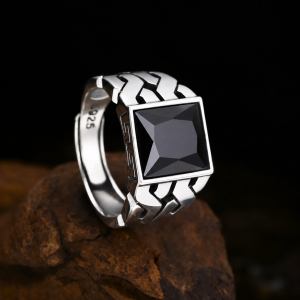
Men’s sterling silver rings by Ronatelli
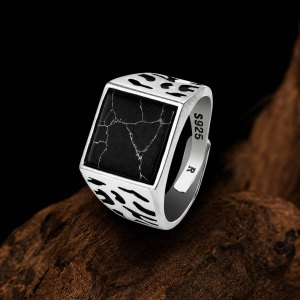
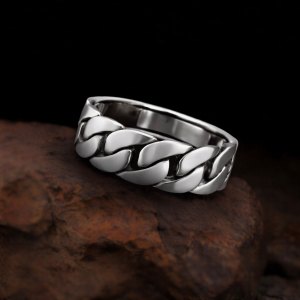
Eleven handmade 925 rings, $129 to $169, from a chain-link band to a black onyx statement ring. Every one is adjustable.
Related guides
The disclosure guidance and the vermeil comparison follow the FTC’s Guides for the Jewelry, Precious Metals, and Pewter Industries (16 CFR 23.4 and 23.7) and its 2018 statement on their revision. What rhodium is, how thick it is, how long it lasts, what wears it, and re-plating follow Jewelers Mutual, Gabriel & Co., Robinson’s Jewelers, Martin Busch Jewelers, Skyjems, and Quick Jewelry Repairs; firescale and heating follow Charles Lewton-Brain on Ganoksin; color follows GIA; rhodium and skin follow DermNet; the ultrasonic warning follows Blue Nile, and the note on pendants Ross-Simons. Ring prices and sizing in the collection box were read from ronatelli.com. All were checked on October 31, 2026. Read our editorial policy.

