Yes, you can wear a chain to a job interview, as long as it stays under your shirt. Career offices keep the list short: a watch and one simple ring, usually a wedding or class ring. Once you have the job, taste stops being the only test. In a kitchen, near live electrical parts, around machinery, and in some hospitals, a rule or safety guidance decides what comes off. This guide covers the interview first, then the jobs with rules, and religious pieces such as a cross.
Key takeaways
- At the interview, a slim chain under a buttoned shirt is fine. On show, it competes with you for attention, so in a conservative field keep it hidden.
- The jewelry career offices accept is short: a conservative watch and one simple ring, usually a wedding or class ring. Silence a smartwatch.
- When you prepare food, the FDA Food Code allows no jewelry on the arms and hands except a plain ring such as a wedding band.
- Where jewelry might touch exposed live electrical parts, OSHA bars conductive pieces, rings, watch bands, bracelets, and necklaces included, unless they’re insulated.
- Around machines and tools, safety guidance says take it all off: a ring caught on equipment can cause a serious injury called a ring avulsion.
- Hospitals set their own rules. Some follow “bare below the elbows,” which means no watch and no jewelry in patient care.
- A cross or other piece you wear for your faith is different: an employer with 15 or more employees generally has to make an exception to its dress code unless that would be an undue hardship.
In this guide Short answer The interview At work Food Electrical Machinery Healthcare Religious pieces FAQ
The short answer: one chain, under the shirt
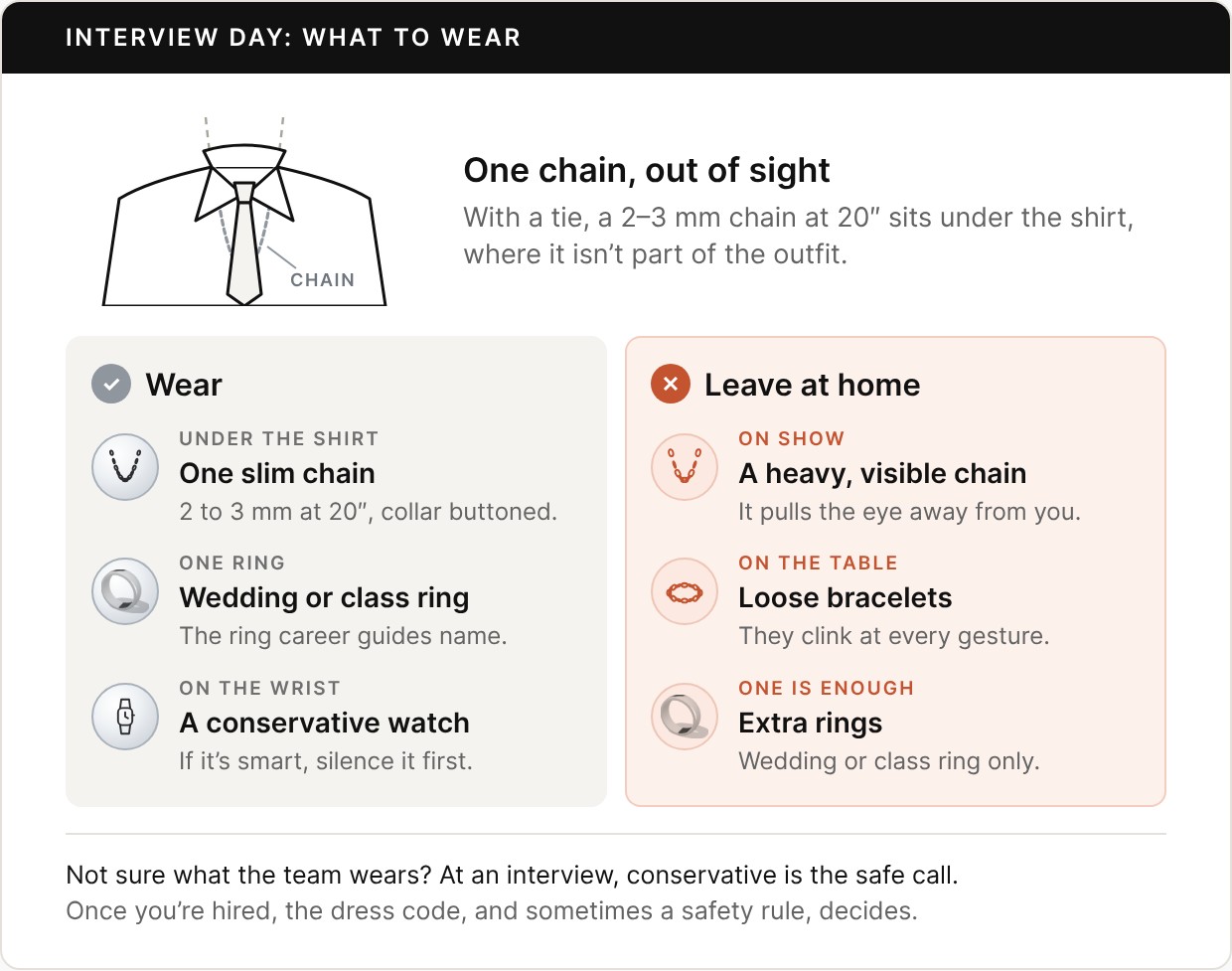
For an interview, the safe set is small. Arizona State University’s career guide puts it in one line: “Limited jewelry such as a watch and a simple ring are appropriate.” Hendrix College’s career office is stricter: men “should avoid wearing any jewelry unless it is a wedding ring, class ring or metal watch.” A chain isn’t on either list, but under a buttoned collar it isn’t part of the outfit either. With a tie, a 2 to 3 mm chain at 20 inches stays out of sight on most men, as our guide to wearing a chain with a suit explains.
At the interview: what career offices advise
“‘Appropriate’ dress varies from workplace to workplace, but when it comes to dressing for an interview, conservative attire is always a wise choice,” ASU’s guide says. The University of Central Florida’s College of Business adds the other half: “Observe other men in your industry to see what is acceptable.” Piece by piece:
- The chain. One slim chain, 2 to 3 mm, at 20 inches, under a buttoned shirt and tie. Without a tie, check the mirror: if the chain shows at the open collar and the field is conservative, leave it at home for this one meeting. Our chain width guide covers how each width reads.
- The ring. A wedding band or a class ring. “Do not wear any rings other than wedding or college ring,” Southwest Tennessee Community College’s career office advises. Once you’re hired, a plain band or a slim signet, with nothing raised, is the quiet office choice in our guide to wearing a ring with a suit.
- The watch. “Wear a conservative watch,” UCF’s guide says. If it’s a smartwatch, silence it: Gentleman’s Gazette tells readers to silence all tech devices before an interview.
- The bracelet. It isn’t on any of the career lists. If you wear one, keep it slim and under the shirt cuff, where it can’t clink on the table; our guide to a bracelet with a suit covers the fit.
- Earrings. All five career offices we read advise against them: ASU, Hendrix, Virginia State, and Southwest Tennessee say take them out, and UCF calls removing them “safest.”
The reason is attention. “The interviewer should be focused on you, not exclusively on your clothes,” Gentleman’s Gazette writes, counting “over-the-top accessories like excessive jewelry” among the distractions. Once you have the offer, look at what the team wears; our guides to the chain, the ring, and the bracelet with a suit cover the office day to day.
At work: where safety or hygiene decides
In some jobs, jewelry is a safety or hygiene question, not a style one:
| Work | Who sets it | What it covers |
|---|---|---|
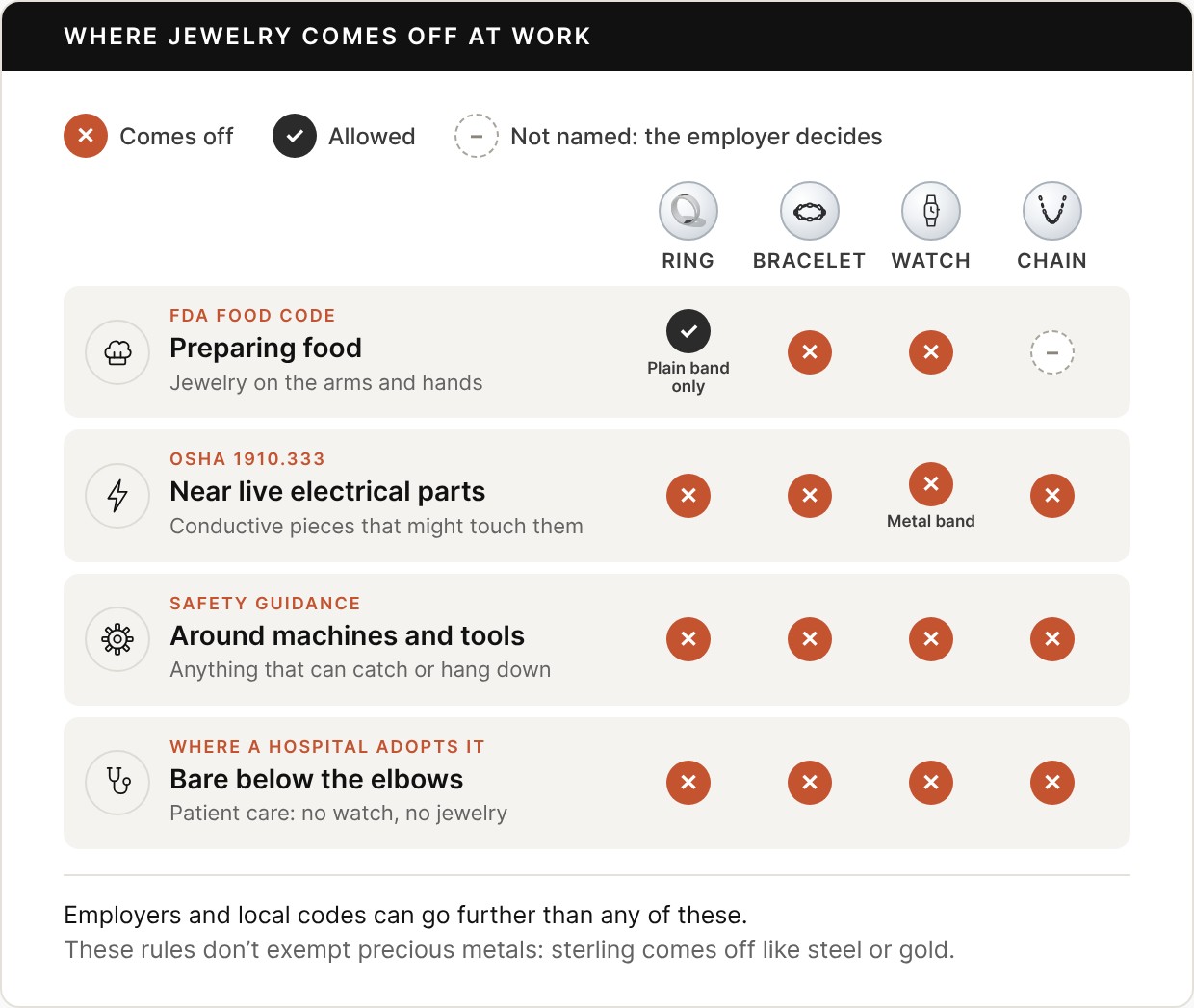
| Preparing food | Who sets itThe FDA Food Code, as adopted by your state or local health department | What it coversJewelry on the arms and hands; a plain ring such as a wedding band may be worn |
| Food plants | Who sets itFDA’s manufacturing rule, 21 CFR 117.10 | What it coversUnsecured jewelry, and hand jewelry that can’t be sanitized while handling food |
| Near exposed live electrical parts | Who sets itOSHA, 29 CFR 1910.333 | What it coversConductive rings, watch bands, bracelets, and necklaces that might touch live parts, unless insulated |
| Machines, tools, and equipment | Who sets itSafety guidance and your employer’s rules | What it coversAnything that can catch or hang down: rings, bracelets, watches, chains |
| Hospitals and clinics | Who sets itEach facility’s policy | What it coversVaries; “bare below the elbows,” as SHEA defines it, means no watch and no jewelry in patient care |
| Offices and customer-facing jobs | Who sets itThe employer’s dress code | What it coversWhatever the code says, with exceptions for religious items |
Food service: a plain band only
The FDA Food Code is a model that states and local governments adopt as their own food rules. The newest edition, issued in September 2026, says food employees “may not wear jewelry on their arms and hands while preparing food,” and adds: “A plain ring, such as a wedding band, may be worn.” Earlier editions, the ones today’s state and local codes were built on, say the same in one sentence and name medical information jewelry too.
The code’s annex gives two reasons. Rings, bracelets, and watches “may collect soil and the construction of the jewelry may hinder routine cleaning,” so they can carry germs into food, and “pieces of the item or the whole item itself may fall into the food being prepared.”
- A plain silver band fits the exception. Minnesota’s version spells it out as “a plain ring such as a flat, smooth band.” A chain-link, braided, or stone ring isn’t a flat, smooth band, and its crevices are the kind of construction the annex says can hinder cleaning.
- Bracelets and watches come off while you prepare food.
- A chain isn’t named. The rule stops at the arms and hands, so a chain under a uniform is the employer’s call.
- Medical ID. Under the 2026 edition, a worker with a disability covered by the ADA “may be allowed to wear a medically necessary device that can be kept clean,” and the annex suggests resolving a medical alert bracelet through reasonable accommodation, for example by wearing the information “in the form of a necklace or anklet.”
Food plants follow a separate FDA rule, 21 CFR 117.10. Anyone working in direct contact with food or packaging removes “all unsecured jewelry and other objects that might fall into food, equipment, or containers,” and, while handling food by hand, any hand jewelry that can’t be adequately sanitized. Hand jewelry that can’t come off may be covered with material that stays intact and clean. If a plain band is the one ring you keep on, our guide to sterling wedding bands covers how a silver one wears.
Electrical work: OSHA names the jewelry
OSHA’s electrical work-practice rule, 29 CFR 1910.333, is specific: “Conductive articles of jewelry and clothing (such as watch bands, bracelets, rings, key chains, necklaces, metalized aprons, cloth with conductive thread, or metal headgear) may not be worn if they might contact exposed energized parts.” The same paragraph allows them if they are “rendered nonconductive by covering, wrapping, or other insulating means.”
Silver conducts electricity, like every metal; our MRI guide explains why that matters in a scanner. So before work where they might touch exposed live parts, the ring, a metal watch band, and the chain come off, or get covered the way the rule allows.
Machines, tools, and the trades
Most machine work has no jewelry rule as specific as OSHA’s electrical one, but the safety advice is consistent. A ring avulsion, an injury that happens when a ring is pulled with force, is rare but serious, Cleveland Clinic says, and workplace accidents, “like getting your ring caught in a machine or equipment,” are among the common causes. Its advice: remove “your rings and jewelry before working with tools, equipment or doing anything that might tug on your fingers and hands.” Our guide to wearing a silver ring every day covers the same risk at the gym.
It doesn’t take a big machine. UC Berkeley’s Office of Environment, Health & Safety reported a case in 2013: an employee jumping down from the bed of a pickup put his hand on a door hinge, and his wedding ring caught on a grease fitting. Its corrective action: “Employees who work around machines and equipment should not wear jewelry on the job site. This includes hand, wrist, and neck jewelry.”
Chains and bracelets are the other half of the problem. The Texas Department of Insurance tells workers to avoid “jewelry that could hang down and get caught in moving parts,” and the safety office of UW–Madison’s College of Agricultural and Life Sciences puts it more bluntly: “Never wear loose clothing, jewelry, or anything that can get caught in machinery.”
If you want to wear a ring at work anyway, ask your employer whether a silicone band is allowed. Cleveland Clinic says there is “some evidence” that silicone rings can prevent ring avulsions, because they break more easily than metal, though experts are still studying them. The silver ring goes back on after the shift.
Hospitals and clinics: the facility decides
There is no single national jewelry rule for healthcare workers. In its 2014 expert guidance on attire, the Society for Healthcare Epidemiology of America (SHEA) defines “bare below the elbows” as short sleeves, “no wristwatch, no jewelry, and no ties during clinical practice,” and says facilities “may consider” adopting it for inpatient care, while noting that the role of attire in spreading infection “remains poorly established.” In a 2013 survey of SHEA members for the guidance (337 responded), 20% said their facility had a policy encouraging the removal of watches and jewelry. Policies differ on rings: in England, NHS guidance lets local policies allow “a single plain metal ring, such as a wedding ring.” Operating rooms are outside SHEA’s guidance; surgical attire, jewelry included, follows separate standards such as AORN’s.
For a clinical job, the interview follows the usual advice. Ask about the jewelry policy before your first shift, not on it.
Religious jewelry: a cross or medal at work
A religious piece gets different treatment from a fashion chain. The EEOC’s guidance on religious dress names “a Christian cross” among its examples. Under Title VII, which covers employers with at least 15 employees, an employer generally has to make an exception to its dress code for a sincerely held religious practice unless that would be an undue hardship. Since the Supreme Court’s 2023 decision in Groff v. DeJoy, undue hardship means a burden that is “substantial in the overall context of an employer’s business.”
- Customer preference doesn’t count. “Customer preference is not a defense to a claim of discrimination,” the EEOC says.
- Safety can, if it’s real. Safety, security, or health can justify a refusal “only if the accommodation would actually pose an undue hardship.”
- Covering is an option only if your faith allows it. An employer may offer to have a religious item covered, such as a cross worn under the shirt, but not where covering it would violate the person’s beliefs.
- A fashion chain gets no exception. An employer may refuse exceptions sought “for non-religious reasons such as personal preference.”
- At an interview. Applicants usually raise it once the employer mentions a dress code that conflicts, the EEOC notes, and no “magic words” are needed.
This is general information, not legal advice. For size and chain choices, see our guides to cross necklaces and saint medals.
FAQ
Can you wear a chain to a job interview?
Yes, under the shirt. With a tie, a 2 to 3 mm chain at 20 inches stays hidden on most men. On show, it competes with you for attention, and career offices advise little jewelry beyond a watch and one simple ring.
Should I take off my wedding ring for an interview?
No. Career offices list a wedding ring among the few pieces to keep on.
Can I wear a cross necklace to a job interview?
Yes, and most men wear it under the shirt for the interview, like any chain. If you wear it for your faith, Title VII generally requires an employer with 15 or more employees to make an exception to a dress code that bans it, unless that would be an undue hardship. A cross worn as fashion doesn’t get that protection, the EEOC says.
Can food workers wear a wedding ring?
A plain one, yes. Under the FDA Food Code, a plain ring such as a wedding band may be worn while preparing food, but no other jewelry on the arms and hands. A local code or an employer can be stricter.
Can electricians wear rings?
Not where the ring might touch exposed energized parts. OSHA’s rule bars conductive jewelry there unless it is covered or insulated. Around tools and machinery, safety guidance says take rings off as well.
Can nurses wear rings?
It depends on the hospital. Under SHEA’s definition of “bare below the elbows,” there is no watch and no jewelry in patient care, though some policies, such as England’s NHS guidance, allow a plain wedding ring.
Is a visible chain unprofessional?
Not everywhere. For an interview, career offices advise little beyond a watch and a ring, and UCF’s guide says anything else should be conservative. Once you’re hired, the dress code and what the team wears decide.
Bottom line
For the interview, wear a watch, a wedding or class ring, and, if you like, one slim chain under a buttoned shirt; leave the rest at home. At work, the dress code decides in an office, but in a kitchen, near live electrical parts, around machinery, and in hospitals that follow bare below the elbows, a rule or safety guidance does, and sterling comes off like any other metal. A piece you wear for your faith gets more room under a dress code: an employer generally has to make an exception unless that would be an undue hardship, and a real safety risk can be one.



From the collection
Men’s sterling silver chains by Ronatelli
Ten handmade 925 chains, from a 2 mm snake chain to a 7 mm curb, nine of them in 20, 22, 24, and 26 inches. Every length is the same price.
Related guides
Interview advice follows the career guides of Arizona State University, Hendrix College, the University of Central Florida College of Business, Virginia State University, and Southwest Tennessee Community College, plus Gentleman’s Gazette. The food rules follow the FDA Food Code (2026 and 2022 editions, §2-303.11 and Annex 3), Minnesota Rule 4626.0095, and 21 CFR 117.10; the electrical rule follows OSHA’s 29 CFR 1910.333; the machinery advice follows Cleveland Clinic, UC Berkeley’s Office of Environment, Health & Safety, the Texas Department of Insurance, and UW–Madison’s CALS Safety; healthcare follows SHEA’s 2014 expert guidance on attire and NHS England’s 2020 uniforms guidance; religious dress follows the EEOC’s guidance and Groff v. DeJoy (2023). Chain details in the collection box were read from ronatelli.com. All were checked on October 31, 2026. This is general information, not legal advice. Read our editorial policy.

