
Wear it in either ear, or in both. The old idea that one side sends a signal faded decades ago. For a first earring, a small sterling stud about 3 to 4 mm across, or a slim huggie, is the easy start, as long as the piercing has healed: sterling silver doesn’t belong in a fresh one. This guide covers which ear, studs versus huggies and hoops, how to size them, which metal to wear and when, and how to look after silver earrings.
Key takeaways
- Either ear, or both. The “right ear” code of the 1970s and ’80s never had one agreed meaning, and by the ’90s many people had forgotten it.
- Start small: a stud about 3 to 4 mm across, or a huggie 8 to 12 mm across. A small hoop, 12 to 20 mm, hangs just below the lobe.
- Sterling silver is for healed ears. Professional piercers start a new piercing in implant-grade titanium or steel or solid gold; silver in a fresh piercing can leave a gray stain in the skin. A lobe takes about six to eight weeks to heal.
- Healed and sensitive? Solid sterling is on the American Academy of Dermatology’s list of metals for people with a nickel allergy. Silver-plated, “silver-tone,” and German silver aren’t, and the backs count too.
- A screw back holds more securely than a push back, which is quicker but can loosen. Clean posts and backs regularly, and keep silver earrings dry and stored apart.
In this guide Which ear Studs, huggies, or hoops Backs Sizes A new piercing Sensitive ears Care At work FAQ
Which ear should a guy wear an earring in?
Either one. No rule decides it today, and the one people half-remember was never consistent. An article in The Point, the journal of the Association of Professional Piercers, traces the idea of a “gay ear” to America in the 1970s and ’80s, when being openly gay was dangerous and coded signals offered some cover. A saying spread with it: “Left is right and right is wrong,” with “wrong” meaning gay. But the meaning changed from place to place, and “many people forgot which ear meant what, as if any ear ever meant anything.” By the article’s account, “as early as the ’90s people had forgotten the meaning,” as piercings became more about punk and youthful rebellion.
The zoologist Desmond Morris made the same point in his book The Naked Man, as quoted by MEL Magazine: “nobody could remember which was supposed to be which,” and in the end “the male earring lost its sexual significance altogether.” Men’s earrings are also much older than the code. Morris notes they were fashionable for men in the Elizabethan era, and the Chandos portrait at London’s National Portrait Gallery, painted around 1610 and very probably of Shakespeare, shows a gold earring in his left ear.
So choose by preference: one earring in either ear, or a matching pair. Earrings are often sold as a pair, so if you wear one, the other is a spare.
Studs, huggies, or hoops?
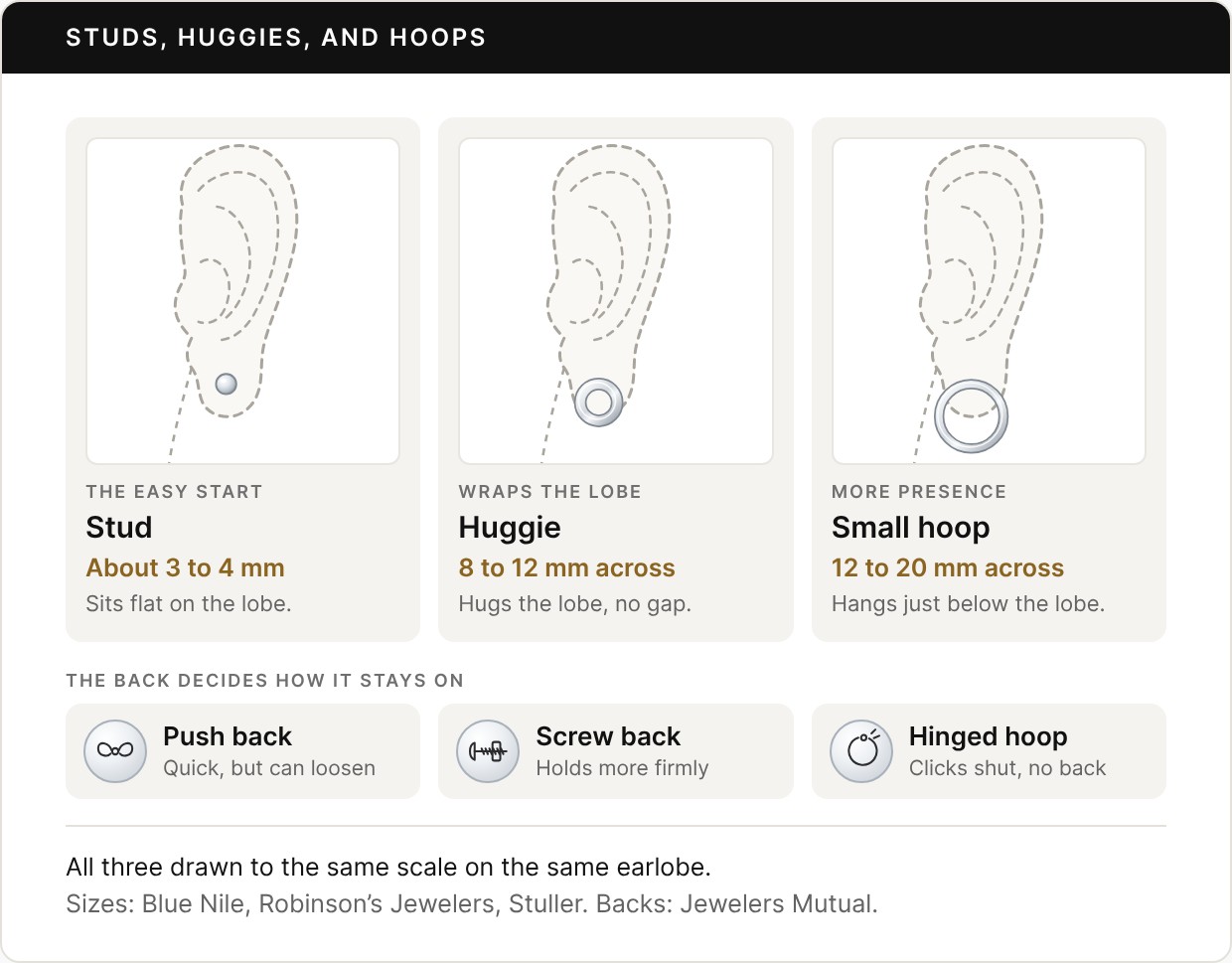
- Studs. A stud sits flat on the lobe: a plain silver dome or disc, a small stone, or a black onyx face, the stone our onyx guide covers. Robinson’s Jewelers calls studs “the perfect starting point” for a man new to earrings: “subtle, comfortable, and nearly impossible to get wrong.”
- Huggies. A huggie is a small, often thicker hoop that wraps the lobe with little or no gap. Blue Nile puts them at about 8 to 12 mm across, and Robinson’s suggests one as a first hoop.
- Small hoops. At 12 to 20 mm across, a hoop hangs just below the lobe, Blue Nile says; medium hoops, 20 to 35 mm, hang farther down. For men, Robinson’s recommends small to medium hoops, slim for everyday wear, and saves thicker or diamond-set hoops for evenings and weekends.
Finish matters as much as size. Plain polished silver is the quietest; a brushed, hammered, or oxidized surface reads more casual, and an oxidized finish needs gentler cleaning, as our guide to oxidized silver explains.
The back decides how it stays on
A stud is only as secure as its back. Jewelers Mutual, the jewelry insurer, compares the common types:
- Push back (also called a friction or butterfly back): easy and discreet, but it grips by friction and can lose its grip with use. Dirt and bacteria build up in its curled wings, and it can poke when you lie down.
- Screw back: the back screws onto a threaded post, which makes it more secure. Jewelers Mutual says it suits sensitive ears because you set the tightness, though it takes more twisting to get on and off.
- Locking back (La Pousette): a disc with side tabs that locks onto the post and is less likely to loosen, but the tabs can be hard to pinch for anyone with stiff fingers.
- Flat back: a flat disc on a thin post, with the earring’s pin-top front pushed in from the front; piercing studios often use it. It is comfortable around the clock, but it takes flat-back earrings, not a standard stud, and a studio may need to trim the post.
- Hinged and latch backs: part of the earring itself, common on huggies and hoops, so there is no separate back to lose.
Clear silicone backs are a useful spare: Jewelers Mutual calls them hypoallergenic and a quick fix for almost any post.
What size earrings should a man wear?
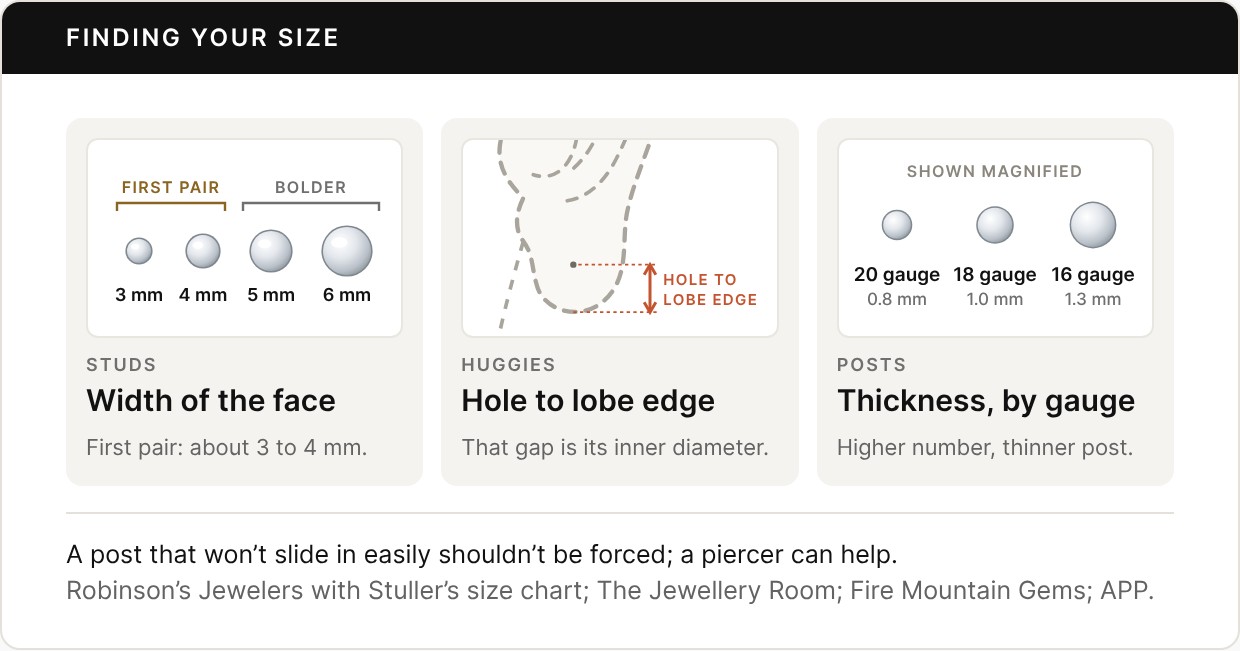
Studs. For a man’s first pair of diamond studs, Robinson’s suggests 0.25 to 0.50 carat in total, and 1.00 carat in total, or 0.50 per ear, for a bolder look. On Stuller’s size chart, a round stone of about 0.12 carat measures 3.2 mm, 0.25 carat 4.1 mm, and 0.50 carat 5.2 mm. So a first pair has a stone about 3 to 4 mm across per stud, the setting adding a little, and 5 mm is where a stud starts to stand out. Silver, onyx, and cubic zirconia studs are sold by the same millimeter sizes, so the guide holds for them too.
Huggies and hoops. Measure from the hole to the edge of your lobe with a millimeter ruler. For a huggie that hugs, that distance is the inner diameter you need, The Jewellery Room advises; for a hoop that hangs a little lower, add a few millimeters. Many listings give the outside diameter instead, which includes the thickness of the hoop, so check which one the seller means.
Posts. A post’s thickness is given as a wire gauge, where a higher number means a thinner post. On Fire Mountain Gems’ chart, 20 gauge is 0.81 mm, 18 gauge 1.02 mm, and 16 gauge 1.29 mm; piercing-jewelry listings often round 16 gauge to 1.2 mm. If a new earring won’t slide in easily, don’t force it: the Association of Professional Piercers warns that pushing jewelry in can tear the tissue, and a piercer can help, if necessary with a thinner gauge while a tight hole adjusts.
Can you wear sterling silver in a new piercing?
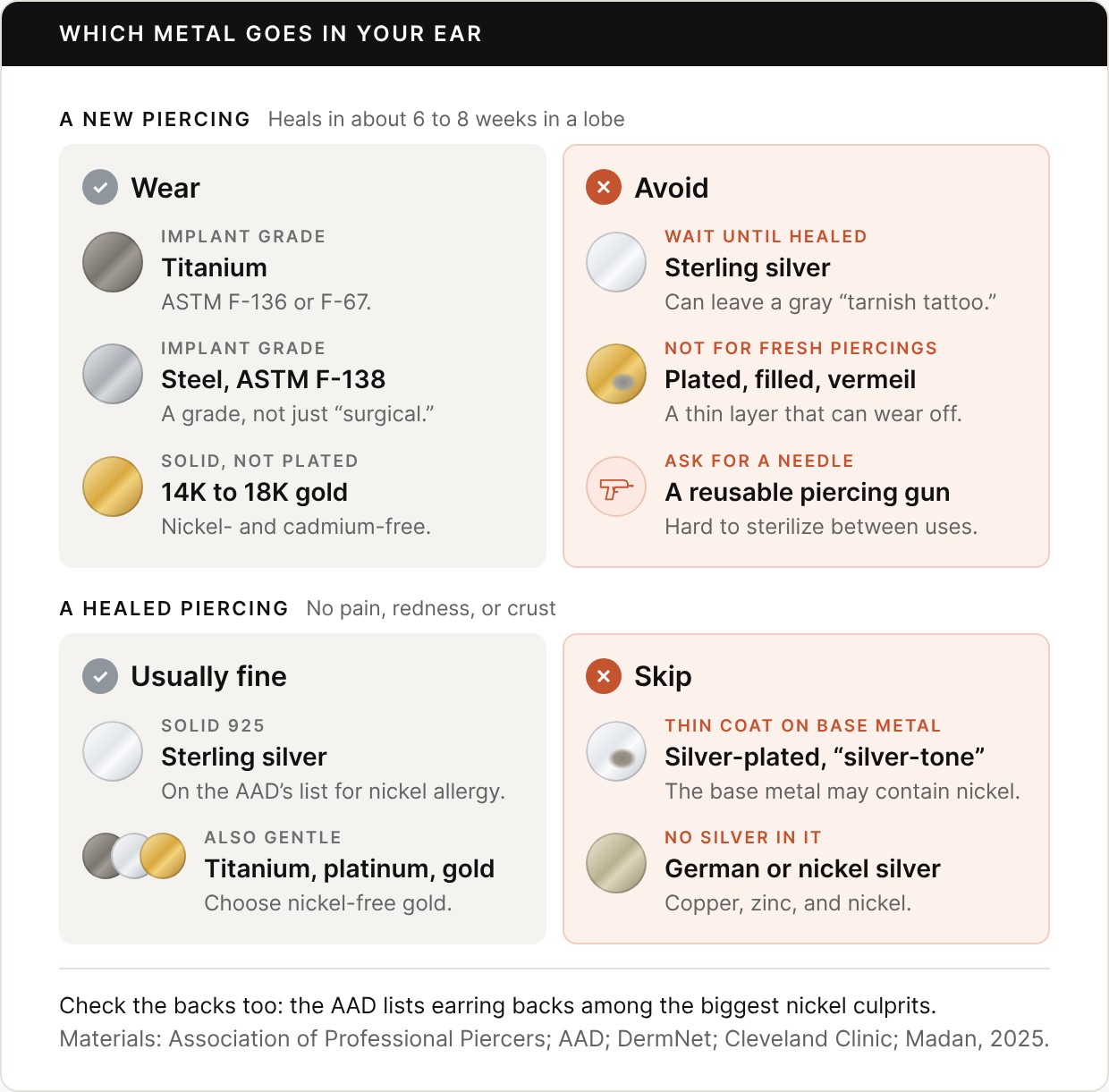
No. Wait until the piercing has healed. The Association of Professional Piercers (APP) lists the materials it accepts in a fresh piercing, including steel and titanium certified to implant standards (such as ASTM F-138 steel, and ASTM F-136 or F-67 titanium), niobium, solid gold of 14K or higher that is nickel- and cadmium-free, platinum, and some types of glass. Sterling silver isn’t on the list, and “gold plated, gold-filled, or gold overlay/vermeil jewelry is not acceptable for fresh piercings,” because the thin gold layer can wear or chip off.
Silver has a particular problem in an open wound. A 2025 case series in Clinical and Experimental Dermatology describes “tarnish tattoos”: silver deposited in the skin from silver jewelry worn in fresh piercings, leaving a blue-gray mark. All four patients had worn silver studs or rings immediately after being pierced, on the nose or ear, and laser treatment helped little in the two who tried it. The author calls it an under-recognized side effect that can be hard to treat. A 2016 case report and literature review describes this kind of silver staining as rare and benign, meaning it is no danger to health. It is also easy to avoid.
Earlobes usually heal in about six to eight weeks, and cartilage takes six to twelve months, according to Cleveland Clinic. Don’t change earrings until the piercing is fully healed: it doesn’t hurt, isn’t red or swollen, isn’t crusty, and the jewelry turns easily. The American Academy of Dermatology (AAD) advises leaving the starter jewelry in for six weeks or more, even at night, because a new piercing can close if you take it out too early.
Where you get pierced matters too. The AAD recommends an experienced piercer in a licensed studio, and the APP doesn’t allow its members to use reusable piercing guns: plastic guns can’t be sterilized in an autoclave, and their blunt studs push through the tissue rather than cut it. Cleveland Clinic also notes that piercing guns aren’t always sterilized between uses, which is why its family physician recommends needles for piercing children. For aftercare, the APP suggests a sterile saline wound wash and advises not twisting the jewelry while it heals. Follow your piercer’s instructions; this guide is general information, not medical advice.
Is sterling silver good for sensitive ears?
Usually, once the piercing has healed and the silver is solid. The AAD’s advice for people with a nickel allergy lists “pure sterling silver” among the metals to wear, alongside surgical-grade stainless steel, high-karat gold, and platinum. Sterling is 92.5% silver, and the rest is almost always copper, as our guide to what 925 means explains. DermNet adds that a small amount of other metal, including traces of nickel, can end up in some sterling, so a solid 925 stamp lowers the risk without ruling it out. Our guide to whether sterling silver is hypoallergenic covers the details.
Earrings are where nickel matters most. “Earrings, earring backs and watches are some of the biggest culprits,” the AAD says, so check the backs as well as the earrings. The European Union sets its strictest nickel limit for posts that pass through a piercing, while the US has no such limit, as our hypoallergenic guide explains. These are the labels to skip if your ears react:
- Silver-plated or “silver-tone.” A thin coat over a base metal that may contain nickel, DermNet notes. Once the coat wears, the base metal touches your skin.
- German silver or nickel silver. No silver at all: an alloy of copper, nickel, and zinc, as our German silver guide explains.
- Cheap “925” from unknown sellers. Some marketplace jewelry sold as sterling has tested high in cadmium, and earrings worn in pierced skin may be a greater concern than other pieces, as our guide to cadmium in fake sterling reports. Our guide to telling if silver is real has the checks.
- “Surgical steel,” if your allergy is strong. The term has no formal definition, Blue Nile notes, and even 316L, the steel often used in earrings, contains some nickel. Many people with mildly sensitive ears wear it without trouble, but with a severe nickel allergy Blue Nile suggests avoiding it; titanium and platinum are nickel-free.
If a healed ear itches, swells, or turns red with a new pair, take them out and go back to a metal that agreed with you. A rash that blisters, becomes infected, or keeps coming back is one for a board-certified dermatologist, who can patch-test you for a metal allergy.
How to care for silver earrings
- Clean the posts and backs. Wash them now and then in warm water with a drop of dish soap, use a soft toothbrush on push backs, then rinse and dry. Our guide to cleaning sterling silver covers stronger methods; keep stones and oxidized finishes out of dips and the foil bath.
- Polish the front only. A silver polishing cloth brings back the shine in seconds. Tarnish is harmless: a dark smudge on the skin that wipes off is usually tarnish rubbing off, as our guide to green and black marks explains. A blue-gray spot in the skin beside the piercing that doesn’t wash off is something else, a tarnish tattoo; show it to a dermatologist.
- Keep them dry. Showering in sterling is fine if you dry it afterward, but take earrings out for the pool, hot tub, and ocean, as our guide to whether sterling silver is waterproof explains. With a new piercing, Cleveland Clinic advises staying out of pools and hot tubs until it has healed.
- Store pairs together, and apart from the rest. Backs on, in a small zip bag or a compartment with an anti-tarnish strip, as our guide to why silver tarnishes suggests.
- Don’t leave the holes empty for long. Even a healed earlobe can close quickly, so Cleveland Clinic advises not leaving earrings out for more than a few hours, and the APP notes that holes can shrink fast once the jewelry is out.
- Take them out for an MRI. Piercings come out like any other jewelry, as our MRI guide explains. If you travel with them, our travel guide covers airport security.
Earrings at work, and with the rest of your jewelry
At work, the setting decides. For a formal office, Robinson’s suggests “a single, high-quality stud in each ear” and nothing that dangles, sparkles too much, or makes noise; in a creative or relaxed workplace, a small, thin hoop is usually fine. At a job interview, take them out if you can: all five career offices in our guide to jewelry at a job interview advise against earrings.
With other jewelry, matching is the simple choice: silver studs with a silver chain or ring. Mixing silver and gold works too if one metal leads, and Robinson’s adds that bold earrings call for minimal rings and necklaces. Our guides to mixing silver and gold and to starting to wear jewelry cover how many pieces to wear in each place.
FAQ
Which ear does a guy wear an earring in?
Either. The right-ear code of the 1970s and ’80s never had one agreed meaning and faded by the ’90s. Wear one earring on whichever side you like, or a pair.
What size stud should a man wear?
For a first pair, a stone about 3 to 4 mm across, which is what Robinson’s Jewelers’ advice of 0.25 to 0.50 carat in total for diamond studs works out to on Stuller’s size chart. About 5 mm and up reads bolder.
Can I put sterling silver earrings in a new piercing?
No. Professional piercers start a new piercing in implant-grade titanium or steel, solid gold of 14K or higher, niobium, platinum, or glass. Wait until it has healed, about six to eight weeks for a lobe, before switching to silver.
Is sterling silver OK for sensitive ears?
Usually, if it is solid 925 and the piercing has healed: the AAD lists pure sterling silver among the metals for people with a nickel allergy. Avoid silver-plated, “silver-tone,” and German silver, and check that the backs are sterling or silicone.
Can you sleep in sterling silver earrings?
While a piercing heals, leave the starter jewelry in day and night, as the AAD advises. Once it has healed, a small stud is the easiest to sleep in; Jewelers Mutual says flat-back earrings are comfortable around the clock and that push backs can poke when you lie down.
Can you shower with silver earrings?
Yes, if you dry them afterward. Take them out for the pool, the hot tub, and the ocean, where chlorine and salt speed up tarnish.
Should a man wear one earring or two?
Either is fine. For formal settings, Robinson’s Jewelers’ advice is restraint: one plain, high-quality stud per ear and nothing that dangles. A single earring in one ear no longer carries an agreed meaning, though some people still ask.
Bottom line
Wear an earring in either ear, or in both: the side has no agreed meaning today, and the old code has largely faded. Start with a sterling stud about 3 to 4 mm across or a slim huggie, on a screw back if you want it secure. Save sterling for a healed piercing; a new one gets implant-grade titanium or steel, or solid gold, for about six to eight weeks in a lobe. After that, solid 925 suits most ears, and plated or “silver-tone” earrings are the ones to skip.
From the collection
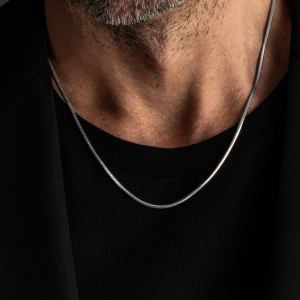
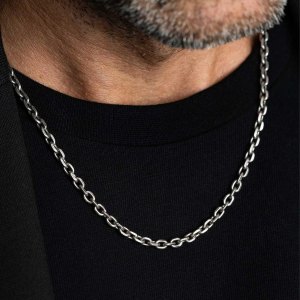
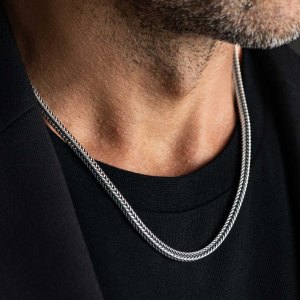
Men’s sterling silver chains by Ronatelli
Ten handmade 925 chains, from a 2 mm snake chain to a 7 mm curb, nine of them in 20, 22, 24, and 26 inches. Every length is the same price.
Related guides
The history of the right-ear code follows The Point, the journal of the Association of Professional Piercers, and MEL Magazine, quoting Desmond Morris; the Chandos portrait follows the National Portrait Gallery. Earring types and backs follow Jewelers Mutual, Blue Nile, and Robinson’s Jewelers; sizes follow Blue Nile, The Jewellery Room, Robinson’s Jewelers with Stuller’s size chart, and Fire Mountain Gems’ gauge chart. Piercing materials, piercing guns, and aftercare follow the Association of Professional Piercers; healing times follow Cleveland Clinic and the American Academy of Dermatology; tarnish tattoos follow Madan (Clinical and Experimental Dermatology, 2025) and Beutler and colleagues (Dermatology Online Journal, 2016); nickel follows the AAD, DermNet, and Blue Nile. This guide is general information, not medical advice. Chain details in the collection box were read from ronatelli.com. All were checked on November 1, 2026. Read our editorial policy.

