
No. We found no clinical trial of a silver bracelet for arthritis, and in the most rigorous trials so far, copper bracelets did no better than a placebo and magnetic wrist straps showed no clear benefit. Silver does have one real use for arthritic hands, but it works mechanically, not through the metal: a silver ring splint that holds a finger joint in place. This guide covers what the trials found, why a bracelet can seem to work anyway, where silver does help, and what to make of health claims on jewelry. It is general information, not medical advice.
Key takeaways
- We found no trial of a silver bracelet for arthritis; a search of PubMed, the US National Library of Medicine’s database, returns none.
- Copper bracelets and magnetic wrist straps did no better than placebo devices in placebo-controlled trials at the University of York, in osteoarthritis (2009) and rheumatoid arthritis (2013).
- Some people feel better anyway, likely because they start wearing one during a flare that would ease on its own and because expectation changes how pain feels, the York trials’ lead author says.
- Silver ring splints do help some people with arthritis in their fingers, by holding a joint, not by the silver: in a 2009 trial, plastic splints worked as well.
- Wearing a silver bracelet you like is fine. Don’t let any bracelet replace treatment, and keep magnets away from pacemakers and insulin pumps.
In this guide Short answer The trials Why it seems to work Ring splints Magnets Claims and the law Wearing one anyway FAQ
The short answer: no evidence for silver
Silver jewelry is credited online with all kinds of effects, from easing joint pain to improving circulation and fighting bacteria through the skin. We looked for evidence behind the arthritis claim and found none: a search of PubMed for silver bracelets or silver jewelry and arthritis returned no studies on November 1, 2026. The bracelets that have been tested for arthritis are copper bracelets and magnetic wrist straps, and the most rigorous trials found no clear benefit from either.
Sterling silver doesn’t get a pass through its copper. It is 92.5% silver, and the other 7.5% is usually copper, as our guide to what 925 means explains. If a solid copper bracelet does no better than a placebo, the copper in a sterling bracelet won’t do better.
What the trials found
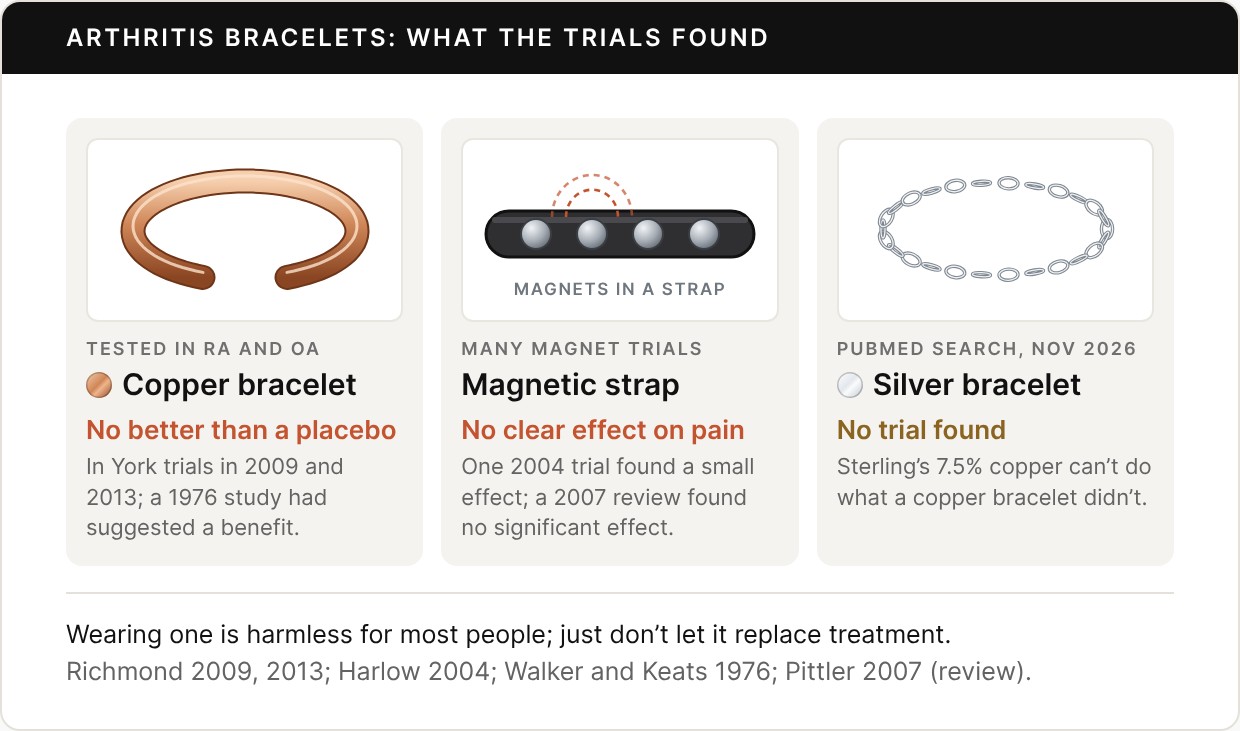
The two trials that tested both copper and magnets against placebo devices come from the same team at the University of York, led by Stewart Richmond. Both were randomized, double-blind, and placebo-controlled, and both had every participant wear each device in turn, so people were compared with themselves:
| Study | Who took part | What they wore | What it found |
|---|---|---|---|
| Richmond et al., 2009 | Who took part45 people with osteoarthritis | What they woreA magnetic wrist strap, a weak magnetic strap, a demagnetized strap, and a copper bracelet, over 16 weeks | What it foundNo difference on the main measures of pain, stiffness, physical function, or medication use; one pain sub-score favored the magnet, without correction for multiple testing |
| Richmond et al., 2013 | Who took part70 people with rheumatoid arthritis | What they woreThe same four kinds of device, five weeks each | What it foundNo significant difference in pain, inflammation, physical function, disease activity, or medication use |
| Harlow et al., 2004 | Who took part194 people with osteoarthritis of the hip or knee | What they woreA standard magnetic bracelet, a weak one, or a dummy, for 12 weeks | What it foundPain fell more with the standard magnet; the authors couldn’t say whether that was an effect of the magnet or a placebo effect |
| Pittler et al., 2007 | Who took partA review of nine placebo-controlled trials of static magnets | What they woreMagnets for pain of various kinds | What it foundNo significant difference in pain; for osteoarthritis, too little evidence to rule a benefit in or out |
The 2009 trial was, in the York team’s words, “the first randomised controlled trial to indicate that copper bracelets are ineffective for relieving arthritis pain.” Earlier work had pointed the other way: a 1976 Australian study that had people wear copper bracelets and look-alike aluminum ones in turn reported preliminary results suggesting that, to a significant number of them, wearing the copper bracelet “appeared to have some therapeutic value.” It also found that copper does dissolve in sweat; a wrist bracelet lost about 90 mg in 50 days. The study didn’t show whether any of that copper reached a joint or did anything there.
Official summaries side with the later trials. The Arthritis Foundation says “studies confirm these treatments are ineffective for arthritis pain,” and the National Center for Complementary and Integrative Health (NCCIH), part of the NIH, says “research studies do not conclusively support the use of static magnets for pain relief.” Rheumatologist Nilanjana Bose told CreakyJoints: “Research has not shown any benefit with use of copper or magnets for arthritic pain.”
Why a bracelet can seem to work
Plenty of people say their bracelet helps, and they aren’t imagining the relief. Richmond gave two reasons in the University of York’s 2013 release: “devices such as these provide a placebo effect for users who believe in them,” and “people normally begin wearing them during a flare up period and then as their symptoms subside naturally over time they confuse this with a therapeutic effect.”
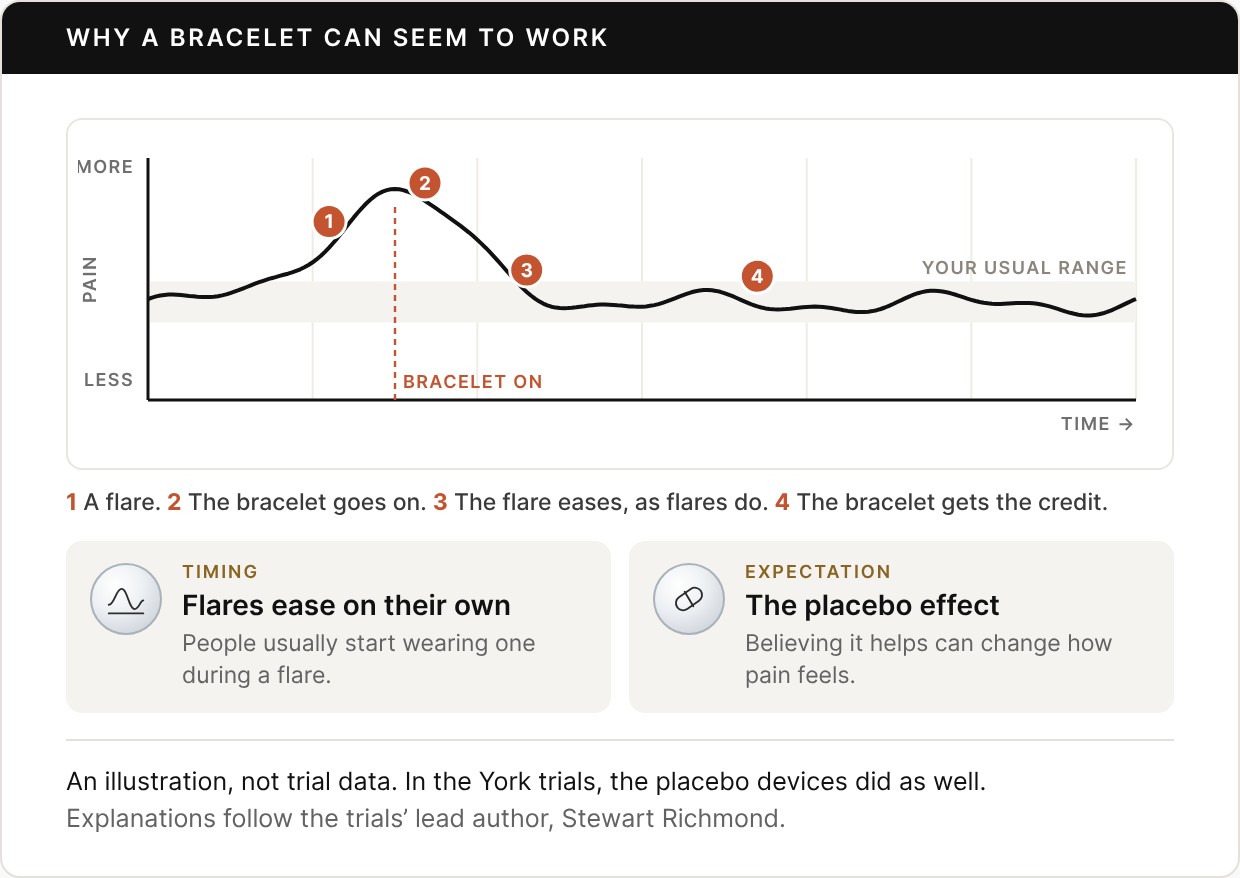
The trials were built to cancel both effects. Everyone wore every device, in random order, and the magnetic straps looked identical. Some wearers could tell the demagnetized strap wasn’t magnetic, which is why both trials also used a weak magnet as a second placebo; in 2013, wearers couldn’t tell that one from the real magnet. The real magnet did no better than either, and neither did the copper bracelet.
Where silver does help: ring splints
Silver has one established role for arthritic hands, and it isn’t a bracelet. A silver ring splint looks like a ring, or two joined rings, and is worn on a finger to hold a joint that has become unstable, such as a swan-neck finger in rheumatoid arthritis, where the middle joint bends backward. A motion-analysis study at the University of Southampton found them “effective in controlling hyperextension deformity of finger joints,” and the university’s announcement called them “elegant rings, which have replaced bulky, plastic ones.”
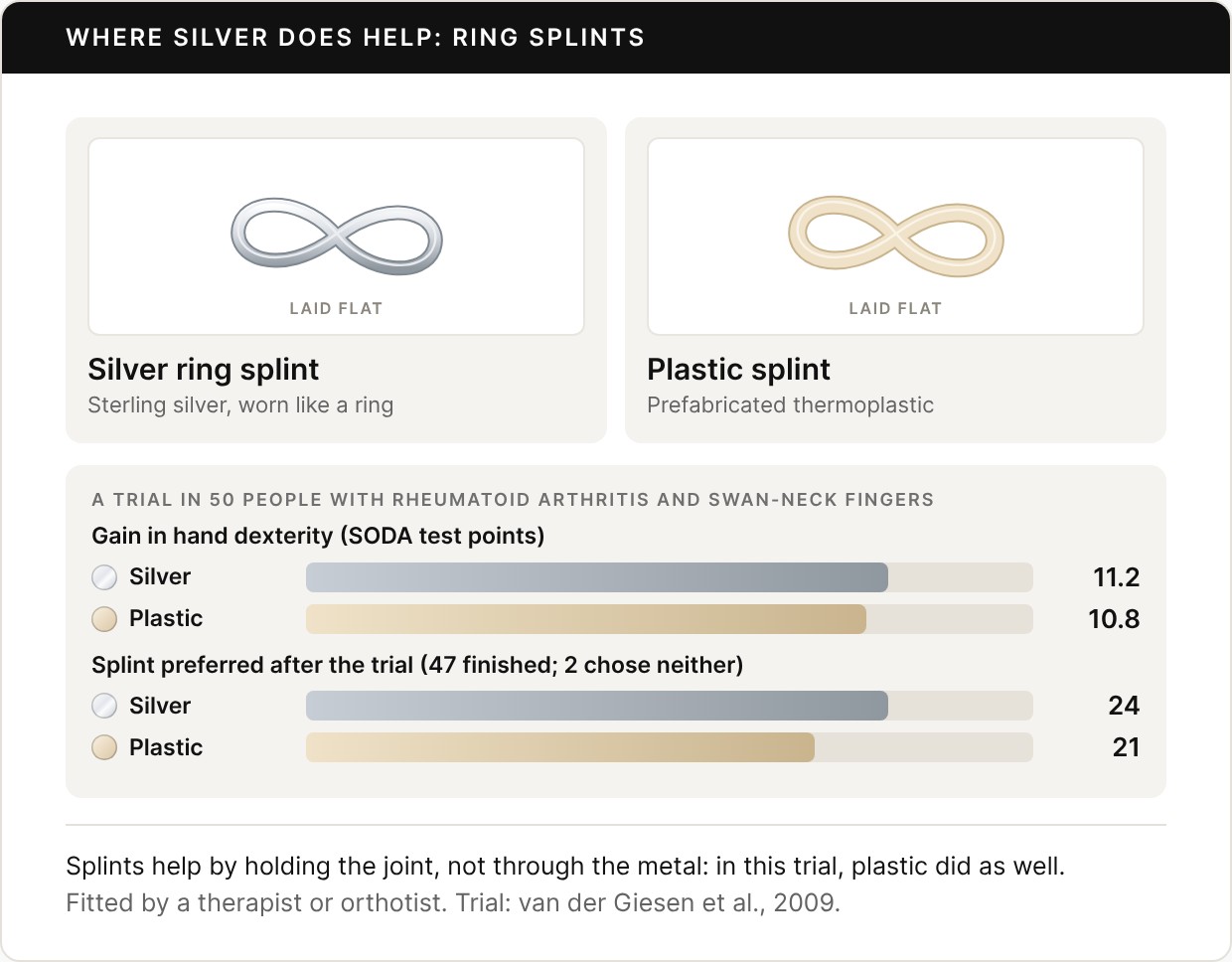
The silver itself isn’t what helps. In a 2009 Dutch trial, 50 people with rheumatoid arthritis and swan-neck fingers wore silver ring splints and prefabricated plastic splints for four weeks each. Dexterity improved about the same with both, and the authors concluded the two were “equally effective and acceptable.” Silver’s advantages are practical: it looks like jewelry, so people are more likely to wear it, and it is stronger and lasts longer than plastic, as the University of Southampton noted. In a 2021 survey by researchers including staff of the Dutch orthotics provider that supplied the splints, 850 of the 2,231 people with hand osteoarthritis who were asked (38%) answered, and most reported less pain and better daily function after three weeks. There was no comparison group.
A ring splint is a medical device, not a piece of jewelry you size yourself. It is usually measured and fitted for a specific joint by a hand therapist, an occupational therapist, or an orthotist, so ask your doctor or therapist if you think one could help.
Magnets: the one real caution
A copper or silver bracelet is harmless to wear for most people, though copper can irritate some people’s skin. Magnets are different for one group: NCCIH notes that “some magnets may interfere with medical devices, such as pacemakers and insulin pumps,” and Medtronic advises keeping jewelry with magnetic closures at least 6 inches (15 cm) from a pacemaker or implanted defibrillator. Magnetic clasps count, as our guide to clasps notes, and the same caution makes sense for beads sold as magnetic hematite, which contain no hematite, as our guide to beaded bracelets explains.
Sterling silver itself isn’t magnetic, so a plain sterling bracelet without a magnetic clasp raises no concern for a pacemaker or an insulin pump. Before an MRI, though, all jewelry comes off, magnetic or not, as our guide to jewelry in an MRI explains.
Health claims and the law
In the US, a seller that says a product relieves pain needs evidence to back it up. In 2015, the Federal Trade Commission settled with Tommie Copper, which had advertised its copper-infused compression clothing as relieving severe and chronic pain and inflammation from arthritis and other conditions. The settlement order imposed an $86.8 million judgment, partially suspended once the company paid $1.35 million, and requires the company and its founder to have “competent and reliable scientific evidence” before any future pain-relief or health claims. “It’s tempting to believe that wearing certain clothing will eliminate severe pain,” said Jessica Rich, then director of the FTC’s Bureau of Consumer Protection, but the company “didn’t have science to back its claims.”
So treat a jewelry listing that promises to ease arthritis, lower inflammation, or improve circulation as a red flag about the seller, not a feature of the piece. Silver taken by mouth is a separate and more serious matter: NCCIH notes that the FDA has warned colloidal silver “isn’t safe or effective for treating any disease or condition,” and that it can cause argyria, “a bluish-gray discoloration of the skin, which is usually permanent.” Wearing silver jewelry is not the same thing.
Wearing a silver bracelet anyway
There is nothing wrong with wearing a silver bracelet because you like it. Richmond’s own warning, in the 2013 York release, is about what a bracelet can displace: people who suspect rheumatoid arthritis should see a doctor early, he said, “to avoid long-term joint damage resulting from uncontrolled inflammation.” Keep taking what your doctor prescribes, and tell your doctor about anything you add. If your hands are stiff or sore, a few practical choices make silver easier to live with:
- A clasp you can work. A large lobster or a box clasp is easier than a spring ring, and a cuff has no clasp at all; our guide to the easiest clasps compares them.
- A comfortable fit. Measure your wrist and add ¾″ to 1″ for a chain bracelet, as our bracelet size guide explains, so it doesn’t press on a swollen wrist.
- Rings that pass the knuckle. Arthritis can enlarge the knuckles, so a ring that fits the base of the finger may not come off. Our guides to jewelry after 40 and to a stuck ring cover the fixes.
- A bracelet that does a job. If your doctor suggests one, a medical ID bracelet tells responders about your condition or medication; our guide to ID bracelets covers what to engrave.
- Skin that tolerates it. Sterling occasionally leaves a harmless green or dark mark that washes off; our guides to silver turning skin green and to whether sterling is hypoallergenic cover marks and rashes.
FAQ
Does wearing silver help arthritis?
There is no evidence that it does. We found no clinical trial of silver bracelets or silver jewelry for arthritis, and the bracelets that have been tested, copper and magnetic, showed no clear benefit over placebo devices in the most rigorous trials. Silver ring splints can help unstable finger joints, but by holding the joint, not through the metal.
Do copper bracelets work for arthritis?
Not in the most rigorous trials. In placebo-controlled trials at the University of York, copper bracelets did no better than a placebo for osteoarthritis (2009) or rheumatoid arthritis (2013). A 1976 study had suggested a benefit, but the later, better-controlled trials didn’t find one.
Does the copper in sterling silver help?
No. Sterling is 92.5% silver and usually 7.5% copper. If a solid copper bracelet does no better than a placebo, the smaller amount of copper in sterling won’t either.
Can a silver bracelet improve circulation?
We found no study showing that it can. For magnets, Stewart Richmond told the Arthritis Foundation that “commercially available magnetic wrist straps will not alter blood flow,” and silver isn’t magnetic at all.
Isn’t silver antibacterial?
Silver ions can kill bacteria, which is why some wound dressings contain silver: in a moist wound, the silver is released as ions, as Wounds International explains. A solid bracelet on dry skin isn’t a dressing, and we found no study showing that one prevents or treats anything.
Are magnetic bracelets safe?
For most people, yes, though there’s no good evidence they ease pain. NCCIH notes that some magnets may interfere with pacemakers and insulin pumps, and Medtronic advises keeping jewelry with magnetic closures at least 6 inches (15 cm) from a pacemaker or implanted defibrillator; the same care makes sense for any magnet. Take all jewelry off before an MRI, magnetic or not.
Should I stop wearing my copper or silver bracelet?
Not if you like it. Both are harmless for most people to wear, though copper can irritate some skin. Just don’t use one in place of treatment, and tell your doctor about anything you are trying for pain.
Bottom line
There’s no evidence that a silver bracelet helps arthritis: we found no study of one, and the copper and magnetic bracelets sold for it showed no clear benefit over placebo devices in the most rigorous trials. If a bracelet seems to help, timing and expectation are the likely reasons. Silver does earn its place in one form, the ring splint, which holds a finger joint and is fitted by a therapist or orthotist. Wear silver because you like it, and leave the treatment to your doctor.
From the collection
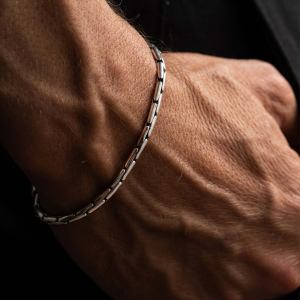
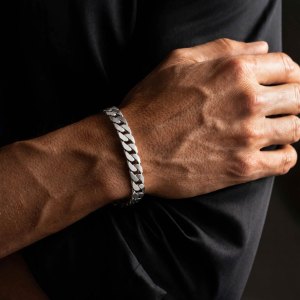
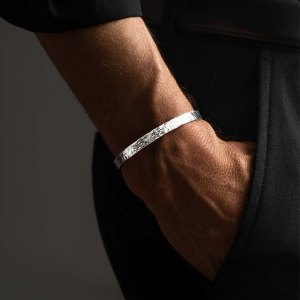
Men’s sterling silver bracelets by Ronatelli
Thirty-one handmade 925 bracelets, from a 3.5 mm bamboo link to an 11 mm woven band, in sizes S to XL. Every cuff is adjustable.
Related guides
Trials: Richmond et al. (Complementary Therapies in Medicine, 2009; PLOS ONE, 2013) and the University of York’s releases on them, Harlow et al. (BMJ, 2004), Pittler et al. (CMAJ, 2007), and Walker and Keats (Agents and Actions, 1976), via PubMed. Summaries follow NCCIH (magnets, 2023 update; colloidal silver), the Arthritis Foundation, and CreakyJoints. Ring splints follow van der Giesen et al. (Arthritis & Rheumatism, 2009), the University of Southampton (2008), and Roux et al. (Journal of Rehabilitation Medicine – Clinical Communications, 2021); silver dressings follow Wounds International; health claims follow the FTC’s 2015 Tommie Copper release; magnetic jewelry and heart devices follow Medtronic. This article is general information, not medical advice. Bracelet details in the collection box were read from ronatelli.com. All were checked on November 1, 2026. Read our editorial policy.

