There is no age at which a man has to stop wearing jewelry, or is too old to start. What changes after 40 is less a set of rules than a few practical shifts: for many men, taste has settled, a watch and a wedding band are already part of the day, and hands and eyes may not be the ones they were at 25. This guide covers what tends to work after 40 and 50, what tends not to, how to fit a ring when your knuckles have changed, which clasps you can close by touch, and the pieces that do a job.
Key takeaways
- Fewer, better pieces: a good watch, your wedding band if you wear one, and one or two pieces you chose on purpose.
- Solid sterling in a quieter finish: brushed or hammered hides the small scratches a mirror polish shows, and an oxidized pattern ages well.
- Size to your build, not your age: start at 3 to 4 mm for a chain (4 to 5 mm on a broad build) and 5 to 7 mm for a bracelet, with three pieces per zone at most.
- If your knuckle has grown, size a ring to pass it, then have a jeweler take up the room below with sizing beads or a European shank, or fit a hinged shank.
- Choose clasps you can work by touch: a large lobster or a box clasp, or a cuff with no clasp at all. Medtronic advises keeping magnetic clasps at least 6 inches (15 cm) from a pacemaker or defibrillator; ask your cardiologist first.
In this guide What changes What works What to skip Rings Clasps Pieces with a job Buying for him FAQ
What changes after 40
Not whether you wear it. In a 2025 YouGov survey of 1,000 British men, 17% of Gen X men, roughly 45 to 60, had bought jewelry for themselves in the past year (watches counted), the same share as Millennials, against 24% of Gen Z and 14% of Baby Boomers. We found no comparable US figures, but nothing suggests the habit stops at 40.
What changes is the man wearing it. Real Men Real Style’s guide to style by decade puts the 40s plainly: “You’re no longer chasing trends or trying to prove anything.” It adds a point that applies to a ring as much as to a suit: “Even if your style hasn’t changed, your body probably has.” For jewelry, that comes down to three things:
- Taste settles. “You know what works,” as the same guide says of the 40s, so a few good pieces do more than a drawer of experiments.
- Hands change. Knuckles can grow with years of hand work, and osteoarthritis of the hands, which Cleveland Clinic says typically affects older adults, can enlarge them too; about 1 in 4 men will have it by age 85. A ring that fit at 30 may no longer pass the knuckle.
- Near vision fades. The American Academy of Ophthalmology says you may notice it shortly after 40, which makes a tiny clasp harder to work. More on both below.
What works after 40
The pieces that suit a man past 40 are mostly the classics, chosen with more care. Most of what follows is the same advice we give any man, applied more strictly:
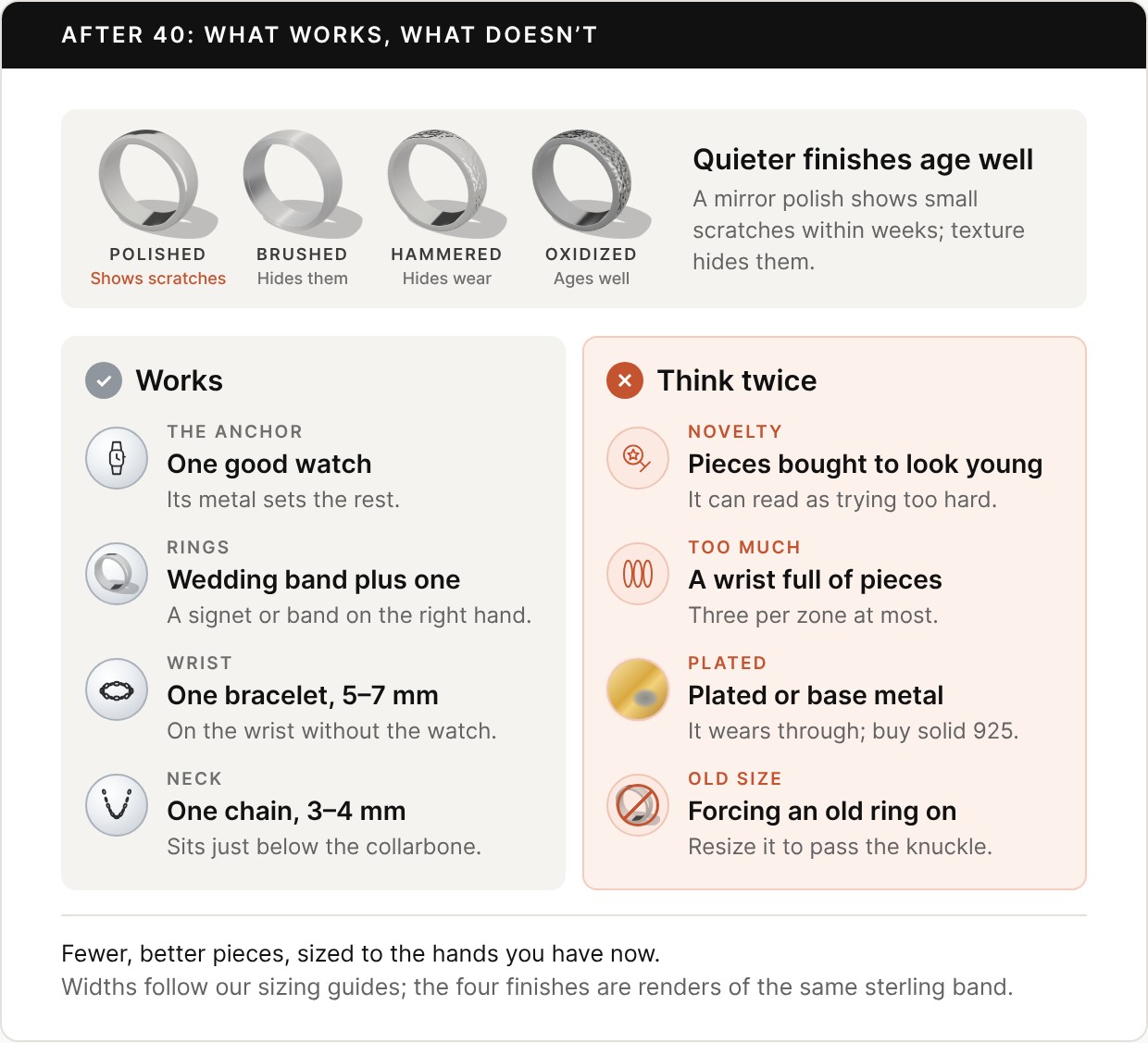
- A good watch, as the anchor. Real Men Real Style lists a classic watch among the pieces that work in every decade. Its metal sets the rest: sterling sits with a steel or titanium watch, and with a gold one, let one metal lead and keep a silver bracelet on the other wrist, as our guides to a bracelet with a watch and mixing silver and gold explain.
- Your wedding band, plus one. A plain band or a signet on the right hand balances a wedding band without competing with it, and works just as well on its own. The pinky is the traditional place for a signet ring, with a face of 10 to 14 mm for most men; the ring finger of the right hand is the modern alternative.
- One bracelet, on the wrist without the watch. A 5 to 7 mm curb, an ID bracelet, or a cuff. Best Life’s list of accessories for men over 50 makes the case for the cuff in sterling: “Sterling doesn’t look cheap, but it doesn’t break the bank, either,” and it “looks just as good out of the box as well as it does worn out over years.”
- One chain, sized to you. Measure your neck and add 4 inches, which gives 20″ or 22″ for most men and 24″ on a broad chest, as our chain length guide explains. Width follows your build: 2 to 4 mm on a slim one, 3 to 6 mm on an average one, and 5 to 7 mm and up on a broad one, per our chain width guide.
- A quieter finish. “Understated designs and matte metals are your friends,” Best Life advises in its entry on cufflinks for men over 50. On a ring especially, a brushed or hammered surface hides the small scratches a mirror polish shows within weeks, and an oxidized pattern gets sharper with wear, as the high points rub bright and the recesses stay dark.
The sizes, at a glance:
| Piece | Start with | Fit check |
|---|---|---|
| Wedding band | Start with4 to 7 mm wide, at least 1.5 mm thick, comfort fit | Fit checkSlides over the knuckle with slight resistance on a warm evening |
| Signet ring | Start withA 10 to 14 mm face on the pinky; 14 to 16 mm on a larger finger | Fit checkOn the pinky, sized to the knuckle, not the base |
| Chain | Start with3 to 4 mm for most men; 2 to 4 mm slim, 5 to 7 mm and up broad | Fit checkNeck plus 4″, rounded up to an even length |
| Bracelet | Start withA 5 to 7 mm curb, a 6 to 9 mm ID bracelet, or a cuff | Fit checkWrist plus ¾″ to 1″; an ID bracelet snug, wrist plus about ½″ |
What tends not to work
None of these is a rule, and plenty of men wear them well. They are choices that can look like trying too hard, or that simply stop working as hands change:
- Pieces bought to look younger. Best Life is blunt about novelty cufflinks: once you hit 50, they “come off less as a coy attempt to lighten things up and more as a lame attempt to grasp onto youth.” The same can go for a trend piece bought only because it is in fashion.
- Everything at once. “A few well-chosen pieces (watch, belt, shoes) say more than a dozen loud ones,” as Real Men Real Style puts it in its advice for men in their 30s, and Gentleman’s Journal agrees that with men’s jewelry, “less really, truly can be more.” Keep to three pieces per zone and two chains at most, as our guide to starting to wear jewelry suggests.
- Plated or base metal. Plating wears through where a piece rubs, while solid sterling is the same metal all the way through, as our guide to whether sterling wears off explains. At this stage, buy fewer pieces in solid 925.
- A ring that no longer fits. If it needs soap and a twist every time, it is too small for your knuckle, and a ring forced over a swollen joint can get stuck. The fixes are below.
Size itself is not on the list. A 7 mm Cuban or a wide cuff suits a broad build at any age, as long as it is the one piece that leads; our Cuban chain guide treats 8 mm and up as a bold statement, not a mistake.
Rings, when your knuckles change
A common practical problem after 40 is a ring that fits the base of the finger but won’t pass the knuckle, or passes the knuckle and then spins. Osteoarthritis of the hand can cause bony enlargements at two joints: Heberden’s nodes at the joint nearest the fingertip and Bouchard’s nodes at the middle joint, as Cleveland Clinic and the Merck Manual describe. The ring has to pass both on its way to the base of the finger. Knuckles can also simply grow with years of hand work; either way, a painful or swollen joint is a question for a doctor, not a jeweler.
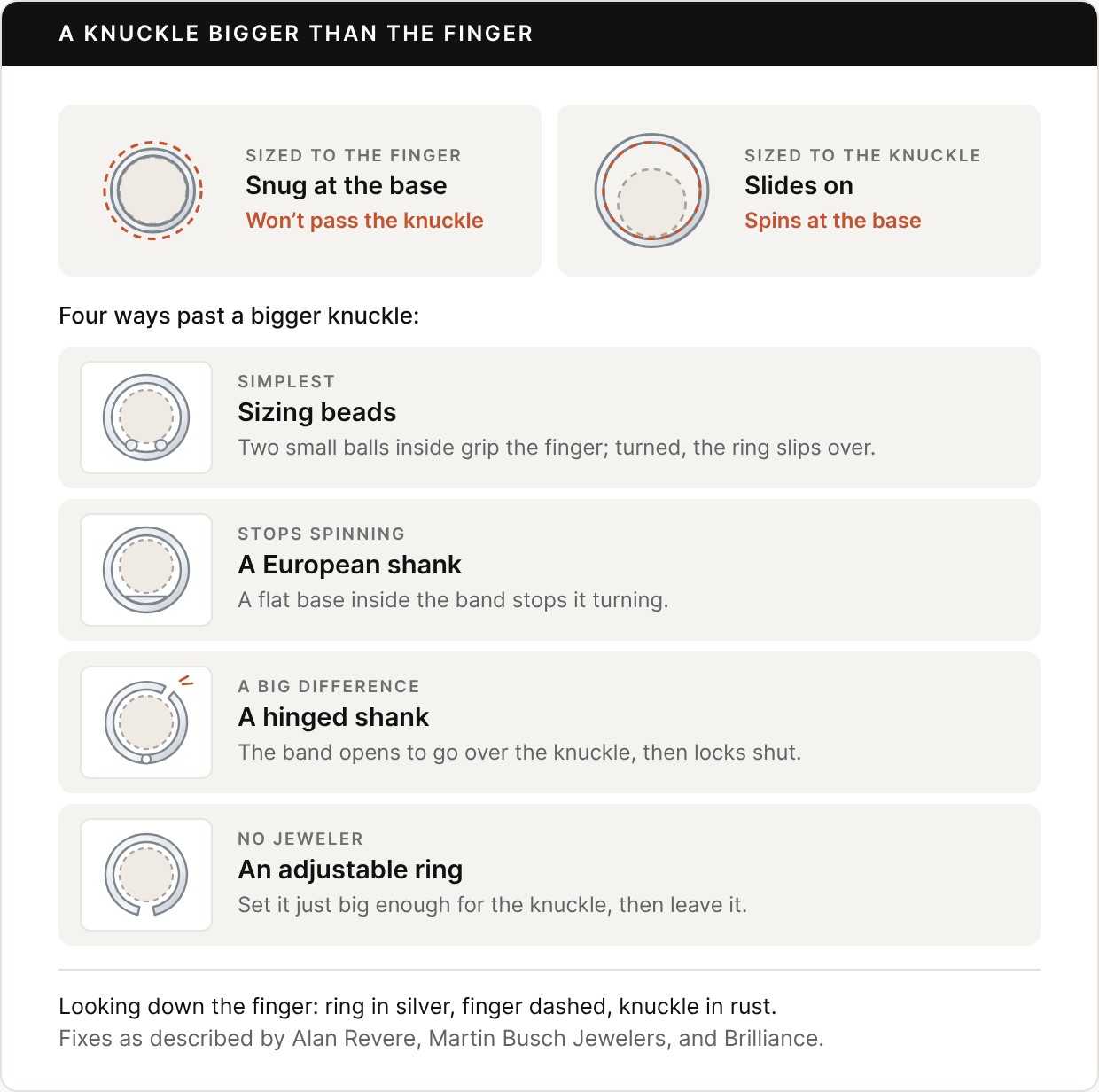
Start by measuring the knuckle as well as the base, at the end of the day, when your hands are warm, as our ring size guide explains. For a small difference, that guide’s rule holds: size about halfway between the two, so the ring needs a push to go on and sits a little loose at the base. When the knuckle is much bigger, size the ring to pass it, as our signet guide advises for a pinky ring and as Brilliance recommends. Then there are four ways around the gap:
- Sizing beads. Two small metal balls are soldered inside the bottom of the band. They hold the ring in place, and “the space between the beads permits the ring to be turned as it is slipped over the knuckle,” jeweler Alan Revere writes on Ganoksin, where he calls them the simplest and most cost-effective fix. Martin Busch Jewelers recommends them for mild to moderate differences.
- A European shank. A flat section added inside the bottom of the band, which Martin Busch Jewelers also calls a sizing bar. It prevents rotation and is ideal for heavier or top-heavy rings, the jeweler notes.
- A hinged shank. Or avoid the compromise: the band is sized to the base and opens on a hinge to go over the knuckle, then locks shut. Martin Busch recommends it for significant size differences or arthritis; it is a custom, more involved job, which Brilliance also offers.
- An adjustable ring. An open or overlapping back lets you set the size by hand, with no jeweler. If your knuckle is much bigger than the base of your finger, set it to the smallest size that still passes the knuckle with a little resistance, then leave it. Closing it tighter means opening it every time it comes off, and bending sterling back and forth hardens it, as our guide to adjustable rings explains.
A comfort-fit band, rounded on the inside, also slides over the knuckle more easily, as our guide to sterling wedding bands notes. If an old ring is simply too small, a jeweler can usually resize a silver ring one to two sizes either way. And if one won’t come off, our guide to getting a stuck ring off covers the safe methods and when to stop and get help.
Clasps you can close by touch
A small clasp can get harder to work with age, for two reasons: near vision fades, and fingers can stiffen. The American Academy of Ophthalmology says you may start to notice presbyopia shortly after age 40, and the National Eye Institute says everyone gets it as they get older, usually after 45. And a chain closes behind your neck, where you can’t see it anyway. Our guide to the easiest clasps ranks them; in short:
- A large lobster clasp, 12 mm or longer. It closes with one hand once you have the knack, and works by touch.
- A box clasp with a safety catch on a heavier chain, from about 7 mm. It clicks shut.
- A toggle on a bracelet worn snug: pass the bar through the ring.
- No clasp at all. A cuff slides on sideways at the narrow edge of the wrist.
- Skip the spring ring. Its lever is tiny and needs a fingernail.
A magnetic clasp is the easiest of all and the least secure. If you have a pacemaker or an implanted defibrillator, Medtronic advises keeping jewelry with magnetic closures at least 6 inches (15 cm) from the device. A necklace clasp can slide around to the front, so ask your cardiologist before wearing one. One old trick works for any chain: close the clasp at the front, where you can see it, then turn the chain until the clasp sits at the back.
Pieces that do a job
- A medical ID. If a doctor has suggested one, wear one that responders will recognize. The MedicAlert Foundation, which sells medical IDs, says first responders “learn to check your wrist, neck and shoe for a medical ID as part of their standard training,” looking for medical identification emblems. A silver ID bracelet can carry medical details too, but a plain engraved plate doesn’t carry that emblem.
- A wedding band you can keep up. A sterling band at least 1.5 mm thick, taken off for lifting and tools, can be worn, polished, and resized for many years, our wedding band guide notes, though gold or platinum holds its shape longer.
- A ring with a history. A father’s ring in silver or gold, or an old signet, can usually be resized one to two sizes to fit you, and a signet can be engraved with initials or a family crest; our signet guide covers which way the engraving should read.
Buying for a man over 50?
If you are shopping for a father or a husband, the same rules make the gift easy. The pieces most dads wear are the classics, a curb bracelet, a plain chain, or a signet or onyx ring, as our guide to Christmas gifts for dad explains. For a milestone, see our 25th anniversary gift ideas. And if you can’t measure his finger, an adjustable ring takes the size question off the table; our guide to finding his ring size without him knowing covers the alternatives.
FAQ
What jewelry should a man over 50 wear?
A good watch, his wedding band if he wears one, and one or two pieces chosen on purpose: a signet or plain band on the right hand, a 5 to 7 mm bracelet or a cuff on the wrist without the watch, or a 3 to 4 mm chain. Solid sterling in a brushed or hammered finish hides daily wear best.
Is a chain too young for a man over 40?
No. Fit and scale matter more than age: a 3 to 4 mm chain at a length that sits just below the collarbone, worn over a T-shirt or under an open collar. A very heavy chain is a statement at any age.
Can older men wear a signet ring?
Yes; it is one of the most traditional men’s rings. Wear it on the pinky or the ring finger of the right hand; on the pinky, size it to pass the knuckle, as our signet guide advises.
My ring won’t go over my knuckle anymore. What can I do?
Don’t force it. A jeweler can size the ring to pass the knuckle and add sizing beads or a European shank to stop it spinning, or fit a hinged shank; an adjustable ring, set once to just pass the knuckle, is the no-jeweler option, though it may turn a little at the base. If it is already stuck, see our stuck ring guide.
What’s the easiest clasp for stiff fingers?
A large lobster clasp, 12 mm or longer, or a box clasp on a heavier chain. A cuff has no clasp at all. A magnetic clasp is easier still but less secure, and it needs care with a heart device.
Are magnetic clasps safe with a pacemaker?
Medtronic advises keeping jewelry with magnetic closures at least 6 inches (15 cm) from a pacemaker or defibrillator, because magnets can temporarily affect how the device works. Ask your cardiologist before wearing one, especially on a necklace.
Should my jewelry match my watch?
Loosely. Sterling silver sits with a steel or titanium watch. With a gold watch, let one metal lead and keep a silver bracelet on the other wrist, as our guide to mixing silver and gold explains.
Bottom line
After 40, jewelry works best as a few good pieces: a watch, your wedding band if you wear one, and one or two pieces you chose on purpose, in solid sterling and a finish that hides wear. Size them to your build and to the hands you have now: rings to pass the knuckle, with beads or a European shank to stop them spinning, and clasps you can close by touch.
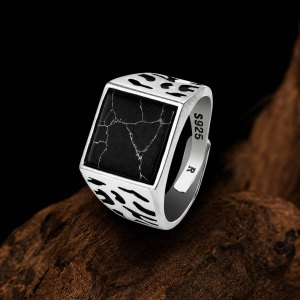
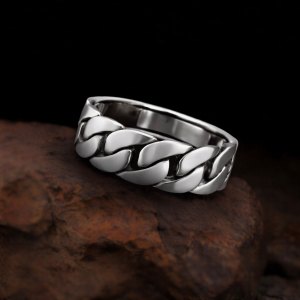
From the collection
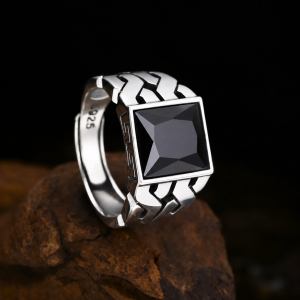
Men’s sterling silver rings by Ronatelli
Eleven handmade 925 rings, $129 to $169, from a chain-link band to a black onyx statement ring. Every one is adjustable.
Related guides
Style points follow Real Men Real Style, Best Life, and Gentleman’s Journal; buying habits follow YouGov’s 2025 survey of British men. Hand osteoarthritis follows Cleveland Clinic and the Merck Manual; ring fixes follow Alan Revere on Ganoksin, Martin Busch Jewelers, and Brilliance; near vision follows the American Academy of Ophthalmology and the National Eye Institute; magnetic clasps follow Medtronic; medical IDs follow the MedicAlert Foundation. This article is general information, not medical advice. Sizes and widths follow our own guides linked above. Ring details in the collection box were read from ronatelli.com. All were checked on October 31, 2026. Read our editorial policy.

