Starting to wear jewelry is easier than it looks, as long as you start with one piece and give it time. This guide is a plan for a man buying for himself: which piece to start with, how to size it without a jeweler, how to get used to it, when to add a second, and where to stop. It also covers matching metals, scaling pieces to your build, what your money buys in sterling silver, and the little care it needs.
Key takeaways
- Start with one plain piece close to what you already wear; our first-piece guide has the shortcut.
- Size it yourself: neck plus 4 inches for a chain, wrist plus ¾ to 1 inch for a bracelet, and your ring size measured at the end of the day.
- For the first few weeks, wear it every day, until you stop noticing it. Daily wear also keeps sterling brighter.
- Add a second piece in another zone and in the same metal. Silver sits with a steel or titanium watch.
- Less is more: three pieces per zone at most, two for chains, and one piece should lead.
- Buy solid 925 sterling, plain and slim at first. Compare price per gram, not just price.
In this guide The plan Sizes How much Metals Your build Buying Care FAQ
The plan: five steps
Most menswear sources we read start in the same place: keep it simple. “If you are in this bucket, you want to start with clean and crisp pieces,” Antonio Centeno of Real Men Real Style writes of men not yet confident wearing jewelry. “Keep it simple in the beginning and then (maybe) you can graduate to more elaborate items.” Here is that idea as a plan.
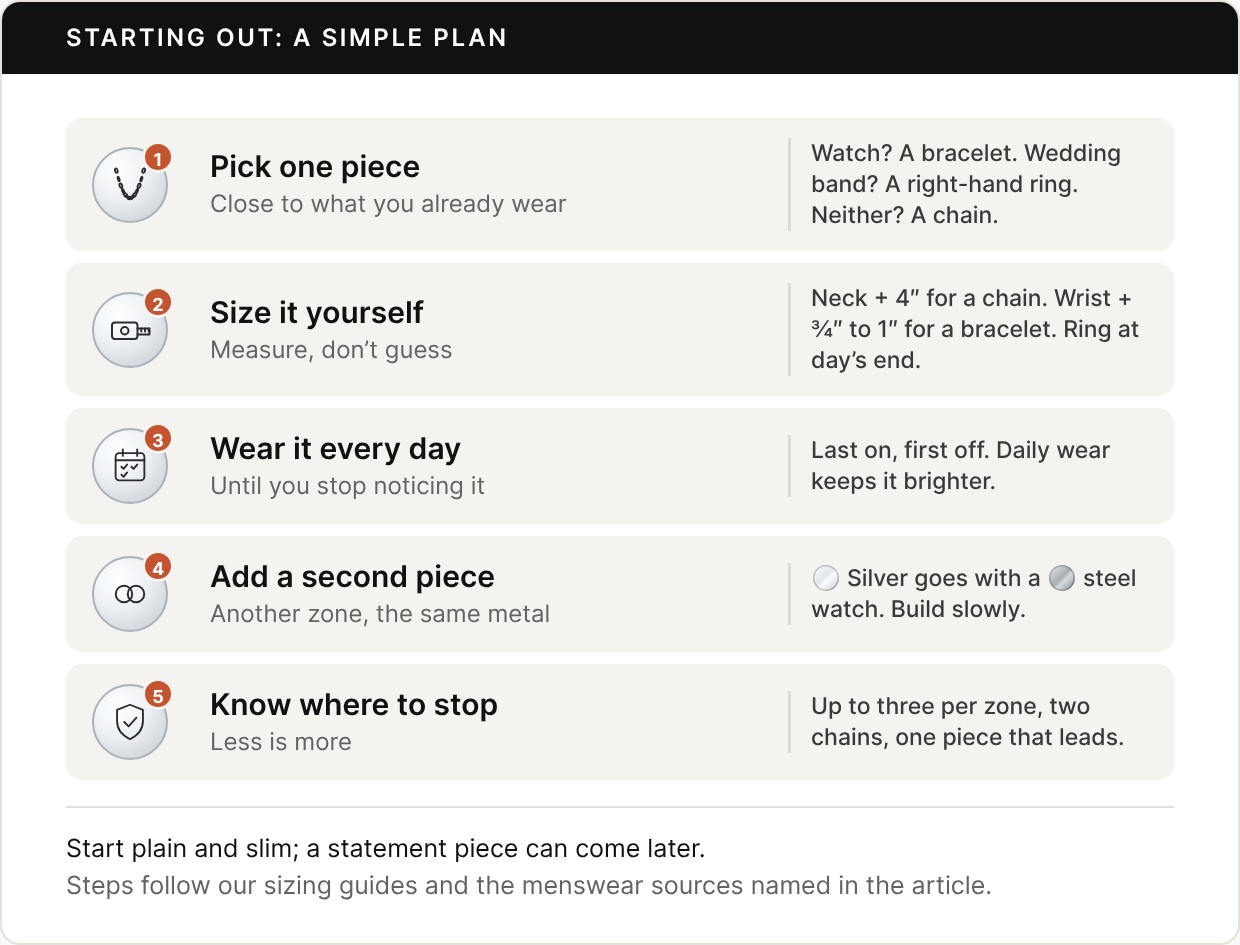
- Pick one piece, close to what you already wear. “The easiest way into jewellery is to find something that does not feel too far removed from what you already wear,” Esquire India advises. If you wear a watch, a bracelet on the other wrist is the smallest step; with a wedding band, a plain ring for the right hand; with neither, a chain. Our guide to a first piece of jewelry walks through the choice.
- Size it yourself. You don’t need a jeweler for a first piece: a tape measure or a strip of paper gets you there. The sizes are in the next section.
- Wear it every day, at first. The model Kaustav Dey, quoted by Esquire India, puts it simply: “let it become an object you wear every day rather than an accessory you put on.” We would wear it daily for the first few weeks before adding anything; after that, it’s yours to wear when you like.
- Add a second piece in another zone. A chain plus a bracelet, or a bracelet plus a ring. “Instead of buying a matching set and putting everything on at once, build a collection slowly,” Esquire India says. For a first pair, keep both in the same metal.
- Know where to stop. More pieces don’t add up to more style; the limits are below.
Size your first piece
These are the starting points from our sizing guides. Each measurement takes a few minutes with a soft tape or, for a ring, a strip of paper:
| Piece | How to measure | Start with |
|---|---|---|
| Chain | How to measureMeasure around the base of your neck, add 4″, and round up to an even number. For most men that is 20″ or 22″. | Start with3 to 4 mm wide; 4 to 5 mm on a broad build |
| Bracelet | How to measureMeasure your wrist snugly just below the wrist bone and add ¾″ to 1″. A 7″ wrist wears an 8″ bracelet. | Start with5 to 7 mm on the wrist without your watch; a first bracelet can stay at the slim end, about 5 mm. On the watch wrist: 3.5 to 5 mm, sized snug (wrist plus ½″ to ¾″) and worn on the hand side of the watch |
| Ring | How to measureWrap a strip of paper around the finger at the end of the day, when your hands are warm. Bands 6 mm or wider: a half size up. | Start withA plain band 5 or 6 mm wide, or a slim signet, on the right hand |
For the details, see our guides to chain length, chain width, bracelet size, and ring size. If you are between two sizes, go longer on a chain. On a ring, go up for a band 6 mm or wider and down for a narrower one, as the ring size guide explains. If you get it wrong, a jeweler can usually resize a sterling band by one to two sizes, as our rings guide notes.
How much is too much
“As a general rule of thumb, less is more and if someone calls it bling, it’s a good indicator that it’s too much,” Gentleman’s Gazette says. The sources give rough limits for each part of the body, and they land close together:
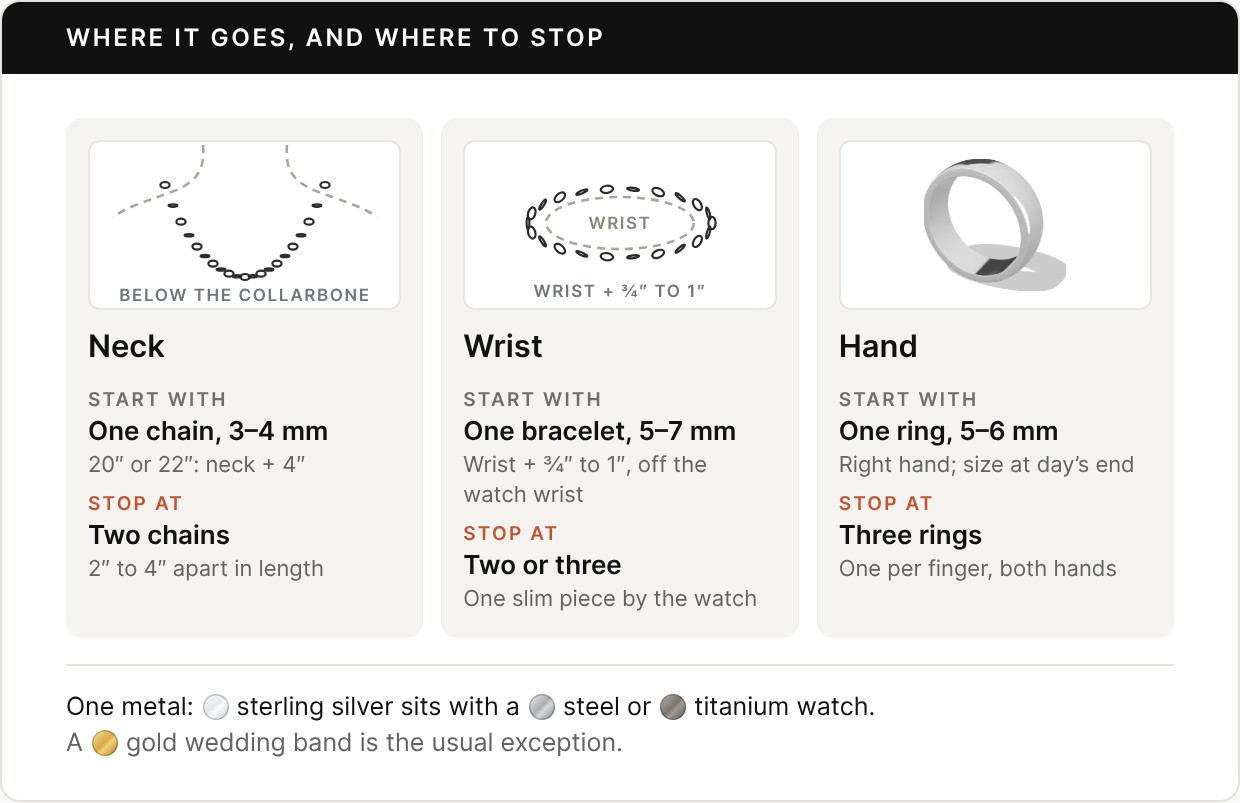
- Per zone. “Three pieces per zone (neck, wrist, fingers) is plenty,” Real Men Real Style says.
- Wrists. “Two items per wrist, and that’s including your watch,” InsideHook advises. Our guide to stacking bracelets allows two, or three at most, on the wrist without the watch.
- Rings. “For rings, most men are fine with a wedding band and maybe one other ring on the opposite hand,” Gentleman’s Gazette says. Our guide to how many rings to wear puts the upper limit at three across both hands, one per finger, with no more than one statement ring per hand.
- Chains. Centeno, writing for The Art of Manliness, puts it plainly: “Two is about the most I recommend.” Our layering guide covers how to pair two.
Whatever the count, let one piece lead. “So, if you have one loud ring or signature cufflinks keep the rest really toned down,” Gentleman’s Gazette adds.
Match your metals
The classic rule is one metal at a time. “Your outfits should only feature one metal tone at a time,” The Art of Manliness says, and “The exception to issues of color matching are wedding bands and heirloom pieces.” For a silver starter, that is easy: sterling is a white metal, in the same family as stainless steel, titanium, white gold, and platinum, as our guide to a bracelet with a watch explains. With a steel watch, silver goes anywhere.
With a gold watch or a gold wedding band, you don’t have to give up silver. Let one metal lead: our guide to mixing silver and gold suggests two pieces in one metal and one in the other, and keeping a silver bracelet off a gold watch’s wrist.
Scale it to your build
Proportion matters more than any single rule. “If you are a bigger person and you have bigger fingers, by all means, go with a ring that is more substantial. If you’re a very thin guy, maybe a thinner band works just like a thinner tie would or a jacket with skinnier lapels,” Gentleman’s Gazette says. Real Men Real Style makes the same point for wrists: “Wide wrist or big hands can handle a larger watch or bigger bracelets.”
In numbers, from our chain width guide: slim builds look best at 2 to 4 mm, average builds at 3 to 6 mm, and broad builds can carry 5 to 7 mm and up. For rings, our rings guide says long fingers carry wide bands easily, and shorter fingers look best at 4 to 6 mm.
What your money buys
- Solid sterling, not plated. “Cheap plating flakes fast,” Real Men Real Style warns. Solid 925 silver is the same metal all the way through, so unless it is rhodium-plated there is nothing to wear off, as our guide to whether sterling wears off explains.
- Price per gram. A piece’s price is the silver plus the making. For the same style, comparing price per gram shows what you are paying for, as our chains guide explains. Weight also exposes hollow links: hollow versions of the same chain often weigh 30% to 50% less, so a much lighter chain at a similar price is giving you less silver.
- The silver is a floor. The metal in a piece is usually worth far less than its price; our guide to what sterling silver is worth shows how to work it out.
- Plain first. A slim, plain piece goes with more clothes, and you’ll wear it more.
Simple care
Sterling needs little. Our guide to why sterling tarnishes boils it down to three habits: silver worn daily tarnishes less than silver kept in a drawer; put jewelry on after lotion, cologne, and hair products have dried; and take it off before swimming, hot tubs, the gym, and cleaning with chemicals. A polishing cloth once a month keeps a daily piece bright, and our cleaning guide covers the rest. If your skin reacts to cheap jewelry, our guide to whether sterling is hypoallergenic explains what to check: 925 doesn’t mean nickel-free.
FAQ
What jewelry should a man start with?
One plain, slim piece close to what you already wear. Our guide to a first piece of jewelry has the shortcut, by whether you wear a watch, a wedding band, or neither.
How much jewelry is too much for a man?
When it competes with you. Real Men Real Style’s limit is three pieces each for the neck, wrists, and fingers; InsideHook says two items per wrist, counting the watch. Our rings guide puts the limit at three rings across both hands.
Should your jewelry match your watch?
Loosely. Sterling silver sits with a steel or titanium watch without any effort. With a gold watch, wear a silver bracelet on the other wrist and let one metal lead. In a suit, match the hardware.
What size chain should a beginner wear?
Measure your neck, add 4 inches, and round up to an even length: 20 or 22 inches for most men. Start at 3 to 4 mm wide, or 4 to 5 mm on a broad build.
Solid or plated for a first piece?
Solid 925 sterling. It is the same metal all the way through, so unless it is rhodium-plated there is nothing to wear off, while plating over base metal wears through. “Cheap plating flakes fast,” as Real Men Real Style puts it.
How do I get used to wearing jewelry?
Wear the same piece every day for the first few weeks, so it becomes part of you rather than something you put on. Then add a second piece.
Can I wear jewelry to work?
In an office, a slim, plain piece is usually fine; at an interview, keep a chain under your shirt. For jobs with food or safety rules, see our guide to jewelry at a job interview and at work.
Bottom line
Start with one plain, solid sterling piece close to what you already wear, size it yourself, and wear it every day until you stop noticing it. Then add a second piece in another zone, in the same metal. Keep to three pieces or fewer per zone and two chains at most, let one piece lead, and scale widths to your build.
From the collection
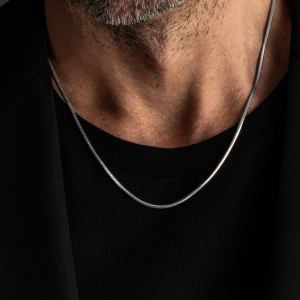
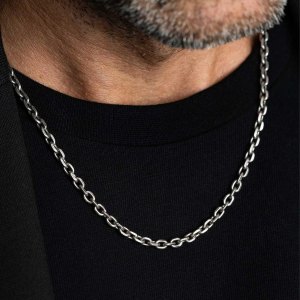
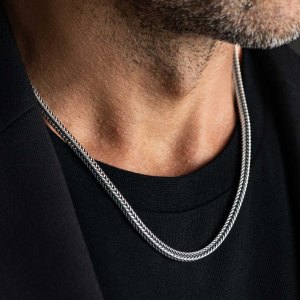
Men’s sterling silver chains by Ronatelli
Ten handmade 925 chains, from a 2 mm snake chain to a 7 mm curb, nine of them in 20, 22, 24, and 26 inches. Every length is the same price.
Related guides
Starting advice follows Real Men Real Style and Esquire India; limits per zone follow Real Men Real Style, InsideHook, Gentleman’s Gazette, and The Art of Manliness; metals follow The Art of Manliness; proportion follows Gentleman’s Gazette and Real Men Real Style. Sizes, widths, buying, and care follow our own guides linked above. Chain details in the collection box were read from ronatelli.com. All were checked on October 31, 2026. Read our editorial policy.

