
A knotted chain is a small problem that is easy to make worse. Pull the ends and the knot tightens; keep pulling and a fine chain can snap. The fix takes two pins, a flat surface, and some patience. This guide covers the method jewelers recommend, how a kink differs from a knot, how to clean the chain afterward, and how to store and pack chains so it doesn’t happen again.
Key takeaways
- Open the clasp, take off the pendant if you can, and lay the chain flat on a plain, hard surface in good light. Don’t hold it up, and never pull the ends.
- Work two pins into the center of the knot and ease the loops outward. A drop of baby oil or a pinch of baby powder helps on a tight knot.
- Wash off any oil or powder as soon as the knot is out, with warm water and a drop of mild dish soap, then dry the chain completely.
- A kink is not a knot: a slight bend can often be rolled flat on a soft cloth, but a sharp kink in a snake or herringbone chain usually stays.
- To prevent it, close the clasp, store each chain on its own, hanging or flat in its own bag, take long and layered chains off at night, and thread fine chains through a straw to travel.
In this guide Before you start Step by step Knot or kink? If it won’t come free Prevention Travel FAQ
Before you start: don’t pull
Every tug on the ends draws the loops of a knot tighter, and the finer the chain, the less it takes to break it. Jewelers Mutual, the jewelry insurer, notes that “thin, delicate chains are the most prone to breakage,” and Robinson’s Jewelers compares yanking a knotted chain to pulling a thread on a sweater: it “will only make it tighter and potentially snap the metal.” Put the scissors away, too, as Jewelers Mutual puts it. Most knots come out with patience, and a jeweler can free the rest; a cut chain needs a repair.
What you need:
- Two straight pins or sewing needles. Jewelers Mutual lists a safety pin, a toothpick, or the post of a stud earring as alternatives.
- A plain, hard surface, such as a cutting board, in good light. A plain, light background makes the links easier to follow.
- Optional: baby oil and a cotton swab, or baby powder, for a tight knot.
- Warm water, mild dish soap, and a soft cloth, to clean the chain afterward.
How to untangle a silver chain, step by step
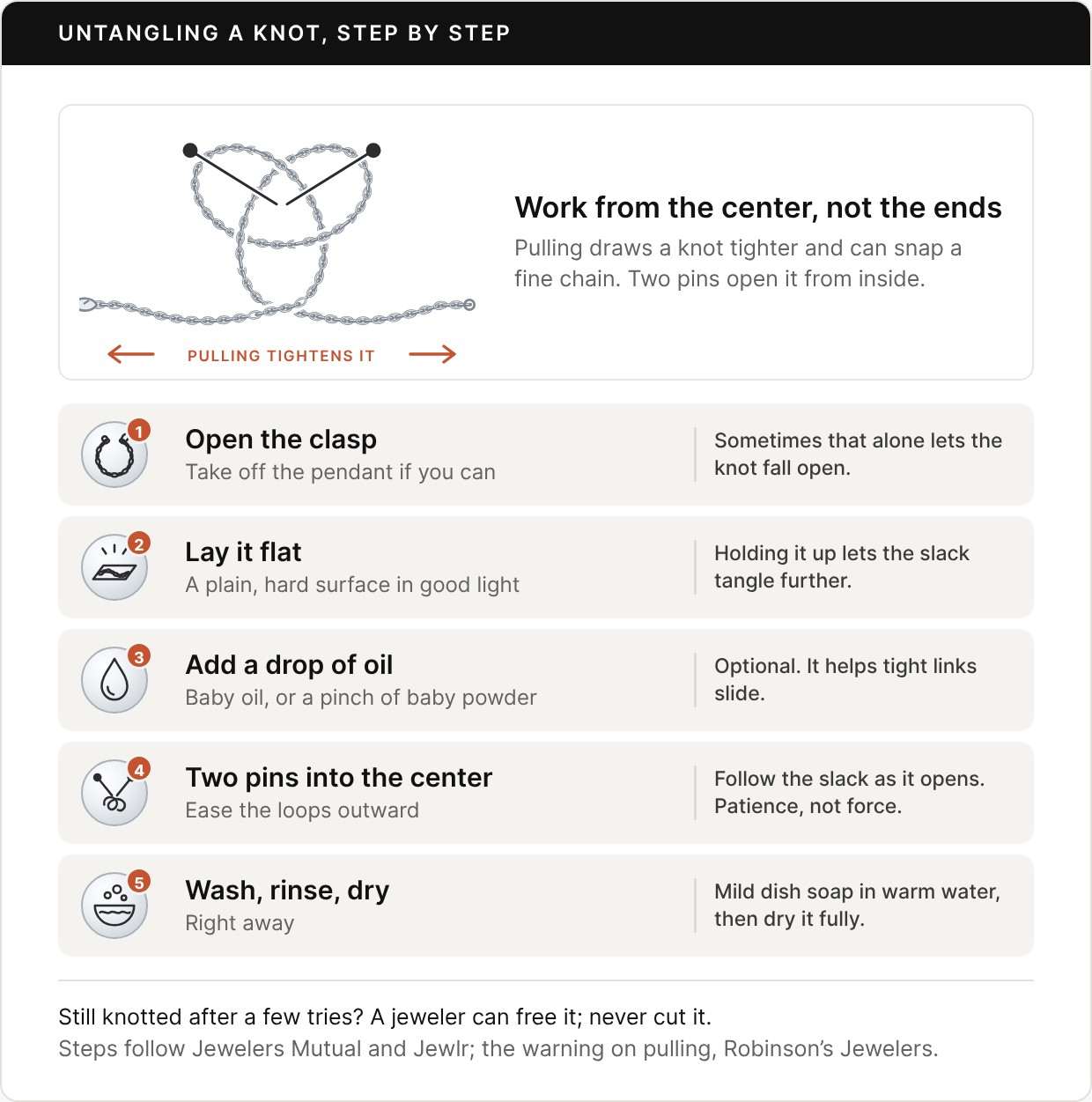
- Open the clasp, and take off the pendant if the knot isn’t holding it. Working on a closed chain “can make things worse,” Jewelers Mutual says, and opening it sometimes frees the knot on its own.
- Lay it flat. Spread the chain out on the surface so the knot sits on its own and the loose lengths are out of the way. Don’t hold it up while you work: Jewlr notes that holding the chain may tangle it further.
- Add a drop of oil to a tight knot. Dab a drop of baby oil onto the knot with a cotton swab and work it in gently with your fingers; Jewelers Mutual also suggests olive oil, or baby powder if you’d rather not use oil. It helps the links slide. A loose knot doesn’t need it.
- Work from the center. Push the tips of the two pins into the middle of the knot and wiggle them gently in small circles to open it, as Jewelers Mutual and Jewlr describe. As the knot loosens, ease the loops outward and follow the slack along the chain, a little at a time. A tight knot may take a few attempts; take a break rather than force it.
- Wash, rinse, and dry. Oil left on the chain “may cause damage or discoloration,” Jewelers Mutual warns, so wash it off as soon as the knot is out: warm water and a drop of mild dish soap, a clean rinse with the sink plugged, then dry it completely with a soft cloth. Our guide to cleaning sterling silver suggests avoiding soaps with moisturizers or antibacterial additives.
Jewelers Mutual also suggests working the knot apart under warm water with a little unscented shampoo or dish soap, which loosens the links without oil; rinse the chain and dry it right away. An oxidized chain can be washed the same way, but keep it out of silver dips and the foil bath, as our guide to oxidized chains explains.
If a pendant with a stone is still on the chain, skip the soak and keep the oil and powder off the stone. Turquoise and lapis are porous and soak up oils, and porous or soft stones shouldn’t be soaked at all, as our guides to whether sterling silver is waterproof and to cleaning explain. Work that part of the knot dry with the pins, then wipe the stone with a soft damp cloth and dry it.
A plated chain comes free the same way as a plain one. Go gently with the pins, because the plating is a thin layer, and wash off any oil with mild soap and warm water, as our guide to wearing a chain every day recommends for a plated chain. Skip the long soak, and dry it straight away.
Is it a knot or a kink?
A knot is the chain wrapped around itself; the links are fine, and pins can usually free it. A kink is a bend in the chain itself, where links have twisted or folded out of line. “If your necklace isn’t fully tangled, the link might just be kinked,” Jaxxon notes, adding that the thinner the chain, the easier it kinks. Robinson’s Jewelers says kinks often form right above a pendant or by the clasp, because a small or stiff bail acts as a pivot that twists the chain above it. Pins won’t help here; what will depends on the chain:
- A slight bend in a cable, curb, or rope chain. Lay the chain on a soft cloth and run a pencil or your fingernail gently back and forth over the bend to roll it straight, as Robinson’s suggests. Don’t pull it straight; our rope chain guide gives the same advice: roll a slight bend flat, and take anything more to a jeweler.
- A sharp kink in a snake or herringbone chain. These are the hard cases. A snake chain’s tube-like structure collapses onto itself, Robinson’s says, “creating a permanent kink that is notoriously difficult to undo,” and once a herringbone chain kinks, “the affected area may remain a weak spot,” the same jeweler writes in a separate guide. Don’t bend it back and forth; as our guide to a broken silver chain explains, a jeweler can tell you whether yours can be eased out.
- A crushed hollow chain. A dented hollow link is hard to repair, as our chain buying guide notes, and a hollow rope kinks where it has been crushed, as our rope chain guide explains. Leave it to a jeweler.
If it won’t come free
Give a tight knot a few rounds, with breaks in between. If it still won’t move, or the chain is very fine, take it to a jeweler, who has the tools and the practice; Jewelers Mutual suggests asking for a professional clean while you are there. Don’t cut the knot out, and don’t squeeze it with pliers. If a link has already opened or snapped, keep every piece: our guide to fixing a broken silver chain covers what you can fix at home, what a jeweler charges, and when a chain isn’t worth repairing.
How to keep a chain from tangling
Many knots start in storage. Chains left loose in a dish or a drawer wind around each other, “or with the bracelets at the bottom of your jewelry box,” as Jewelers Mutual puts it. A few habits stop that:
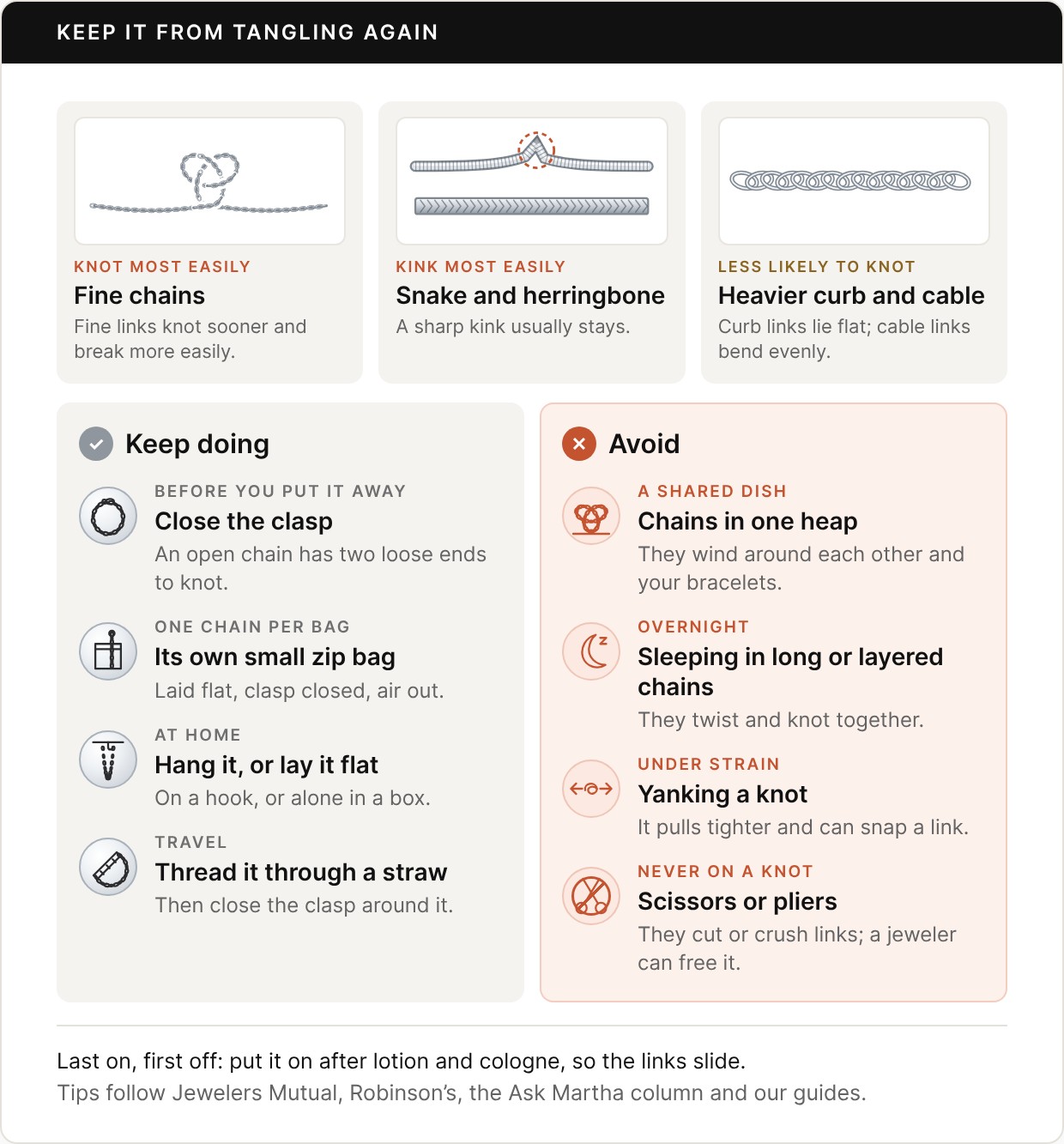
- Close the clasp before you put it away. An open chain has two loose ends to work into a knot. Our guides to layering chains and to travel give the same rule.
- Give each chain its own place. Hang it on its own hook in a jewelry box, or on a wall-mounted key holder, as Jewelers Mutual suggests, or lay it flat in its own box or pouch. The box the chain came in works too, Jewelers Mutual adds, and for superfine chains it suggests the straw trick at home as well: thread the chain through a drinking straw, close the clasp, and store the straws flat in a drawer, about one inch apart.
- Or its own small bag. One chain per zip-top bag, laid flat and sealed with the air pressed out and an anti-tarnish strip inside, also slows tarnish, as our guide to why sterling silver tarnishes explains. Jewelers Mutual notes that the jewelry trade stores chains in small zip-lock bags too, closed “with some of the chain draping down the outside”; for tarnish, keep the whole chain inside the sealed bag.
- Wrap a heavy chain. For heavier pieces such as a rope chain, Robinson’s suggests wrapping each one around an empty paper towel roll and securing the clasp to the cardboard.
- Last on, first off. Put the chain on after lotion, cologne, and hairspray; Robinson’s says their residue increases friction between links, making it easier for them to snag.
- Take some chains off at night. A solid chain usually comes through a night unharmed, but our guide to wearing a chain every day takes off long chains and heavy pendants, which twist, layered chains, which knot into each other, and snake, herringbone, and hollow chains, which can kink or crush.
Some chains tangle more than others. “The more delicate the chain, the more likely it is to tangle,” Jewelers Mutual says, and the Ask Martha column in The Boston Globe notes that “thin herringbone or serpentine-chain jewelry is often the first to tangle during travel.” Robinson’s rates the cable and curb chains among the least likely to tangle: a cable’s simple, uniform links leave little room for snagging, and a curb’s links lie flat. A pendant adds its own twist, so pick a chain and bail that fit it; our guide to the best chain for a pendant has the widths. If a fine chain keeps knotting, our guide to thin chains compares 2 to 4 mm styles.
Packing chains for travel
A suitcase is one of the quickest places for a chain to knot. The simplest fix is a drinking straw: thread the chain through it and close the clasp around the outside, so it can’t twist around itself. Packing expert Anne McAlpin, quoted in the Ask Martha column, recommends a standard straw without a bendable elbow, cut down to half the chain’s length for a short chain or a bracelet. For heavier chains, the same column suggests laying each flat in its own snack-size bag, squeezing the air out, and zipping it shut with only the clasp hanging out of the top. Our guide to traveling with silver jewelry covers airport security and tarnish on the road.
FAQ
Can you use olive oil to untangle a silver chain?
Yes. Jewelers Mutual suggests baby oil or olive oil, dabbed onto the knot with a cotton swab. Wash it off as soon as the knot is out, with warm water and mild dish soap, because oil residue can damage or discolor the chain. Keep oil away from porous stones such as turquoise.
Does baby powder work on a knotted chain?
It can, and it is an option if you’d rather not use oil. Mental Floss, citing Today, describes shaking the chain in a plastic bag with a tablespoon of baby powder for about a minute, then gently massaging the knot loose. Wash and dry the chain afterward.
How do you untangle a very fine chain?
The same way, more slowly: flat on a hard surface, a drop of oil, and two fine needles worked into the center. Fine chains are the most likely to break, so stop and take it to a jeweler if the knot won’t move after a few tries.
How do you untangle two chains knotted together?
Open both clasps, lay them flat, and find where they cross. Work the pins into the knot and ease the loops apart, then pass the free end of one chain back through the loops until it slides out. As our layering guide says, pulling only tightens it. Store them separately afterward.
Can a kinked chain be straightened?
A slight bend in a cable, curb, or rope chain often can: roll it flat on a soft cloth. A sharp kink in a snake or herringbone chain usually stays and remains a weak point; a jeweler can tell you whether yours can be eased out.
Why does my chain keep tangling?
Often storage: chains kept loose together, or put away with the clasp open. Movement plays a part too: Robinson’s notes that walking and turning your head make a chain rotate, and a fine one folds in on itself. Sleeping in long or layered chains, a pendant that twists on a small bail, and a chain that is simply very fine all add to it.
Bottom line
To untangle a silver chain, open the clasp, lay the chain flat, add a drop of baby oil if the knot is tight, and work two pins into the center, easing the loops outward instead of pulling the ends. Wash and dry it afterward. A kink is different: roll a slight bend flat, and take a sharp kink in a snake or herringbone chain to a jeweler. Then give each chain its own place, clasp closed, and knots become rare.


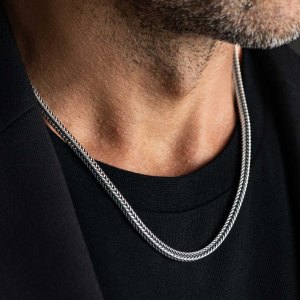
From the collection
Men’s sterling silver chains by Ronatelli
Ten handmade 925 chains, from a 2 mm snake chain to a 7 mm curb, nine of them in 20, 22, 24, and 26 inches. Every length is the same price.
Related guides
Untangling methods follow Jewelers Mutual and Jewlr; the warning on pulling follows Robinson’s Jewelers, and the baby powder method follows Today, via Mental Floss. Kinks follow Robinson’s Jewelers and Jaxxon; storage follows Jewelers Mutual and Robinson’s Jewelers; packing follows the Ask Martha column in The Boston Globe. Cleaning, stone, storage, and chain-style details follow our own guides linked above. Chain details in the collection box were read from ronatelli.com. All were checked on October 31, 2026. Read our editorial policy.

