
No. Before an MRI, facilities ask you to take off all jewelry, including rings, chains, watches, and body piercings, and that includes sterling silver, gold, and titanium. Those metals aren’t magnetic, so the scanner’s magnet has no real pull on them, but they conduct electricity, and the radio waves an MRI uses can heat conductive metal touching the skin. Metal near the area being scanned can also spoil the picture. If a ring or piercing won’t come off, tell the facility before your appointment.
Key takeaways
- Take off all jewelry before an MRI, silver and gold included. Piercings count.
- Silver, gold, titanium, and platinum aren’t noticeably pulled by the magnet. Steel parts, magnetic clasps, and “hematine” beads can be.
- Not magnetic isn’t the same as safe: silver, like every metal, conducts electricity, and an MRI’s radio waves can heat conductive metal on the skin.
- If something won’t come off, say so when you book. The staff decide what happens next.
- CT scans and X-rays also call for jewelry off. At airport security it can usually stay on.
General information, not medical advice. Your imaging facility’s instructions come first. If anything here differs from what they tell you, follow them.
In this guide The rule Why Silver and gold Hidden metal Won’t come off CT and airport FAQ
What MRI facilities ask you to remove
Every patient guide we checked says the same thing. RadiologyInfo.org, the patient site of the American College of Radiology and the Radiological Society of North America, tells patients preparing for a body MRI: “You should remove all jewelry,” and adds that most facilities will ask you to change into a hospital gown. Its MRI safety page lists “metallic jewelry and watches” among the items to remove before entering the scanner room. Cleveland Clinic’s list of items not allowed in the exam room includes jewelry, watches, and body piercings. “Metal and electronic items aren’t allowed in the exam room because they can interfere with the MRI machine or cause burns,” it explains.
Expect to be checked before you go in. The technologist goes through a screening form with you, including whether you have implants or devices, and then “will instruct you to remove all metallic objects from your pockets and hair, as well as metallic jewelry,” RadiologyInfo says. Anyone who comes into the room with you has to remove metal and fill out a screening form too.
It goes beyond jewelry. Some athletic wear, socks, and other clothing contain metallic threads or “metal-based antibacterial compounds” that “can heat up and burn the patient during an MRI,” RadiologyInfo warns, which is one reason facilities hand out gowns.
Why jewelry has to come off: pull, heat, and blur
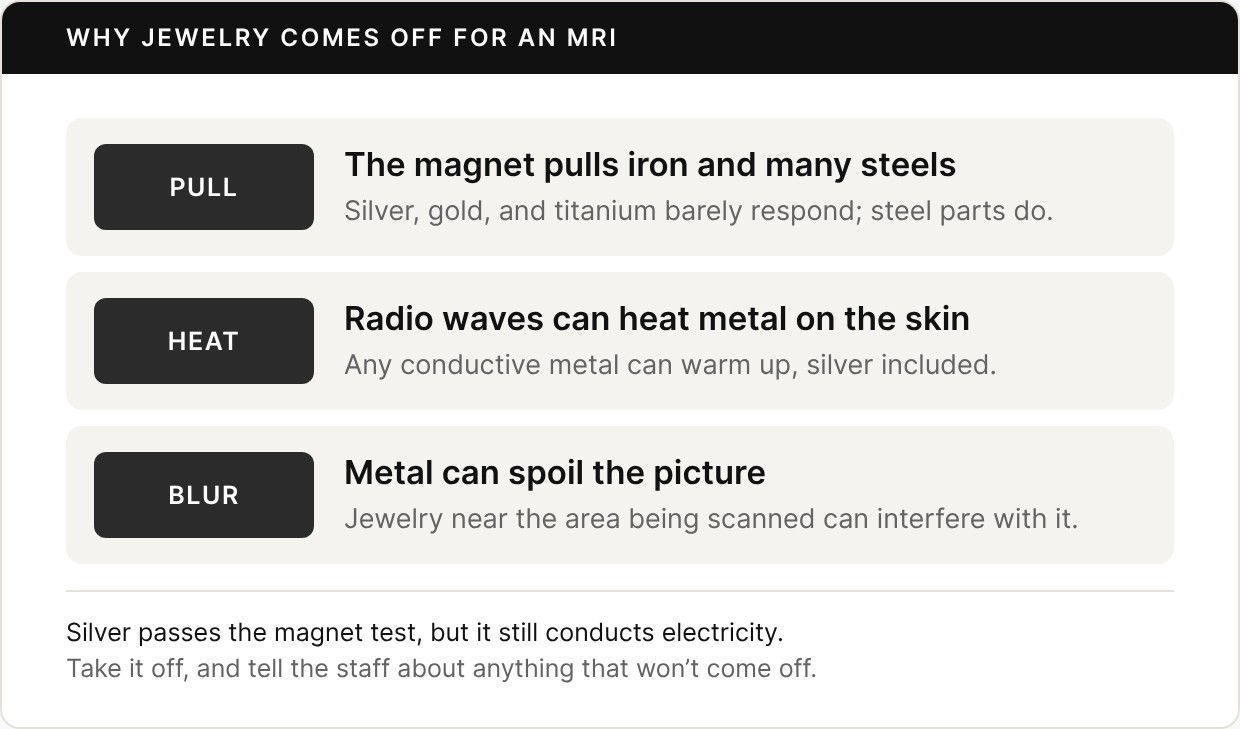
- Pull. The scanner’s magnet pulls on magnetic metal, not on every metal. The static field “will attract magnetic objects (from small items such as keys and cell phones, to large, heavy items such as oxygen tanks and floor buffers),” the FDA says, and they may cause injury “if those objects become projectiles.” RadiologyInfo specifies “metals known to be ferromagnetic, such as iron.”
- Heat. An MRI also sends radio waves into the body, and “the radiofrequency energy used during the MRI scan could lead to heating of the body,” the FDA says. Conductive objects can concentrate that energy. The burn-prevention guidelines on MRIsafety.com, run by MR safety researcher Frank G. Shellock, note that damaged coils, monitoring equipment, and other “external accessories or objects made from conductive materials have caused excessive heating, resulting in burn injuries,” and they call for no unnecessary metal touching the skin, naming “jewelry, necklaces, bracelets.” On a page last updated in 2017, the FDA said it received around 300 adverse event reports a year for MRI scanners and coils, most of which “describe heating and/or burns,” and noted that adverse events “are very rare.” Those reports cover all kinds of MRI incidents, not jewelry in particular.
- Blur. Metal close to the body part being scanned can spoil the picture. RadiologyInfo lists “metallic jewelry, including those used for body piercing or body modification” among objects that “may interfere with image quality if close to the area under examination.”
Is sterling silver safe to wear in an MRI?
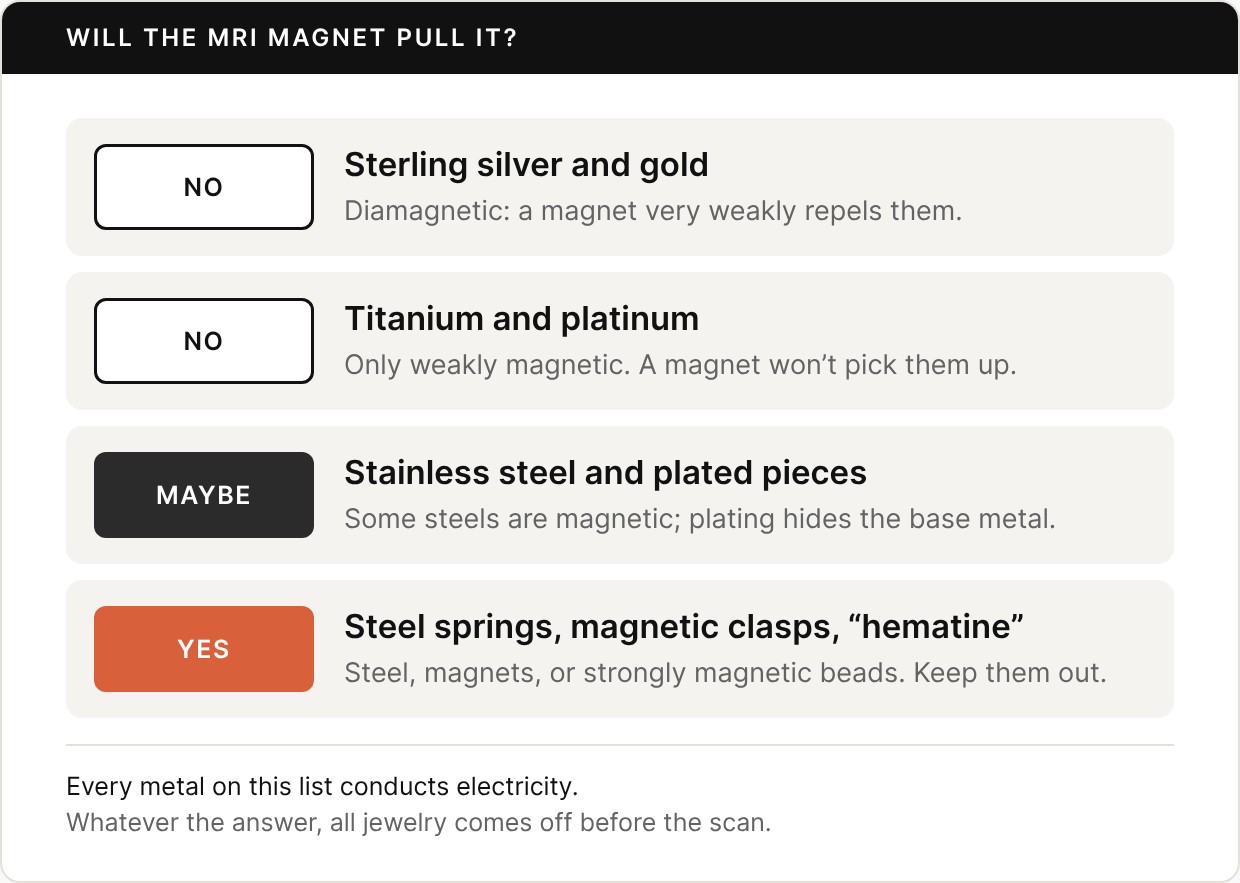
No. It isn’t magnetic, but facilities still ask you to take it off. Silver and gold are diamagnetic, meaning a magnet very weakly repels them, and titanium and platinum are only weakly paramagnetic, according to Wikipedia’s element data, which cite the CRC Handbook of Chemistry and Physics. None of them is ferromagnetic like iron, so the magnet has no real pull on a solid silver, gold, or titanium ring. That’s also why a magnet helps spot fake silver, as our guides to telling if silver is real and to silver turning fingers green explain.
The problem is heat. Silver conducts electricity, as every metal does. When conductive material sits in the scanner’s radio-frequency field, “a concentration of electrical currents sufficient to cause excessive heating and tissue damage may occur,” MRIsafety.com’s burn guidelines say. They tie the risk to an object’s size and shape, noting that heating is mainly a problem for conductive objects “that have elongated shapes or that form loops of a certain diameter.” Those lines are about cables, leads, and implants, but a fastened chain or bracelet is also a closed metal loop.
Silver has been linked to an MRI burn before, though not as jewelry: MRIsafety.com cites a 2013 case report by Pietryga and colleagues of a burn during MRI “likely caused by invisible silver embedded microfibers in the fabric of an undershirt.” For piercing jewelry, the heating risk is considered fairly low. The site’s body piercing page says that “the risk of excessive heating of body piercing jewelry is relatively low considering the size and shape of most items used for piercings,” yet it still says metallic piercing jewelry “should be removed prior to entering the MR environment.”
Hidden steel and magnets in “silver” jewelry
A piece that is mostly silver can still have parts a magnet will pull, or a core you can’t see.
- Clasp springs. Some genuine sterling chains use a steel spring inside the clasp, as our guide to telling if silver is real notes.
- Plated pieces. Silver-plated jewelry is “a thin electroplated coat over base metal,” and silver-tone may contain no silver at all, as our guide to silver-filled vs. sterling silver explains. The listing may not say what the base metal is.
- Stainless steel. Some grades are magnetic; our comparison of silver, steel, and titanium covers how steel differs from silver.
- Magnetic clasps and “hematine.” A magnetic clasp holds itself shut with magnets, and beads with a strong pull sold as hematite are usually “hematine,” which contains no hematite, as our guide to beaded bracelets explains.
A magnet at home can show that a piece has magnetic parts. A piece that doesn’t pull can still contain steel, since not every grade is magnetic. And no magnet test tells you a piece is safe to wear in the scanner, because every metal conducts. Everything comes off.
If a ring or piercing won’t come off
Tell the facility when you book, not when you arrive, and say it again on the screening form. RadiologyInfo’s advice is to discuss any questions or concerns “with the MRI technologist or radiologist before the MRI exam.” What happens next is their decision.
- Rings. Try to get a tight ring off a day or two ahead, not in the waiting room. If the finger is injured, swollen, or numb, don’t force it; tell the facility. Our guide to getting a stuck ring off covers safe methods and when to stop. If it has to be cut, silver is the easy case: a manual cutter goes through it, and a jeweler can usually solder and resize it afterward. Titanium and steel need a powered ring saw or a bolt cutter, and tungsten and ceramic are cracked off and can’t be repaired.
- Piercings. If piercing jewelry can’t be removed, MRIsafety.com’s guidance tells MRI staff what to do: explain the risks, check the jewelry with a strong handheld magnet if needed, tape down anything ferromagnetic so it can’t move, and ask the patient to report any heating or unusual sensation right away. These are decisions for the MRI team, not steps to take on your own. To keep a piercing from closing, the page describes a clinical method, published by Muensterer in 2004, that leaves the tip of an intravenous catheter in the piercing as a spacer, done “under the guidance and direction of a physician.” If you’d like to wear a nonmetal retainer instead, ask the facility before your appointment.
- Permanent jewelry. A welded bracelet or anklet is still metal jewelry. Tell the facility, and ask the studio that put it on about removing it and replacing it afterward.
CT scans, X-rays, and airport security
CT scanners and X-ray machines use X-rays, not a magnet, so there’s no pull to worry about. Jewelry usually still has to go: RadiologyInfo tells patients to “leave jewelry at home” for a body CT, and for a bone X-ray to remove jewelry and any metal objects or clothing “that might interfere with the x-ray images.”
The MRI rules don’t carry over to the airport. “In general, jewelry doesn’t need to be removed before going through security,” TSA said through its AskTSA account in 2022, as InStore reported, adding: “we recommend putting on heavy jewelry after you go through security.” Our guide to traveling with silver jewelry covers the rest.
| Situation | Jewelry | Source |
|---|---|---|
| MRI | JewelryRemove all jewelry, including piercings | SourceRadiologyInfo, Cleveland Clinic |
| CT scan | JewelryLeave it at home | SourceRadiologyInfo, Body CT |
| Bone X-ray | JewelryRemove jewelry and metal that could interfere with the images | SourceRadiologyInfo, Bone X-ray |
| Airport security | JewelryUsually stays on; put heavy pieces on after screening | SourceTSA, as reported by InStore |
FAQ
Can you wear sterling silver in an MRI?
No. Sterling isn’t magnetic, but it conducts electricity, and MRI facilities ask you to remove all jewelry, silver included.
Is sterling silver magnetic?
No. Silver is diamagnetic, so a magnet very weakly repels it. If a magnet pulls part of a “silver” piece, that part contains steel, iron, or a magnet, such as a clasp spring or a magnetic clasp.
Can I keep my wedding ring on during an MRI?
Expect to be asked to take it off. If it won’t come off, tell the facility before your appointment. The staff will decide what to do. If a silver ring does have to be cut, a jeweler can usually repair it.
Do earrings and other piercings have to come out?
Yes. Cleveland Clinic lists body piercings among the items not allowed in the exam room. If one can’t come out, tell the facility in advance.
Are gold and titanium safe in an MRI?
The magnet has no real pull on them, but both conduct electricity, so they come off like any other jewelry.
What about a medical ID bracelet?
Most are metal, and facilities ask you to remove jewelry, so expect to take it off. Put what it says on the screening form and tell the technologist, especially about any implant or device.
What if I forget to take something off?
Screening is meant to catch it: the technologist will ask you to remove metal jewelry before you enter the scanner room. If you remember something once you’re inside, or feel warmth or anything unusual during the scan, tell the technologist right away; RadiologyInfo says you’ll be handed a call button for questions or if you “feel anything unusual.”
Do I need to take jewelry off for a CT scan or X-ray?
Usually. RadiologyInfo says to leave jewelry at home for a body CT and to remove jewelry and metal that might interfere with a bone X-ray.
Bottom line
Take off all jewelry before an MRI, including sterling silver, gold, titanium, and piercings. Silver isn’t magnetic, so the magnet won’t pull it, but it conducts electricity, and the scanner’s radio waves can heat conductive metal on the skin; metal can also spoil the image. If a ring or piercing won’t come off, tell the facility when you book and follow the staff’s instructions. This guide is general information, and your facility’s rules come first.
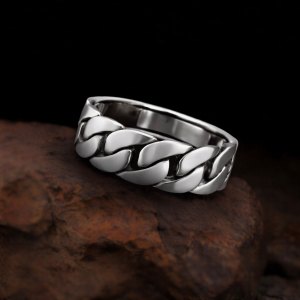
From the collection
Men’s sterling silver rings by Ronatelli
Eleven handmade 925 rings, $129 to $169, from a chain-link band to a black onyx statement ring. Every one is adjustable.
Related guides
MRI, CT, and X-ray preparation follows RadiologyInfo.org from the ACR and RSNA (“MRI Safety,” reviewed December 22, 2025; “Body MRI” and “Body CT,” June 15, 2026; “Bone X-ray,” March 11, 2024), Cleveland Clinic’s MRI page (updated August 5, 2026), and the FDA’s “MRI: Benefits and Risks” (content current as of December 9, 2017). Heating, loops, and piercings follow Frank G. Shellock’s MRIsafety.com (“Guidelines to Prevent RF-Induced Burns Associated with MRI” and “Body Piercing Jewelry and MRI Safety”). Magnetic properties follow Wikipedia’s element data, which cite the CRC Handbook of Chemistry and Physics. TSA guidance follows InStore (June 2022). This guide is general information, not medical advice. All were checked on October 31, 2026. Read our editorial policy.

